

PEAK PLEASURE
Rarefied air with the world at your fingertips – we like the sound of that.
Rarefied air with the world at your fingertips – we like the sound of that.
WORDS JO FERRIS
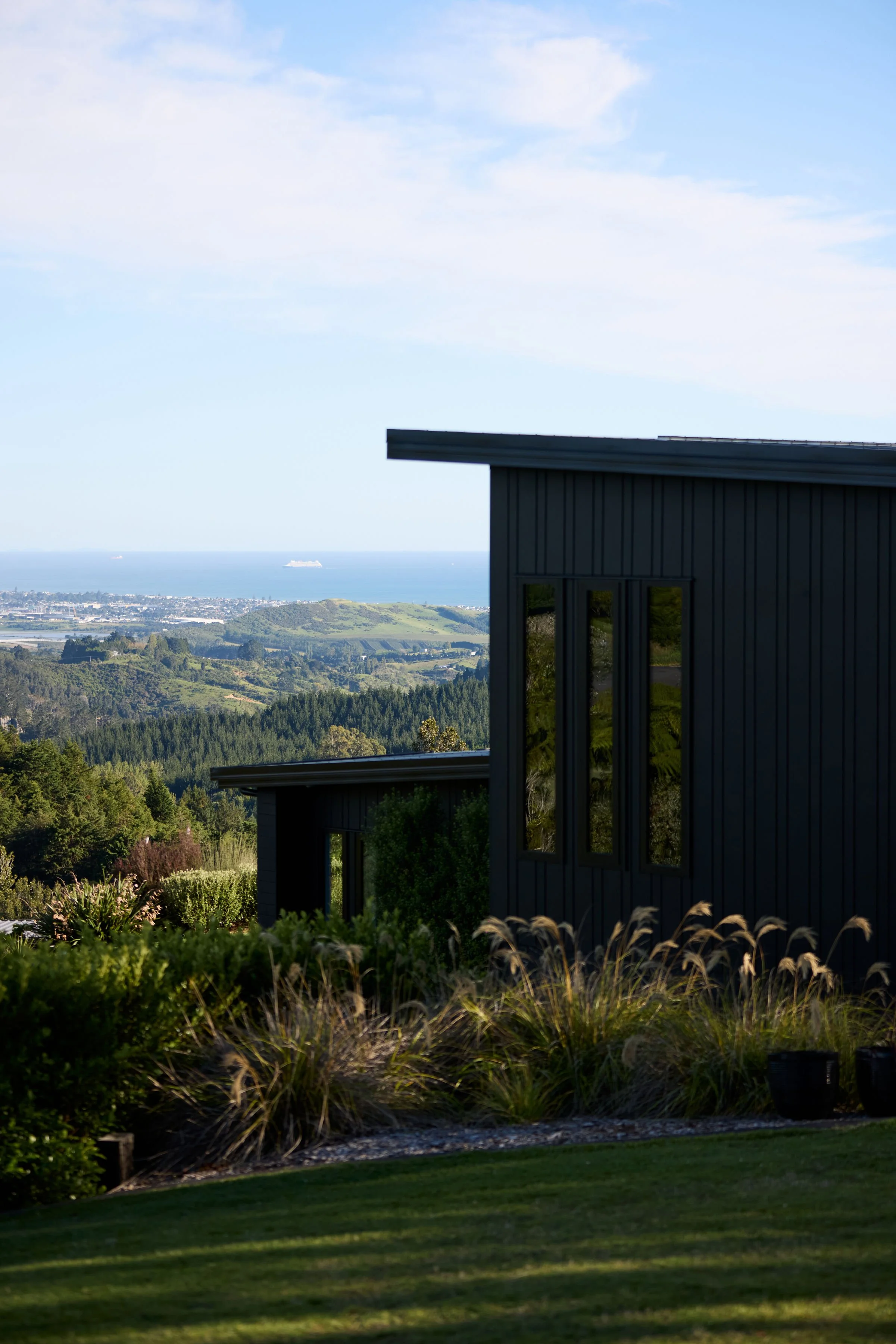
Due to this region’s unique geography, spectacular scenery underpins where and how to live in the Bay. Hilltop locations arguably claim the best vistas, however.
High in the Pāpāmoa hills, Summerhill has an air of mystery about it. Not often featured in real estate circles, this lifestyle parkland is best known to locals who visit its golf course and surrounding recreational areas.
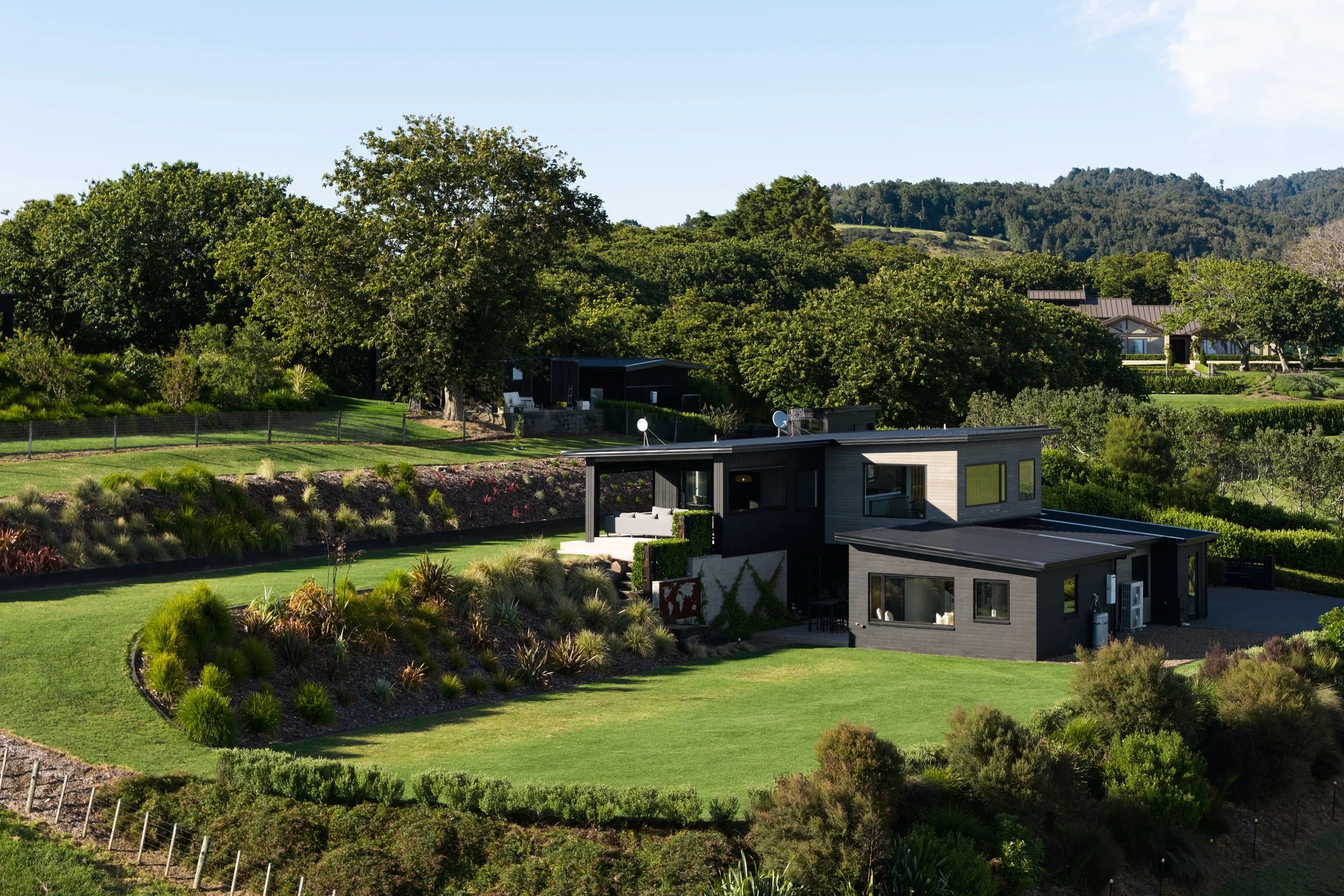
Properties in Summerhill don’t come on to the market that often, and for good reason. The sense of seclusion and scenery is worth holding on to. For golfers, this is a rare opportunity to enter a tightly held area – no green fees required. Even if golf isn’t part of your equation, the freedom to wander or jog around the course is a pastime to cherish.
Sitting in a private enclave of just 11 residences, this home boasts an extraordinary panorama that encompasses the surrounding hills, the coastline up to Coromandel and scenery across to the Kaimais. Pāpāmoa’s regional park and historic pā site are in front, and Tauranga Harbour is also in view. At night, when the city lights and stars twinkle, it’s magical.
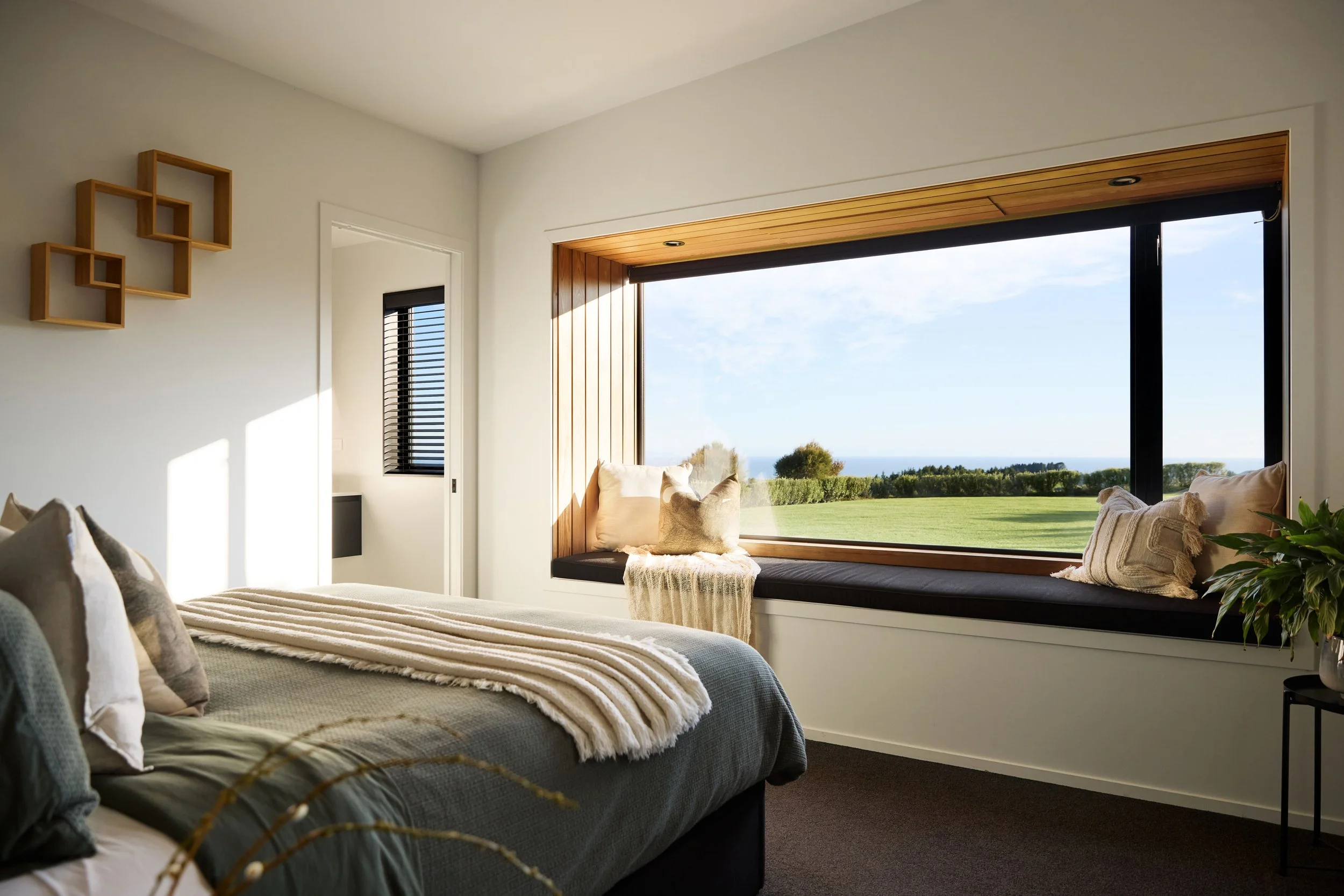
Thoughtful design provides degrees of separation, courtesy of a two-level configuration and tiered landscaping. A guest room and ensuite upstairs provide privacy for visitors, while the three bedrooms on the level below include the sanctuary-like master suite, which savours its own spectacular scenery, best enjoyed on the cushioned window seat in the sun or outside in a private courtyard.
The other big feature downstairs is the games room. Tailored for pool, darts, and big-screen movies or sport, it complements entertainment of a different kind upstairs.
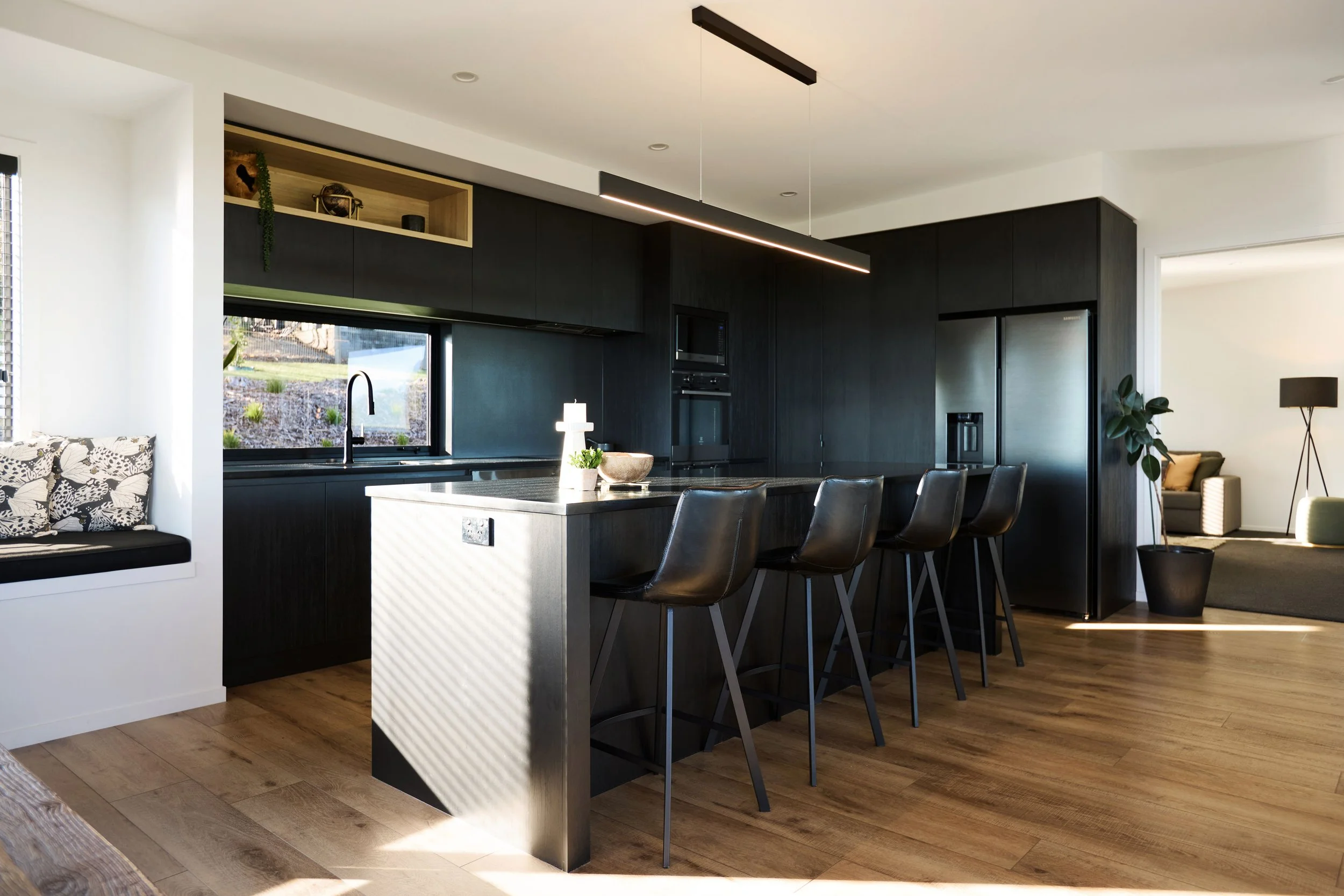
The heart of the home focuses on food, wine and good company. Delicious dark cabinetry in the kitchen enhances its ‘country restaurant’ vibe. Flowing outdoors to a sheltered alfresco lounge, the scenery is centre stage. Toasting sunset is a necessity where you can wind down at day’s end and cherish the tranquillity. Either relaxing in the family room around the hanging fire or enjoying quiet time in the second lounge, this home just keeps on giving.
The grounds revolve around playground lawns, native plants and an outdoor fire setting. A garden shed keeps tools out of the garage and there’s ample room to develop further with a swimming pool, home orchard or practice greens.
Far from the madding crowd, amid the serenity of Summerhill, the view shows just how close suburbia is, yet allows you to leave others to it.
5 Chestnut Lane, Summerhill, Pāpāmoa Hills

LESS IS MORE
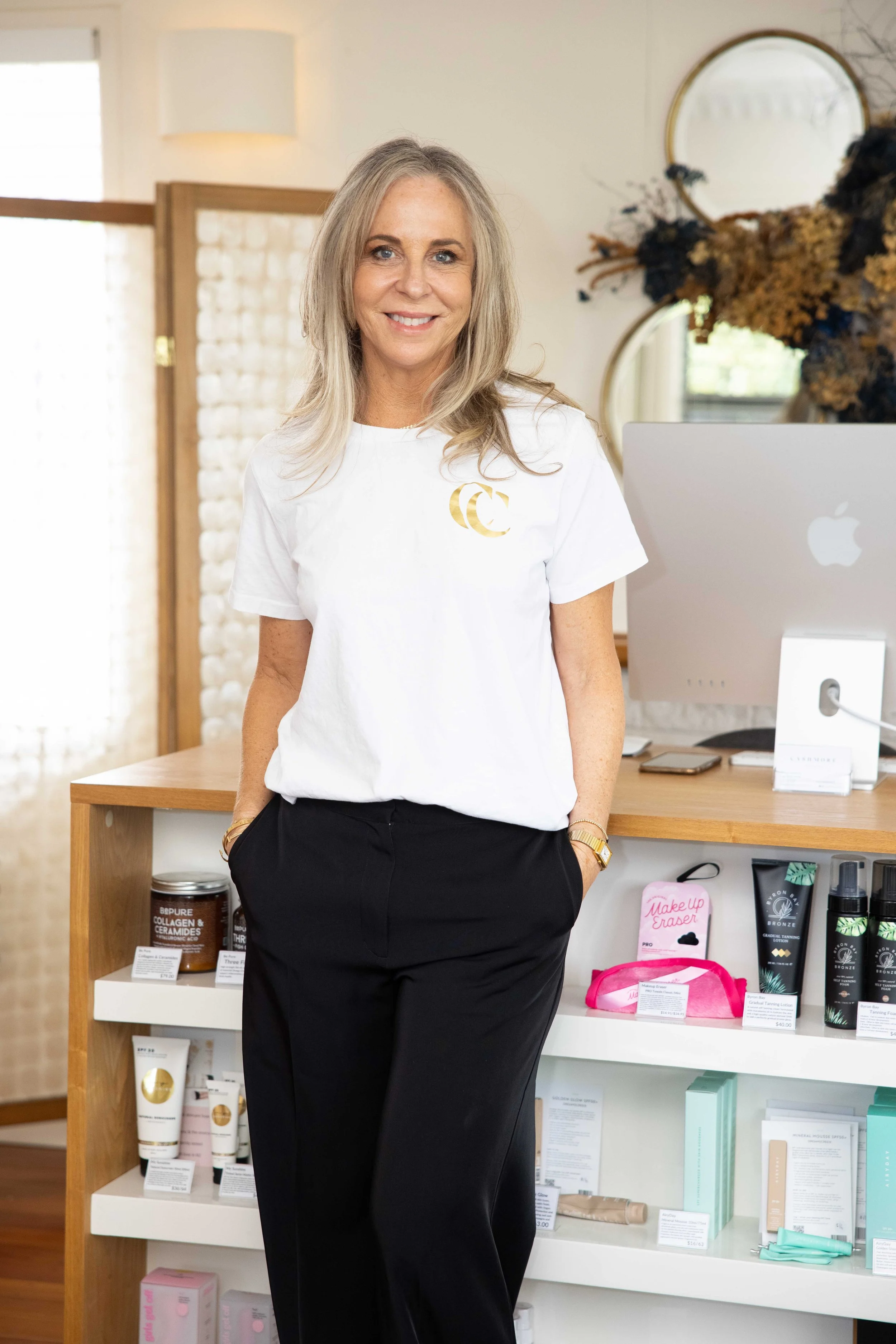
Leanne Cashmore of Cashmore Clinic on the art of looking refreshed and never ‘done’.
Leanne Cashmore of Cashmore Clinic on the art of looking refreshed and never ‘done’
PHOTO SALINA GALVAN
There’s a common misconception about lip filler that I’d love to put to rest. It’s that when you do it, everyone will know.
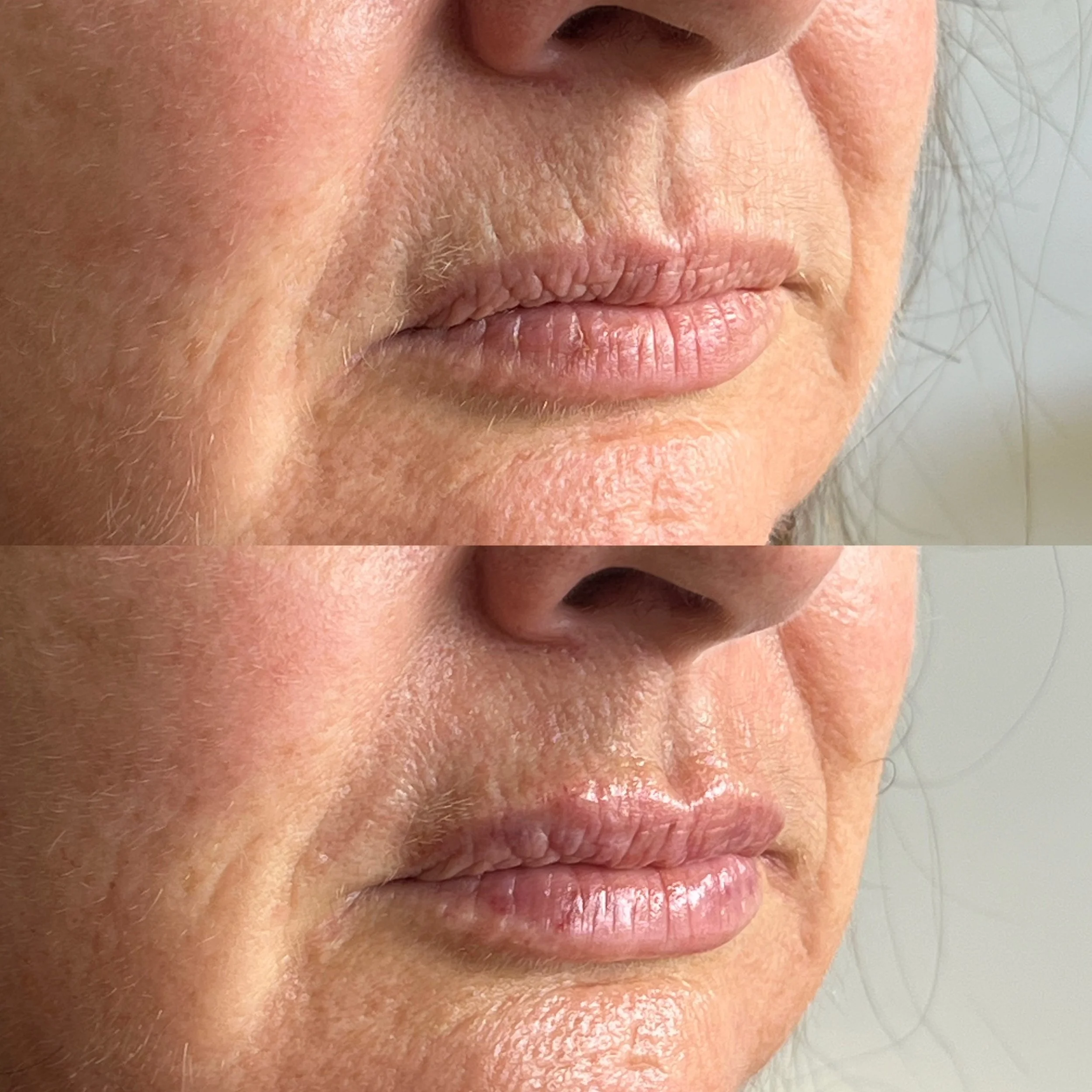
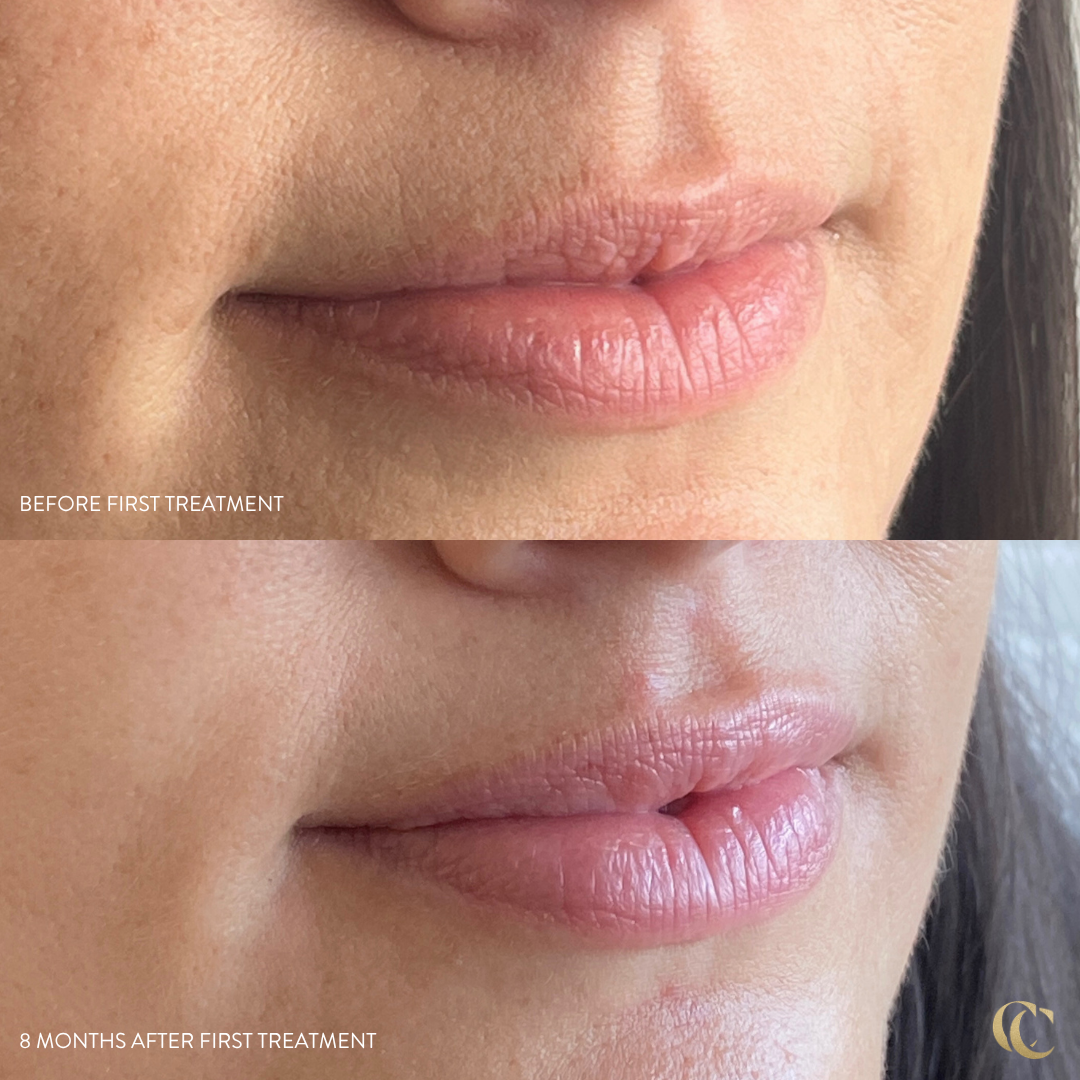
One of the questions I hear most often is, “Will I look done?” I always say, “Not if we’re doing it well.”
For me, lip enhancement has never been about creating a dramatically different mouth. I look at what’s already there and ask how we can restore softness and definition in a way that feels completely at home on your face.
As we age, we naturally lose volume in the lips and definition around the border. Fine lines can become more noticeable, too, and the overall effect can make the lower face look a little more tired or harsh than it once did. A small, considered amount of hyaluronic acid filler can help replenish some of what’s been lost, subtly refreshing the area without changing the fundamental shape.
Hyaluronic acid is a substance naturally found in the body that plays an important role in hydration and volume. When used thoughtfully, it can enhance, rather than transform.
That’s where I think the conversation around lip filler needs to change. We’re quite comfortable talking about Botox, teeth whitening, laser treatments and skincare as part of a broader approach to looking after ourselves. Lip filler can be the same. Rather than becoming the first thing people see, it’s a small aesthetic treatment that supports your overall appearance.
The technique matters enormously, and so does restraint. My approach is always to use the minimum amount needed to achieve the desired result, taking into account your natural anatomy and proportions, and what you want to achieve. The goal is never to make everyone look the same.
It’s also important to remember that lip filler is a medical treatment. Choosing an experienced, appropriately qualified injector who understands facial anatomy is essential.
At the end of the day, the best result is one that looks like you, just a little fresher.

ABOVE AND BEYOND
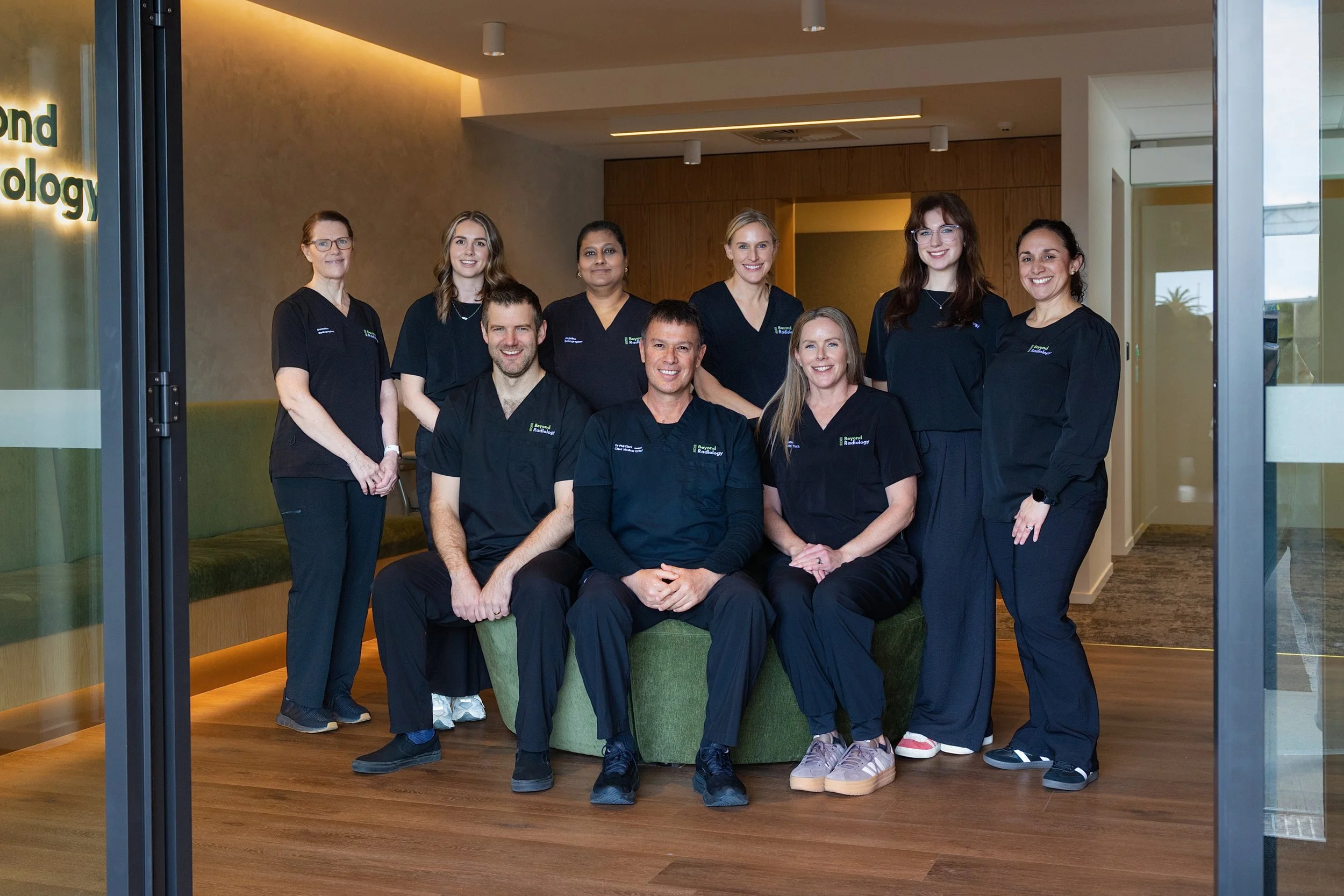
A new radiology clinic in the Mount is mixing cutting-edge technology with old-school values of compassion and kindness. Dr Phil Clark talks us through Beyond Radiology’s approach to healthcare.
A new radiology clinic in the Mount is mixing cutting-edge technology with old-school values of compassion and kindness. Dr Phil Clark talks us through Beyond Radiology’s approach to healthcare.
PHOTOS DEBORAH DE GRAAF
There was a time when medical imaging was something that happened largely behind the scenes. You saw your doctor, got a referral, had the scan and waited for the results. Today, expectations are very different.
As diagnostic technology has become more sophisticated, imaging has become an increasingly important part of how injuries and illnesses are investigated, diagnosed and treated. In a region growing as quickly as the Bay of Plenty, demand for those services is growing too.
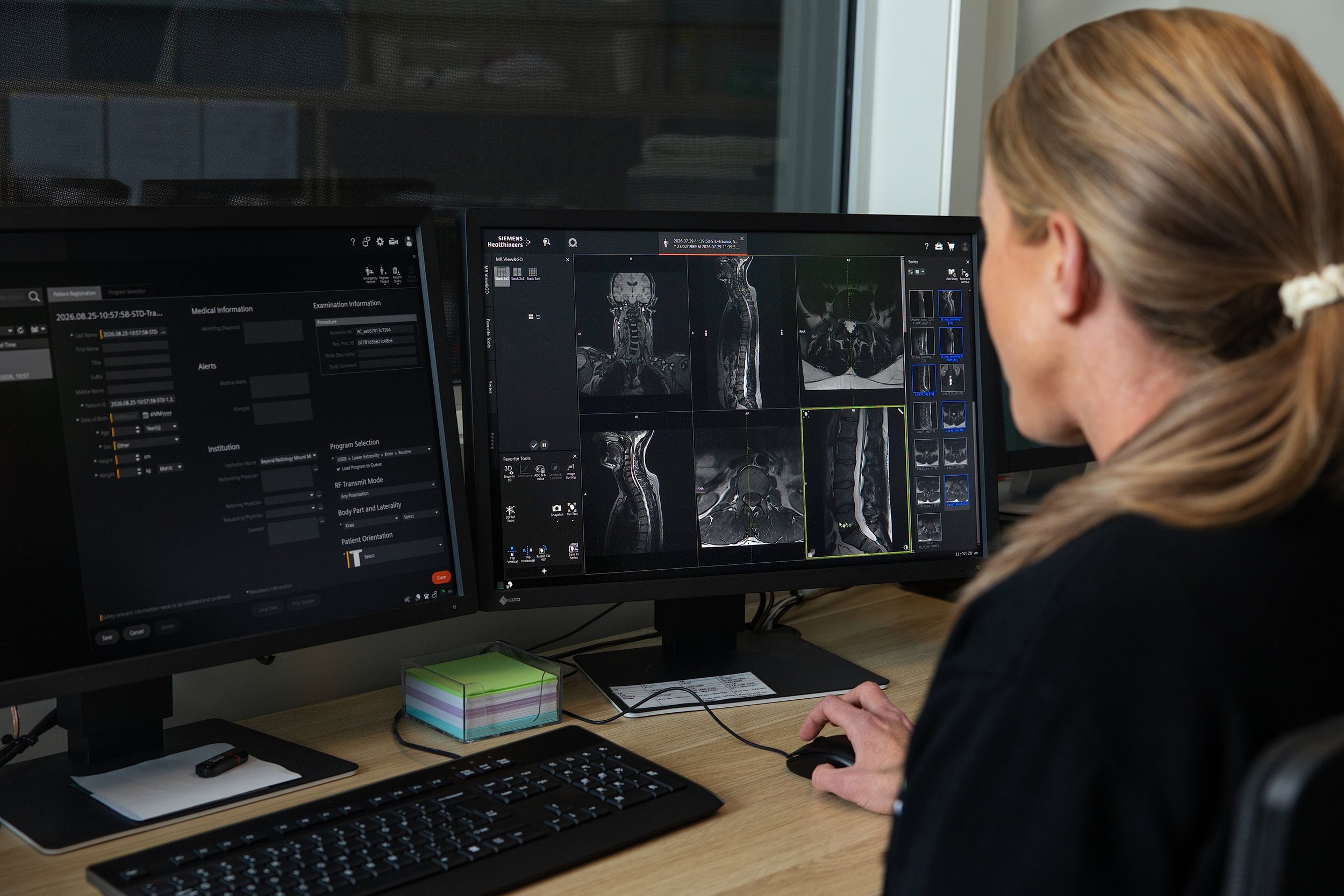
It’s a changing landscape that sits at the heart of Beyond Radiology, a New Zealand-owned, clinician-led Radiology practice that has recently opened its first clinic in Mount Maunganui.
Leading the clinical team is chief medical officer Phil Clark, a radiologist with experience across both the public and private sectors in New Zealand and Australia. For Phil, the focus is firmly on bringing clinical expertise, advanced technology and a more personal approach to the patient experience.
That philosophy is evident at Beyond Radiology’s new clinic at Owens Place, where the latest advanced equipment has been installed, offering a wide array of X-ray, ultrasound and MRI scans, as well as ultrasound-guided injections.
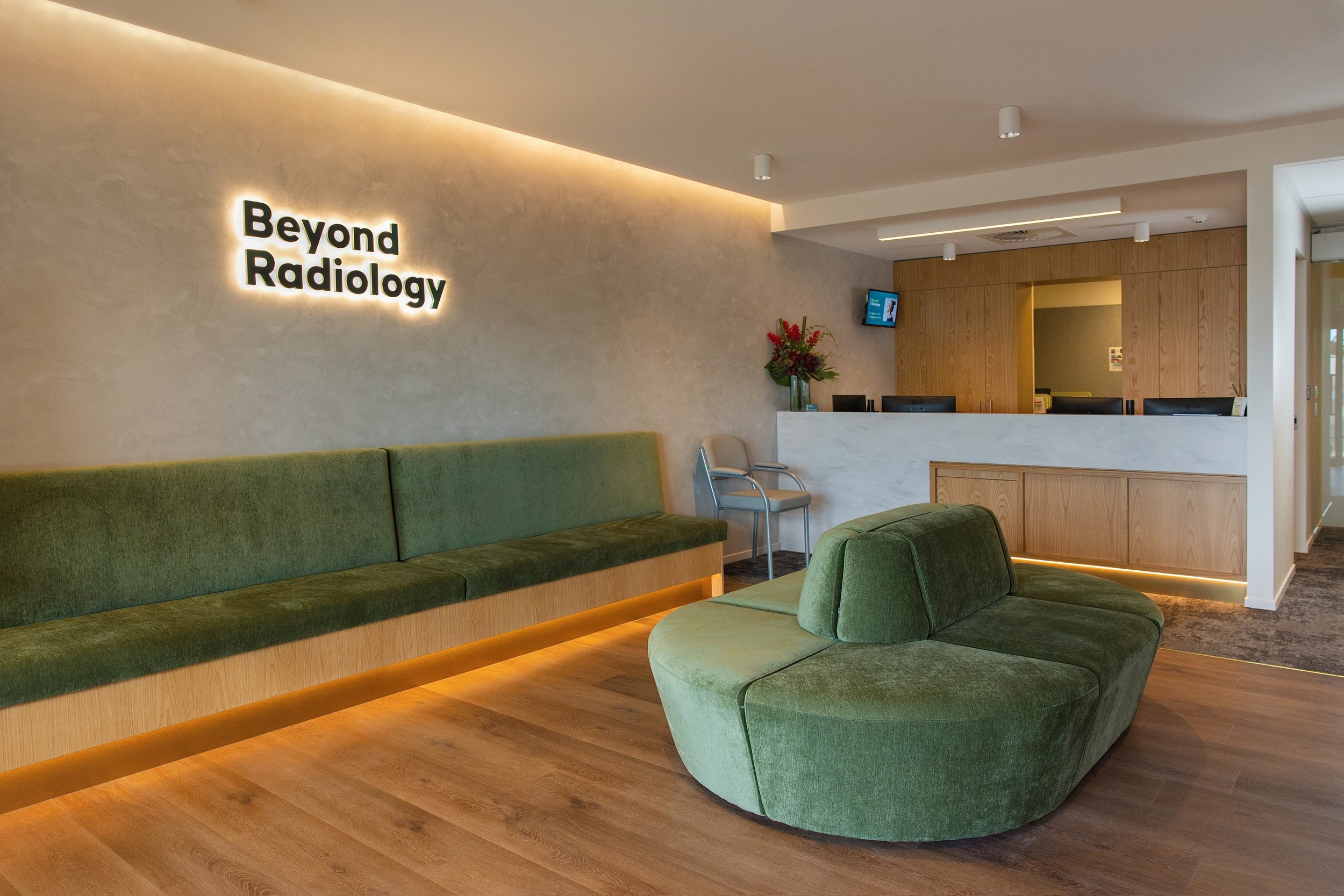
“We live and breathe the mantra of going above and beyond every single day, with a quality, patient-focused, clinician-led service,” says Phil. “We treat all patients with the same dignity and respect all the way through. Irrespective of their background, every patient is treated equally.”
With times tough for many people, Beyond Radiology has made the decision not to charge a surcharge on ACC X-rays, ultrasound scans or ultrasound-guided procedures, helping keep essential imaging accessible to the wider community.
The technology matters too. As imaging becomes increasingly sophisticated, the ability to see fine detail and provide clinicians with clearer answers is transforming the way injuries and illnesses are investigated and treated. At Mount Maunganui, that technology is backed by a team of highly trained and experienced professionals.
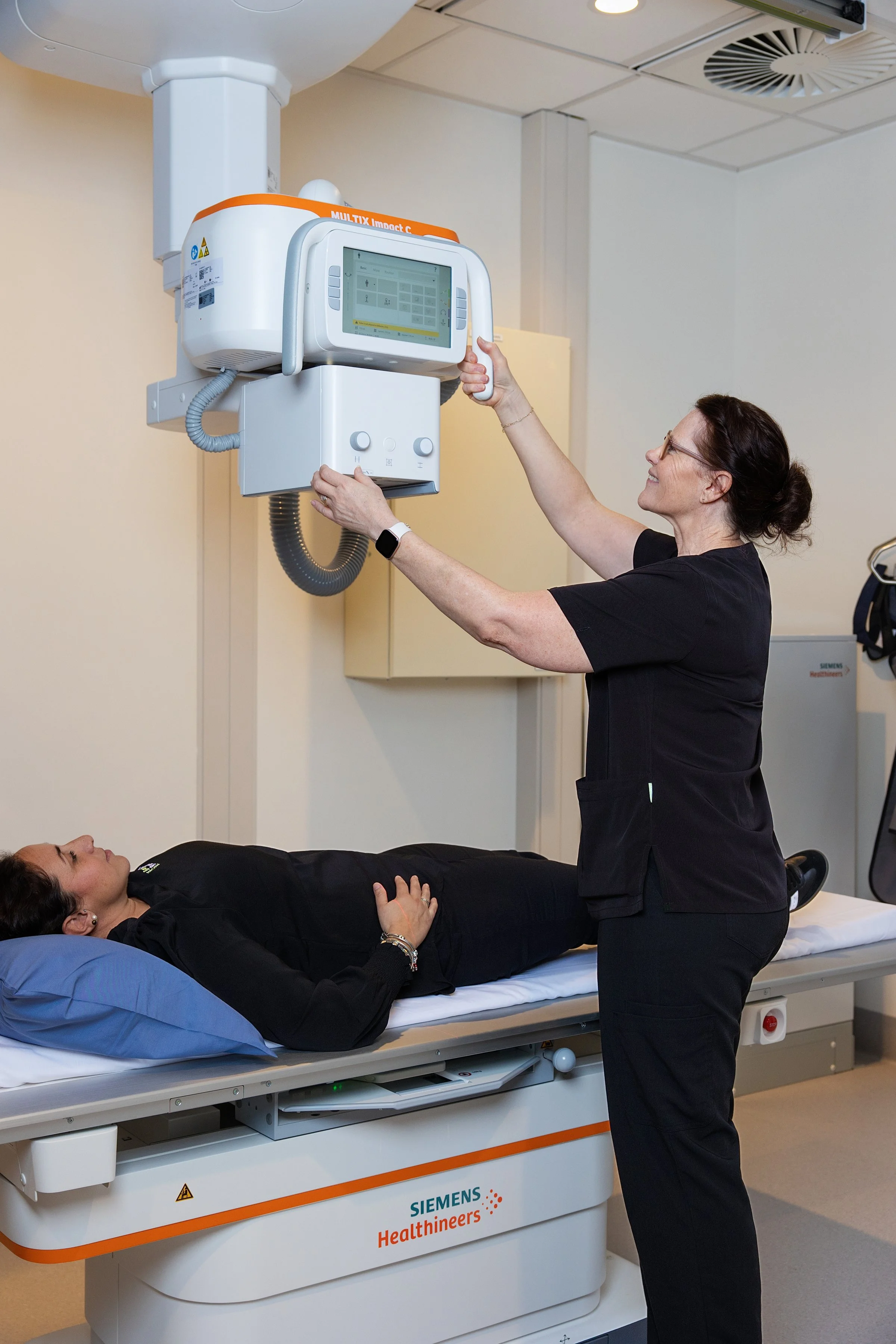
Although the machines may be state-of-the-art, the philosophy behind Beyond Radiology is refreshingly straightforward. Patients should be treated with kindness, care, dignity and respect, whatever their background.
It’s a particularly relevant approach in the Bay of Plenty, where rapid population growth is driving increased demand for radiology services and greater access to diagnostic imaging.
“We’re really excited about being here,” says Phil, “and about the difference we can make for patients.” With its first Bay of Plenty clinic now open, Beyond Radiology has the opportunity to bring a combination of advanced imaging, clinical expertise and patient-focused care to a growing community – and to make the journey through medical imaging just a little easier along the way.

DESIGNING FOR LIFE
Mod Architecture’s Andrew Ward has just received another design award. He speaks to UNO about his surprisingly simple secret to designing a great house: above all else, it needs to feel like a home.
Mod Architecture’s Andrew Ward has just received another design award. He speaks to UNO about his surprisingly simple secret to designing a great house: above all else, it needs to feel like a home.
PHOTO ROSE MINNÉE PHOTOGRAPHY
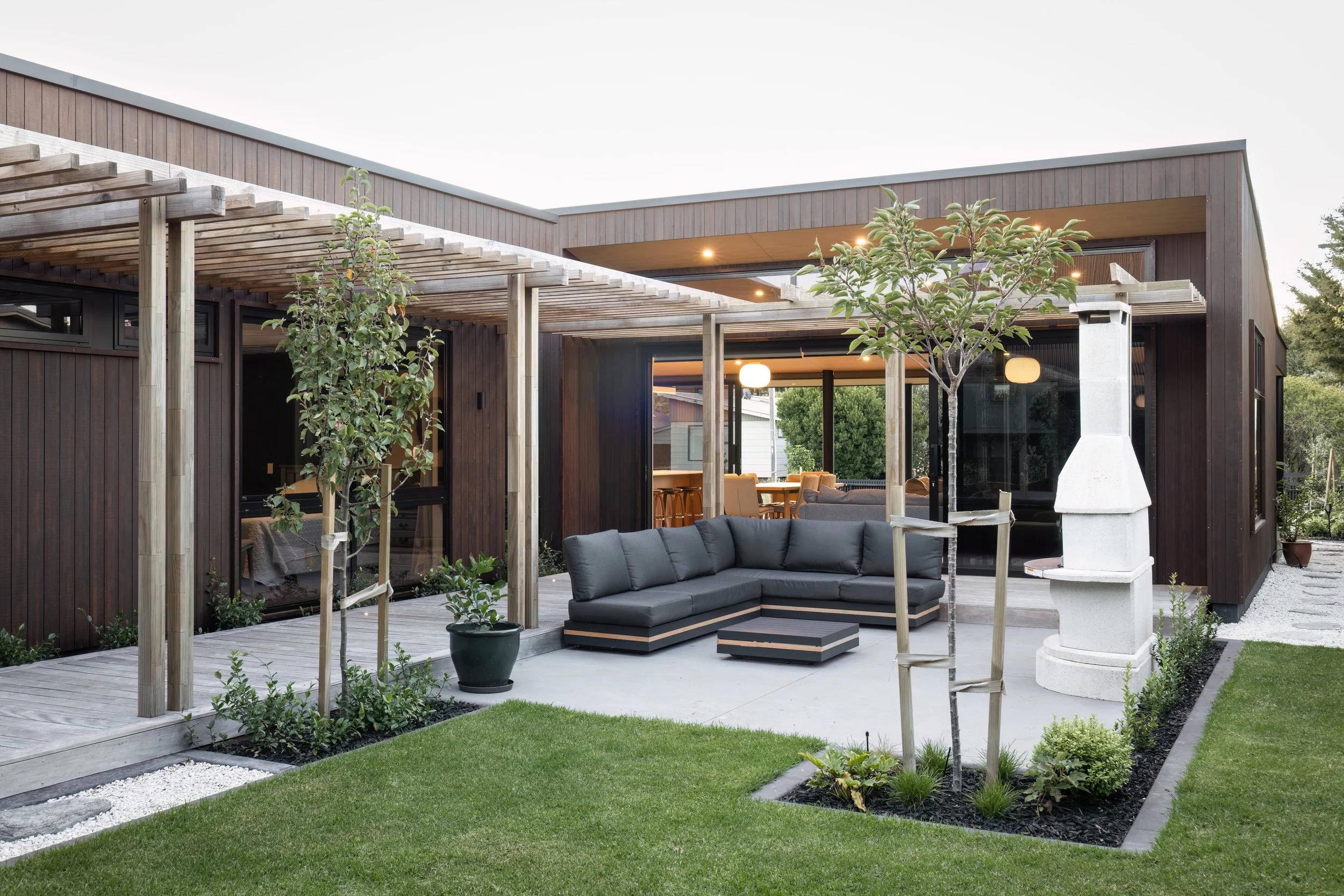
Before architect Andrew Ward can begin designing a house, he first needs to understand the people who will live in it.
“To me, the house is not just its exterior,” he says. “A lot of planning and design thought goes into that, but it also needs to work with how the interior functions and how you feel within the space.”
In practice, this means thinking about details. like where the surfboards will be stored, whether the bathroom should be light for early birds or darker for night owls, and where the afternoon sun will fall, so outdoor living spaces can make the most of the Bay’s long sunny afternoons and flow naturally into the rooms inside.
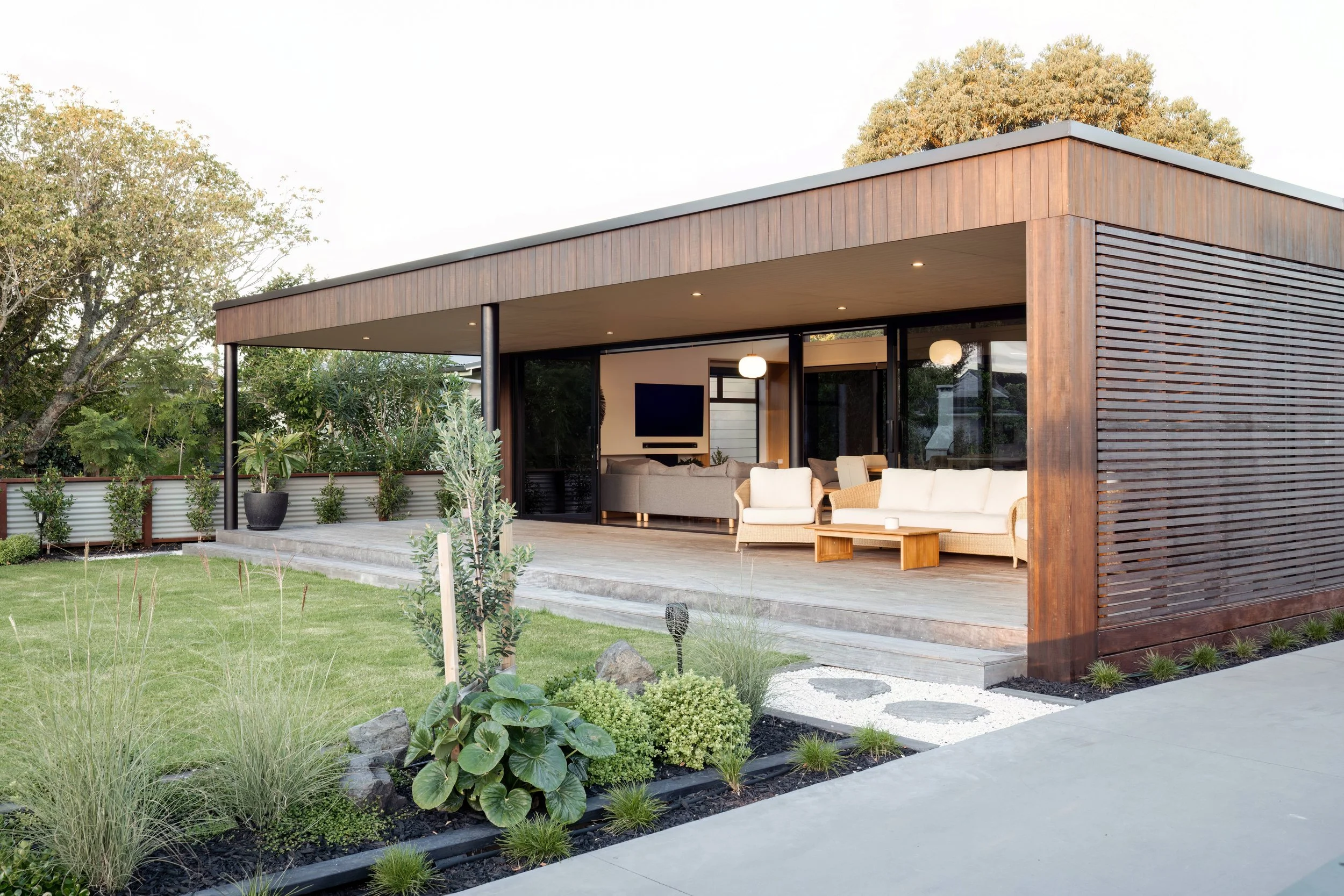
Before the design process begins, he imagines himself living in each space, diving into the granular details like where his favourite chair would be, what he’d see when he passed a window and even if the wind would rush in if he opened a door.
He then goes through a highly detailed questionnaire with his clients that’s designed to reveal how they’ll live in the space. This is reasonably extensive to ensure he doesn’t miss important details that they may not have even considered, like how many people will live there, whether they’ll have family staying, whether they work from home and what time they get up in the morning. How do they actually use their house?
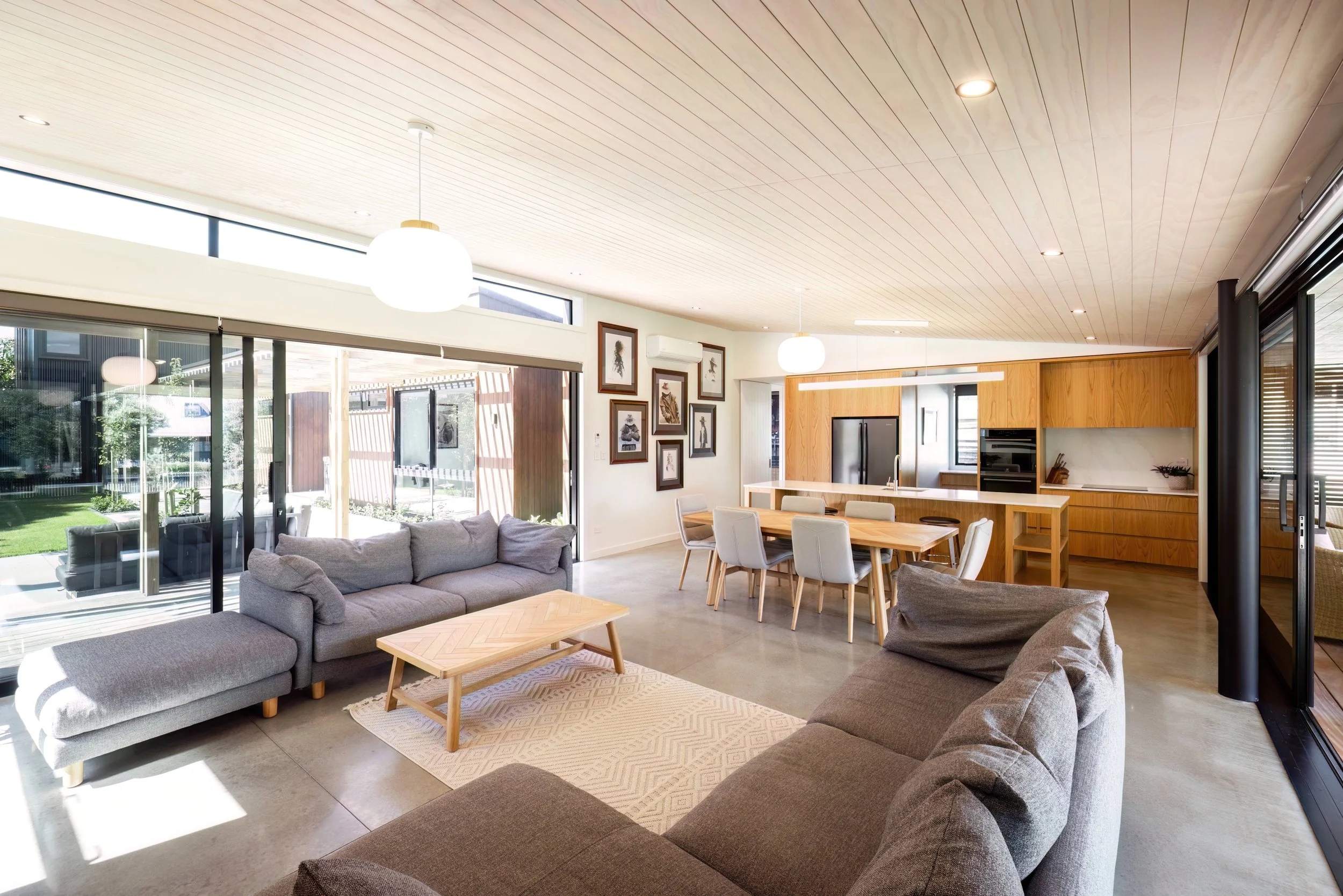
He gives the example of a family living near the beach. Their lifestyle might mean they need an outdoor shower for washing off the sand. Take that a step further, and it could mean positioning a door leading directly into the bathroom to make living in the home that much easier. These are the details that turn a great looking house into an equally great place to live.
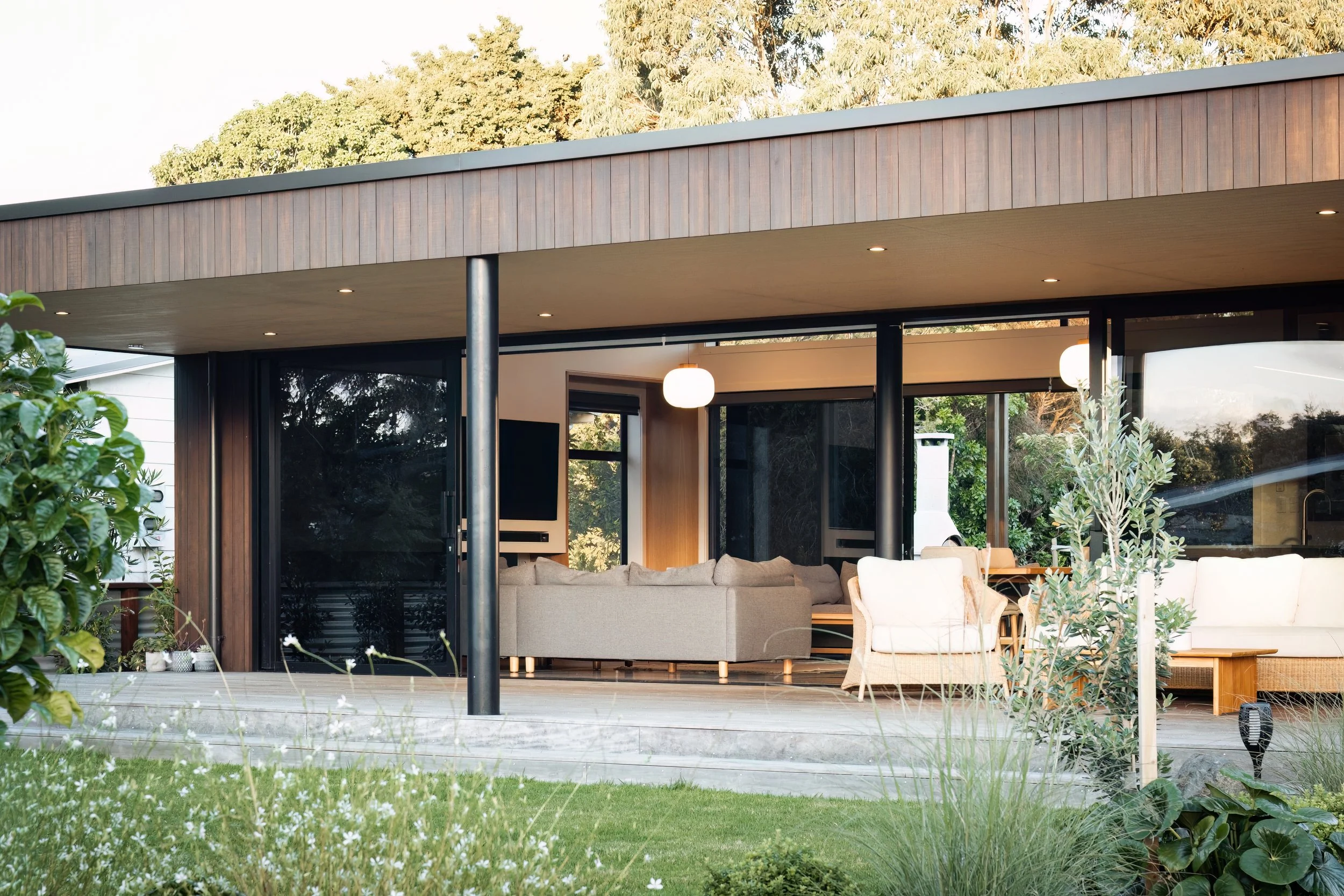
It’s this lifestyle-driven process and design philosophy that saw Mod Architecture’s Whangamata House receive a Highly Commended in the 2026 ADNZ Resene Architectural Design Awards. The clients came to Andrew with their functional requirements and some loose ideas, including a desire for an internal courtyard, before going on the design journey with him.
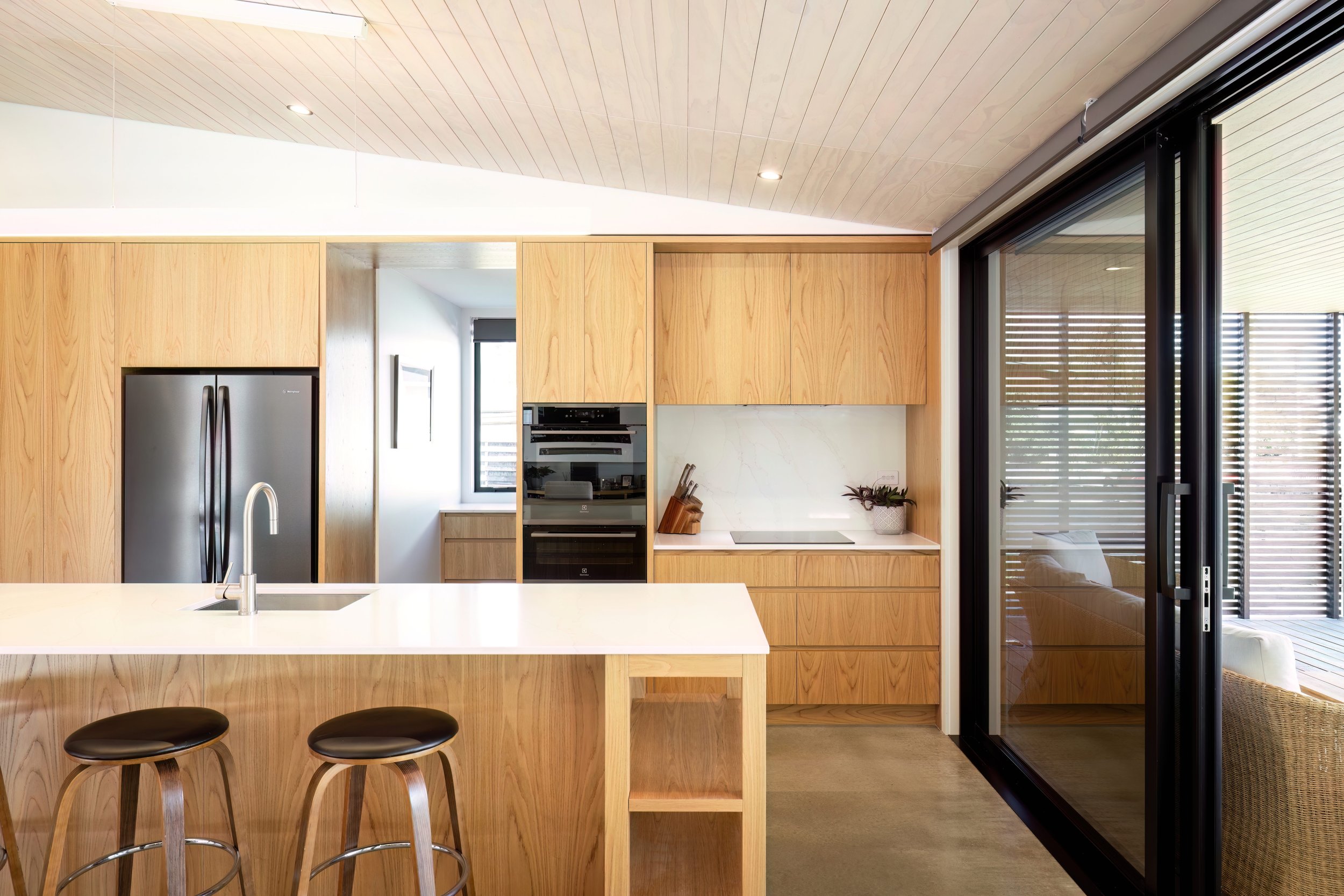
Andrew says he designed the house to retain the relaxed feel of a classic beach bach. To that end, there’s no formal main entrance. Instead, the house opens towards the street, reflecting the informality of a beach town in which everyone’s out and about, and a trip to the beach is always on the cards.
The clients also wanted to encourage their adult children to visit regularly, so Andrew designed the garage and additional accommodation to be separate from the main living areas, allowing the owners to live comfortably on their own while still having plenty of space available for when the family comes to stay.
Andrew says the site itself helped shape the design. Running east to west, it offered the opportunity to create an internal courtyard that could become a sheltered outdoor living space, protected from the neighbours, wind and changing sun. Rather than treating the courtyard as an afterthought, Andrew made it central to the way the house works, coupling it with an outdoor zone at the front of the house, with a large veranda providing shade and shelter at different times of year.
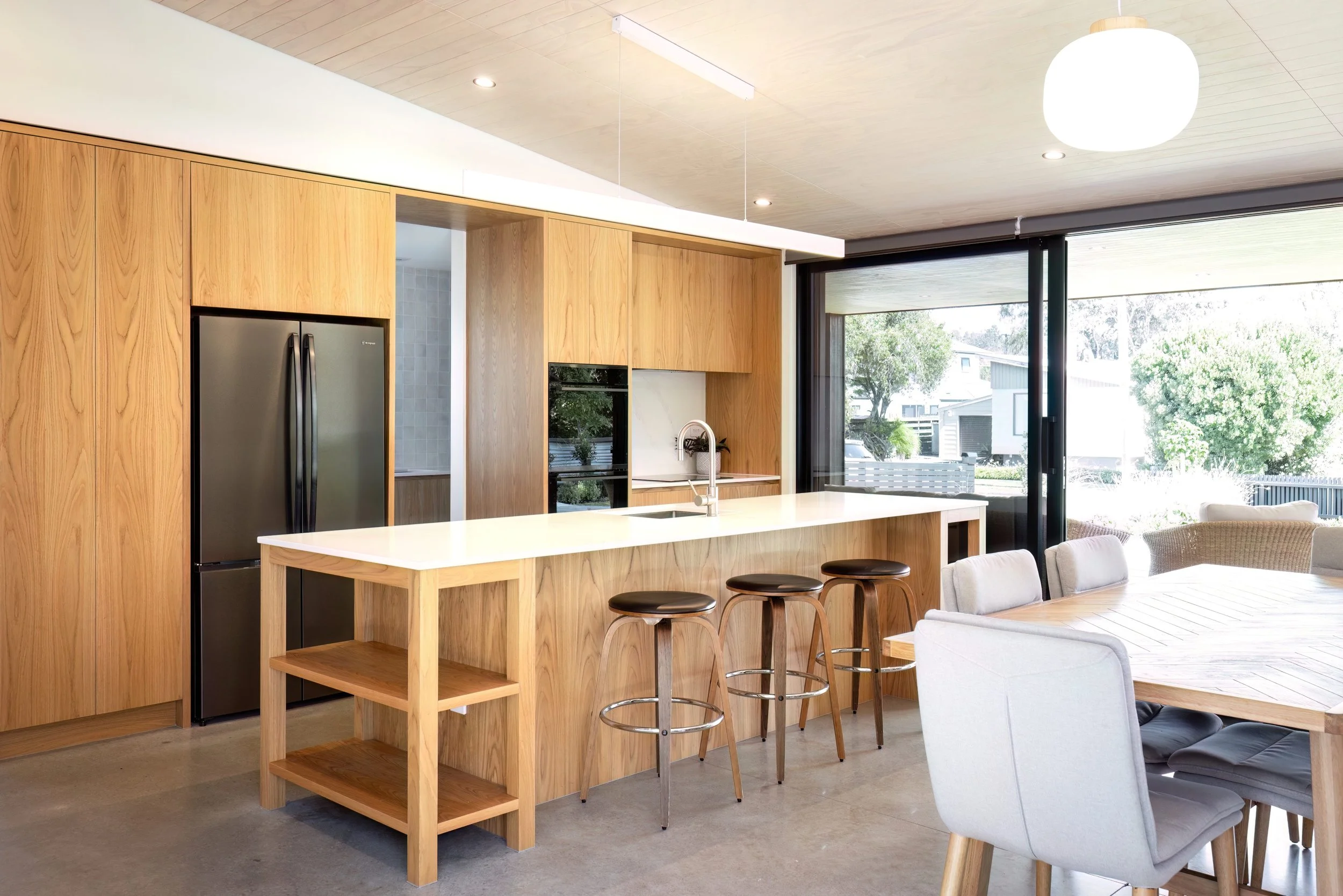
The result is a home with several distinct places to gather, depending on the weather, time of day and how the family wants to use them. The judges praised the way the different building volumes work together, creating patterns and shadows, and a strong relationship between the spaces and the home’s central courtyard.
Andrew says that one of his advantages as an architect is that he lives here in the Bay. He understands the character, the weather, how the conditions change throughout the year and, most important of all, the way we all enjoy life and use our homes.
“The most important thing with one of my designs, and the thing that makes it feel like a home, is that it’s designed for you and how you want to live.”
For Andrew, the payoff goes beyond simply creating a beautiful house.
“Good architecture can definitely enhance your life, enhance your wellbeing.”
After all the conversations, decisions, revisions and inevitable moments of anxiety that come with any project, the best part is seeing the finished home come to life.
“If you’ve done a good job, you’ve improved their life,” he smiles. “That’s definitely pretty special.”

BEYOND BIG CITIES AND BEYOND THE PLATE
Michelin has created an appetite our food columnist Rae Baker sees as an opportunity. How about we band together to show what our food culture’s made of?
Michelin has created an appetite our food columnist Rae Baker sees as an opportunity. How about we band together to show what our food culture’s made of?
PHOTO TOURISM BAY OF PLENTY
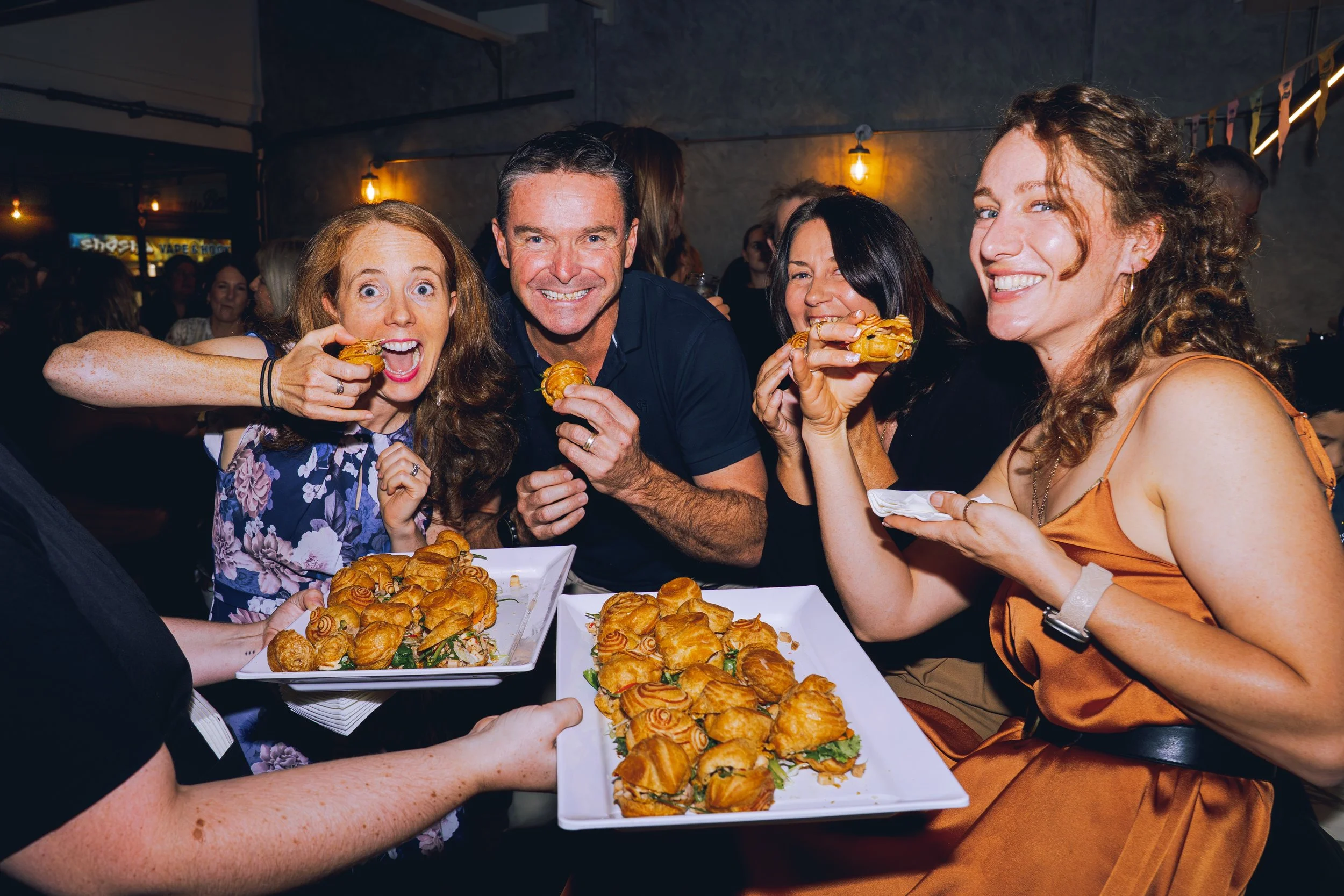
The arrival of the Michelin Guide in New Zealand has generated plenty of excitement, and rightly so. Internationally, a Michelin recommendation or star can transform a restaurant’s reputation, attract global visitors and elevate an entire country’s culinary profile.
For New Zealand, it’s another chance to showcase our food story on the world stage, but although much of the conversation has centred on which restaurants might earn recognition, I think the bigger opportunity lies elsewhere. It’s with the regions.
Tourism New Zealand has identified food and beverages as a key driver of international visitation, recognising that today’s travellers increasingly choose destinations based on the experiences they’ll have, not just the sights they’ll see. Food has become one of those experiences. Visitors want to discover local produce, meet the people behind it and experience the flavours that define a place.
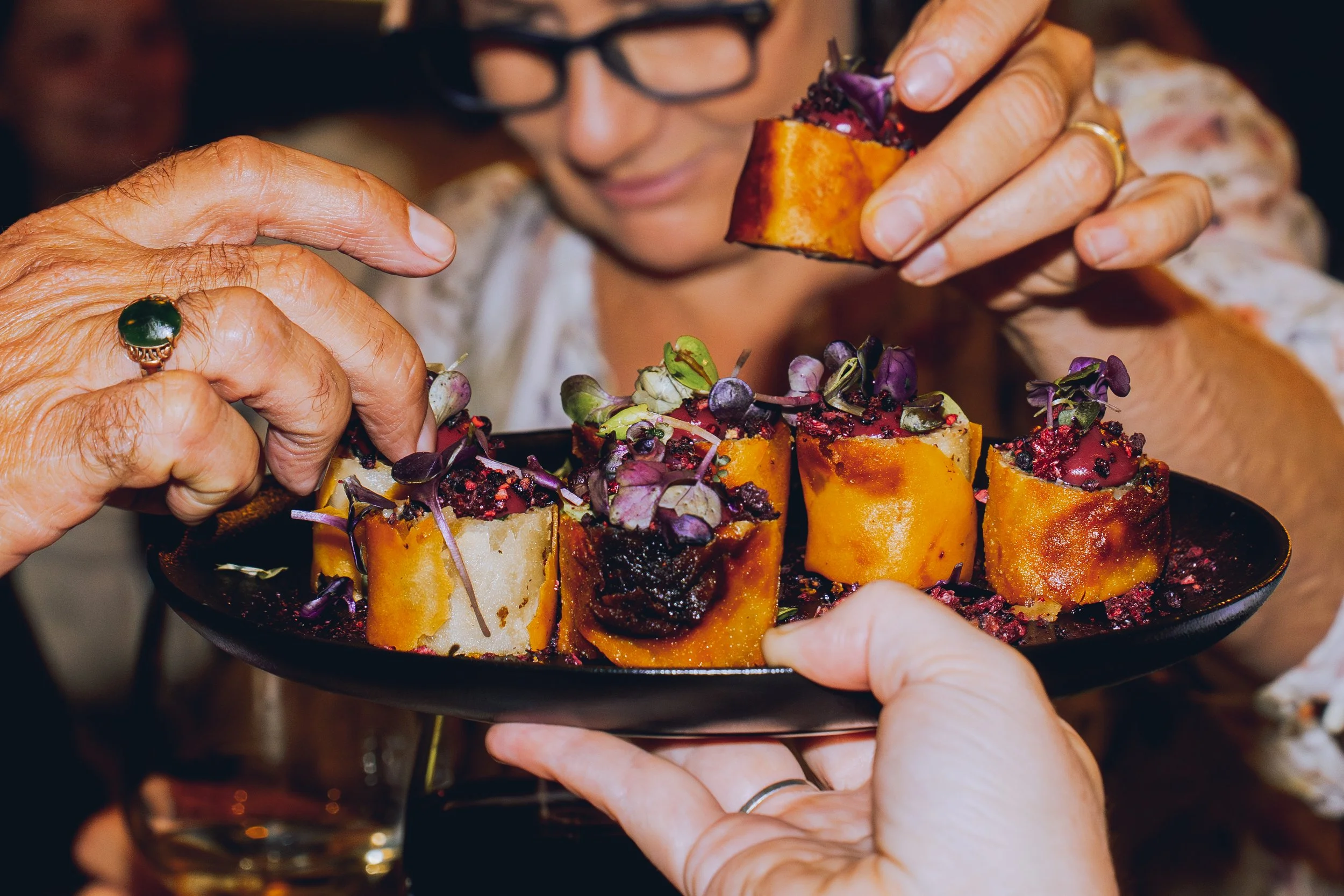
Michelin has the potential to put New Zealand on more international itineraries. The question is: once visitors decide to come, how do we encourage them to travel beyond our major cities?
That’s where our beautiful Bay of Plenty has a genuine opportunity to shine. We’re fortunate to have many of the ingredients already in place: a thriving horticulture sector, innovative producers, talented chefs, award- winning restaurants, boutique breweries and distilleries, bustling farmers’ markets and a climate that allows incredible produce to flourish almost year-round. More importantly, we have something visitors are increasingly seeking: authenticity and manaakitanga (hospitality, generosity...) in abundance.
The Bay of Plenty has never tried to be a fine-dining capital – and that might be one of its greatest strengths. Our food culture is relaxed, welcoming and deeply connected to the people and the landscape that produces it. Whether it’s sharing a long lunch overlooking the ocean or meeting the grower behind the ingredients on your plate, our hospitality reflects the lifestyle that makes this region special.
The challenge isn’t creating great food experiences, it’s making them easy to discover. This is where regionalcollaboration becomes so important. Food trails, seasonal campaigns, destination marketing, accommodation packages, festivals and events all help visitors to see the bigger picture. Rather than promoting individual venues in isolation, they create a compelling reason to spend another night, explore another town or venture a little further off the beaten track.
Events such as Flavours of Plenty have already demonstrated what’s possible when an entire region comes together to celebrate its food identity. By connecting producers, chefs, hospitality businesses and communities, they offer visitors something they can’t replicate elsewhere – a genuine taste of place.
As Michelin shines a brighter spotlight on New Zealand’s culinary credentials, the Bay of Plenty has an opportunity to ensure our region is part of that story – not by trying to imitate the world’s dining capitals, but by confidently showcasing what makes our own food culture distinctive. After all, people don’t travel to the Bay for a single restaurant. They come for the beaches, the orchards, the sunshine, the hospitality and the lifestyle. Great food simply brings those experiences together.
Perhaps that’s the opportunity Michelin presents – not to chase stars, but to give more people a reason to discover everything else that’s waiting beyond the city limits.

MUD,SWEAT AND TEARS
The backyard of The Hits radio host Hayley Bath’s dreams hasn’t begun quite as she intended.
The backyard of The Hits radio host Hayley Bath’s dreams hasn’t begun quite as she intended.

When I first started planning our backyard renovation, I pictured a green oasis – a nice, flat lawn in the middle, surrounded by beautiful trees and lush, tropical garden beds.
Instead, I’ve got a 700m2 mud pit with digger tread marks all through it, a shredded tyre on the trailer, piles of green waste that are somehow taller than the original trees and some serious trauma. Oh, and did I mention that the car is currently stuck in the mud on the lawn? At this stage, I’ve given up any hope of getting it out. I’ll put a sprinkler on top of it and call it a permanent water feature.
My spirit has almost been broken, and we’re only halfway through the work, so in case you get lured into the idea of landscaping your own backyard, I’ve decided to walk you through what I’ve learned so far.
When you’re a fly-by-the-seat-of-your-pants kind of person, you need to marry someone patient.
Bless my hubby, he’s the most patient man on Earth. He knows by now that when I get the idea to do a little bit of weeding on a Sunday, it’ll turn into a big project that dominates our next 10 weekends. Like the calm hero he is, he sighed, pulled on his gloves, followed me outside and somehow didn’t roll his eyes when I started looking around, feeling inspired.
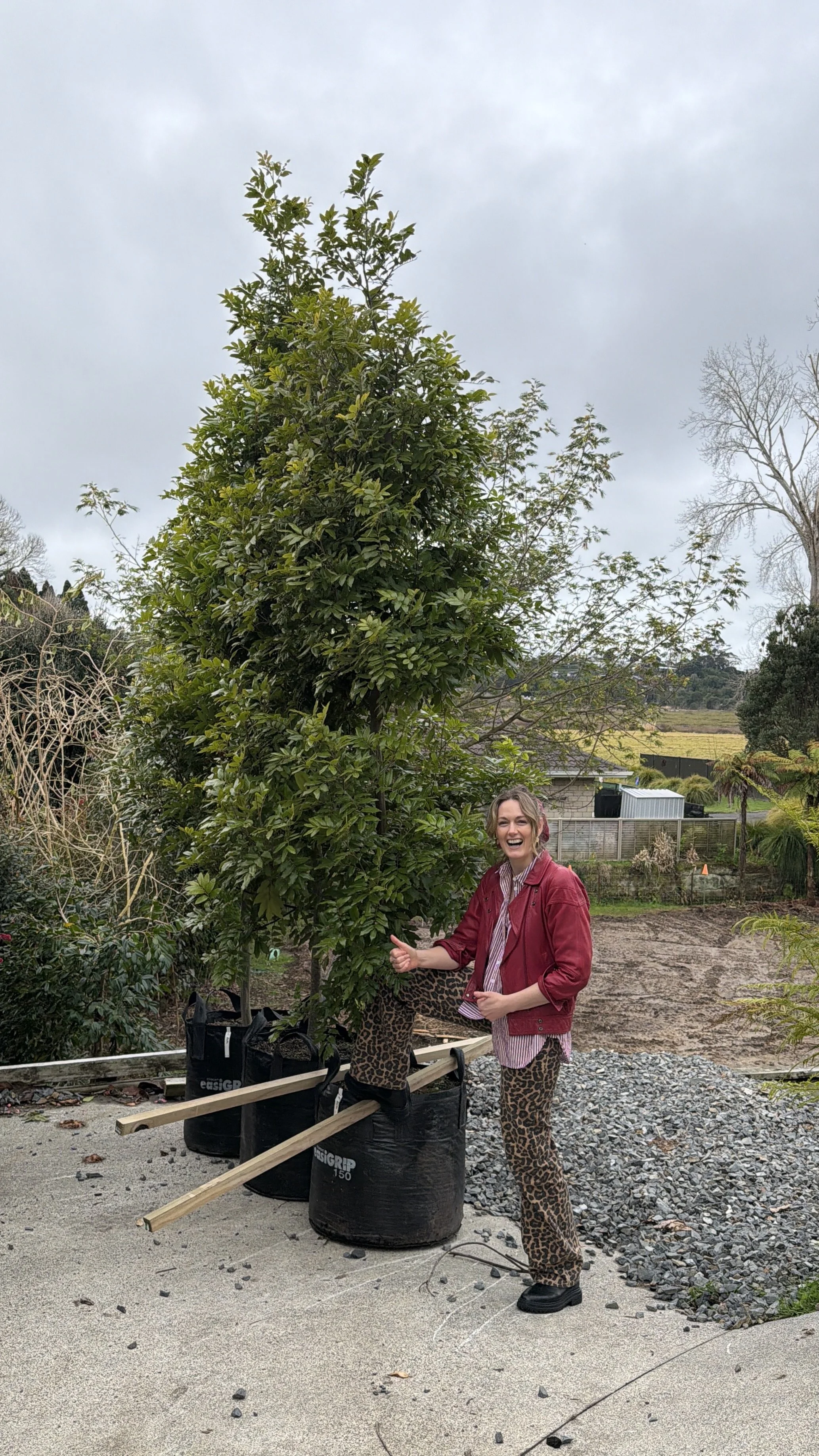
When you plan to work outside, a thunderstorm will roll in. It’s Murphy’s Law.
I pictured sunshine, I got a storm, complete with lightning strikes, but when you’re working towards a deadline because trees need to be planted and grass needs to be sown at the right time of year, you’ve just got to carry on. Trees had to be chainsawed, green waste hauled off into a mulch pile and trailer-loads of dirt brought in to keep our project on track. The digger battled on through the rain, leaving behind a sodden mess, alongside the car stuck on the lawn after I’d held my own bogan car rally, doing skids in the mud trying to get it out.
You shouldn’t burn ponga logs.
I learned this the hard way. I thought we’d have a lovely little brazier campfire and maybe also a singalong while getting rid of the ponga trunk. Nature said, “Nope.” The ponga combusted spectacularly, sending kids running away screaming and embers sailing high into the air towards land filled with toetoe plants nearby. I suddenly realised those fluffy plants are essentially highly flammable tinder on sticks. A quick Google confirmed you shouldn’t burn ponga for exactly this reason. Oops.
The tramping boots you bought 10 years ago will finally be used.
Tramping is a form of torture, something I hadn’t realised when I shelled out for a new pair of boots 10 years ago, convinced I’d become an elite hiker who relished the blisters, mosquito bites and heartburning sensation of being out of breath. I went on one tramp, then shamefully shoved the boots into the back of a cupboard, swearing never again, but when the thunderstorm washed out my gumboots, the hiking boots came out. They now sit proudly outside my back door, sporting a satisfyingly a worn-in look and no longer screaming, “Tramping queen failure!” at me when I see them.
Measure the distance between the trees before you buy the hammock.
tend to get overexcited and am much more interested in the finished result than the actual process. Before our backyard is even complete, I’m already decorating it. A two-person hammock was purchased without checking the measurements. When this behemoth hammock arrived, I realised it was actually bigger than the gap between the two trees I planned to hang it between. Never mind. I’ll simply plant another pōhutukawa tree and wait 10 years for it to mature so it can hold the other end of the hammock.
I don’t have time to relax anyway.
Is there hope in this chaos? Will this mud pit eventually turn into the green oasis I envisaged? If it doesn’t, I’ve considered buying a few pigs, releasing them into the backyard and calling it done.
Meanwhile, the costs keep piling up, but the $1,000 I’m about to spend on this $500 backyard reno may well be the best $4,000 I’ve ever spent. At this point, the maths is beyond me. I’m just hoping the garden looks good – or the pigs are cute, at least.
Catch Hayley on The Hits 95FM, weekdays from 9am till 3pm.

DIVA IN DEMAND
Jackie Clarke’s been keeping herself entertained for several successful decades – and music lovers right along with her.
Jackie Clarke’s been keeping herself entertained for several successful decades – and music lovers right along with her.
WORDS JO - MARIE BAKER

There were only six people in the pub when a teenage Jackie Clarke turned up in Mount Maunganui, ready to put on a show. It was a Tuesday night in the mid-1980s and Jackie – wearing a vintage outfit and winklepickers, her hair teased high – was touring with her first band, Marching Orders.
“You really learn your trade by bravely singing your show when no one’s interested,” she laughs.
Four decades later, Jackie’s coming back to the Bay to perform on a considerably grander scale. The much-loved singer, actor and entertainer will return to Mercury Baypark Arena on November 28 for DIVAS! Christmas Special, alongside Tina Cross, Suzanne Lynch and Annie Crummer, and backed by a four-piece band.
The show is a festive reincarnation of the DIVAS! performance that premiered in Tauranga in 2024 before touring the country, celebrating some of the greatest female voices of the past six decades. Expect everyone from Aretha Franklin, Dolly Parton and Nina Simone, to Whitney Houston, ABBA, Taylor Swift and P!NK.
Jackie says an important omission from the previous show will also be rectified. “We didn’t have any Mariah Carey last time, and I think we’ll definitely fix that, especially with this show’s Christmas vibe. We put a lot of thought into the songs we choose and it just releases the joy monster in people. It’s a great party.”
There will, naturally, also be frocks.
“We love any excuse to put on an amazing frock and let rip. To sing songs by Celine Dion and Adele and all the greats, you have to have a great frock to get you in the zone.
“Come dressed to the nines. If the audience is better dressed than us, that’s the perfect scenario. Don’t hold back.”

Behind all that glamour, preparations begin in more domestic surroundings. The women spend hours around their kitchen tables, drinking coffee, eating Tina’s home baking and painstakingly working on their vocal arrangements.
“We put a lot of detail into it,” says Jackie. “We don’t just turn up and sing. You work so hard so that it appears effortless, and that’s the magic – and when you get those moments of perfection, it’s just the best feeling in the world.”
That friendship and trust has been built over decades; Jackie has sung with Annie, Suzanne and Tina (in different incarnations) for almost 30 years. Together, she says, they tackle songs she wouldn’t dream of attempting alone, and if something still goes wrong on stage despite all that preparation, she can live with that too.
“People love mistakes. People love the humanity of watching things fall apart. That’s often where the real juice is.”
Tauranga has long been something of a second home. Jackie was involved with Tarnished Frocks and Divas from its humble beginnings in 2005 through to its spectacular arena productions, forging lifelong friendships along the way. The homegrown extravaganza gave hundreds of local women the chance to sing, dance, model and perform, often doing things they’d never imagined themselves capable of.
“The whole thing was such a beautiful kaupapa,” says Jackie. “All these people were given an opportunity to discover their best selves. Tauranga always has a special place in my heart. It lit a fire in a lot of people in the best possible way.”
Jackie’s career has been quite a journey from that near-empty Mount pub. Working across music, theatre and television, she found fame with musical comedy trio When The Cat’s Been Spayed, and became a familiar TV face through shows including Saturday Live and New Zealand Idol.
“It’s a wave that you ride, and it comes and it goes. I’m like a hardy perennial. I keep on keeping on through the highs and lows.”
At 60, she certainly isn’t seeking easier challenges. Just weeks before DIVAS!, she’ll take to Auckland’s Q Theatre in Songs for Nobodies, a one-woman play that requires her to portray 10 characters across five stories involving legendary singers Judy Garland, Patsy Cline, Edith Piaf, Billie Holiday and Maria Callas.
“These one-woman shows are so petrifying,” she says, “but it’s a beautiful space to be in when you’re actually scaring yourself shitless with a huge challenge.”
It makes returning to Tauranga to sing with close friends all the more wonderful. The contrast is part of what Jackie still loves about her work – wildly different projects drawing on her “la la la” and “blah blah blah” skills. “I’ve just turned 60, and I feel like I’m in my prime. I really feel like I’m getting the hang of this.
“You can always feel how music feeds people’s souls, and it doesn’t matter if it’s in a bar for six people or it’s a massive arena show. The chemistry is the same. I’ve spent my life entertaining myself, and if you do that, the audience will be entertained as well.”

FINDING YOUR FEET
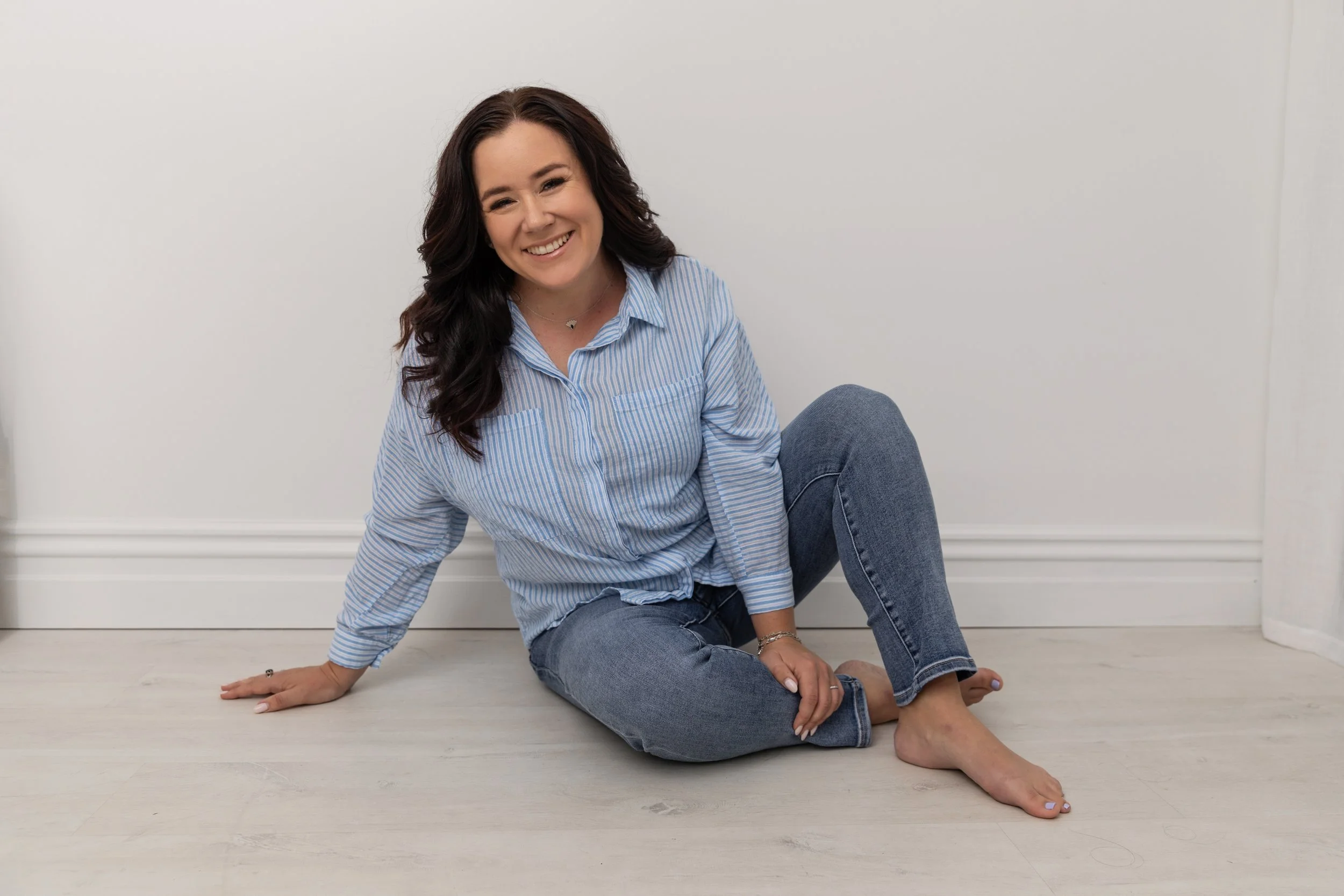
Fontein Coaching’s Cass Fontein offers tools to support you to stay grounded, manage overwhelm and focus on what’s within your control.
Fontein Coaching’s Cass Fontein offers tools to support you to stay grounded, manage overwhelm and focus on what’s within your control. PHOTO CASEY VAN LIEFDE
You know those days when your brain has 47 tabs open? You’re replying to an email while thinking about the conversation you need to have later. Your phone pings. You remember something you forgot yesterday. Someone’s waiting for an answer. You’re worrying about something that’s happening next week. Suddenly, even the smallest decision feels much harder than it should.
Welcome to overwhelm.
Spring has a way of bringing energy back into our lives. The days get longer, our calendars fill up, projects gain momentum and before we know it, life feels very full again.
When that happens, our instinct is often to try to get everything under control. The problem is that a lot of what occupies our minds was never within our control in the first place.
We worry about what someone thinks of us, replay conversations that are already over, and take on responsibility for other people’s emotions. We spend energy solving problems that haven’t actually happened yet. Meanwhile, the things we can influence get lost amongst the noise.
When everything starts feeling like too much, I like to bring it back to one question: what’s actually within my control right now? Sometimes, the answer is surprisingly small.
I can put my phone down, send the email I’ve been avoiding, or say no. I can ask for help, or I can simply decide that a problem doesn’t need to be solved today. These things won’t magically remove everything happening around us, but they remind us that we still have agency.
It’s a picture I come back to again and again, with clients and in my own life. There are two circles. Inside the first is everything you can control, like your actions, your boundaries, where you place your attention, how you speak to yourself and what you choose to do next. Outside sits everything else, like other people’s opinions and reactions, the past, unexpected changes and the outcomes we wish we could guarantee.
When overwhelm creeps in, notice which circle is getting most of your energy, then come back to the present. Feel your feet on the floor. Take a slow breath. Notice what you can see and hear. Give your mind something that’s happening now to think about, rather than another scenario that may or may not happen later. Then choose one thing.
Being grounded doesn’t mean becoming someone who’s permanently calm or unaffected by life. We’re human. We get stressed. We overthink. We have days when everything feels like a lot. Being grounded is knowing how to find your way back when it does – back to what you can influence.
The next time your brain has 47 tabs open, you don’t need to close them all. Just find the one that’s actually yours, and start there. FONTEINCOACHING.CO.NZ

LET’S GET PHYSICAL
If your idea of a holiday involves some real get up and go, there’s a world of active adventures waiting to be explored. YOU Travel & Cruise Bethlehem explores everything from cycling and hiking to mountain biking and expedition travel.
If your idea of a holiday involves some real get up and go, there’s a world of active adventures waiting to be explored. YOU Travel & Cruise Bethlehem explores everything from cycling and hiking to mountain biking and expedition travel.
WORDS LIZ FRENCH
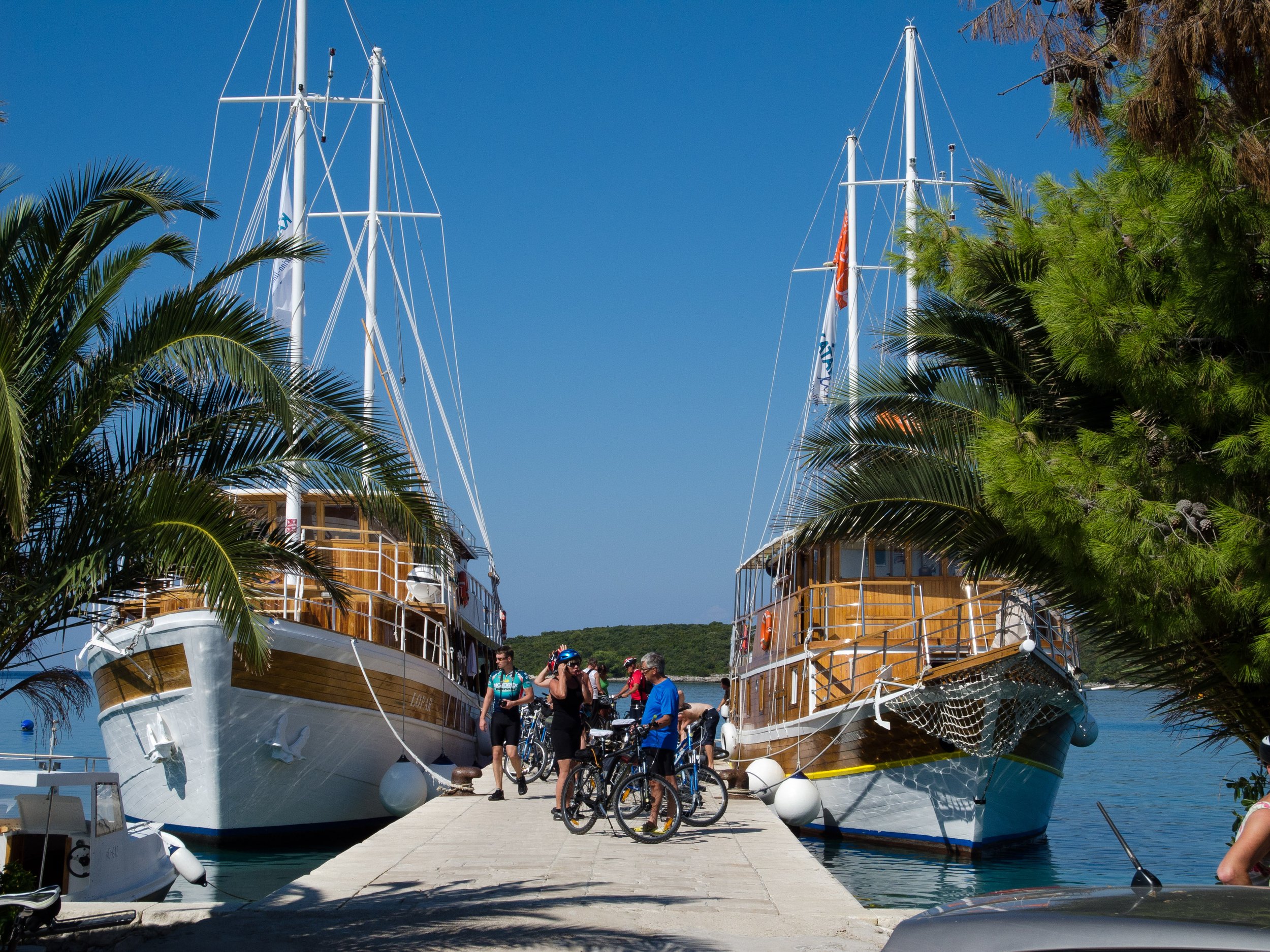
Bike and cruise, Croatia.
Active travel isn’t a new concept but it does seem to be experiencing a major modern surge of late. Although walking, hiking and cycling holidays have existed for generations, post-pandemic lifestyle priorities and a demand for experiential travel have catapulted physical activity into a primary holiday choice, where travellers prefer active engagement over passive relaxation.
For families, couples and solo travellers alike, the options are wide-ranging, from cycling and hiking holidays to more adventurous expeditions.
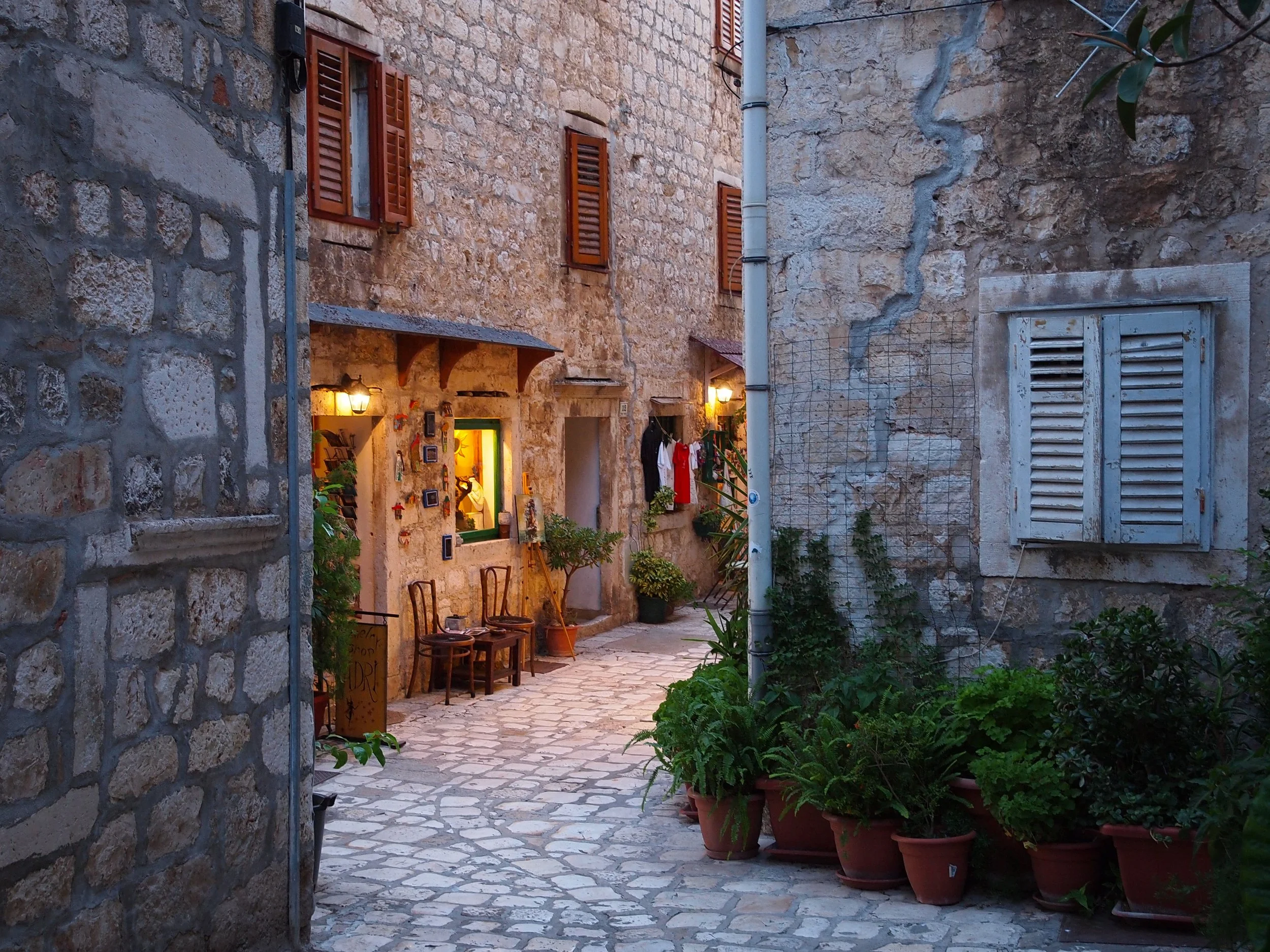
Hvar, Croatia.
MEET YOUR MATCH
Cycling gently through scenery, mountain biking gnarly trails, rambling amid glorious views, hiking remote regions... Once you’ve decided on your style of holiday, there’s a destination and a tour (self-guided or with a group) to match.
One of the most important considerations is choosing a reputable tour company and making sure the experience matches your expectations. Active travel can be wonderfully liberating, but a little advance research can make all the difference.
Managing director of You Travel & Cruise Bethlehem Catherine Membery’s recent family cycling holiday in the Lauterbrunnen/Jungfrau and Verbier areas of Switzerland is the perfect example of this. Mountain trails, farmland and Swiss villages provided glorious alpine scenery, and cable cars and trains added another dimension to exploring the region. “Knowing the practical details in advance is useful,” advises Catherine. “We learned e-bikes can’t be hired to under-16s, while self-catering accommodation helped avoid the expense of eating out in Switzerland.”
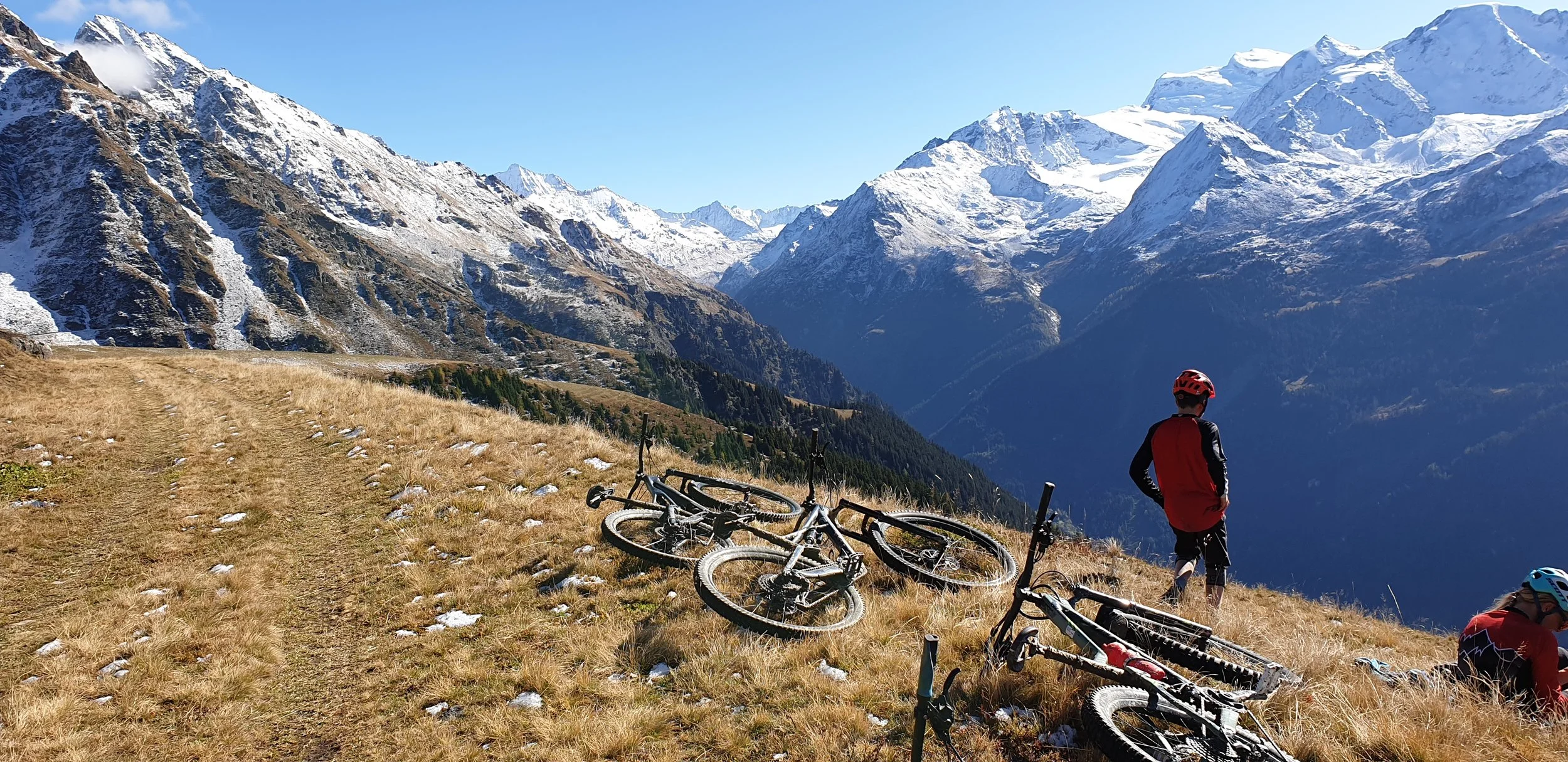
Verbier, Switzerland.
That holiday also spanned a visit to the UK, where the family discovered exhilarating mountain bike trails in Wales.
The advent of e-bikes has made cycling holidays available to a much wider range of travellers. The array of adventures on offer for young and old can be overwhelming, though, so it pays to match the experience to your ability and interests.
“It’s great to extend your comfort zone, but not to be uncomfortably outside it,” says Catherine. “Preferred destinations, activities and ability levels can all help narrow down the choices, whether the aim is a gentle ride through countryside or a more demanding mountain adventure.”
Europe remains popular with active travellers, with the attraction of countries like Slovenia and Scandinavia increasing. Equally, there are amazing experiences to be had in Asia, from trekking in Nepal to golfing in Vietnam, as well as in Canada and South America, with skiing in British Columbia and hiking in Peru among the possibilities.

Denali Park, Alaska.
BEST OF BOTH WORLDS
Of course, some quality R&R can go hand in hand with all that. In cruising and cycling Croatia, you enjoy life on board with wonderful coastal scenery, combined with stopovers to cycle inland. Not to mention the cool swims when you arrive back sweltering.
Taking a barge through the French or Netherlands canals with bikes on board is another brilliant combination. This style of holiday could appeal to couples, families or friend groups in which some are more sporty than others. Likewise, motorhome holidays, which are now available all over the globe.
Small-ship cruising is another active way to see the world – kayak among icebergs in the Arctic or Antarctica, or snorkel among turtles in Galapagos. Expeditions of all kinds are available to provide life-changing experiences in some of the world’s wildest places.

Seward, Alaska.
IN THE KNOW
Walking in Puglia is delightful in cool weather but decidedly not under the searing sun, yet although sweltering in Europe in mid-summer is a recurring theme these days, don’t let that put you off. Instead, consider the best seasons for maximising your active adventure, wherever you’re pointing your compass.
If ending each day fatigued yet fizzing is your idea of a perfect adventure, there’s a world of possibilities waiting to be explored.

TRAINING DAYS
Columnist Amanda Jeffs suggests we try giving the AI employee many of us have hired a decent job description.
Columnist Amanda Jeffs suggests we try giving the AI employee many of us have hired a decent job description.
PHOTO DEBORAH DE GRAAF
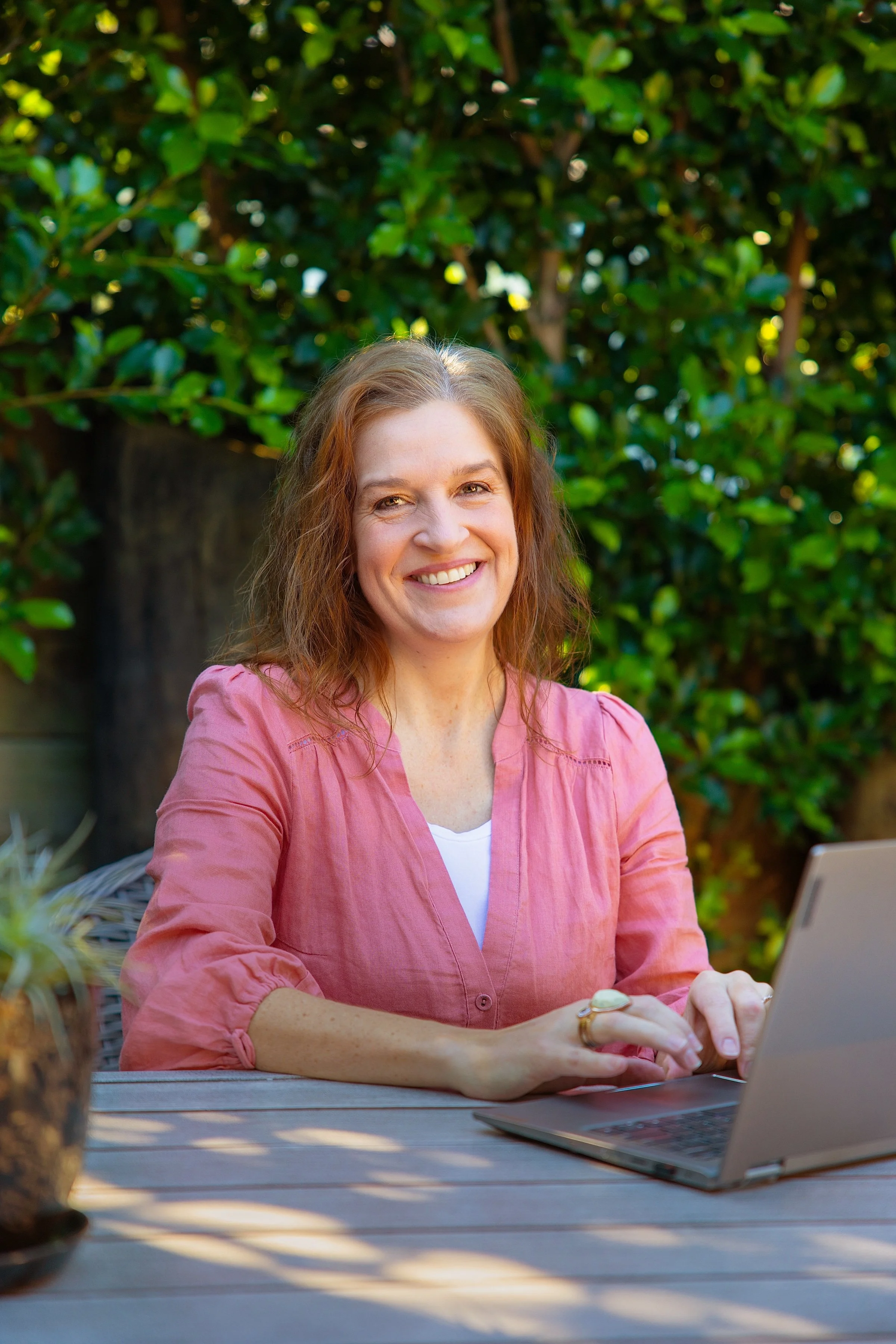
Imagine a consultant in the Mount. Let’s call her Kelly. She’s good at her job, and about six months ago, she signed up for one of the big AI tools, the way you’d sign up for a gym in January. She uses it every day now, but admits she’s not sure it’s changed her work life much. Its writing is generic, and fixing it takes as long as it would have to start from scratch.
The thing is, she hasn’t been let down by AI. She’s hired a new employee and never onboarded them. There’s no manual, no brief, no clear sense of the job.
I hear a version of this constantly. Clients ask me how AI can help them, and I ask what they do every day. Half the time, they can’t break it down. There aren’t any workflows or units of work, there isn’t a business plan or goals. You can’t train a new hire with zero structure.
That’s where I start with a lot of founders, before we add AI. I call it a leadership and clarity problem. You wouldn’t sit a new intern (let’s call her Chloe) at an empty desk, tell her to go for it and walk away. Chloe would just sit there, useless through no fault of her own. That’s most people’s experience of AI.
Here at home, more than eight in 10 businesses already use AI. Barely one in 10 has a written policy for it, and nearly one in five is using it without anybody in charge. That gap has nothing to do with budget or which tool they’ve picked. It comes down to whether anyone has bothered to explain, clearly, what they actually want.
You can’t manage what you can’t describe. If your business plan lives entirely in your head, good luck training Chloe or anyone else to do the job well.
Success also means drawing a line around what AI shouldn’t touch. In my own business, I have three simple categories: things I keep to myself, things I do alongside AI, and things I hand over completely. For example, AI will never send an email without me checking it first. Rules like that belong in an actual written policy.
Last year, New Zealand released Responsible AI Guidance alongside its national AI strategy, and the reassuring thing is that a workable policy can be one page, not a legal document. Used well, I think it’s the biggest advantage a business can have right now, but you have to learn how to do it properly first – then you’ll understand what the fuss is about.
Back at the café, Kelly doesn’t need a better tool. She needs to sit Chloe down, tell her what her job actually is, and see what happens next.
Amanda Jeffs is the founder of SHE IS AI, a platform that helps women lead the conversation on AI. Her human- readiness arm, SHE IS SOL, launches on October 1.

DREAM SCENARIO
Built by Buildlab, this extraordinary Mount Maunganui home showcases meticulous craftsmanship and breathtaking views.
Built by Buildlab, this extraordinary Mount Maunganui home showcases meticulous craftsmanship and breathtaking views.
WORDS PIP CROMBIE | PHOTOS AMANDA AITKEN
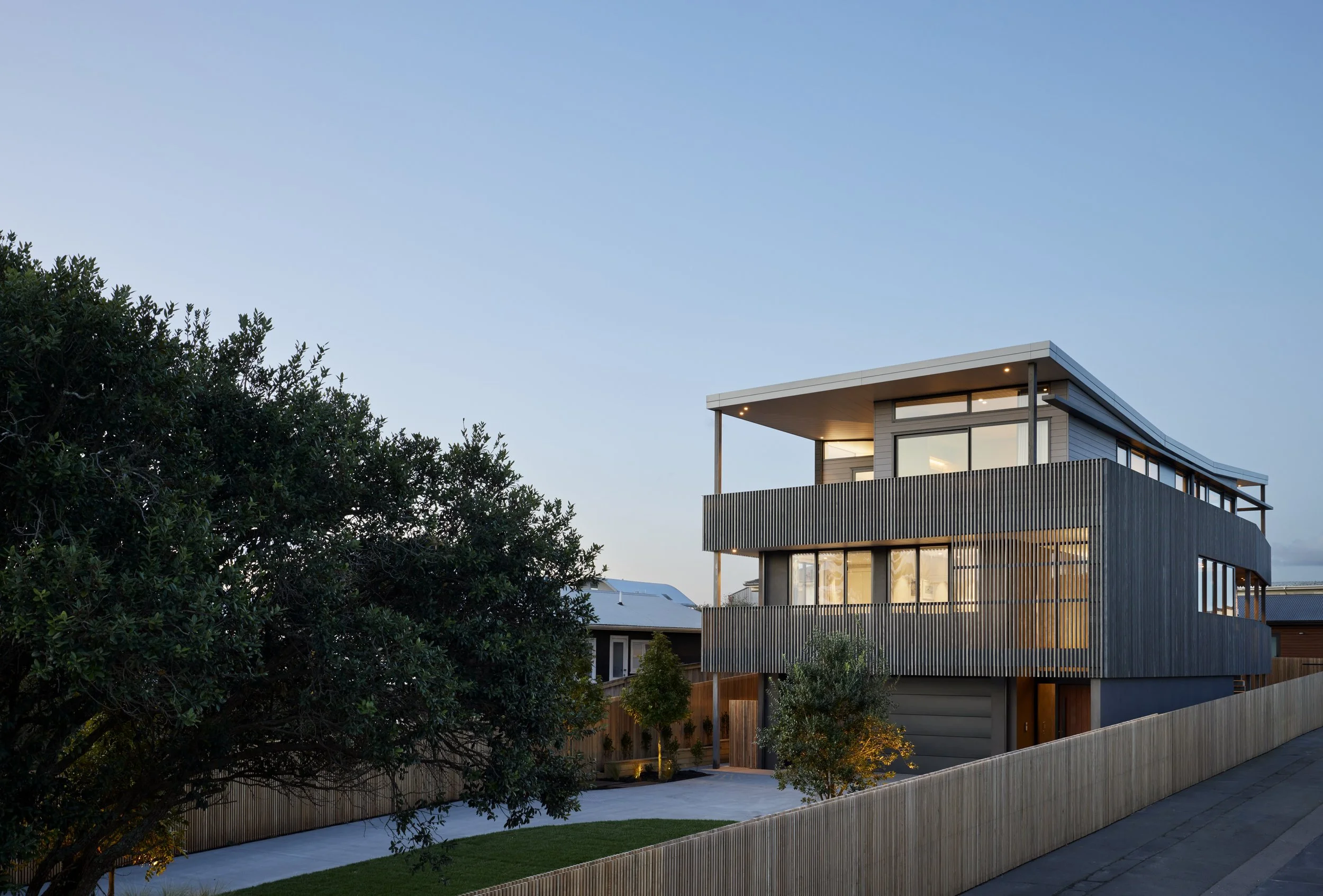
While Mount Maunganui’s new builds are usually impressive, this one in particular is an absolute standout.
The sequence of spaces – contracted walkways opening dramatically onto large interior living areas and outdoor decks – creates a continual sense of surprise as you move through the three-storey home. The original house demonstrated the potential of the site, but the new design takes much greater advantage of its position.
Every transition has been carefully considered to maximise the treescape of the adjacent Mount Golf Club, with eastern and northerly views towards the ocean and Mauao beyond. The roofline reaches the most recent approved height requirements, and soars like a huge wingspan across the entire build.
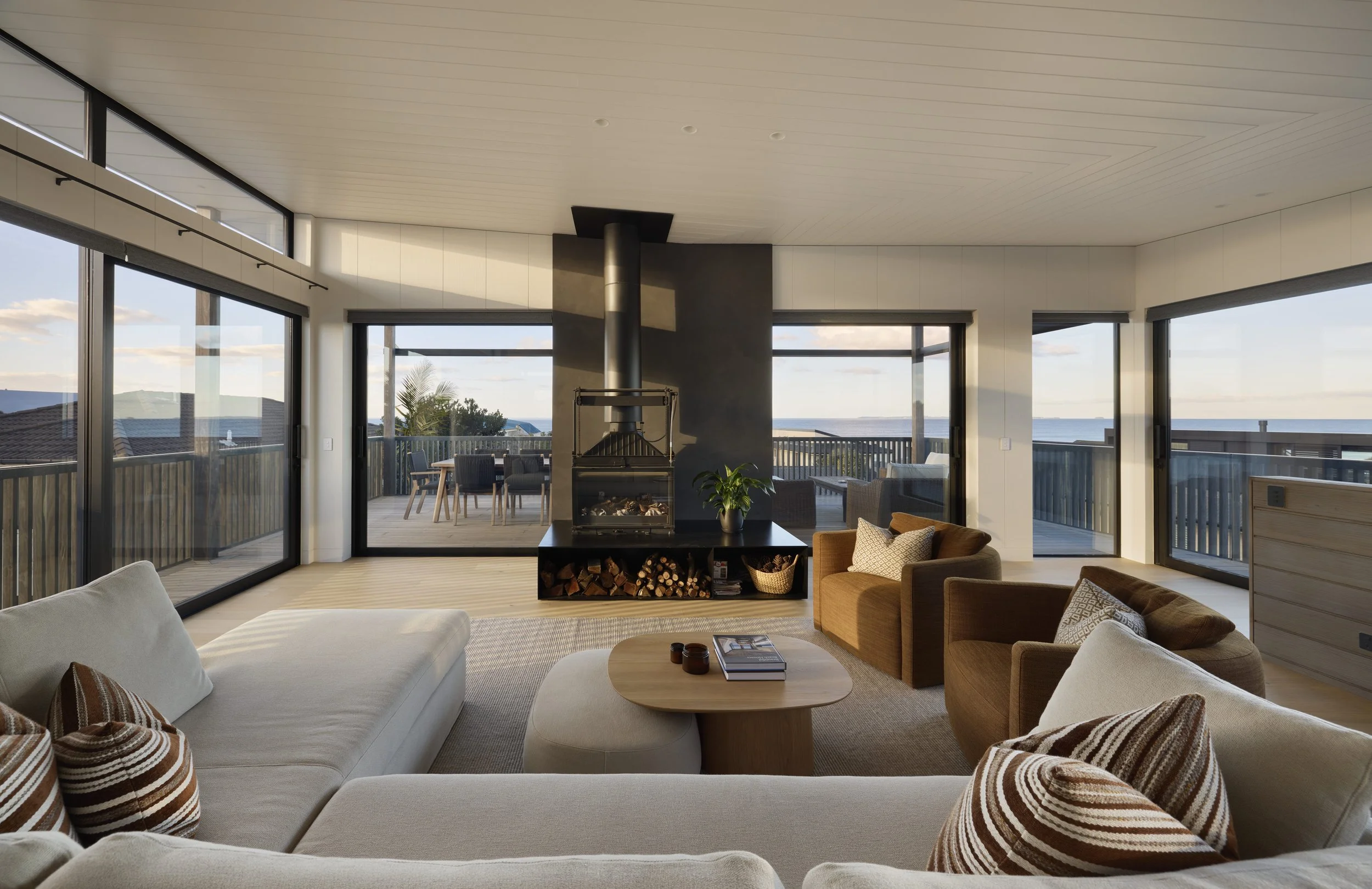
This is clearly a dream home for both the owners and builder Matt Frost, owner of local high-end building company Buildlab.
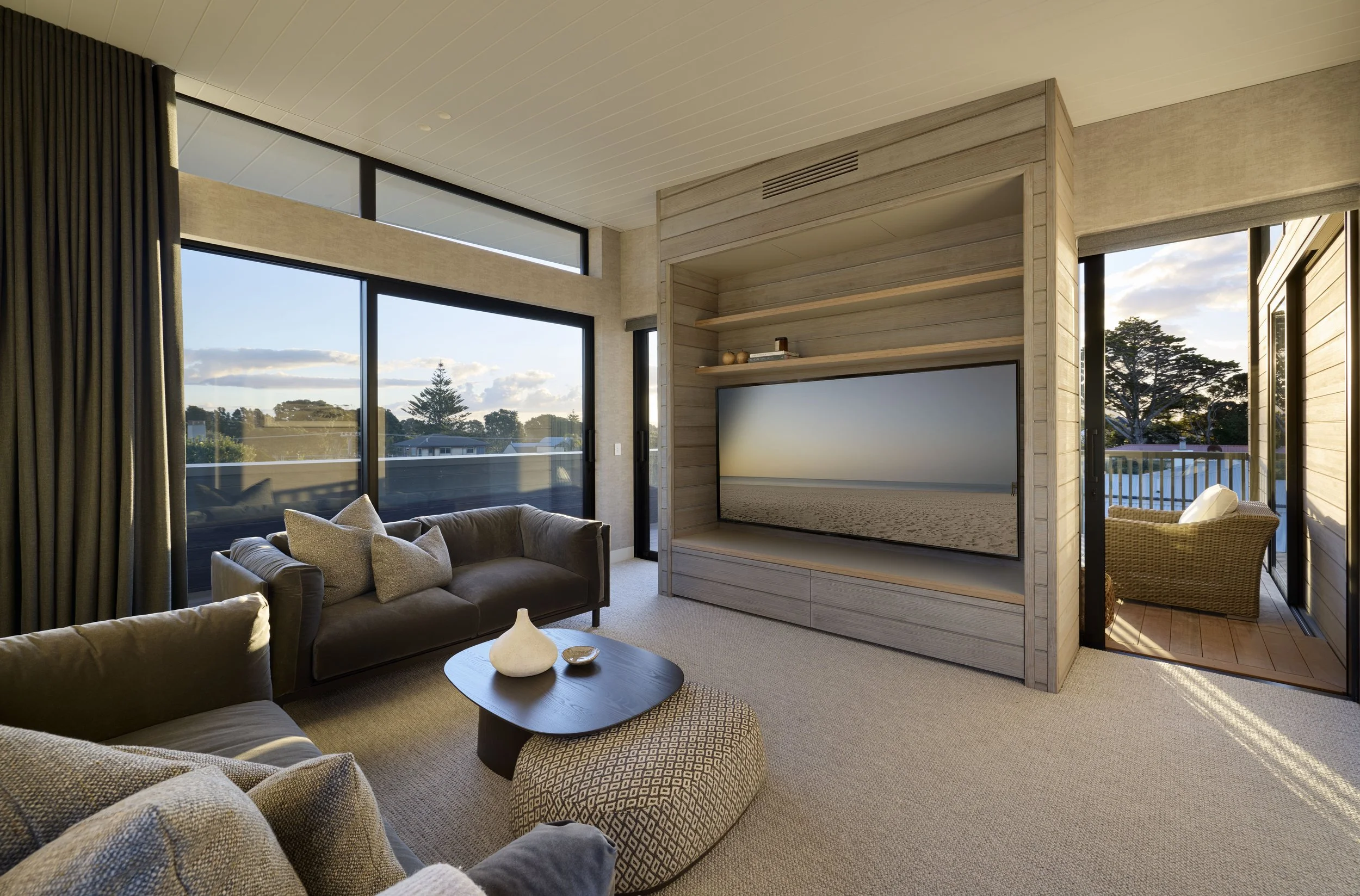
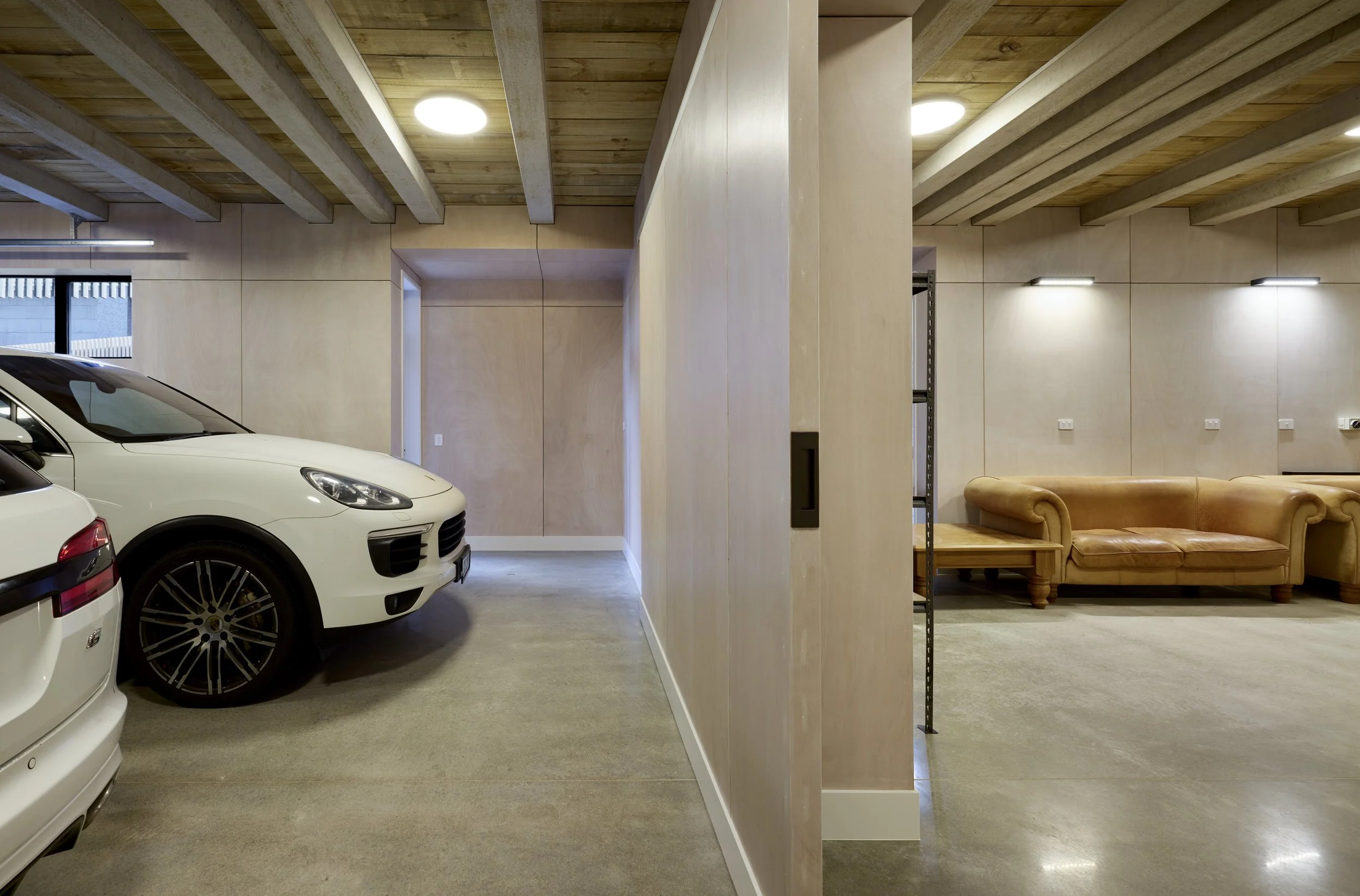
“This is one of the largest house builds my company has completed,” Matt tells me. At around 450m2, it includes three bedrooms, a secluded media room, a kitchen and scullery that speak to easy entertaining, and an expansive, sun-filled dining/lounge area. An office nook with a view and an oversized window seat, plus a large garage with an extensive workshop complete the home.
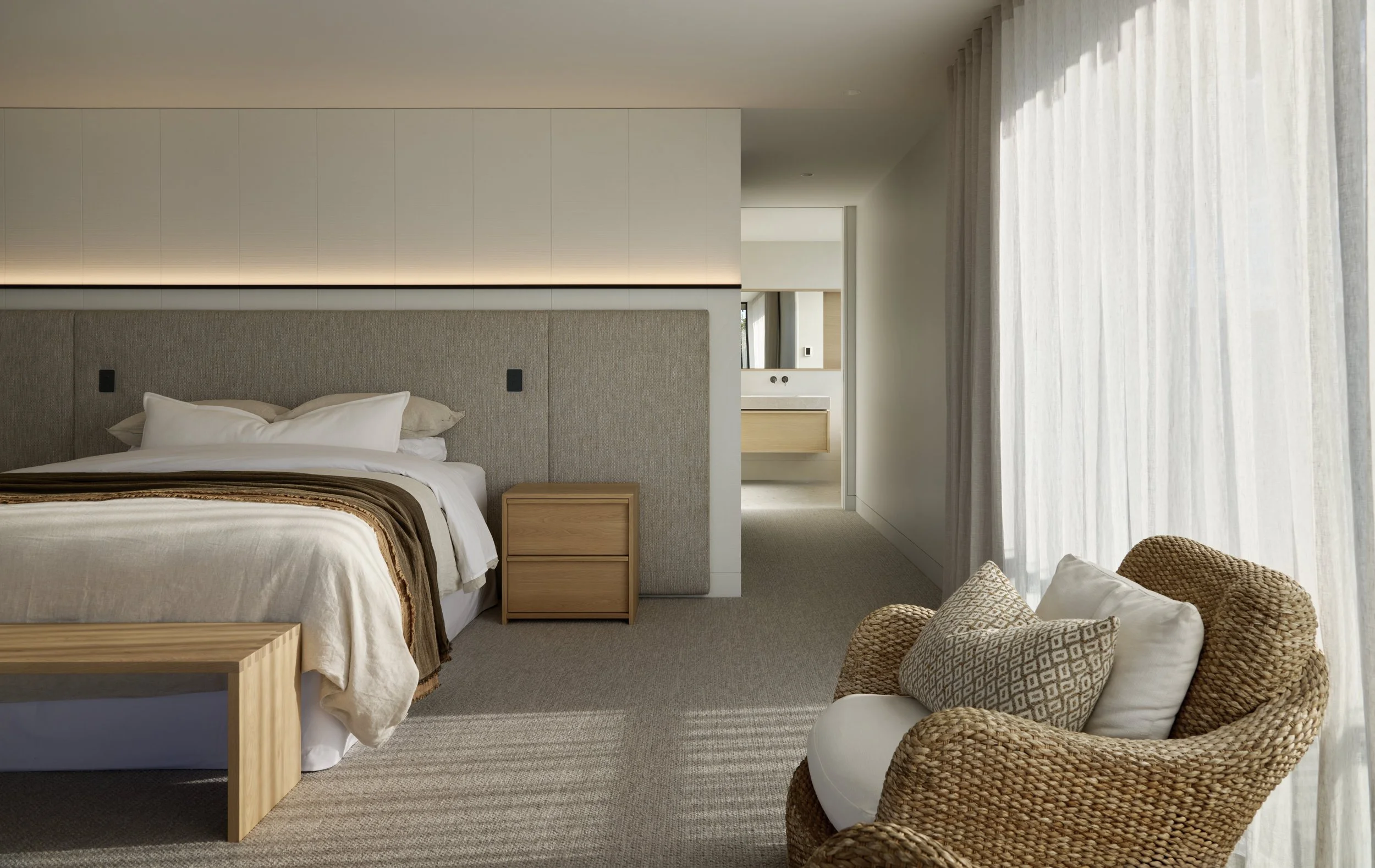
The exterior combines silver-grey Accoya cladding with crisp white Abodo Vulcan timber, creating a distinctive yet timeless façade. Floor-to-ceiling aluminium joinery strengthens the architectural lines, and custom-folded aluminium fascias with concealed fixings provide a seamless finish. Externally, a floating concrete staircase forms a sculptural focal point, complemented by handcrafted batten screens individually made and installed by the Buildlab team.
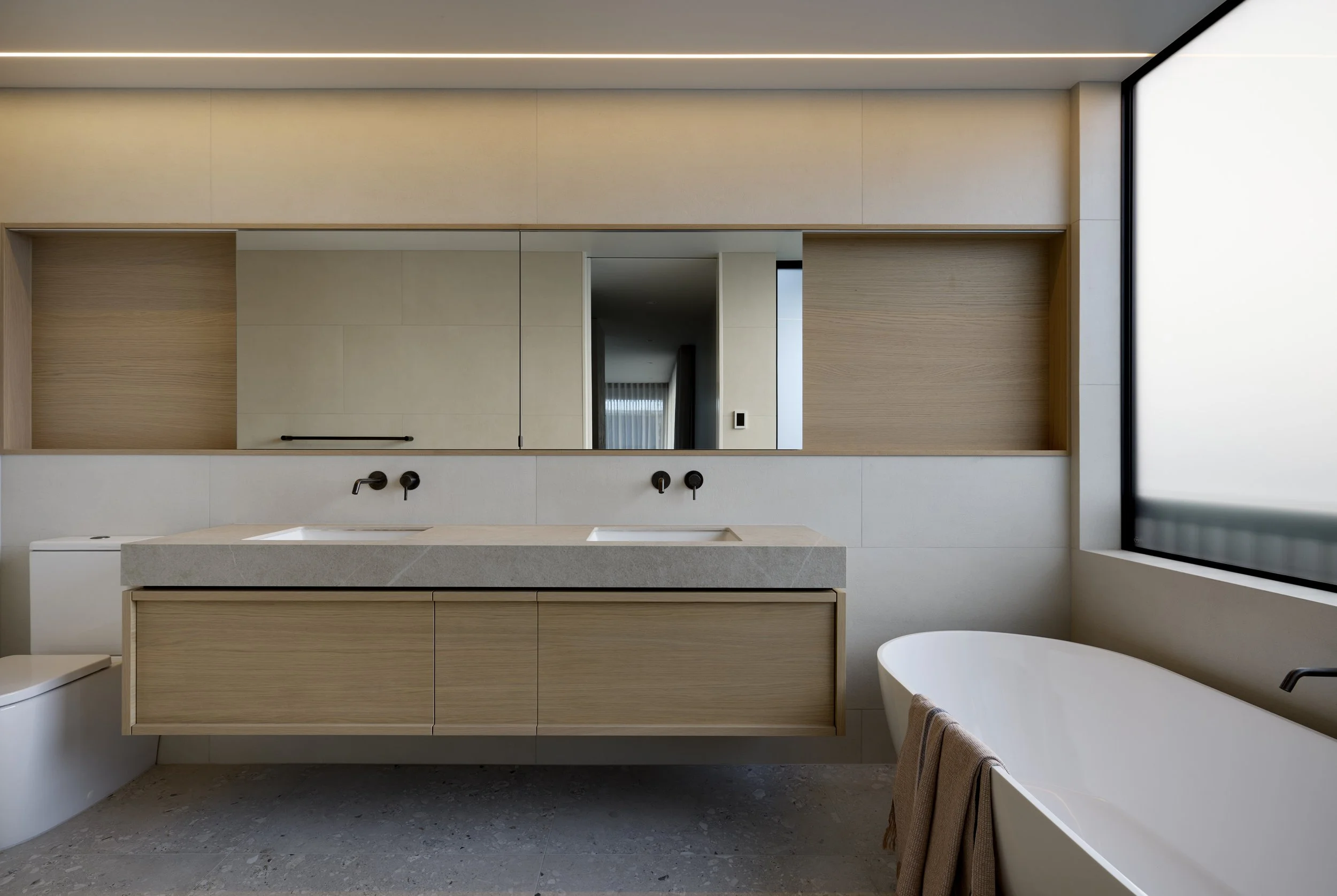
Inside, Abodo timber continues in the custom-crafted stair balustrade, lift walls and feature areas, creating a strong connection between the interior and exterior. Custom kitchen cabinetry is paired with travertine-finish benchtops, while plaster walls complement the exterior. Rough-sawn plywood linings feature every groove individually hand-routed, and tongue-and-groove raked ceilings follow the roofline.
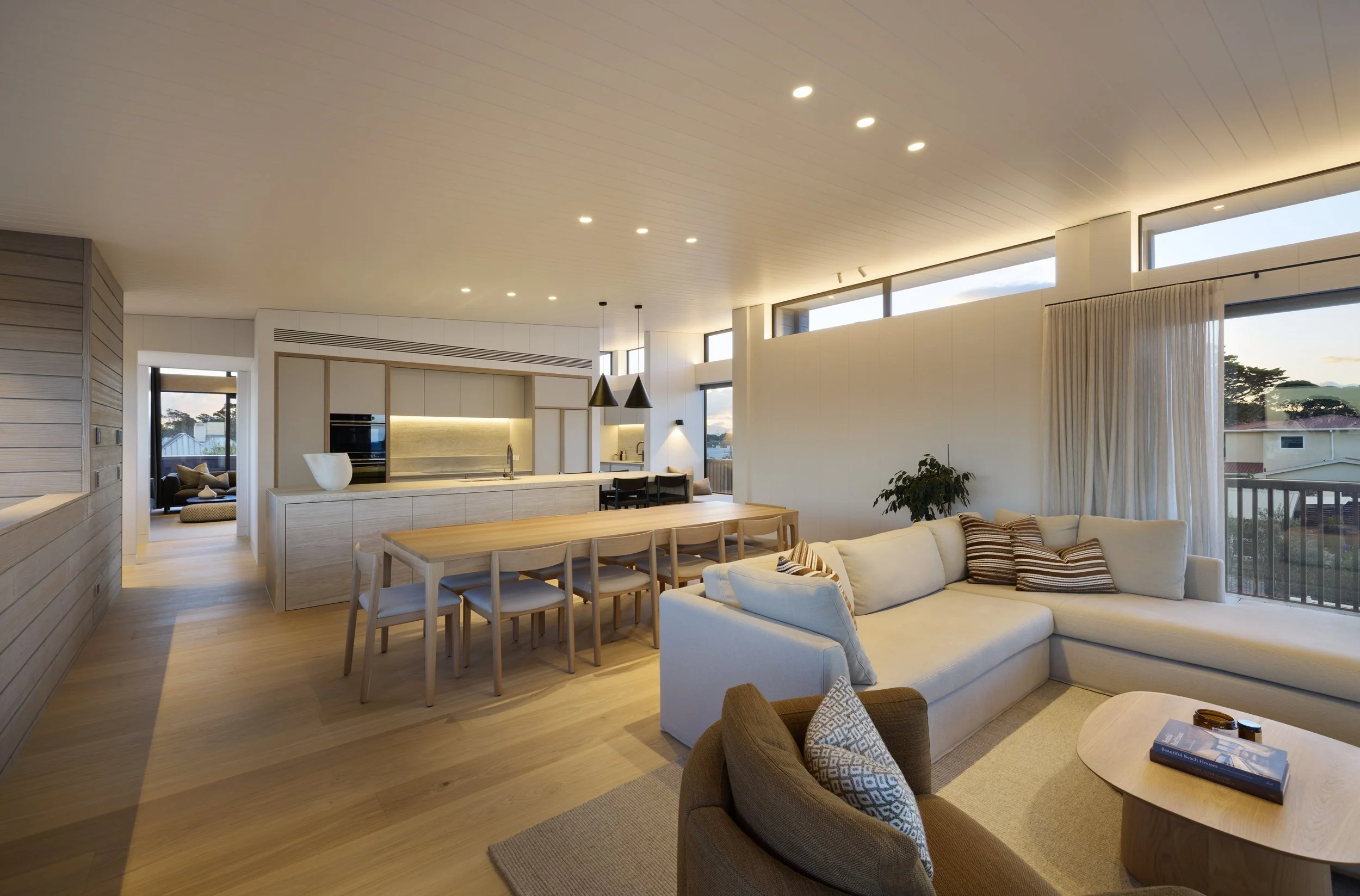
Full-height flush doors, recessed cavity sliders and custom negative details create clean, consistent shadow lines without conventional architraves. Negative-detailed plywood continues into the garage and workshop, ensuring the same visual is carried into these spaces. A thoughtful mix of polished concrete, engineered timber and carpet adds warmth, luxury, texture and practicality throughout.
Matt spent 10 years working with a previous employer, progressing from apprentice to project manager and eventually running around half of the business. He set up Buildlab five years ago, and the company has grown from three to a team of 16. Early on, Buildlab focused mainly on renovations, cementing its reputation and proving itself to clients, but has since moved to high- end, architecturally detailed homes that require exceptional craftsmanship and technical expertise.
“I’d worked with the owners of this build previously on a townhouse development. They’d considered renovating the current home, but it became obvious after several sets of renovation plans that it was never going to be what they really wanted. They finally settled on a new build and recruited Brendon Gordon Architects to design it. They asked Buildlab to price it up – we were stoked! I’ve worked with Brendon’s designs before and his attention to detail is amazing. His plans are precise and clear, and he works with the client and builder on every element, right down to colour. I knew working together would result in a seamless construction process with very little rework required.
“The construction was particularly complex,” Matt continues. “The house is built around a substantial structural steel frame – a ‘birdcage’. Timber framing was then craned onto site and hand-built within the structure. We reached the third level in approximately three months, an exceptionally fast pace that brought comments from neighbouring contractors about how quickly the project was progressing. The speed came from careful planning, efficient sequencing and our highly experienced team. I’m really proud of how it all came together.”
One unexpected challenge occurred when the owners sold their previous home several months earlier than originally planned and needed to move in. “I heard from them right before the Christmas break,” recalls Matt. “The end of March was the original deadline, so it was a bit of pressure. We pulled out all stops, and got the carpet in right before the owners moved in – and then we just worked around each other on the finishing touches.”
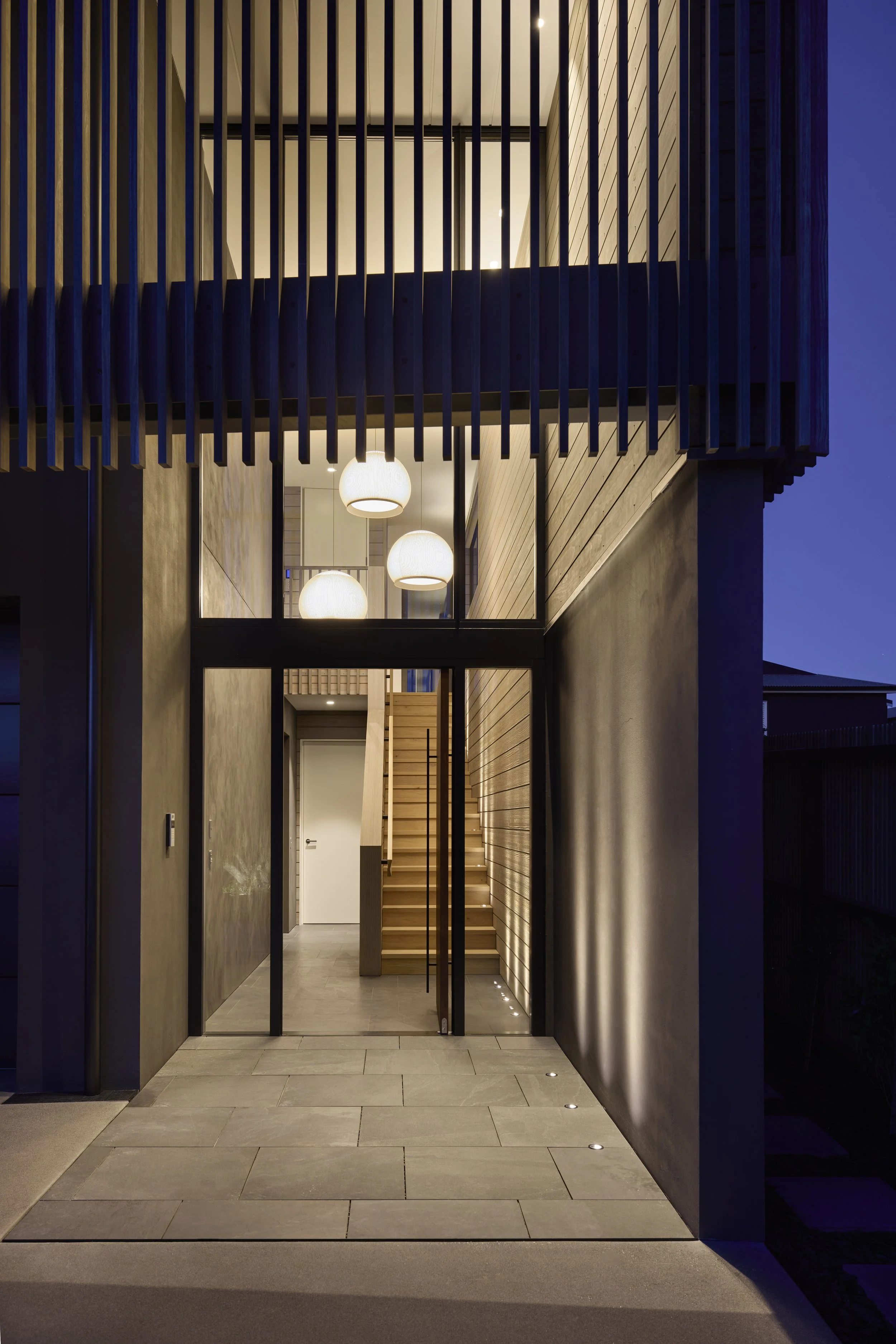
The success of the project relied heavily on planning. “A standard house requires thinking two steps ahead, whereas a project like this requires anticipating 10 or 15 stages in advance to ensure every hidden detail works perfectly as construction progresses. There were a lot of moving parts, but working closely with Brendon, then Jacqui from Twill Interiors, meant that the project evolved through strong teamwork, detailed documentation, excellent communication, and the genuine passion my staff and I have for solving difficult construction challenges.”
A defining feature was the clients’ desire for Buildlab to complete as much of the work in-house and minimise subcontracting. “This enabled us to take ownership of many elements we wouldn’t ordinarily do, such as specialist architectural detailing, custom screens, extensive timber work and feature finishes all made on site. It gave us greater control over quality and consistency, creating a home that showcases our workmanship”.
As I leave and look back, the orb lampshades over the stairwell glow like huge owl’s eyes seeing me on my way, waiting to guide the next person into this beautiful, liveable, ambient home.

NOW YOU SEE THEM
But many don’t, which is just the way the makers of the mounts propping up the displays at Tauranga Museum like it.
But many don’t, which is just the way the makers of the mounts propping up the displays at Tauranga Museum like it.
WORDS JO-MARIE BAKER / PHOTOS MICHAL PINKERTON + SUPPLIED
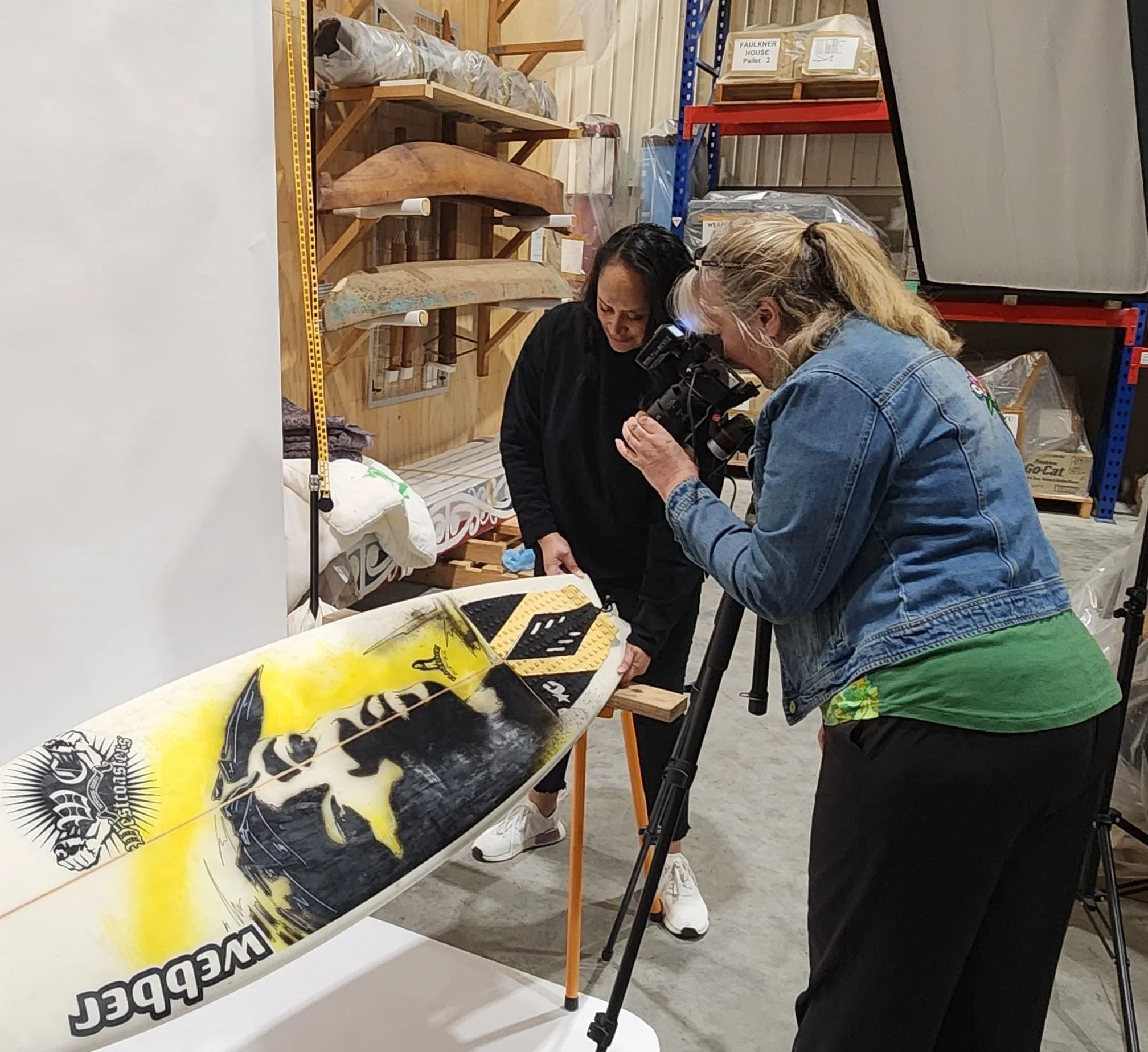
When Tauranga Museum opens in 2028, visitors will marvel at the taonga and objects on display. What they probably won’t notice are the hundreds of bespoke mounts that support them.
That’s exactly how specialist mount maker Den Feaver measures success. With more than 30 years’ experience creating mounts for New Zealand’s leading museums, Den, of Feaver Museum Service, is working with Tauranga Museum’s exhibition team to make custom supports for hundreds of objects destined for permanent display, while passing his specialist skills on to collection specialist Chelsea Tairi.
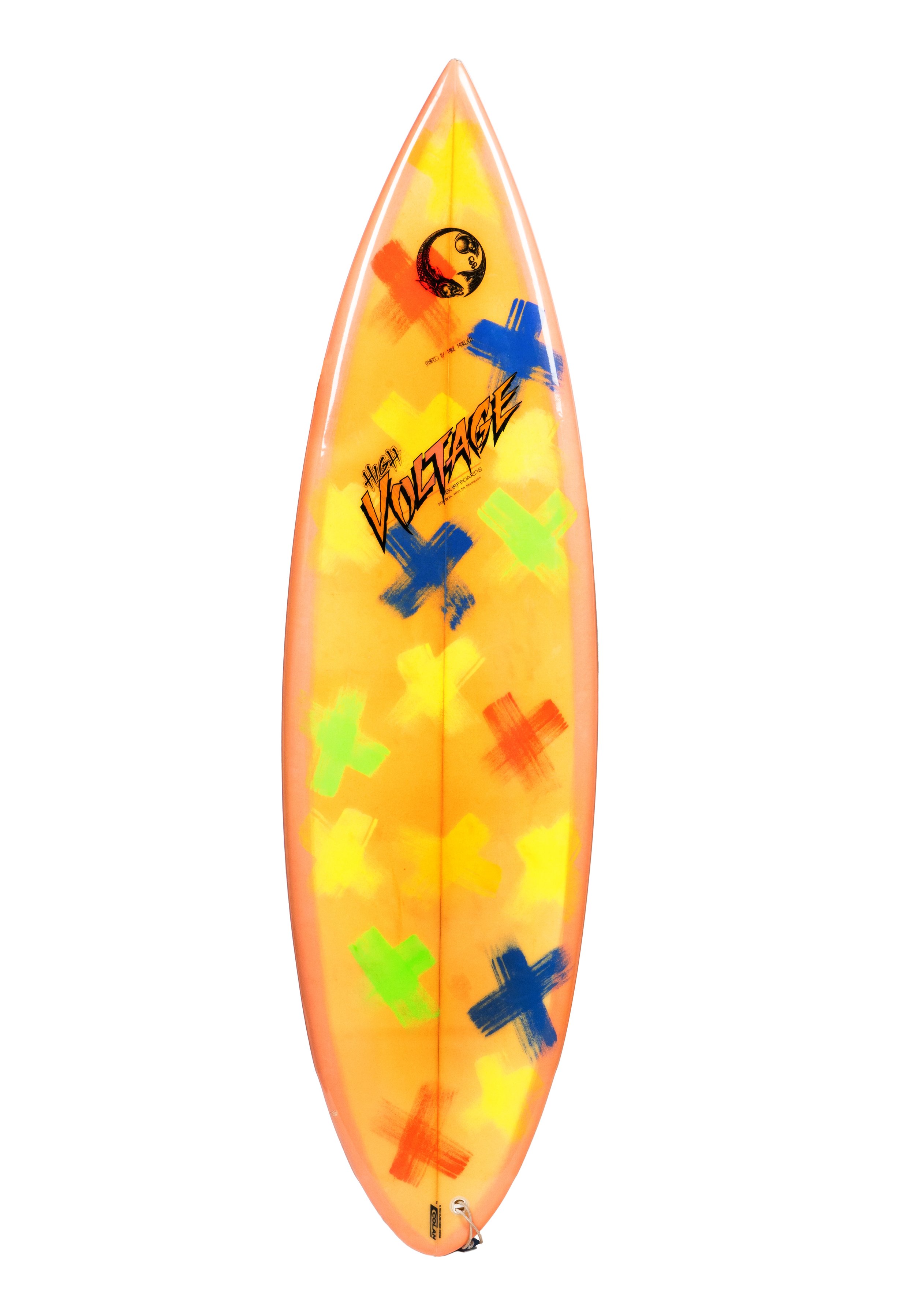
Objects range from tiny obsidian shards and shark-tooth fishhooks to historical surfboards and a 3.5m plaster cast of a broadbill swordfish. Mounts for displaying them are typically crafted from stainless steel into bespoke brackets or armatures designed to hold objects securely while disappearing into the background.
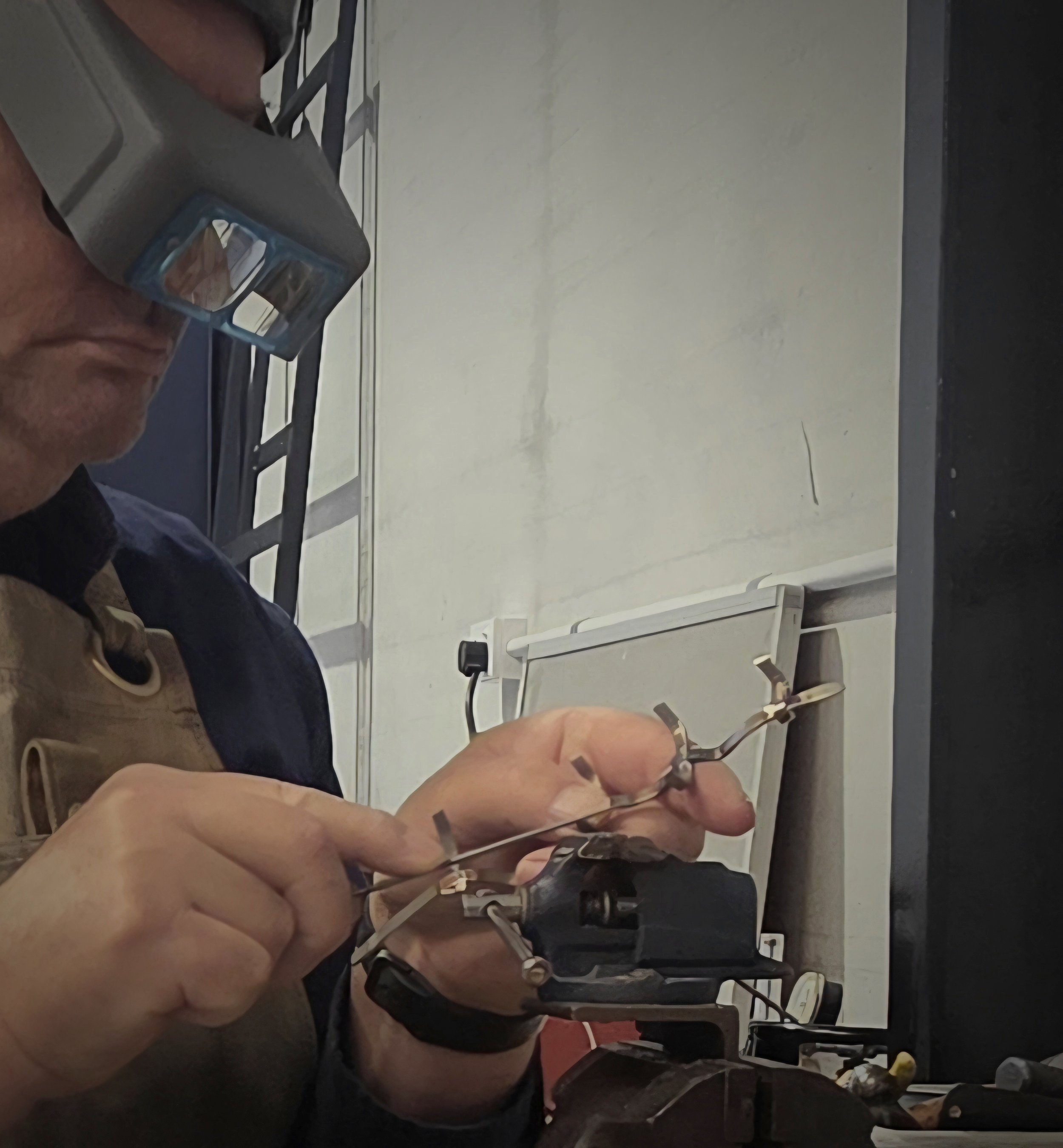
Den’s mount-making career began almost by chance. While photographing a ceramics collection in New Plymouth, he stopped to help an artist install another exhibition and was subsequently offered a technician’s role.
Den says good mount makers need fine motor skills, attention to detail and, above all, empathy for the objects they’re handling. “A good mount is the mount you don’t see, one that keeps the object safe and puts it in a positive light. And if you do see it, it needs to accentuate the environment, rather than detract from it.”
Whether he’s handling a plastic cup from the 1970s or an irreplaceable taonga, Den says every object deserves exactly the same care and respect.
Over the coming months, Den and Chelsea will work side by side to create hundreds of bespoke mounts. She’s looking forward to picking up skills as the project progresses.
“It’s a once in a lifetime opportunity,” she says. “Sharing the responsibility of mounting the taonga and objects that will be on display in our new museum is very exciting, and I’m lucky to be part of that. I’m really excited to soak up everything I possibly can from Dennis.”
After 15 years working in museums, Chelsea says she’s become fascinated by the craft of mount making. The unsung heroes of the permanent displays being developed for Tauranga Museum will prop up taonga Māori, social history and contemporary objects, all carefully curated to tell fascinating stories of our region’s past and present.
LETSTALK.TAURANGA.GOVT.NZ/PROJECTS/ TAURANGA-MUSEUM

COME TO YOUR SENSES
Books are only part of the story at Tauranga’s brand new library and community hub.
Books are only part of the story at Tauranga’s brand new library and community hub.
WORDS HAYLEY BARNETT
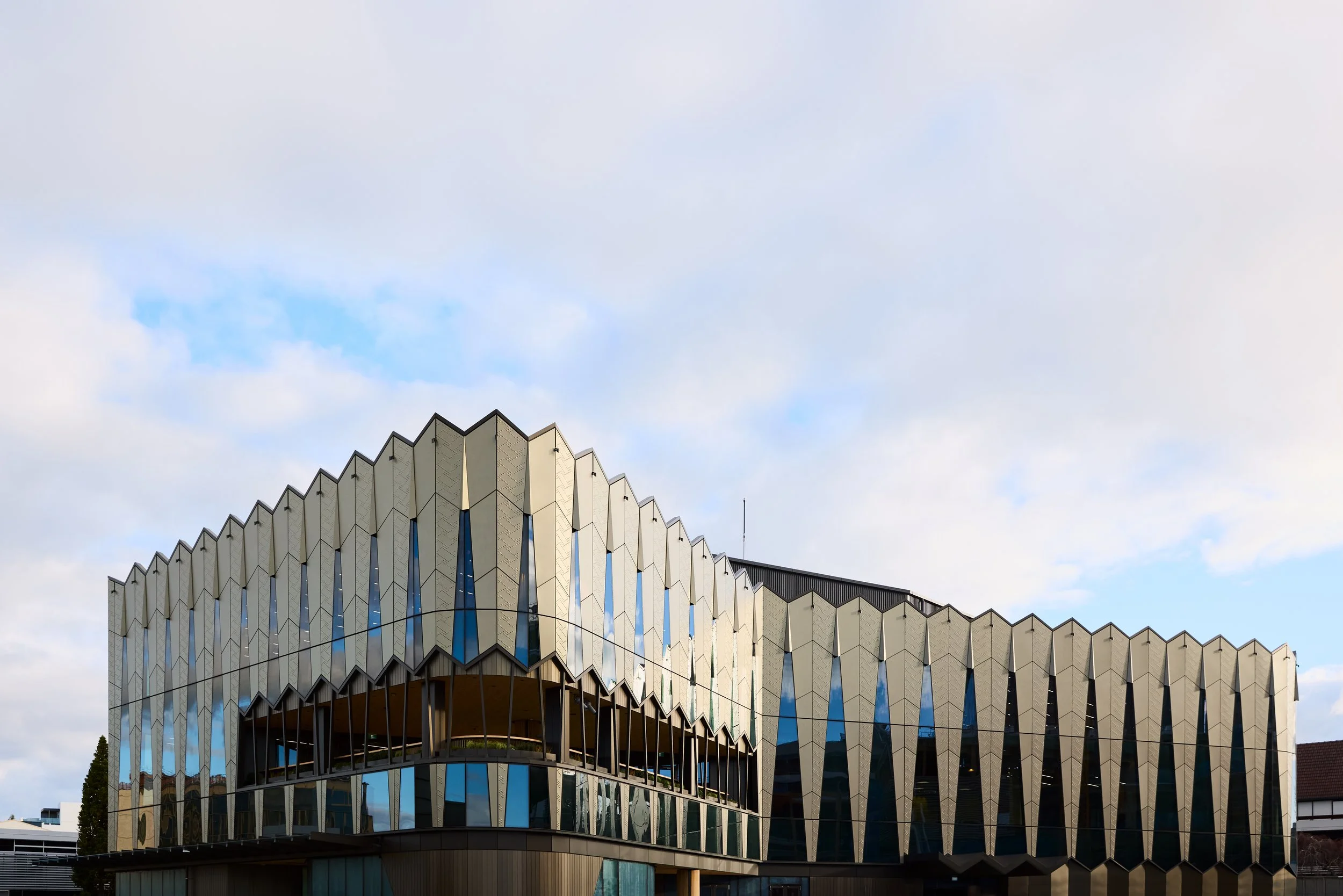
He Puna Manawa, Tauranga Library and Community Hub.
As the highly anticipated new Tauranga Library and Community Hub gets set to open its doors on October 16, it’s not just book lovers who have something to look forward to.
“For people who maybe reading books isn’t their thing, these other experiences mean everybody’s included,” says Joanna Thomas, Tauranga City Council’s manager of Libraries and Community Hubs. “It’s a place that every family can go and have an outing and create a memory.”
One of those other experiences sits on the first floor, the same floor as the children’s and youth spaces, where things get loud. It’s a soundproofed sensory room with blackout blinds and a wall built for projecting colour across it. When you turn everything up, it hums with lights, texture, vibration and sound. Turn it down and it goes almost silent.
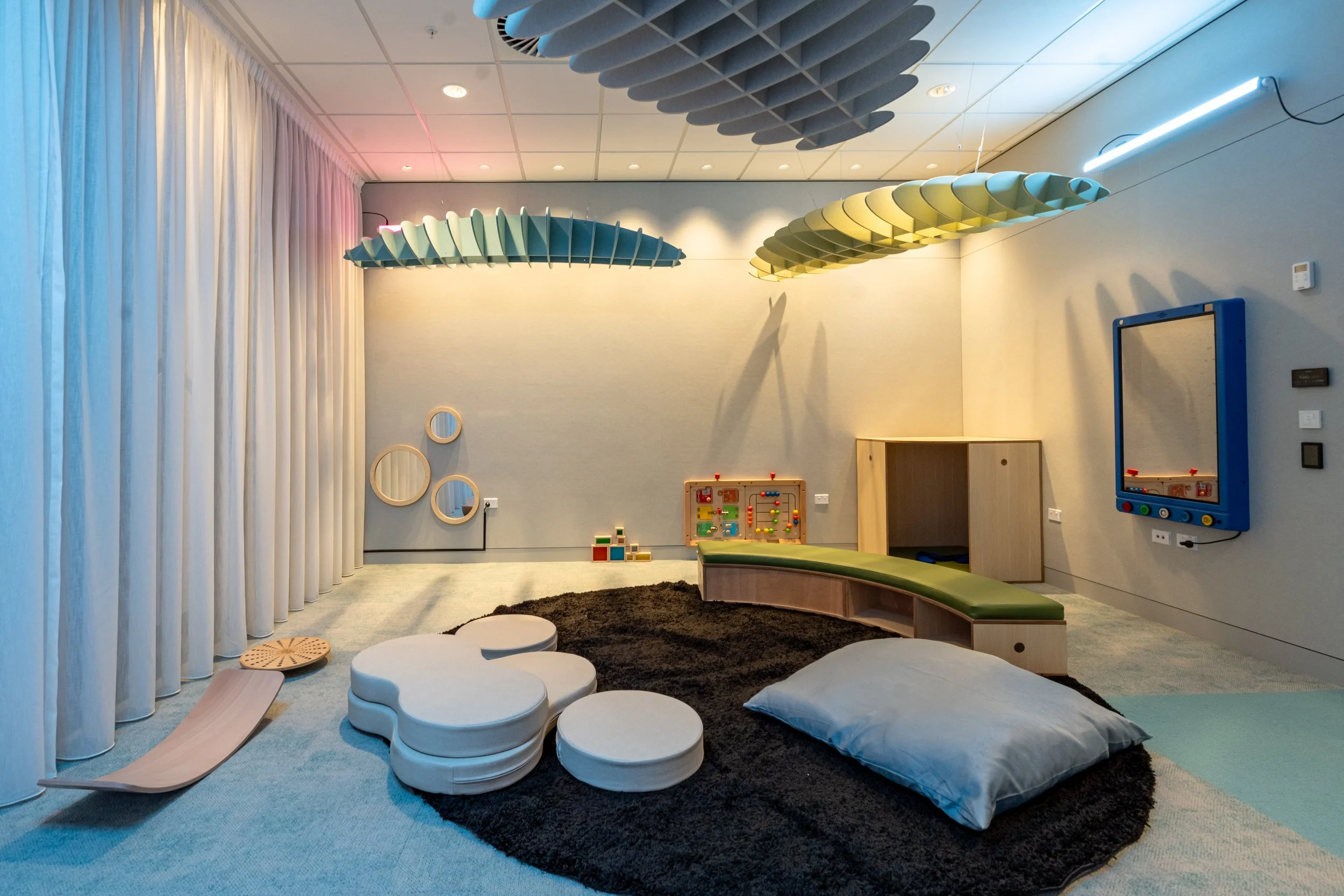
The sensory room.
Joanna says the idea goes back to 2017, when the Council first consulted the community on what a library and museum in the city centre should look like. Families were already asking for something like this. They wanted somewhere neurodivergent kids and adults could go that wasn’t a school or a hospital.
“There wasn’t anything like that that was open to the public,” says Joanna.
One of the people who pushed hardest for it was Joanna’s colleague Michelle Anderson. “She’s been a great inspiration for all of the development,” says Joanna.
The council ran workshops with stakeholders, including Tauranga Special School, CCS and Parent to Parent, to work out what the room needed to do.
“Parents and caregivers who book the room will have exclusive use of the space to meet their children’s needs,” says Joanna. “They’re not out in an open space where it can be quite distracting.”
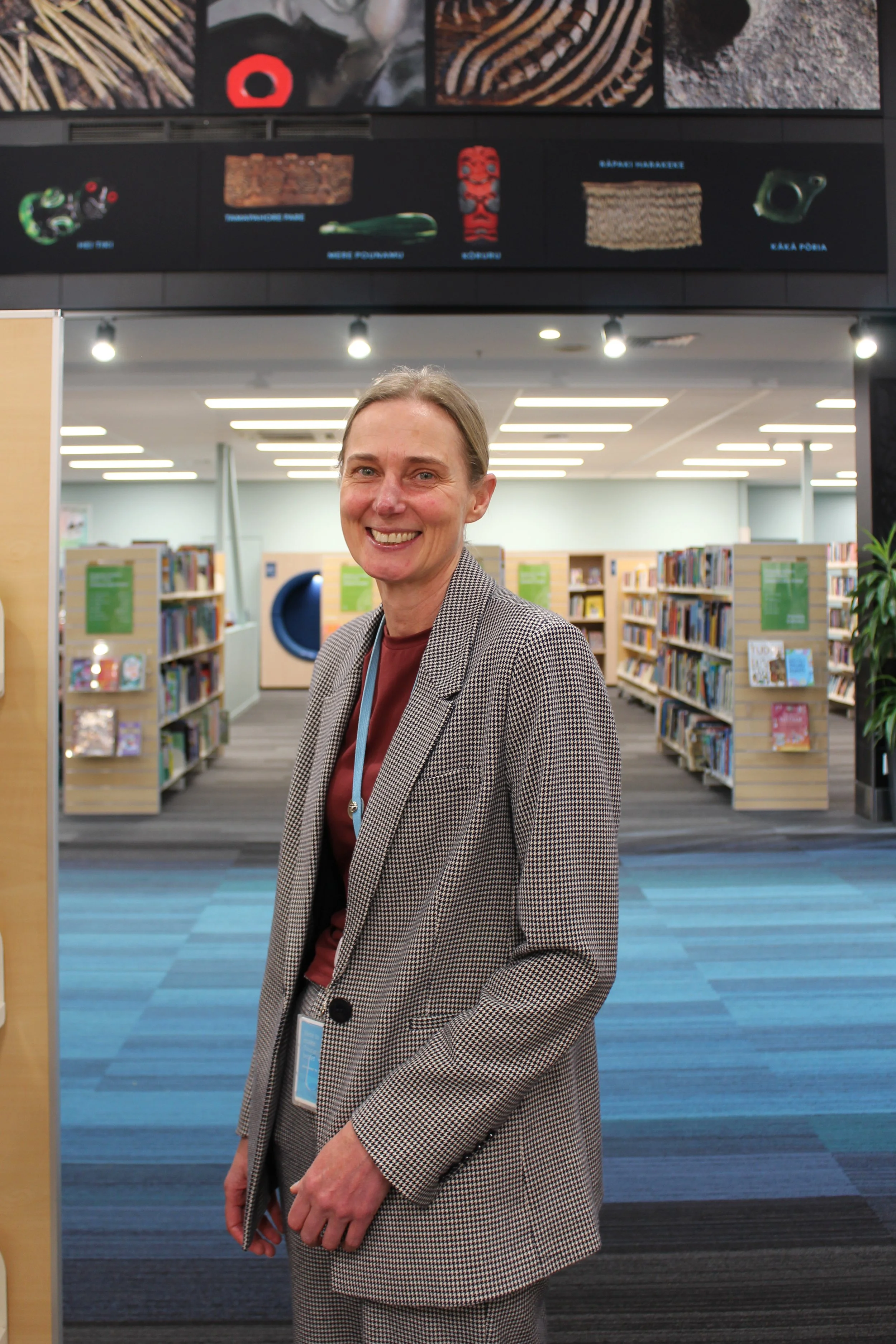
Joanna Thomas.
Adults with disabilities and their caregivers have the same option. The library runs sensory storytimes too, creating a safe welcoming environment where kids can explore stories at their own pace.
Funded fully by Lottery Grants, the room will be free and booked in advance, and a short induction will be included so everyone knows how to use the equipment safely.
He Puna Manawa, the new Tauranga Library and Community Hub, will open with a dawn blessing, followed by a community celebration day on October 17, with open sessions for the sensory room and tours through the rest of the building.
The sensory space is small, just 5.3 by 6.5m2, but it’s doing what Joanna set out for the whole building to do. “Not everyone who comes through the door is just here for the books,” she says. “Now there’s somewhere for them too.”

RACE TO THE TOP
How a Mount Maunganui coach built an unlikely speed-climbing programme that’s producing world champions.
How a Mount Maunganui coach built an unlikely speed-climbing programme that’s producing world champions.
WORDS JO-MARIE BAKER / PHOTOS KATIE COX + JAN VIRT
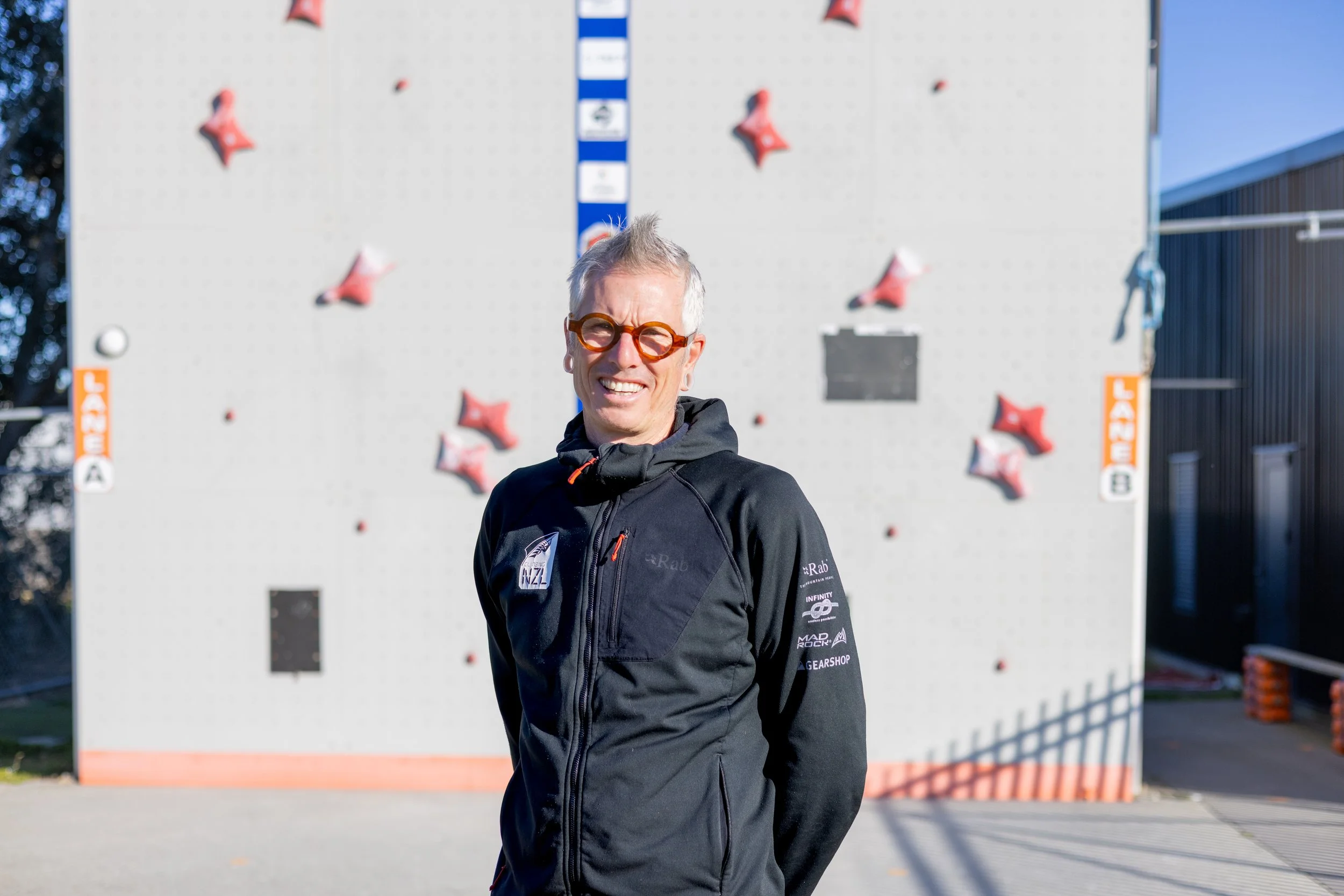
At 12 years old, Mila Piatek could barely reach the starting hold. The former gymnast stretched as high as she could, her fingertips straining for the grip that marked the beginning of the Olympic speed climbing route. She was so small it took more than a month just to master the first move. There were no shortcuts. She climbed, she fell, and she climbed again.
Three years later, teenage Mila raced 15m up a wall in 7.77 seconds to stand on top of the podium at the World Climbing Youth Championship in Italy, becoming an Under-17 world champion and Oceania record holder.
Her journey to become the world’s best is remarkable in its own right, but perhaps the more extraordinary story is how Mount Maunganui has built the speed- climbing programme that made it possible.
Rob Moore saw potential in Mila long before any medals arrived. The vastly experienced coach looks for athletes with either strength or elasticity (what he calls “power and pop”) that can translate into explosive speed on the wall.
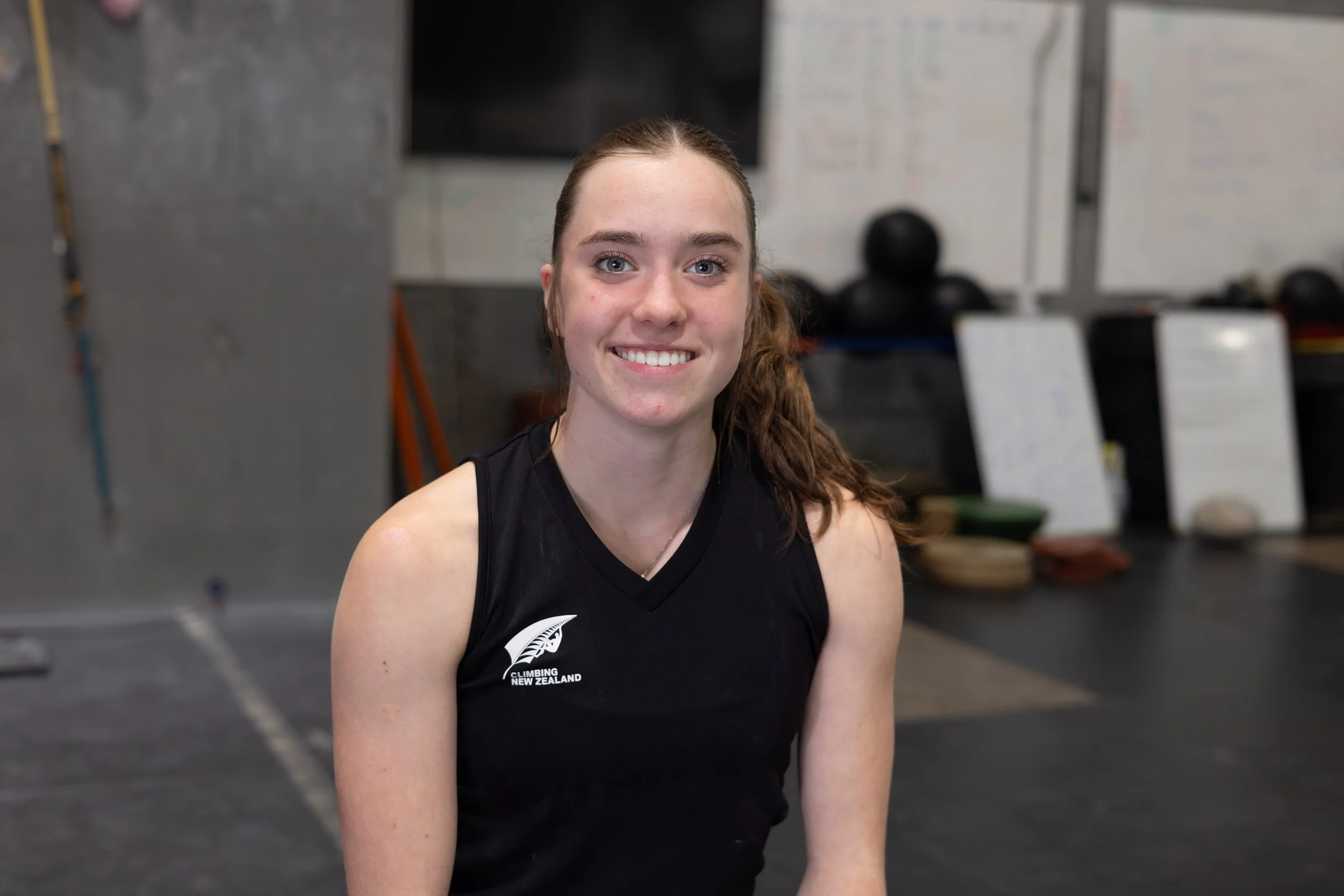
“One of the things that was really obvious about Mila right from the start is she had an incredible amount of pop. She bounces between the holds like Tigger.”
Rob’s competitive streak runs deep. He has competed internationally in speed skating, climbing and mountain biking, and his fascination with chasing records can be traced all the way back to his childhood.
“Every Christmas holiday, the first thing Dad and I would do was find the biggest hill nearby and find out what the record was to get to the top. Then we’d spend our entire holiday training to break that record.”
The instinct to find a benchmark, then figure out how to beat it would eventually underpin an audacious experiment here in the Bay. Could New Zealand produce speed climbers capable of taking on the world?
Rob’s ambitions stretched well beyond winning at home.
“You can achieve success within the New Zealand climbing community, and some people think it’s okay to stop there, but to me, that was never enough. Why don’t we strive further and try to be the best in the world?”
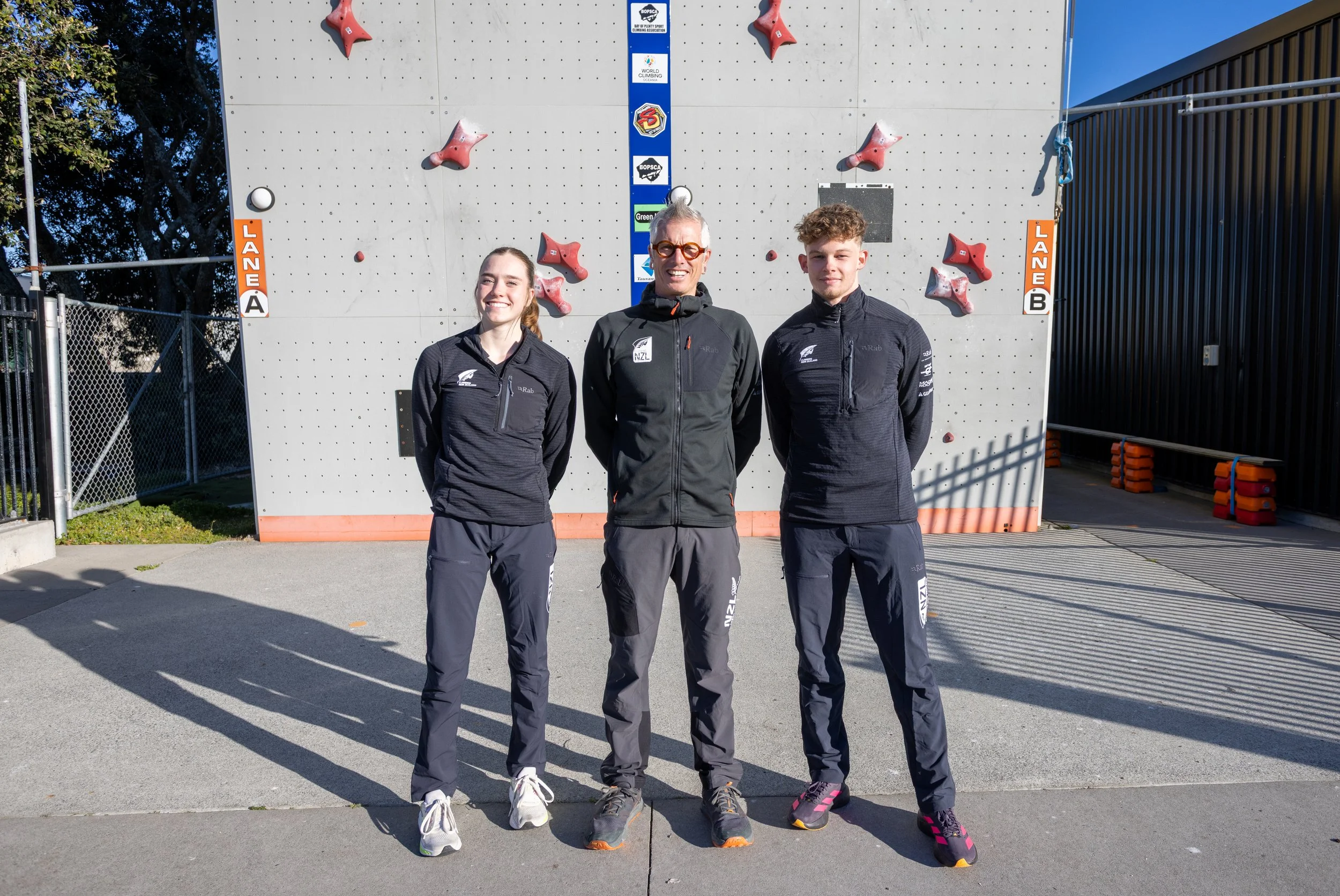
Rob opened Mount Maunganui’s Rocktopia climbing gym in 1999 and has coached the New Zealand climbing team since 2001. His focus on the competitive side of the sport sharpened after he began coaching a tenacious Sarah Tetzlaff towards the 2018 Youth Olympics in Buenos Aires. But there was one glaring problem – New Zealand didn’t have the right facilities. Training for the speed discipline meant travelling as far as New Caledonia.
Rob decided to fix that. Through the Bay of Plenty Sport Climbing Association (BOPSCA), funding and local support were secured, and in 2019, New Zealand’s only Olympic-sized speed wall opened at Blake Park – an exact replica of the standardised route used in competitions around the world.
In 2022, Rob launched a dedicated, high performance speed-climbing programme from scratch and made a controversial call: athletes who joined would have to specialise exclusively in speed, giving up the traditional Boulder and Lead disciplines.
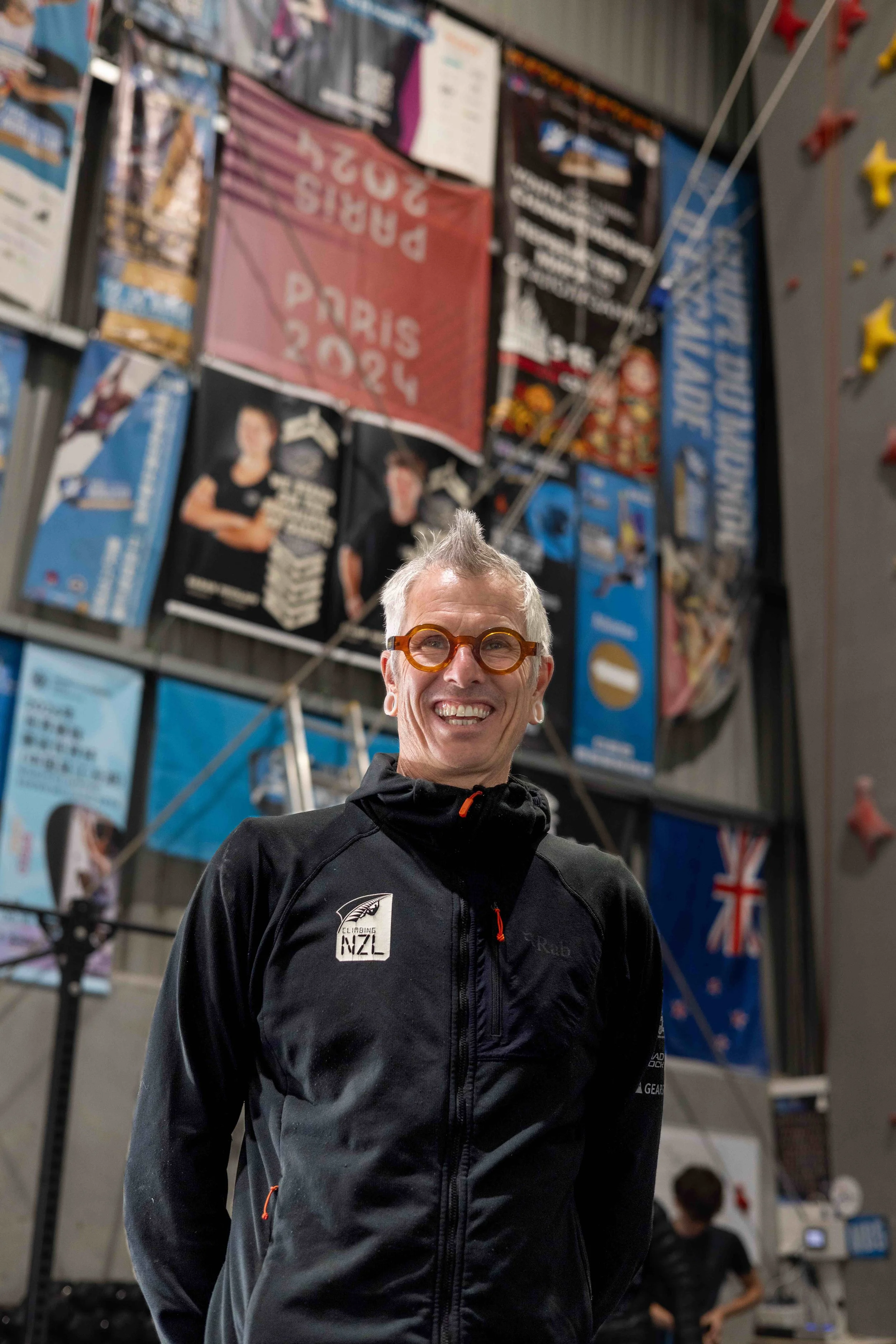
Six signed up. Among them was Tauranga teenager Julian David, who would later go on to win a Youth World Championship and compete alongside Sarah at the 2024 Paris Olympics.
“This shouldn’t have worked at all, when you look at it from the outside,” says Julian. “Not knowing how it was going to go was crazy, to be honest, but Rob’s drive, determination and passion for climbing is incredible.”
Julian’s journey began as a student at Tauranga Intermediate School. He loved climbing trees, and when he inevitably fell out of one, a teacher offered some practical advice: “We’ve got a climbing wall in the gym. Go climb that instead.”
He did. Aged 12 and with no formal training, Julian entered the AIMS Games and came third. The result caught Rob’s eye.
Once he joined the speed programme, Julian’s rise was rapid. He secured New Zealand’s first Youth World Championship title in 2023 and the Paris Olympics suddenly became a realistic goal for the French-born athlete. A year later, aged 19, he finished eighth in Paris with a personal best of 5.20 seconds.

“I was like everyone’s younger brother in the Olympic village. I love sport, so walking past world champions and people I watched on TV growing up was just surreal.”
Coming home proved harder. After years of setting personal bests almost every time he competed, Julian spent much of 2025 struggling to improve and grappling with the post-Olympic blues. He worked closely with High Performance Sport New Zealand and psychologists to strengthen his mental game and return to form.
At this level, progress is measured in tiny increments. “0.1 of a second for me now would be a huge personal best,” says Julian. “That would mean making finals consistently and being up there with the best in the world.”
Getting his mindset right is just as important as the physical preparation. “The margin of error when you’re racing up a 15m wall in five seconds becomes smaller and smaller the faster you go. Not making mistakes is super crucial, but really easy to do. Mindset is a huge part of it.”
For Julian, that means using familiar rituals, routines, music and visualisation techniques to shut down any nerves and let instinct take over.
“The ideal mental state is when you don’t remember what happens or what’s going on. It’s too fast to comprehend anyway. It should just happen. But getting into that state is what’s difficult.”
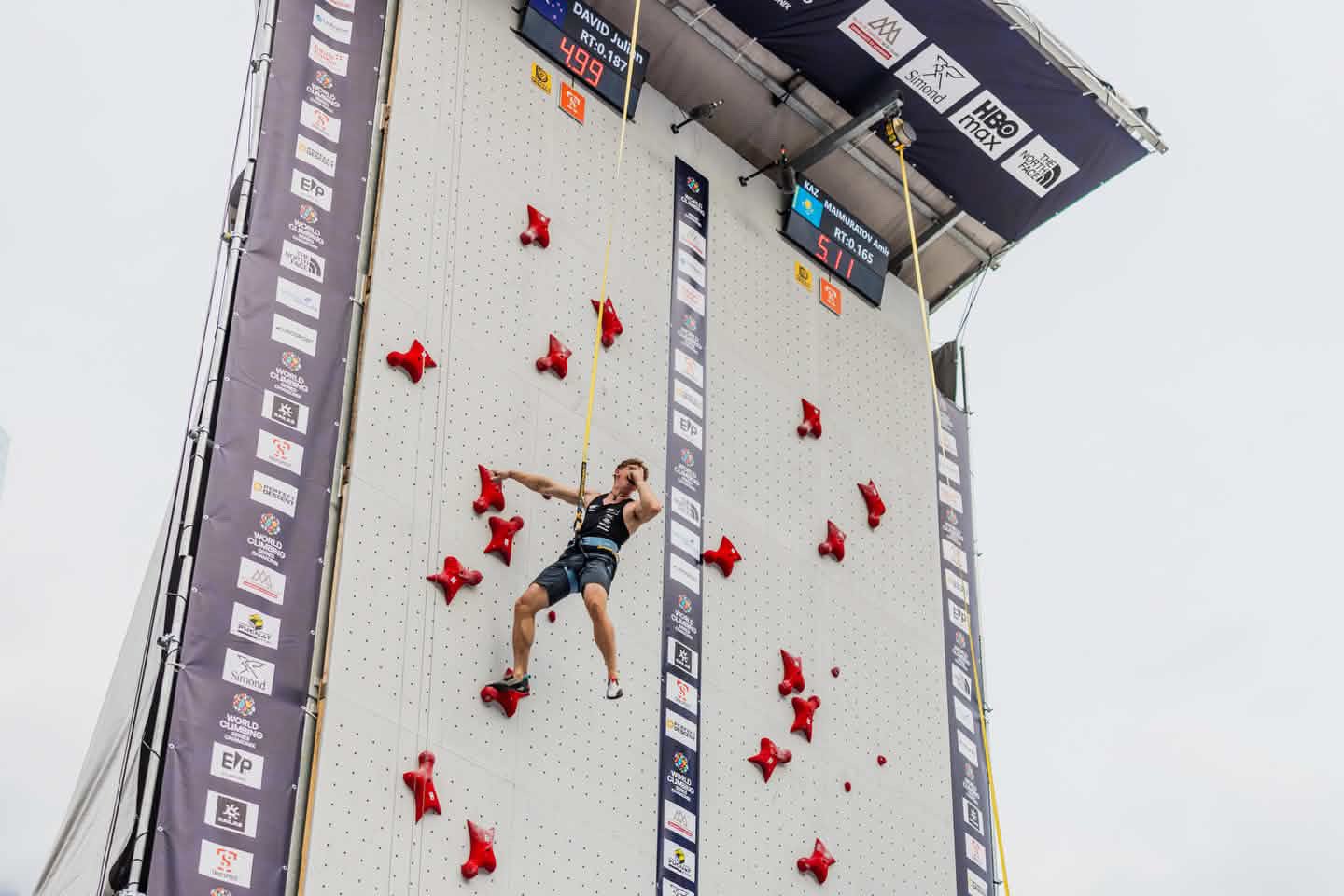
In July, after more than 12 months fighting his way back to form, Julian finally broke the five-second barrier, clocking 4.99 seconds at a World Cup event in Chamonix, France – achieving his biggest goal for 2026.
Days later, he was in Arco, Italy, watching his 15 year-old teammate, Mila, race for the same world title he’d won three years earlier. The parallels were uncanny. Neither had been expected to win; both found themselves up against world-record holders whose mistakes in the final knockout rounds unexpectedly opened the door.
“It was déjà vu,” says Julian. “I had never understood what it was like for my coach until that moment, and I’ve never been that amped to watch anyone climb in my life as I was to watch her.”
Mila’s campaign in Arco almost unravelled before it began. She slipped during her first of just two qualifying runs, leaving one final chance to make the knockout rounds.
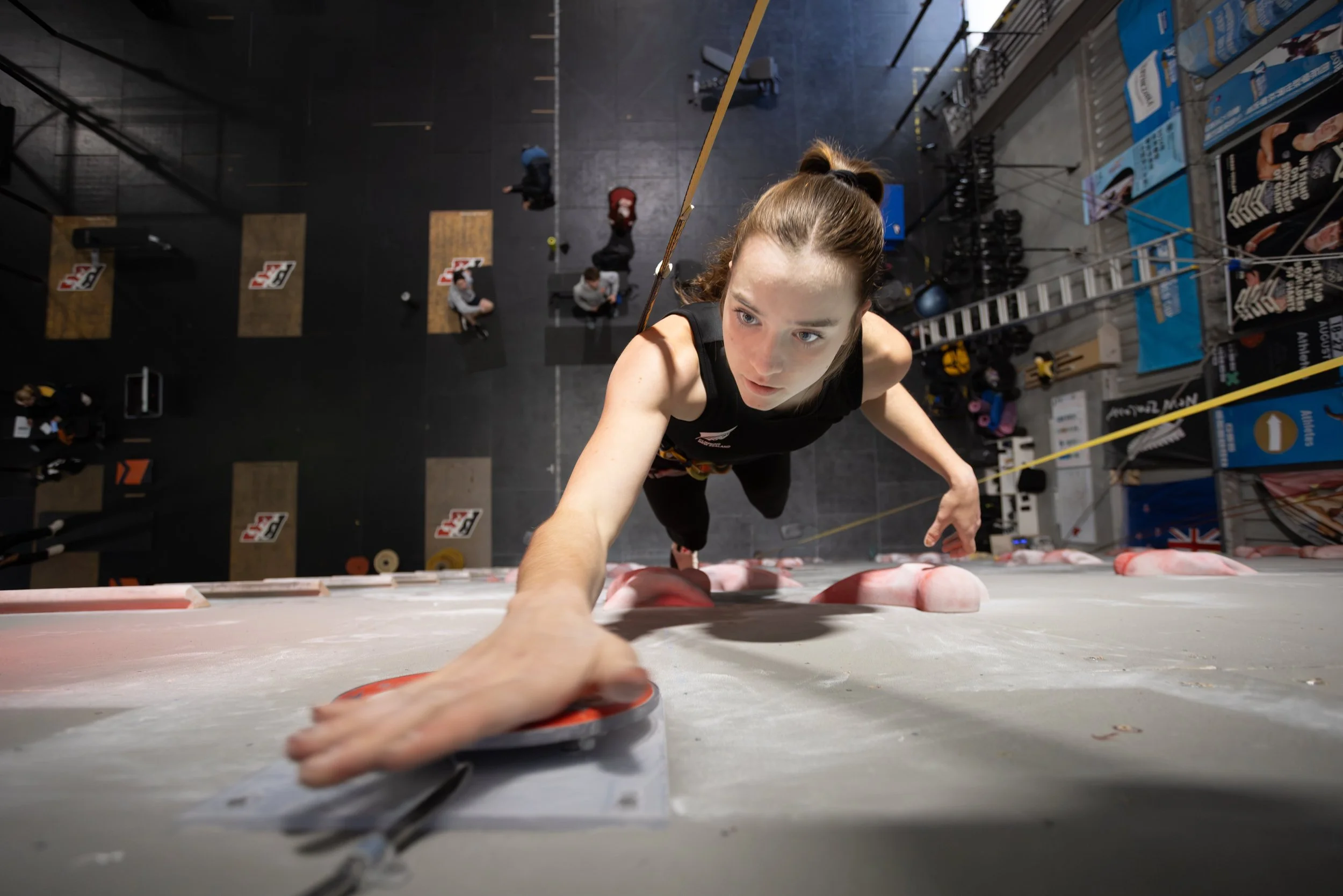
“I was a little bit shook,” she recalls, “but Rob came behind the wall and told me to reset. He reminded me, ‘You’re at Worlds. This is your opportunity to let it happen and show what you’re capable of.’”
Rob took the pressure off, reminding Mila it was only her second international competition and helping to put the mistake behind her. After a couple of practice starts on the warm-up wall, she was calm and ready to go again.
Mila safely qualified for finals and, from there, simply kept advancing. Each knockout race ended the same way: she hit the stop pad and looked for one thing – the green timer signalling she was through. In the quarterfinals she clocked 7.70 seconds – a personal best and new Oceania record.
“I was bawling my eyes out between every single run just from joy,” she says. “I’ve never cried out of happiness before. I was just over the moon.”
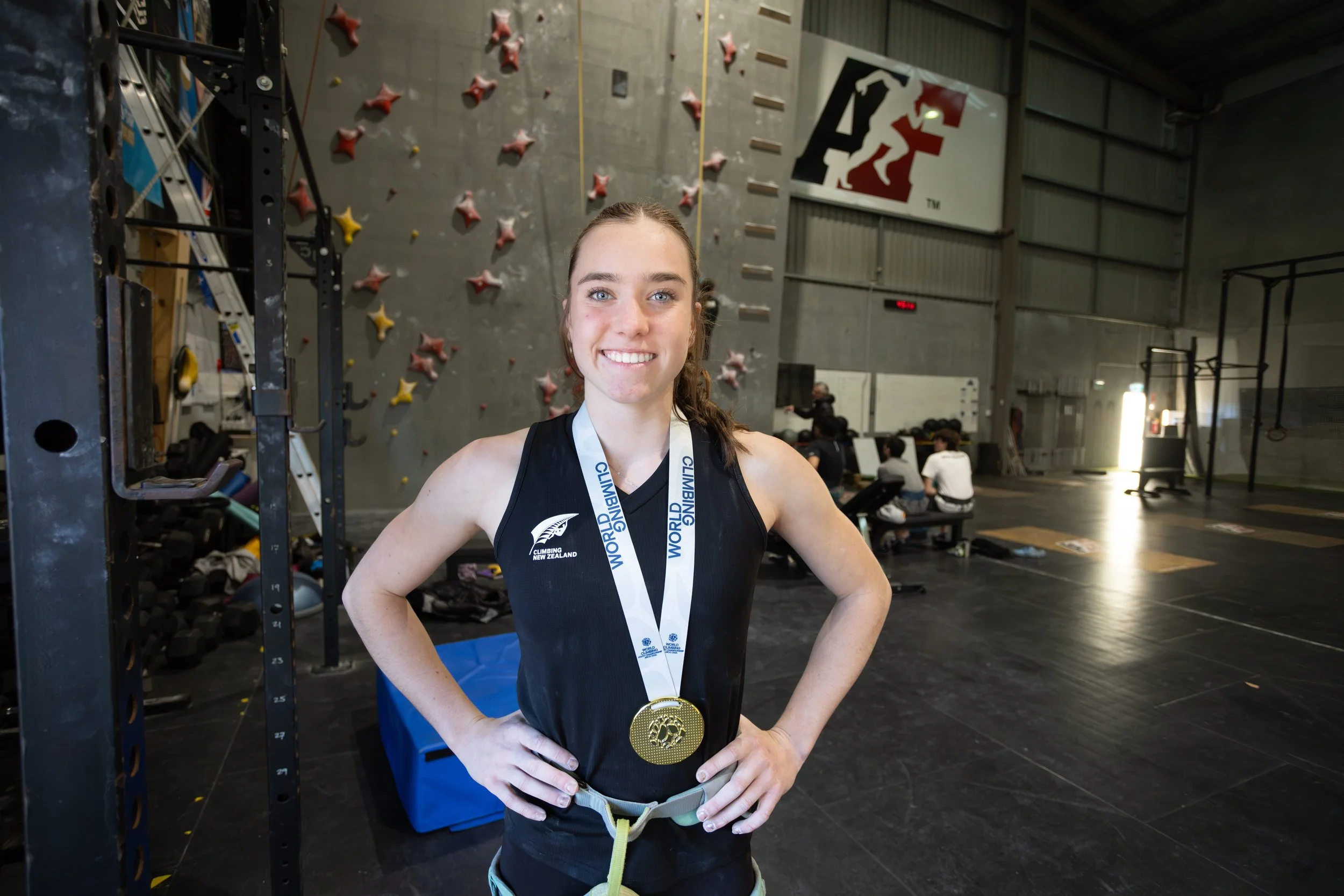
The celebrations with her coach, family and teammates that followed her gold medal victory were overwhelmingly emotional. The young girl who had once spent six weeks trying to master the first move was now a world champion.
“I credit so much of my win to Rob,” she says. “If he wasn’t there, I don’t actually think it could have happened. Rob was incredible.”
Back home in Mount Maunganui, life has quickly returned to normal. Teachers have been lining up to see the gold medal, while her friends welcomed her home with a surprise party. She’s back at her part-time job at Rocktopia and has settled into her usual training regime.
Fortunately, training with Rob is never monotonous.
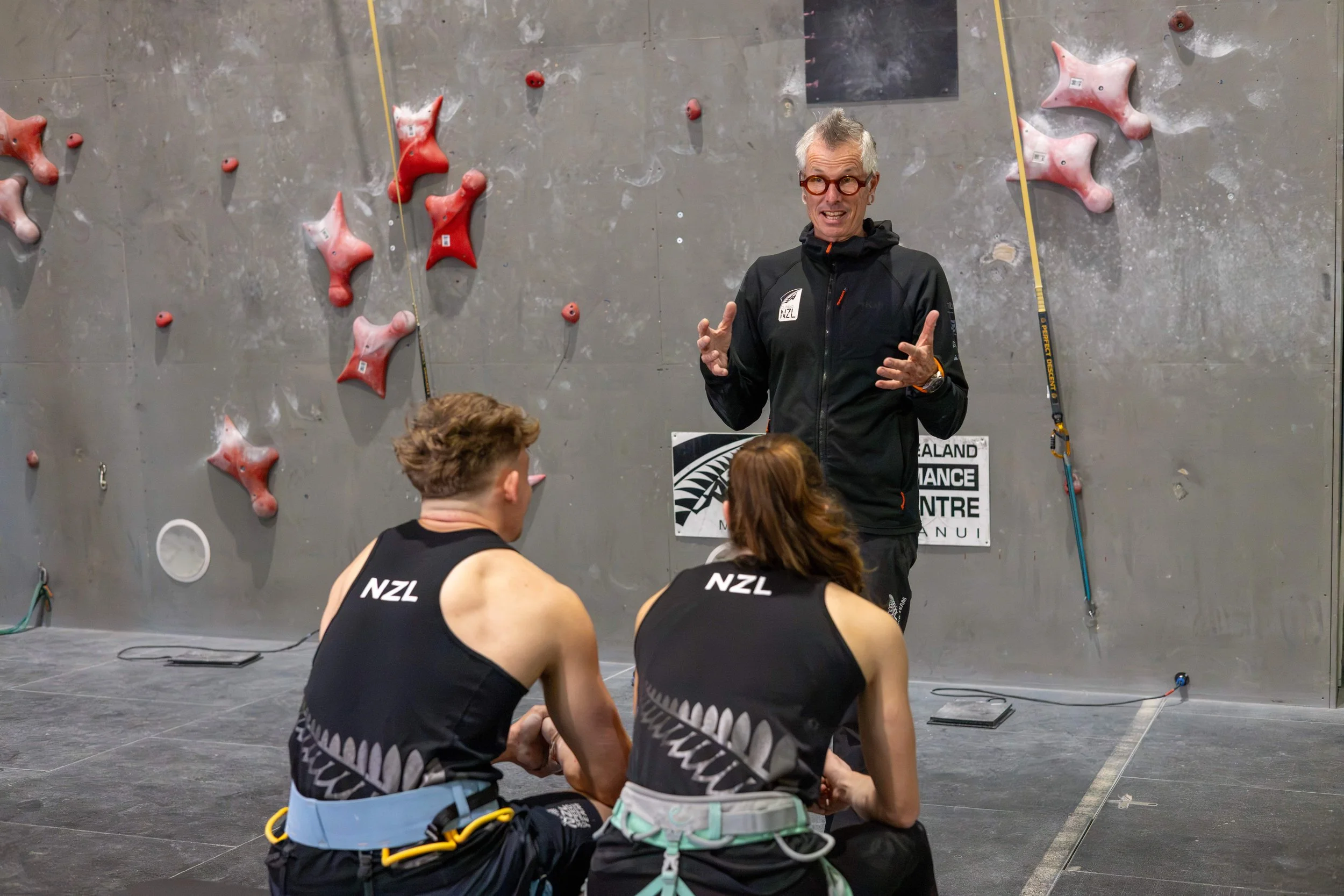
“Rob has so much energy and passion for the sport that it rubs off on you. He has a way of bringing the best vibes to every training session.”
Mila has already set her sight on new goals. Next year, she becomes eligible for the Open World Cup circuit, before the Oceania qualifying event for the LA Olympics takes place at Blake Park on October 23 and 24, 2027.
Only one women’s Olympic spot is available, setting up a tantalising contest between Mila and Paris Olympian Sarah Tetzlaff – her long-time mentor, role model and one of her earliest speed climbing coaches. Rob believes that rivalry could lift the entire programme.
“If they can both embrace it and both be pushing each other, then it’s only going to be good for our sport. We should be able to get everybody to lift together.”
Whatever happens, the groundwork for a successful future has already been laid. Rob acknowledges today’s youngsters are progressing faster because they’re benefitting from everything he has learned while coaching his original six athletes.
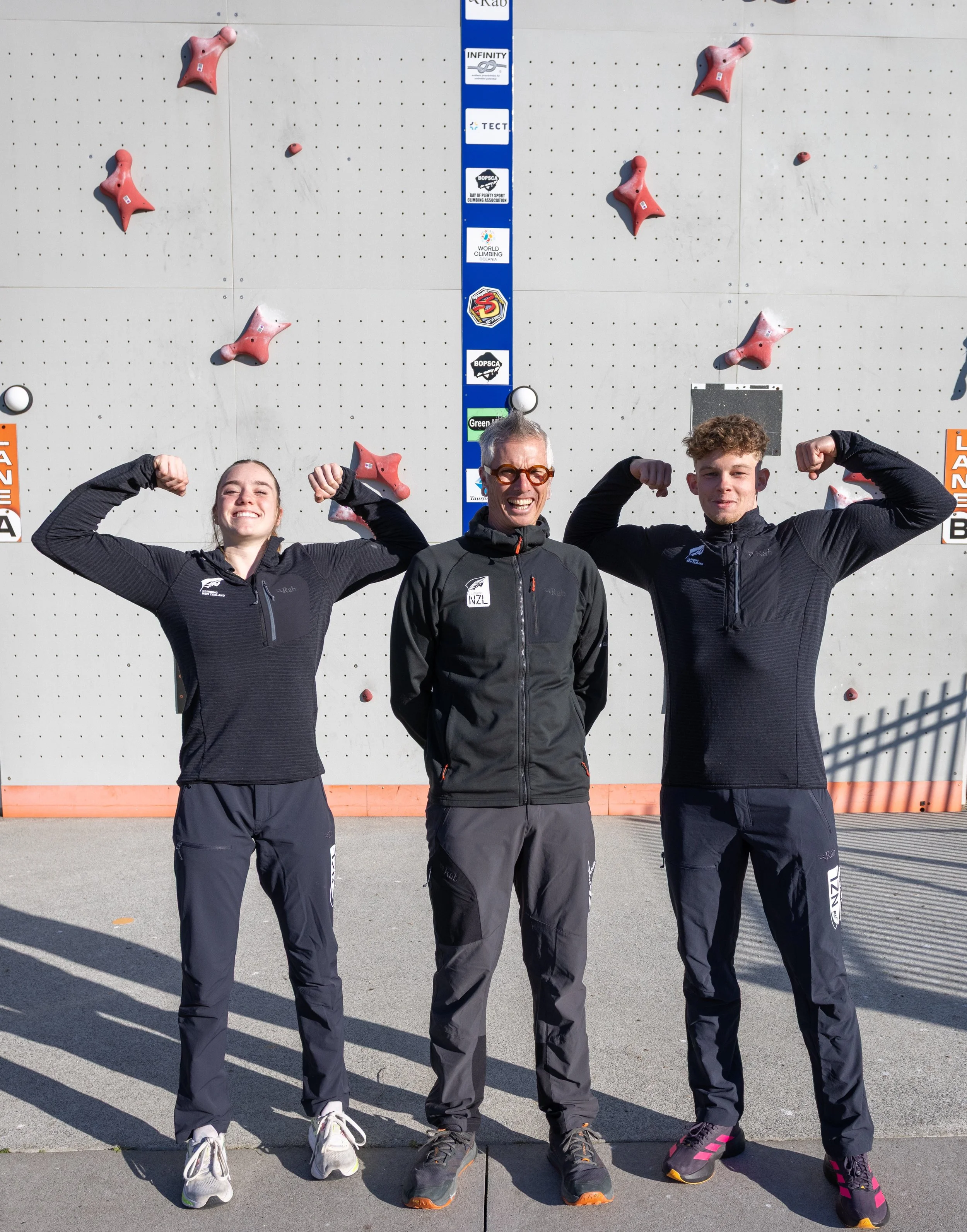
Now aged 21, Julian’s happy the next generation has experienced speed climbers to look up to and train alongside.
“But it goes both ways. I love training with those kids.
They’re so psyched on speed climbing and bring the vibes. They help me as much as I help them.”
Come October 2027, the Bay of Plenty will have the chance to watch them all chase their Olympic dreams on home soil.

LAST DRINKS
The kids are alright – and increasingly, they’re sober. As Gen Z turns its back on booze, older Kiwis are drinking at hazardous levels. UNO looks at why our relationship with alcohol is changing.
The kids are alright – and increasingly, they’re sober. As Gen Z turns its back on booze, older Kiwis are drinking at hazardous levels. UNO looks at why our relationship with alcohol is changing.
WORDS HAYLEY BARNETT

Ask 19-year-old Payten Thomsen what a flat party looks like these days and she’ll break it down like a pie chart. A third of the room are drinking, a third are high on substances, and the rest, herself included, are stone-cold sober.
“There’s not a lot of pressure to drink,” she says of her generation, first-years scattered throughout flats around Hamilton. “If you go to a party, you’re not the only one who’s not drinking.”
Her maths lines up with the official numbers too. In the 2024/25 New Zealand Health Survey, hazardous drinking among 18- to 24-year-olds fell 13.2 percentage points in five years, down to 22.6 percent. Across the whole adult population, three in four New Zealanders had a drink in the past year, down from 81.6 percent in 2019/20, and the number of us drinking at hazardous levels has dropped from 21.3 percent to 16.6 percent over the same period. Something’s changing in how this country drinks.
Associate professor Andy Towers, co-director of Massey University’s Mental Health and Addiction Programme, says the stats are considerably less flattering for anyone over 45. “Everyone keeps talking about youth drinking as the problem. It’s not – it’s Kiwi drinking, and more often than not, it’s actually middle-aged or older drinkers who are the problem.”
Andy’s spent the past decade using Massey’s long-running study of ageing, which tracks around 4,500 New Zealanders, to look specifically at how people aged over 50 drink. What he found surprised even him. Roughly 35 to 40 percent of New Zealanders aged 50-plus qualify as hazardous drinkers, drinking often enough, or heavily enough in a single sitting, to put themselves at real risk of cancer, heart disease and stroke down the track.
When Andy’s team compared that figure with England, the US, South Africa, China, Mexico and several other countries, New Zealand came out worst. “We get the gold medal for drinking,” he says. “We drink more frequently on more days a week than pretty much anywhere else in the world, and about 16 percent of that group binge every single time they drink, which is around six or more drinks, whenever they touch it.”
He traces it back a century, to six o’clock closing, driven by the law that shut New Zealand pubs at 6pm from 1917 until 1967, and allowed no food, entertainment or women at the bar. Workers would finish their shift and race the clock.

“It taught two generations of Kiwis that when you drink, you drink to get drunk – it’s not for enjoyment or atmosphere,” says Andy. “We got rid of six o’clock closing, but we never got rid of the culture. It’s taken this long for it to actually start changing, and it’s not us changing it – it’s our kids.”
So why the generational split? Andy puts it down to a handful of things, including decades of clearer public health messaging that there’s no truly safe level of drinking, a cost-of-living squeeze that’s made big nights out a luxury, and a generation that grew up with phones recording everything.
“My own daughter, who’s 18, said to me, ‘I don’t want to be drunk and have people videoing me. I just don’t think it’s cool,’” says Andy.
Of course, there’s also the fact that Gen Z is doing more of its socialising online rather than at the pub.
Payten sees the same pattern from the inside. “It’s a big cost thing,” she says. “We’re students, we don’t have a lot of money, so it’s just not financially viable.”
She also points to a steady diet of short-form video content on TikTok and Instagram, flagging new research on alcohol and health. “I never see advertising for drinking. I see a lot more negative than positive.”
Where Payten’s non-drinking stance does get pushback is, funnily enough, from her own family at Christmastime. “They always offer and wonder why I won’t have one, and I’m like, ‘No, no, no,’” she laughs.
The rise of good non-alcoholic drinks has made this change feel a lot less like a sacrifice. Andy sees the boom in sophisticated zero-alcohol beers, wines and spirits as one of the reasons the change has stuck.
“People don’t have to choose anymore between being part of the occasion and looking after their health,” he says. “You can still hold a drink that fits a barbecue or a wedding or a Friday night – you just don’t pay for it the next day.”
The change in younger people not feeling the old pressure their parents’ generation still carries is, in Andy’s view, the real story. New Zealand’s official low-risk drinking advice hasn’t changed since 2011, when a moderate drink or two was still considered heart-healthy. It currently allows men up to 15 standard drinks a week and women 10, which is far looser than Australia’s revised limit of 10 drinks a week for anyone, and Canada’s proposed ceiling of two.

Andy’s helping lead the review of New Zealand’s guidelines, work that’s been repeatedly slowed, he says, by an alcohol industry with a habit of turning up to meetings public health researchers never get invited to. Nationally, alcohol is linked to roughly 900 deaths, 1,250 cancer diagnoses and 30,000 hospital admissions a year, at an estimated cost to the country of $9.1 billion.
For 41-year-old Sarah Jesson, these statistics stopped being abstract on a Friday night in May 2023. She and a friend had already worked through a couple of bottles of wine that night when they told themselves they’d just have one between them. They ended up walking to the bottle store for a box of RTDs. “I’d said I wouldn’t, and then I did,” she says. “My husband said he couldn’t really trust my word anymore. I realised then that I wasn’t in control.”
Two nights later, she was at an AA meeting with a friend who’d recently got sober herself. “I think I needed the shock factor,” she says. “I was in a room full of people whose lives had actually been derailed. It was a picture of where things could go.”
She hasn’t had a drink for more than three years now, though she’s candid that her first stretch exemplified what’s sometimes called ‘Cali sober’, when people swap wine for weed before quitting that too. Real sobriety started just over a year ago.
Underneath the drinking was anxiety Sarah had been managing since experiencing a run of hard life events. “It was masking it, but not fixing it,” she says.
“The odd drink did take the edge off, for a while, but I needed more and more of it just to feel normal.”
She’s seen a free counsellor through the Salvation Army, who talked her through what she calls the “pleasure-pain circuit”. It’s the idea that heavy, repeated use of a substance rewires the brain’s reward loop, and that the first two years of sobriety carry predictable relapse points at three, six, nine, 12 and 18 months.
The part she’s still working on is the identity that came with the drinking. “I’ve always been a party girl,” she says. “I love nothing more than a big night out.”
Rebuilding that without alcohol has meant relearning how to be silly, loud and sober at dinners and nights out that she used to think she needed a drink to enjoy. “It’s actually been a fun challenge, working out if that side of me exists without the chemicals. It turns out it does!”
Sarah admits she’s amazed at how ordinary it’s felt to ask for help, and how rare that seems to be among the generation just ahead of hers. Her mother worked in alcohol and drug detox for years and told Sarah that mid-life is exactly the moment to make the change, because habits set in more the older you get.
“I think it’s a lot harder for that Boomer generation,” says Sarah. “It’s the generation of silence. You’re stoic, you just get on with it. That’s not necessarily a bad thing, but it makes it so much harder to put your hand up and say, ‘Actually, I don’t want to do this anymore.’”
Andy agrees, and has heard the same thing from retirees who come to his talks. Many only stop drinking once they’re already sick. He’d like to see people feel able to opt out long before that point arrives.
“If you’re thinking about it, there’s a good chance other people your age are thinking about it too,” he says. “They’re just too scared to say it first.”
At Payten’s flat parties, nobody feels the need to be first. Sober is normal on a Friday night, alongside drunk and high and everything in between. It might be a slow handover, in which each generation’s deciding to drink less than the one before, but it’s a movement that’s quickly gaining traction.
New Zealand spent a century teaching itself to drink hard and fast. Now it’s taking its time teaching itself not to.

SHAPING THE FUTURE
Far from ‘just’ considering carpets and curtains, this interior design studio supports clients to live their best lives.
Far from ‘just’ considering carpets and curtains, this interior design studio supports clients to live their best lives.
WORDS PIP CROMBIE | PHOTOS KATIE COX
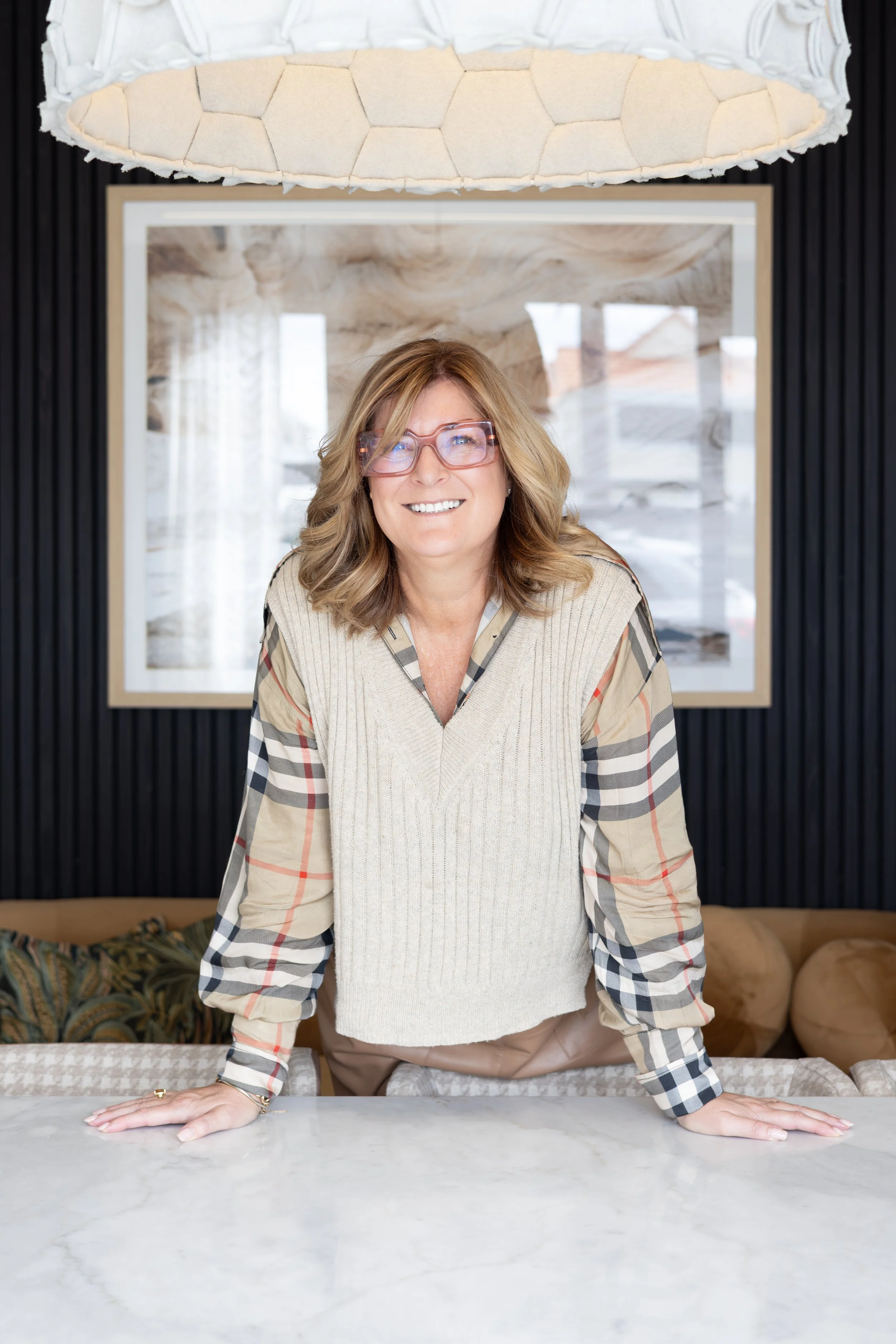
Sally Lines
I first connected with Urban Lounge’s Sally Lines more than 20 years ago, in her early days of interior design and mine with UNO. Catching up with her now as her business nears an amazing 25-year milestone is very special. These days, she’s creative director of the Mount Maunganui design studio, among a team of nine multi-disciplinary design specialists who collectively bring visual impact and functionality to new builds, interior and exterior renovations, and commercial projects big and small, locally and beyond. This is one of the biggest, if not the biggest design studios in the region, the team bringing diverse expertise and a sprinkle of magic in all they touch.
“I really can’t believe it,” says Sally. “Urban Lounge has been shaped by every person who’s worked here. Each team member has brought a different flavour, perspective and contribution to the company over the past decades. The celebration we’re planning will acknowledge what we’ve built together and include team members past and present . Urban Lounge is not simply about me – it’s bigger than me. It’s about the whole team and the future of the company.”
Last year, Louise Blackmore stepped into the management and expanded leadership role. “I freed Sally up to be the creative director,” she says. “Me managing the day-to-day aspects of the business allows Sally to concentrate on the creativity she’s known for.” Thanks to her background in furniture design, Louise still contributes creatively too.
The perception of interior design has changed since the business began. “It was seen as a privilege, but most people now ensure a budget is incorporated into their project, as the process can be long and decision fatigue is very real,” says Sally.
“There’s research to show that interiors seamlessly melding with exteriors and the multitude of environments in which we live and work do impact our thinking, our sleep, the way we function on a daily basis. We focus on acknowledging the five senses in our design ethos. Do you want to block road noise, harness natural light, encourage airflow? Our value lies in the discussion, our experience and understanding how our clients live. It’s about examining the psychology behind a space and creating something that works in three dimensions, not simply producing an attractive, two-dimensional image.”
This comment leads me to ask the question every business seems to be dealing with today – what of the impact of AI in the design arena? “Yes, we’re certainly seeing it used, and of course we use AI in our administrative platforms,” says Sally. “AI can be helpful to visualise ideas, but an image is not a resolved interior. It doesn’t account properly for natural light, the site, surrounding trees, council requirements or how somebody actually lives. The result can be flat and one-dimensional. People sometimes treat AI-generated concepts as gospel, then discover that it doesn’t work in practice and call us in to rectify the problems. There’s more efficiency with a designer.”
Louise agrees. “Our approach is about keeping people in the process. AI can’t pull the extraordinary out of the bag; good design starts from scratch, provides practical solutions and beautiful aesthetics.”
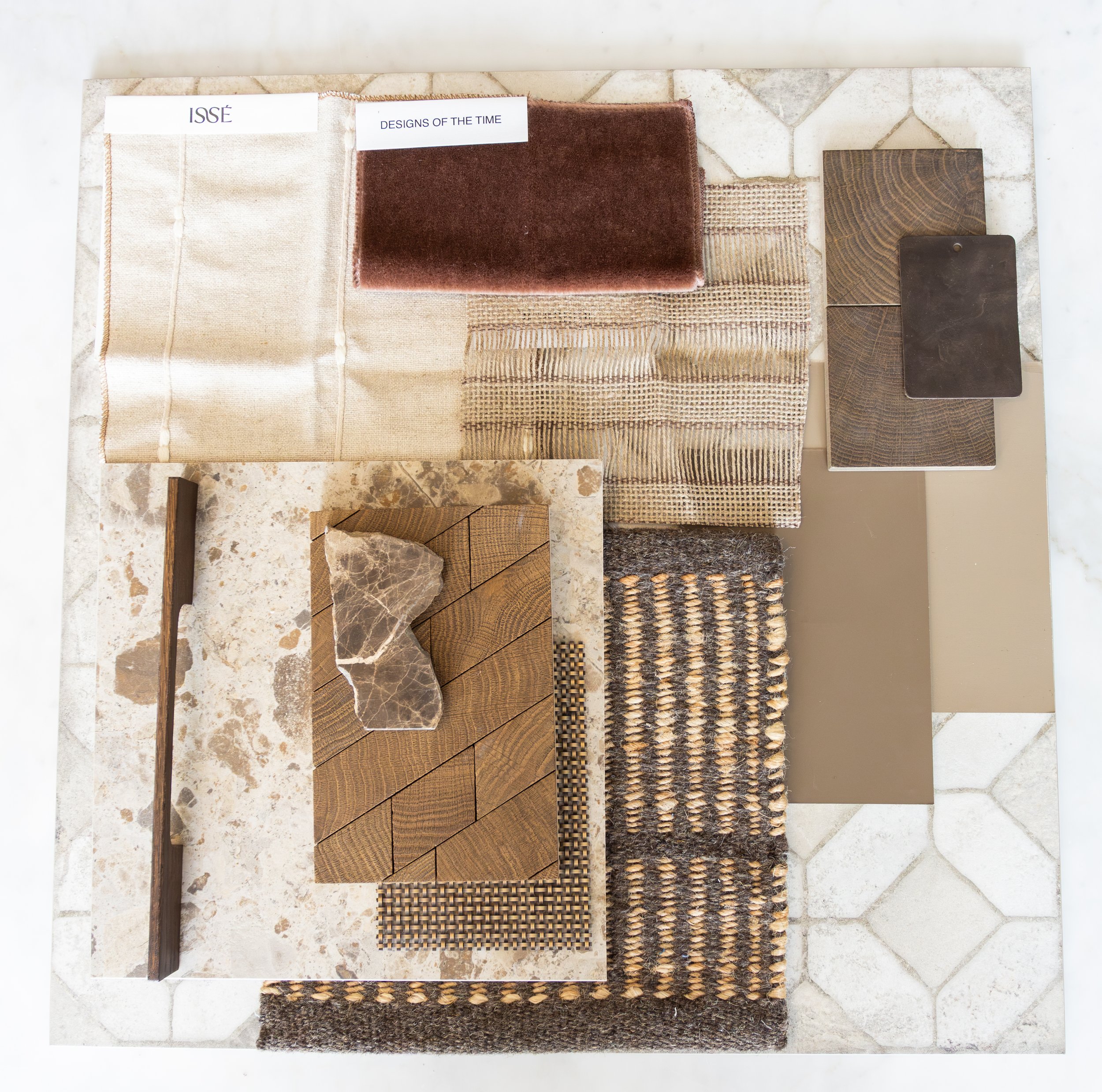
From interior designers Kayla Celliers and Mel Walker, who you’ll encounter first as a new client, to registered architect Julianne Chou, your project will be sensitively approached by the entire Urban Lounge team. Sales and account manager Victoria Martin Gardner beams in from Melbourne, where she extends the business’s prowess in Australia.
From the first meeting, the process is design-focused and clients are encouraged to visit the studio to immerse themselves in product samples. “We meet representatives from all sorts of industries every week, so we’re constantly exposed to beautiful new things; however, our skill is looking beyond trends, analysing each project as a stand-alone and applying sound design principles,” says Sally.
Their workload shifts between residential and commercial projects, often in a 60/40 split one way then the other as the market changes. Christine Morris oversees the operational delivery of commercial projects, managing client budgets, purchasing and project administration for clients including Metlifecare and other boutique lifestyle villages. This work keeps around two of the team occupied almost permanently.
When I ask Sally what the most meaningful project of her career has been, she doesn’t hesitate. “For the past 10 to 15 years, we’ve had the privilege of working with Stand Tū Māia”.
Secondary specialist service Stand Tū Māia works as an alternative option to state care for children and families affected by complex trauma in New Zealand. “We’ve helped redevelop environments designed to support children and families, transforming spaces that once felt institutional into places that feel like a home, while remaining robust and durable,” says Sally. “Of all the beautiful homes and commercial interiors we’ve completed, this work remains especially important to me. I’ve attended openings with children and their families and cried every time. The organisation’s board and staff do incredible work, and we love being able to contribute.”
You’ll hear more from the Urban Lounge team in upcoming issues of UNO. “There’s so much more to interior design than choosing pretty things,” says Sally. “I hope our new column will help readers think more deeply about what they’re creating and why. We’ll be giving practical help based on the team’s collective expertise in a myriad of areas.” Watch this space!

FEET FIRST
A podiatrist in Tauranga is challenging the conventional approach to foot problems, using hands-on therapy to address the underlying causes. Shaun McCann’s pioneering technique is helping patients get back on their feet, and back to the things they love.
A podiatrist in Tauranga is challenging the conventional approach to foot problems, using hands-on therapy to address the underlying causes. Shaun McCann’s pioneering technique is helping patients get back on their feet, and back to the things they love.
WORDS KARL PUSCHMANN
PHOTOS KATIE COX
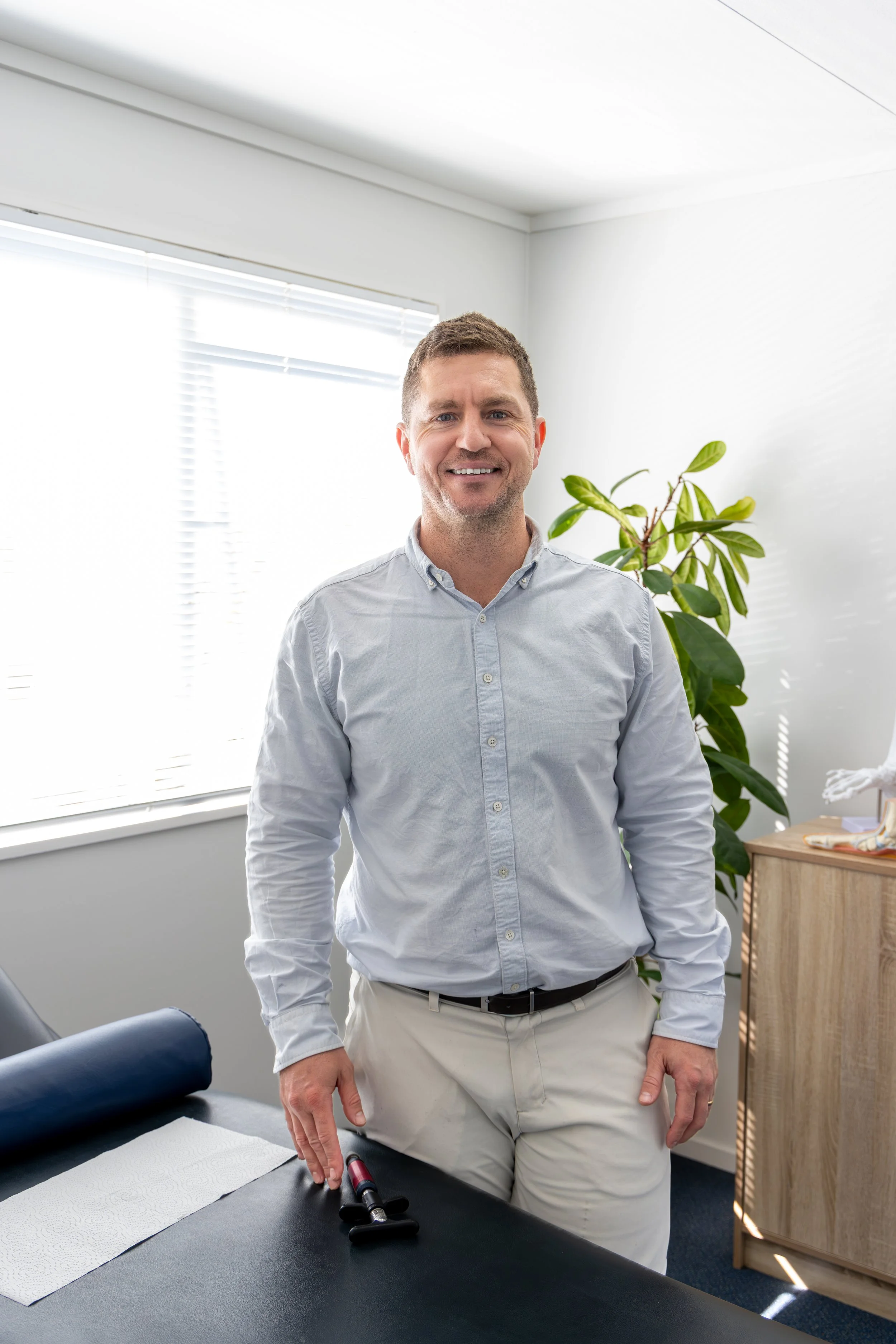
Podiatrist Shaun McCann had grown as frustrated as his patients. Every week, a patient would hobble into the clinic carrying a bag full of prescription orthotics that simply hadn’t worked. Along with their orthotics, they carried the desperate hope that he held the answer their previous specialists had missed.
The problem was, he didn’t.
“I started to get frustrated with the limitations of the treatment and methods that I’d been taught,” he says. “I thought there had to be another way of treating the foot and leg, without having to put someone in an orthotic or referring them to surgery.”
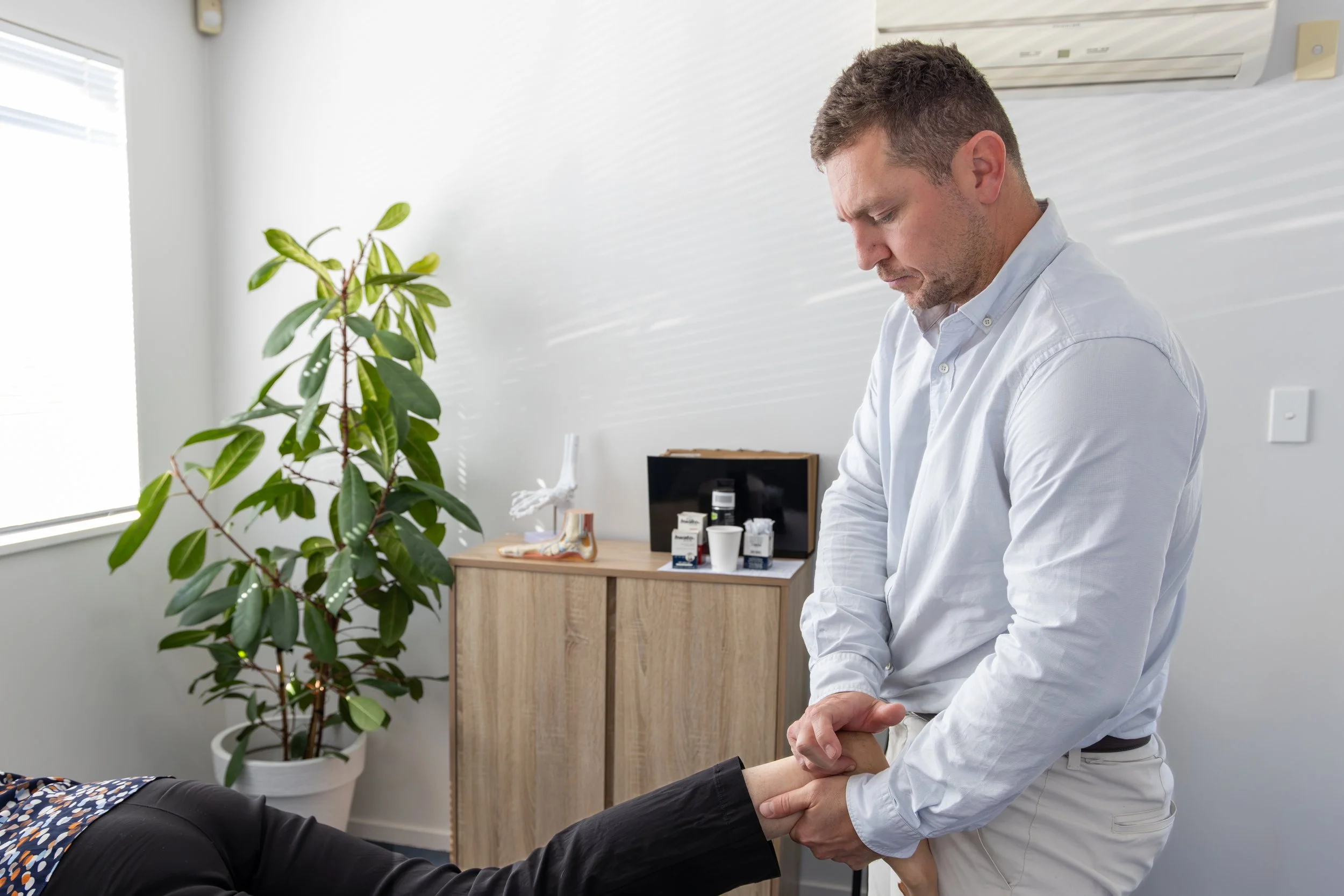
He couldn’t ignore the pattern, or the feeling that there had to be another solution, so he began looking beyond podiatry, talking to friends and colleagues in related fields, including physiotherapy and chiropractic. Conversations with his best friend, a physio, saw Shaun questioned on why podiatry sometimes relied on external devices or surgery, instead of working to strengthen and condition the body itself.
“This led me to foot mobilisation therapy,” he says, describing the hands-on technique he now practices that addresses misalignments in the foot, followed by strength and conditioning exercises designed to reinforce these changes.
Shaun holds a BHSc (Podiatry) and says that although orthotics have a role, they’re an aid, not the long-term solution. He’s also quick to point out that his approach isn’t the answer for everyone.
“Orthotics will work for a percentage of people, but not everyone,” he says. “It’s the same with my treatment. It doesn’t fix everyone – it provides another option.”
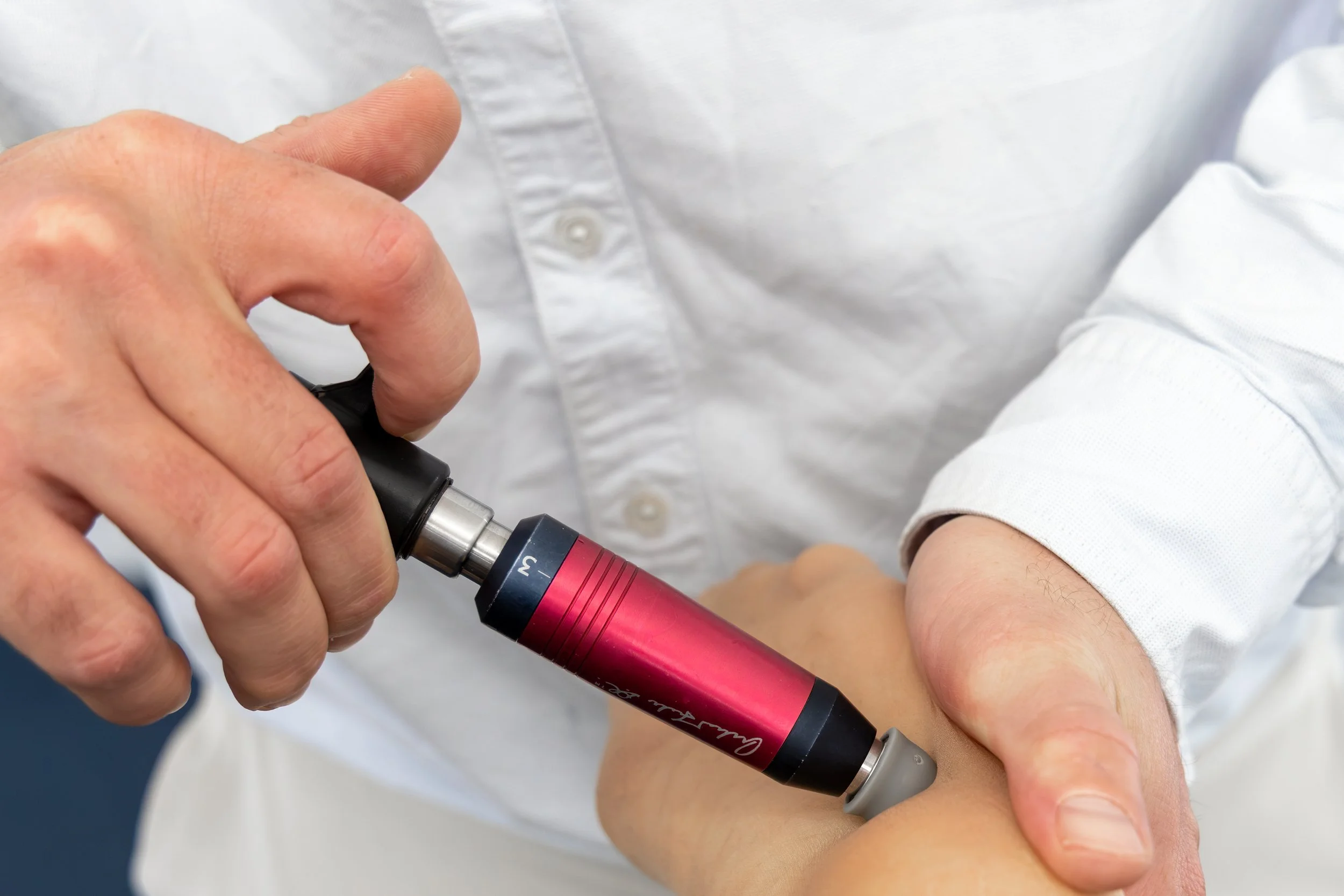
Foot mobilisation therapy uses manual techniques similar to those used by chiropractors, osteopaths and physiotherapists to treat conditions including plantar fasciitis, Achilles tendinopathies, hammer toes, bunions, osteoarthritis and ankle sprains. Strength and conditioning exercises are then prescribed for clients to continue at home.
“This addresses the underlying weaknesses and misalignments, so ultimately the patient can walk better barefoot again, rather than relying on external devices like orthotics,” says Shaun.
Treatment can also include other techniques, like category-four musculoskeletal laser, dry needling and strapping. Shaun says the approach is tailored to the individual, with diagnostic information such as X-rays or ultrasounds helping to establish a short-, mid- and long-term treatment plan.
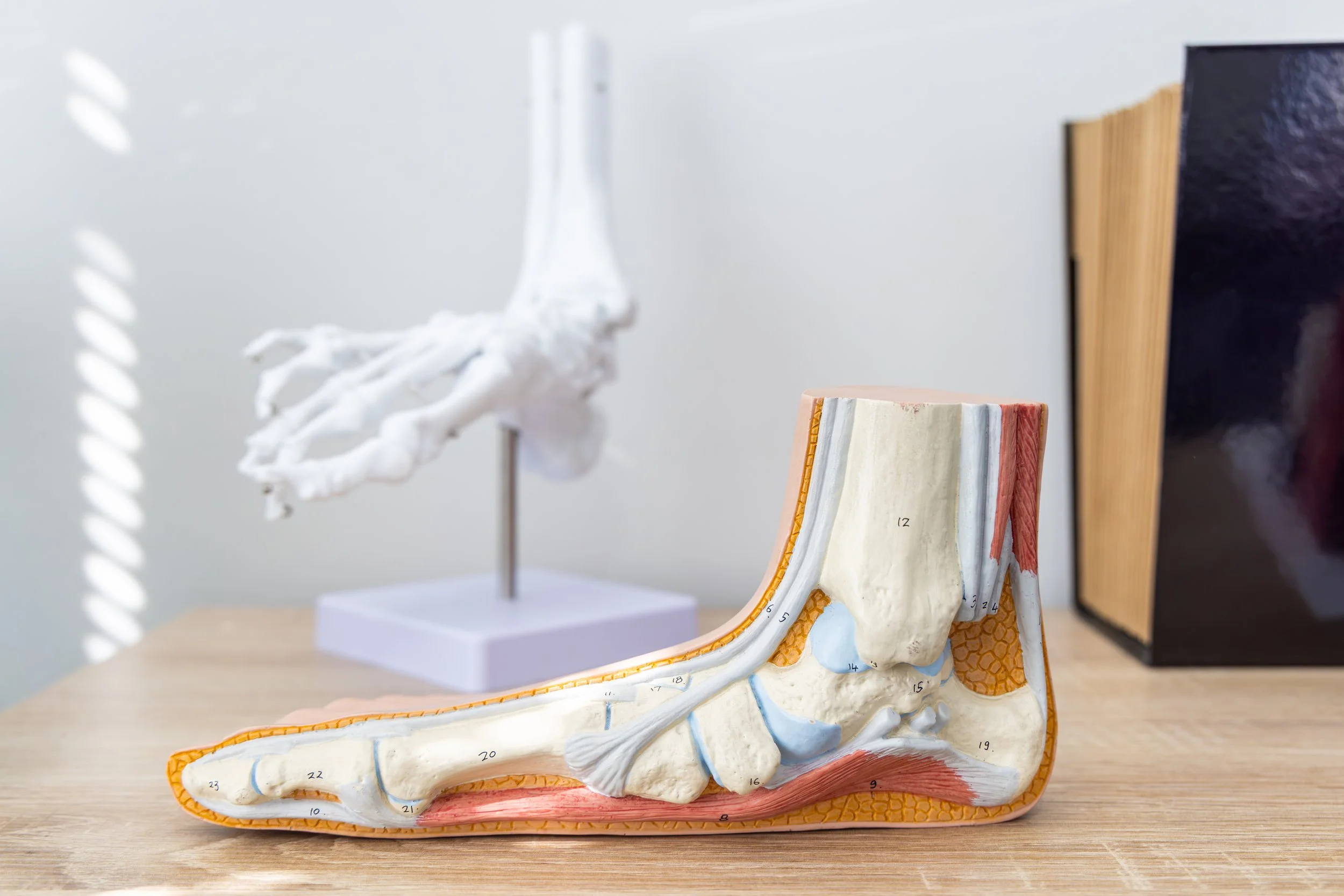
A key part of Shaun’s approach is giving clients measurable evidence of change. X-rays can be taken before and after treatment, allowing changes in the foot to be assessed objectively, as opposed to relying solely on how their foot feels.
“I can physically see the evidence of why they feel better,” he says. It also helps him work towards a bigger goal: making clients less dependent on treatment.
“I’m trying to get someone from A to B, and then get them self-sufficient,” he explains.
Shaun spent five years working in Australia, including several years in a clinic dedicated to foot mobilisation. Working directly with patients allowed him to develop not only his understanding of the technique, but also the confidence and practical experience needed to manage the realities of treatment.
With a baby on the way, Shaun and his wife decided it was time to come home. They chose Tauranga, where his wife is from, and decided to see whether his new approach could take root here.
On returning, he saw an opportunity. He was the first to pioneer foot mobilisation therapy as a specialty in New Zealand, and today he says only two places in the country specialise in the practice. Over the past nine years, he’s opened two clinics in Auckland and Corrective Foot Solutions here in Tauranga, where he practices. Treatment is ACC funded, and private health insurance may also cover it where podiatry is included in the policy.
For people dealing with foot problems, particularly bunions, Shaun says early action makes the biggest difference. Exercise and appropriate footwear can help, but hereditary factors and the way a person stands and walks can also contribute.
“The sooner someone can get on to treating something like a bunion, the better,” he says. “The longer you leave it, the harder it gets.”
Ultimately, the goal is not simply to make feet feel better. It’s to help people return to the things they enjoy, whether that means exercise, socialising, shopping, Pilates or yoga.
“After treatment, people feel stronger on their feet and more stable and mobile,” he says. “And they always mention that they can wear their favourite shoes!”

BEHIND THE SEAMS
Three local designers reveal what it takes to be accepted into one of the country’s most prestigious, and arguably most creative, design shows – the wonderful World of WearableArt.
Three local designers reveal what it takes to be accepted into one of the country’s most prestigious, and arguably most creative, design shows – the wonderful World of WearableArt.
WORDS PIP CROMBIE / PHOTOS ALAN GIBSON + ANNE SHIRLEY + SUPPLIED

Whether as a career pinnacle or pure entertainment, the World of WearableArt (aka WOW – September 17 to October 4) is a significant fixture on the annual calendar for those who love fashion, creativity, drama and theatre. Sophisticated, swashbuckling and sensorial, it’s a show you simply must experience.
A sumptuous visual feast, WOW thrills audience who travel from far and wide to celebrate the creativity of those who are bold, brave and beyond ingenious in their artistic resourcefulness. Conceived by Nelson sculptor Suzie Moncrieff in 1987, it challenges designers to bring art to life.
The first show was attended by 200. In 2005, it relocated to Wellington, a move made to facilitate WOW’s creative and commercial growth. It paid off. Audience size surged 60 percent, with 28,000 attending that year. WOW is now seen by more than 60,000 people annually in sold-out shows that run for two weeks.
GLO! is the theme for 2026. Embedded in this are recurring competition sections (or ‘worlds’) Aotearoa, Avant-garde and Open, plus three unique themes announced annually. This year, they’re Bizarre Bra, Kinetic and Metallic.
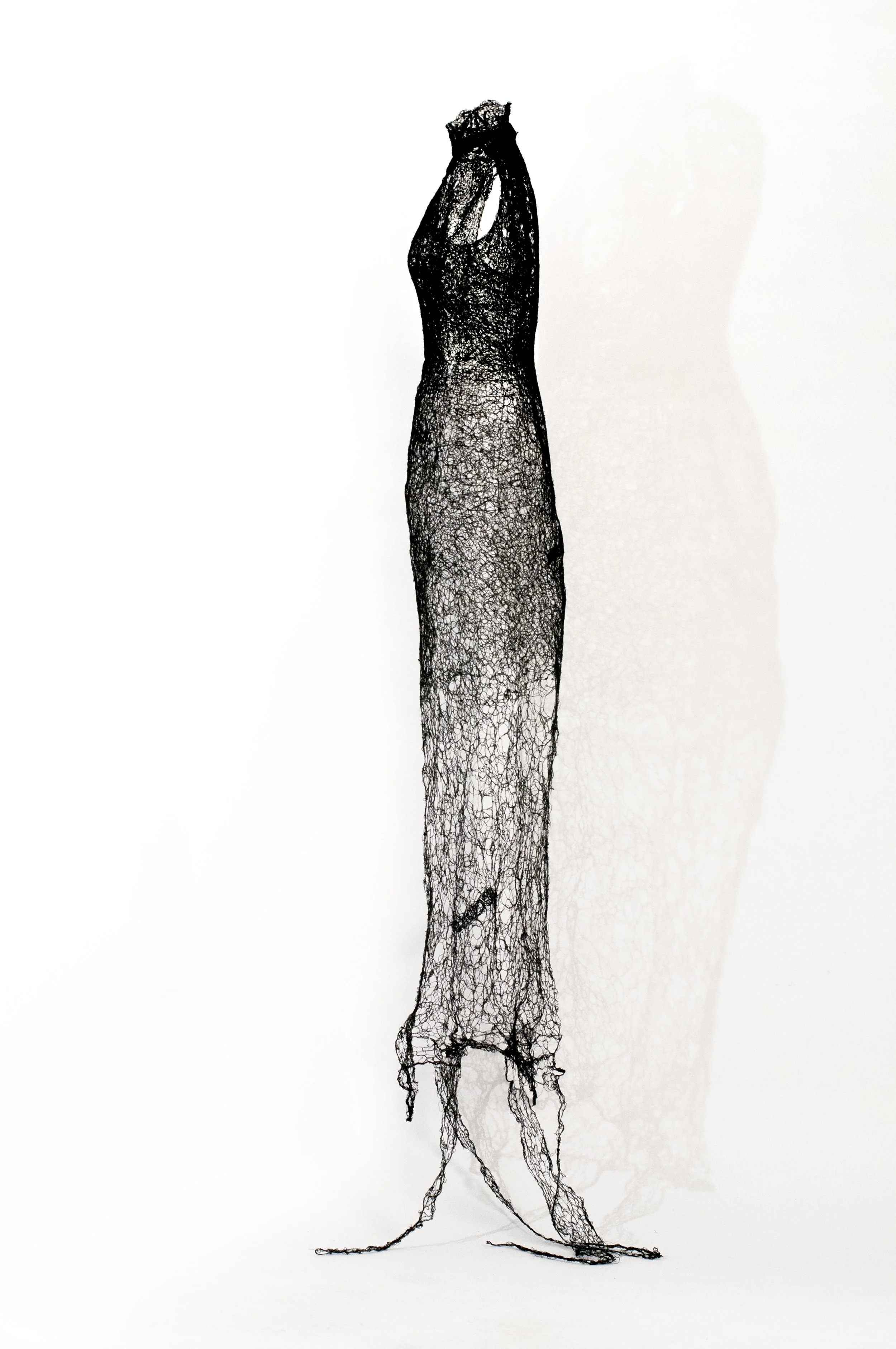
The show itself is the culmination of a fierce competition, when finalists’ creations get their moment to shine. Secrecy shrouds the garments until they make their appearance and the winners are announced live. Careers have been launched on the WOW stage, talents recognised, opportunities offered.
So who are the people behind the wearable art, what drives them, qualifies them, tempts them to turn visual concepts into reality? Let’s meet three Tauranga locals who have achieved the coveted status of WOW 2026 finalist – each in very different ways.
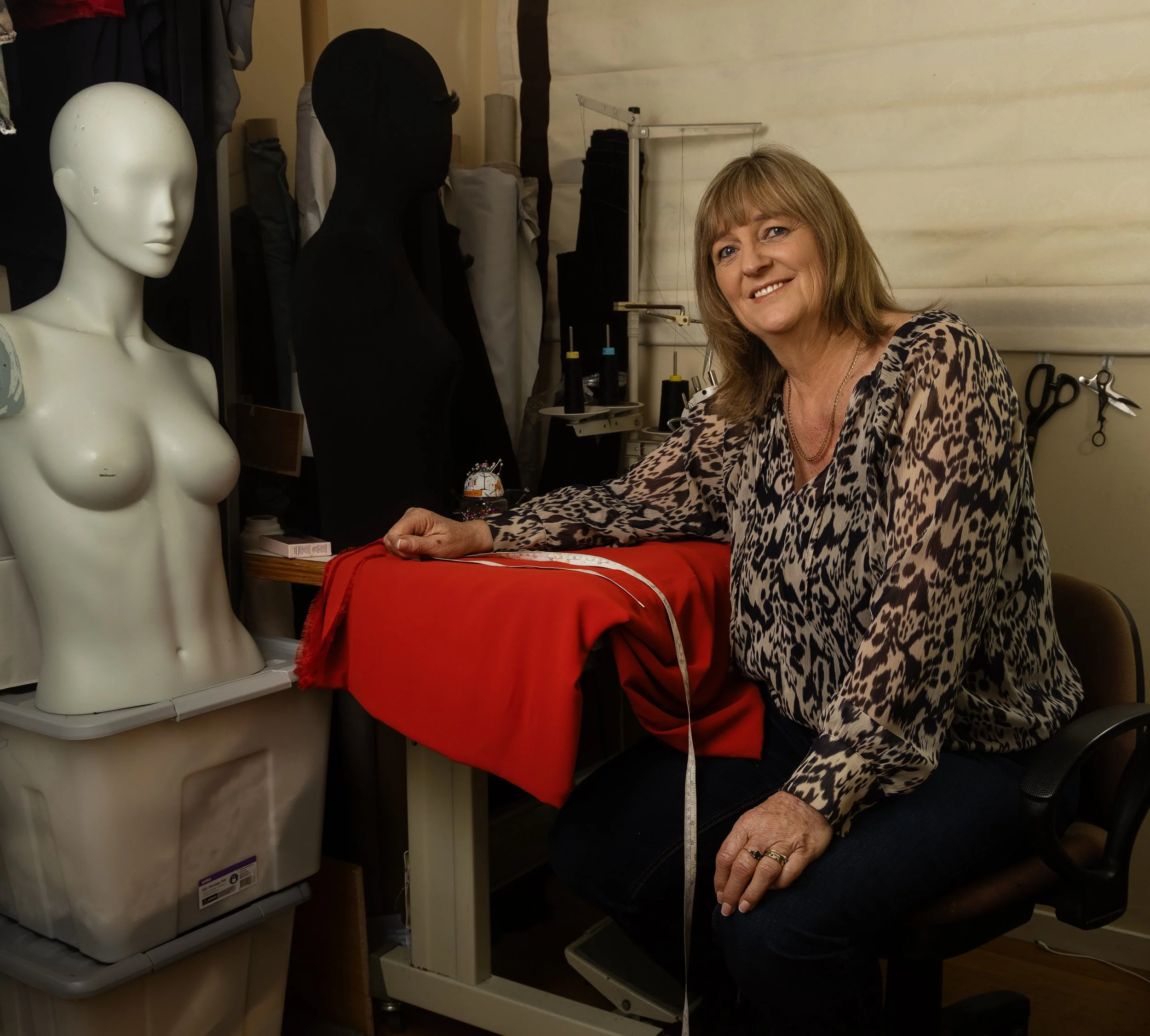
ANNE-MARIE SIMON Anne-Marie Simon has worked on the education side of fashion since 2008, as a tutor at Toi Ohomai Polytechnic. Prior to this, she worked as a machinist, pattern-maker, production manager and designer, and overseas manufacturing interior soft goods for luxury launches. Over the years, she’s successfully entered art and design events such as the Miles Art Award and the Parkin Drawing Prize, enjoying working with textiles and thread to explore non-traditional creative works.
In 2025, Anne-Marie undertook academic research following her 2018 Master of Educational Leadership. For this, she explored the impact of technology on wearable art design and how designers integrate digital and traditional textile techniques in their creative practice. “Although new technology has an important place and enables outcomes that would likely be impossible by hand, you still have to have the creative idea, and bring that vision to life,” she explains.
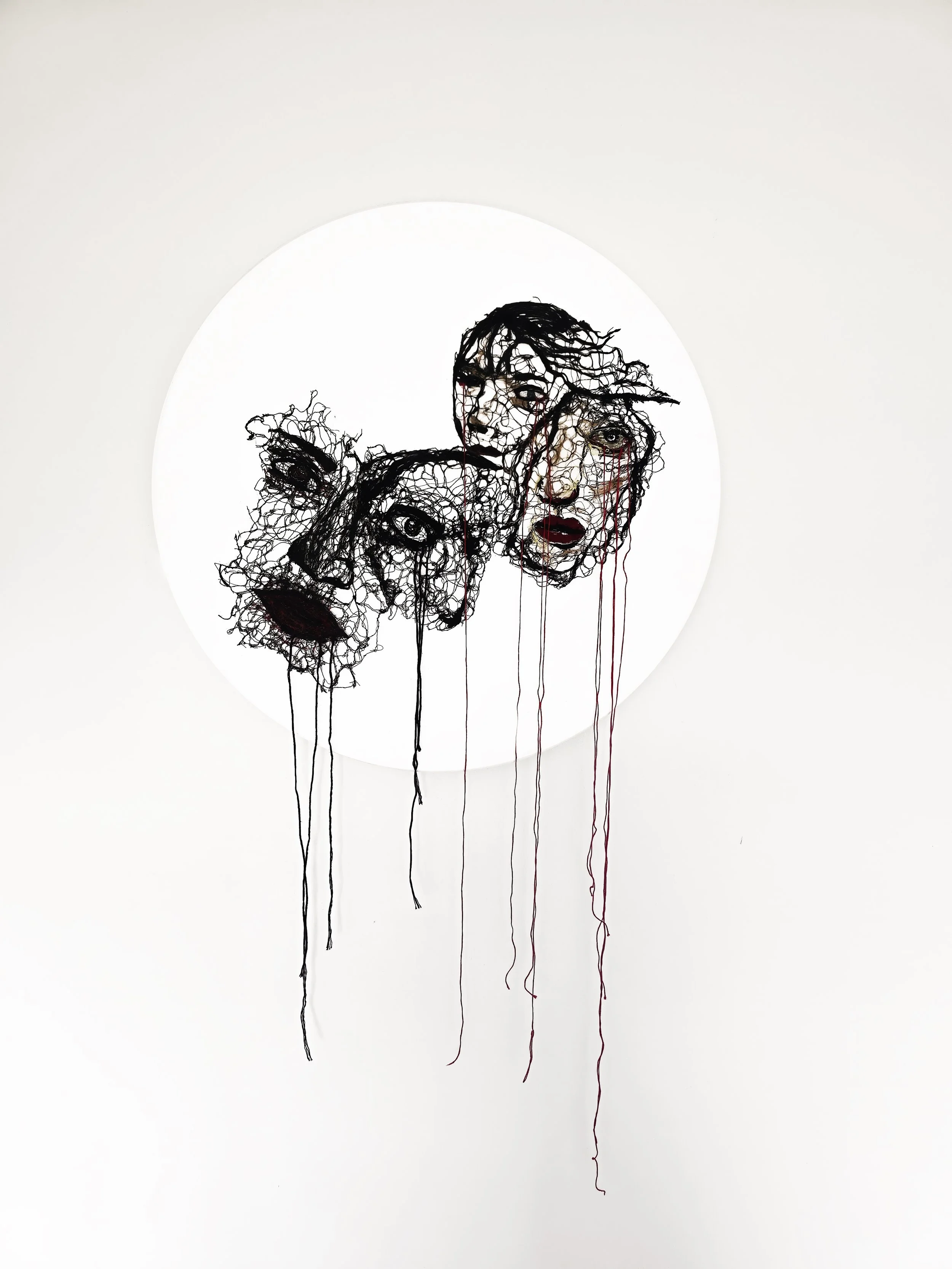
Interviewing and surveying previous WOW finalists about their processes and techniques inspired Anne-Marie to enter. She combined both traditional and digital techniques, experimenting, testing and problem-solving along the way, over many months and late nights in her home studio. Did her research influence her garment? “Absolutely – that and a large bucket of RJ’s Licorice Allsorts. The experience has also led to my next project, The Digital Seam, an exhibition I’m curating for Toi Ohomai’s Mauao Gallery in October, featuring works from previous WOW finalists. I’m thrilled that Georgia [Chalmers-Jones, overleaf] will be part of the panel on opening day!”
GEORGIA CHALMERS-JONES Film and television costumer Georgia Chalmers-Jones has entered WOW three times, each time gaining a finalist nomination. In 2023, she was a sectional winner with her first piece, The Golden Age of Queens, inspired by the reigning queens of the 14th and 15th centuries. The mainly leather piece was made with traditional leather tooling (largely self-taught) and by hand-cutting the lace with a scalpel.
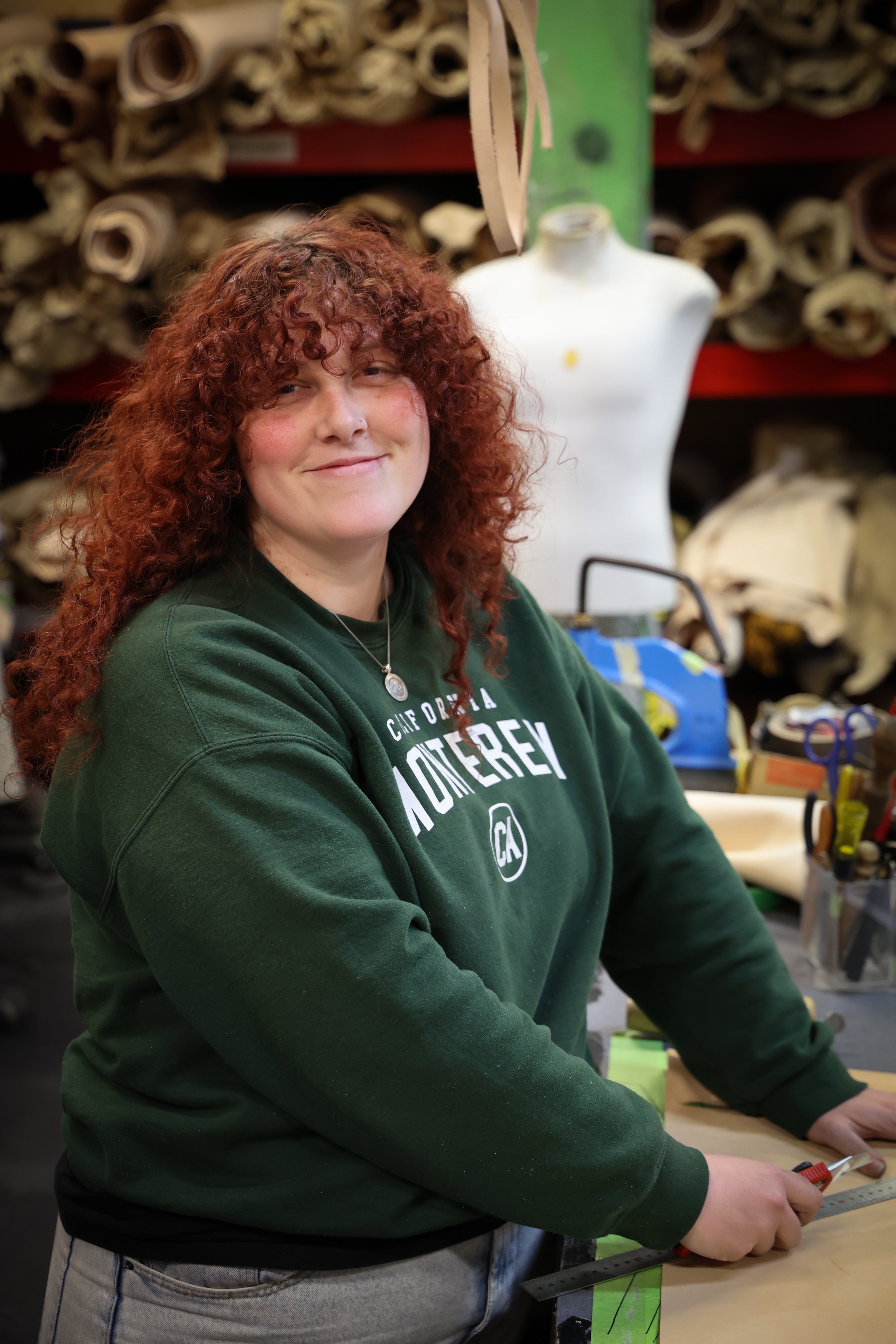
Having studied at the South Seas Film & Television School in 2013, then worked in the UK for a couple of years on Outlaw King and Outlander, Georgia has been part of the film industry for 10-plus years, contributing to movies and TV shows including East of Eden, Spartacus, Time Bandits and The Lord of the Rings: The Rings of Power. She’s currently working in Wellington on The Hunt for Gollum, and when UNO spoke to her, she was “hiding in a cupboard because it’s so noisy in the design room! I’m usually part of a 50- to 80-strong costume department... embroiderers, jewellers, sculptors, seamstresses, dye and textile technicians, art finishers, illustrators, leather workers. Each is so skilled and exacting in their craft, there’s such a wealth of knowledge and shared techniques that I can learn from and experience in my day-to-day.”


While creating her current piece for WOW, Georgia was working on The Legend of Zelda. “I made it at home in every spare moment I could find. I didn’t have enough space to paint it, so I laid dropcloths in the lounge. It wasn’t quite as wild as my 2024 entry, Hakuturi, though. For that, I had to soak and flatten the ends of nīkau palm leaf before I could cut it, and the only way was to get in the shower wearing it.”
EMMA HIGHFIELD A six-time finalist since 2007, Emma Highfield’s no stranger to fashion. After completing her Bachelor of Fine Arts at Elam School of Fine Arts, she launched a bespoke lingerie brand. “I handcrafted everything myself; I’m a self-taught pattern-maker and seamstress. My designs, Emma Highfield Lingerie, were showcased in [lingerie show] Project Born in 2012, alongside Wētā Workshop. I’ve always loved creating art in many mediums. I’m a co-founder at [women’s fashion label] Dear Dylan, which is very design-based work, but also very different to my personal creative pursuits. WOW’s an opportunity to explore my interests in new and exciting ways.”

Having had a break as she grew her business and became a mother, she’s back with passion. Her 2026 entry was inspired by time spent in her flower beds, an environment where growth is shaped by tenacity and care. “It’s always such an amazing achievement to be selected as a finalist and have my work showcased in such a spectacular event,” she says. “I already have a few exciting concepts I’m pondering for WOW 2027.”
Like Georgia and Emma, Anne-Marie’s work may become a fixture at WOW as well. “Regardless of the judging outcome, this experience has inspired me to enter WOW again,” she says. “I was thrilled and genuinely shocked to be accepted. After researching and admiring the work of previous finalists, it feels quite surreal to now be one myself.”

Georgia agrees. “It’s always such an amazing feeling. It’s both a sigh of relief and intense. You spend all that time creating and making and putting your soul into the piece, then you wait while it goes through the judging process, and you almost forget you have an entry. It’s so exciting to see how it’s featured on stage.
“I’ve caught the bug,” she continues. “I was warned by another designer after my first entry, that it’s a real possibility that you’ll give up a good chunk of your life to create a new and exciting piece every year, if you can. It’s definitely not a bad problem to have!” WOW fans are in for a treat, and the judges have a challenge on their hands.

LAUGHING MATTERS
Vulnerable, powerful and a whole lot of fun, Riley Brebner’s brand of entertainment both tickles the funny bone and tugs at the heartstrings.
Vulnerable, powerful and a whole lot of fun, Riley Brebner’s brand of entertainment both tickles the funny bone and tugs at the heartstrings.
WORDS MONIQUE BALVERT O’CONNOR
Former Aquinas College student Riley Brebner used to get in trouble now and then for laughing and talking too much at school. Imagine turning that into the foundation of a career.
Riley’s done just that, and the theatre-maker will soon be on stage to deliver a smash-hit, debut solo show as part of the upcoming Tauranga Arts Festival – at which laughing will be fully encouraged. UNO’s thrilled to sponsor this home-grown talent.
Riley learnt about the power of laughter at an early age. It turned out to be an invaluable tool when it came to dodging detention and fitting in.
“I could diffuse a situation by making my teachers laugh, and I got into the popular group because I was funny,” they say. “I think I laugh more than many people. Humour’s a big thing for me – it’s how I connect with people. I’d never survive in a serious job.”
Instead, 25-year-old Riley has a job that’s designed to make you chuckle. Their hour-long solo comedy show Eat, Sleep, Dance, Repeat, which Tauranga festivalgoers will soon get to enjoy, was a sell-out success in Auckland recently. It also won Riley the Most Promising Emerging Artist award and the Dunedin Fringe Tour Ready award at the NZ Fringe Awards in Wellington.
In a mockumentary format, the show follows four students (all played by Riley) rehearsing for a Stage Challenge performance. It’s written from the teenager’s perspective as they endeavour to win the nationals, and tracks the rehearsal process – in which lots of things go wrong and relationships form.
Speaking from their parents Megan and Mark’s Tauranga home, Riley says, “I describe it as a love letter to the arts. Think of the number of hours you put into preparing for a performance like Stage Challenge, and at a time when your understanding of the world is so funny. It’s when you learn about bigger things, form opinions and your own identity, feel vulnerable, have crushes, discover where your passion lies. As a teenager, I remember thinking, ‘This is my whole world’.
“It’s so fun to perform and play these teenagers, who are based on people I went to school or drama school with – and I reckon I’m a little bit of all of them. It’s nostalgic in terms of overall high school experiences.”
Speech and drama and a good dose of acting were all part of Riley’s school years. They enjoyed performing in Tauranga Musical Theatre’s The Wizard of Oz and The Little Mermaid, then directed Chitty Chitty Bang Bang during a gap year before heading off to study at the National Academy of Singing and Dramatic Art in Christchurch. They graduated in 2022 with a Bachelor of Performing Arts and the realisation that acting and creating work was a passion – as well as the way to be seen and get work in Aotearoa’s performing arts world.
Riley says their favourite thing about theatre is how impactful it can be. Educational work to benefit young people was an early post-graduate focus, via school tours of performances including Crash Bash, about safe driving, and Sex Wise, on sexuality, consent and online safety. Then came a successful audition for TV show, Camp Be Better, which spurred a move to Auckland.
Riley loves that their adopted city has a fabulous improv scene and a group called Bull Rush that puts its hilarious, fast and fearless acting on show every Friday at Basement Theatre. “That’s been my launch into the Auckland theatre scene... how I got seen and got to meet the right people and set up important connections,” says Riley, citing comedian Tom Sainsbury as a mentor.
Performing with Bull Rush, touring Eat, Sleep, Dance, Repeat, writing a TV show, creating a play, working to pay the bills, and studying towards a post-graduate qualification in teaching all keep Riley happy and busy. Becoming a drama teacher one day could be on the cards.
“I have a passion for working with teenagers. It’s the seed from which a lot of my work inspiration comes from. Teenagers need stories in which they can see themselves.
“My favourite theatre is vulnerable comedy – it comes from people living in their truth. ‘Tickle the ribs, then stab the heart’ is a quote I really love. You’re allowing your audience to feel safe, connect with you and let you in, and at the same time you’re talking about really important things. These are the shows that affect me and inspire my own work.
“Oh, and it’s great to have people laughing.”
A Canadian acrobatic troupe, singing sensation Macy Gray, local legends Hittmen Bucket Drummers, bilingual theatre, cult cabaret, music shows, classical piano, a pocket orchestra, a light installation, a poetry slam, a zinefest, a literary programme, an interactive gaming event, comedic performances and more – Tauranga Arts Festival 2026 is set to deliver big time.
Eleven days and nights will be jam-packed with fun from October 22 to November 1.
Visit TAURANGAFESTIVAL.CO.NZ for information and tickets. Tickets are also available from Baycourt and Eventfinda.

BETWEEN THE LINES
Make a well-deserved date with one of the latest page-turners to hit our shelves.
Make a well-deserved date with one of the latest page-turners to hit our shelves.
THE NOWHERE BOY
Anne Cleary, Allen & Unwin
Winner of the 2025 Allen & Unwin Aotearoa NZ Fiction Prize, Anne Cleary’s debut novel explores the razor-thin line between love and obsession. When three-year-old Oliver vanishes from a remote beach carpark, suspicion and desperation ripple through everyone left behind. As the search for Oliver intensifies, another woman clings to the impossible belief she’s been handed a second chance at motherhood. Tense and impossible to put down, The Nowhere Boy is a haunting must-read for fans of psychological drama.
FAMESICK
Lena Dunham, HarperCollins
Part memoir, part reckoning, Famesick sees Lena Dunham reflecting on the dizzying highs and brutal fallout of fame. Charting the years after TV show Girls turned her into a cultural lightning rod, Lena writes candidly about chronic illness, addiction, ambition and the cost of living publicly while privately falling apart. The book peels back the glossy veneer of celebrity to reveal a woman trying to reclaim herself beyond fame.
YESTERYEAR
Caro Claire Burke, 4th Estate
This unsettling and addictive debut novel takes a sharp swipe at influencer culture. Natalie Heller Mills has built an empire selling the fantasy of wholesome pioneer living to millions online, with polished sourdough loaves, a cowboy husband, perfect children and all. Then she wakes to find herself trapped in the brutal realities of the 1800s she’s been romanticising. Darkly funny, Caro Claire Burke peels back the performance of modern femininity and asks what’s left underneath.

ORGAN SPEAK
Giulia Enders, Harper Collins
More than a decade after Gut, Giulia Enders is back with a wider look at the body’s inner workings. Organ Speak explores what our organs can teach us about stress, healing, safety and connection. Enders has a knack for making science feel surprisingly intimate, by swapping dry medical jargon for sharp storytelling and everyday insight. This is the kind of book that makes you pay closer attention to yourself.
WHY WE GARDEN
Hannah Moloney, Simon & Schuster
In Why We Garden, Australian gardening guru and Gardening Australia presenter Hannah Moloney digs beneath the soil to uncover what really draws us to growing things. Page by page, she weaves together stories from gardeners, artists, activists and everyday people to reveal how gardening nourishes far more than our backyards. Hannah makes a compelling case for gardening as an act of hope and care in an increasingly disconnected world.

RULE OF LIES
Jamison R Firestone, HarperCollins
This political thriller plunges readers into the chaos of post- Soviet Russia through the eyes of an American lawyer caught in the middle of corruption and rising authoritarianism. From mafia threats to exposing state corruption alongside Sergei Magnitsky and Alexei Navalny, Firestone’s real-life story unfolds with the pace of a spy novel. Rule of Lies is an eye-opening account of power and survival under Putin’s Russia.