

A taste of Somethin’ Somethin’
Mount Maunganui’s cheekiest café is shaking up the scene with matcha magic, cult-status offcuts and a drinks menu that’s anything but ordinary.
Mount Maunganui’s cheekiest café is shaking up the scene with matcha magic, cult-status offcuts and a drinks menu that’s anything but ordinary.
WORDS Hayley Barnett | PHOTOS Rachel Hadfield, Timmo and Sarah Brooky

Tucked behind a couple of shops on Mount Maunganui’s Heath Street is a café where somethin’ cool is brewing. And I don’t mean the coffee, though that’s good, and super cool, too.
The old Heath Street Café is now being run by dynamic husband-and-wife duo Nathan and Ash, a foodie couple who admit Somethin’ Somethin’ wasn’t always the plan. In fact, Ash didn’t even know Nathan had bought the place until it was a done deal.

“I think if I’d known, I probably would’ve talked him out of it,” she laughs. Thankfully, she didn’t. What started as a spontaneous leap into hospitality has turned into one of the Mount’s most loved destinations for coffee, creative snacks and viral drinks.
Ever tried a white chocolate or strawberry matcha? Ash, now the mastermind behind the drinks menu, didn’t know what matcha was at first, but, since learning about the healthy beverage, she’s gone
deep down the rabbit hole.

“I just started Googling and experimenting,” she says, “and now people literally drive from out of town for our drinks.”
These drinks aren’t just photogenic, they’re genuinely delicious. And yes, they make great content for the ‘gram, but what really sets Somethin’ Somethin’ apart is how it doesn’t try to be just another café.
“We didn’t want to open a regular place,” Ash says. “We wanted to do something a little different. We wanted to make it a place people go out of their way for.” And they have. From their now-iconic “offcuts” (random bits of delicious baked goods that became so popular they now sell out daily) to their ever-evolving menu inspired by international coffee trends, Somethin’ Somethin’ is always doing, well, something.
Take their trip to the Melbourne Coffee Expo earlier this year, for example. That sparked an entire menu revamp.
“In Melbourne, people take their coffee so seriously,” Ash says. “Every café had its own coffee menu, cocktail-style. We came home and thought, why aren’t we doing that?”
Now, they serve up seasonal coffee specials that go beyond the flat white, like their signature Mount Blanc.

Food-wise, Nathan brings the ideas. A self-proclaimed foodie who never wanted to be “on the tools”, he’s the brain behind the food menu, while their tight-knit kitchen team brings them to life. After winning Battle of the Snack at the Flavours of Plenty festival, they also took out the People's Choice Award, beating local heavyweights. “We didn’t think we’d win again,” Ash says. “I didn’t even go into work that day!”
And while it still looks and feels like a café (for now), Somethin’ Somethin’ is constantly pushing the boundaries. With event catering and collabs with local brands, Ash and Nathan are dreaming bigger than just brunch. “We want it to be a community hub,” says Ash, “but also a destination café. The kind of place you tell your friends about.”
They’ve nailed both.

Future served
Young Kiwis are flipping expectations while quietly growing into tomorrow’s leaders.
Young Kiwis are flipping expectations while quietly growing into tomorrow’s leaders.

Jaun Odendaal
Walk into any McDonald’s across the country and you’ll find something remarkable happening behind the counter. Teenagers and young adults are managing teams, solving problems on the fly, training others, and picking up life skills they’ll carry long after they leave.
As one of Aotearoa’s largest youth employers, McDonald’s employs more than 10,000 people across the country, with around 70 percent of them being under 25. While it’s often seen as just a stepping stone, what’s becoming increasingly clear is that Macca’s can be the launchpad for something much bigger.
Seventeen-year-old Hamish Lawes, from McDonald’s Fenton Street Rotorua, is proof of just how far a young person can go when given the tools and encouragement to grow. Having joined the crew a year ago, the John Paul College student and avid musical performer, was drawn to the flexibility Macca’s offered.
“I liked the hours and the team,” he explains. “When I started, I thought I’d come and get the job done, but the more I learned, the more I realised how much opportunity there actually is.”
He’s now assistant shift manager, preparing to take on the shift manager role, and will soon be attending McDonald’s Advancing Your Leadership course.
“I love that no two days are the same,” he adds. “Teaching others different stations keeps things fresh, and the problem-solving skills I’ve gained are things I’ll use forever.”

Hamish Lawes.
Down in Taupō, Jaun Odendaal has had a similar experience. At 23, he’s been at McDonald’s for four years.
“I started while I was still in school, just to make some money,” he says. “I enjoyed the job so much I decided to stay and work up the ranks.”
Now a crew trainer with a hand in kitchen operations and maintenance, Jaun is aiming for a management role.
“It’s not just about flipping burgers,” he says. “For me, being a crew trainer is about understanding people. I like figuring out how they learn and adapting the way I train.” Looking ahead, Jaun adds, “I want to be the best manager I can be for my crew.”
There’s still a tendency to underestimate jobs like these. But, in many ways, what young people learn at Macca’s, including valuable skills like communication, time management and teamwork under pressure, are the same skills that carry them forward in life, no matter what they choose to do.
For Hamish, Jaun and many others, it’s not just a job. It’s where they learned to back themselves.

Raising spirits
How three Bay distilleries are redefining New Zealand gin.
How three Bay distilleries are redefining New Zealand gin.
PHOTOS Alan Gisbon + Erin Cave + Supplied
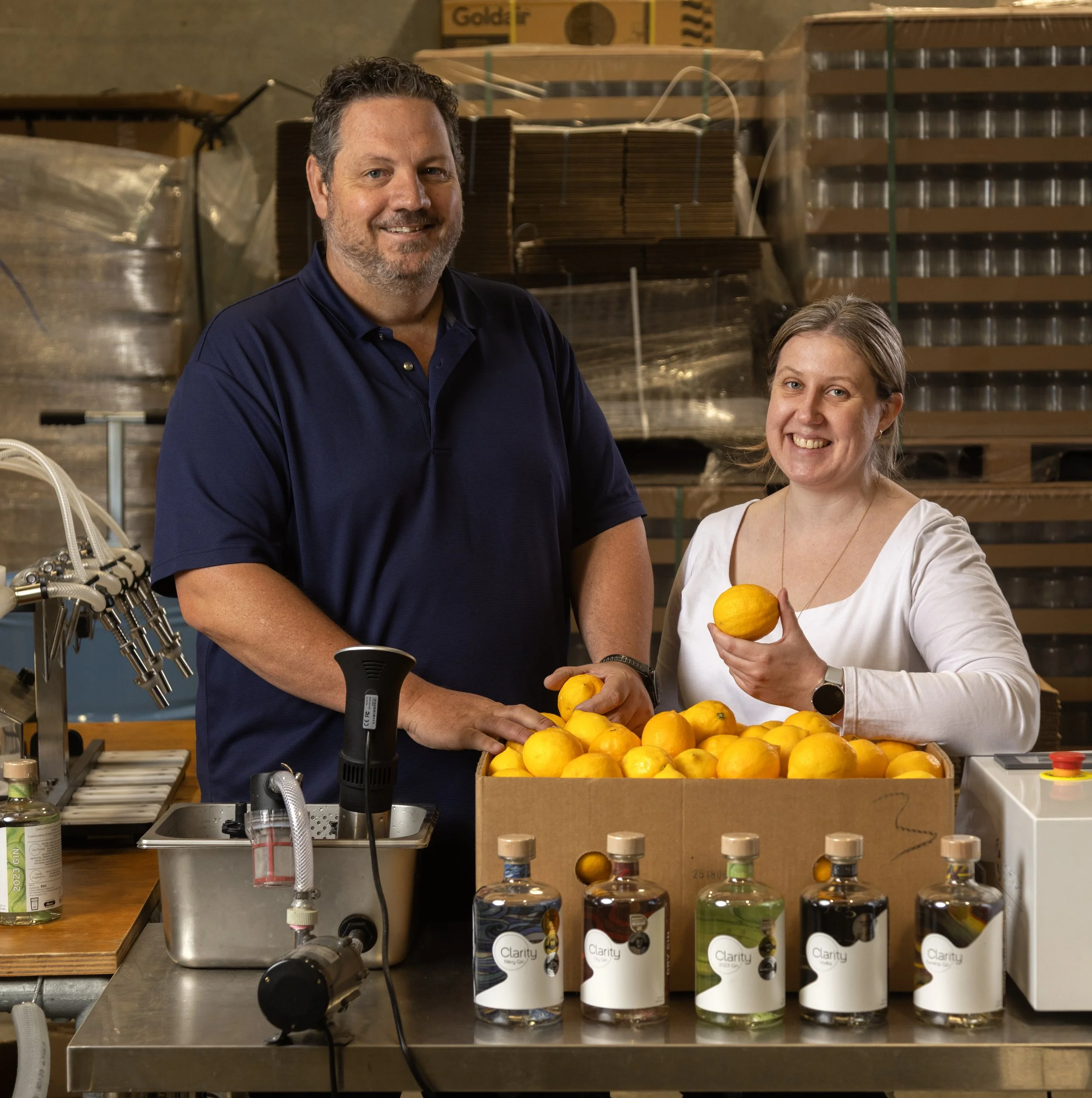
George White and Stephanie Downer's successful Clarity Distilling Company started as a hobby.
It might seem unlikely, but behind the roller doors of a nondescript unit in Tauriko’s commercial estate, two friends are crafting one of the world’s best gins. Just 25 minutes away in another small space in Ōmokoroa, a similar story is unfolding as two friends blend botanicals to bring their award-winning gin to life. And just over the hill, in Matahui, gin drinkers can bottle their own creation - and become award winners themselves.
Far from being on the rocks, gin is obviously continuing its recent resurgence. The clear spirit has gained popularity thanks to its clean herbal aromatics and botanical complexity. Because gin can be produced relatively quickly, small-batch makers have embraced it as a space for creativity, developing unique signature styles and exciting flavour profiles. Juniper remains the foundation, of course, but now it’s not unusual to find exotic ingredients like mānuka, licorice, or Szechuan pepper in the mix, adding bold new twists to traditional flavours. Small independent distilleries in the Bay of Plenty are at the forefront of the gin revolution here in Aotearoa.
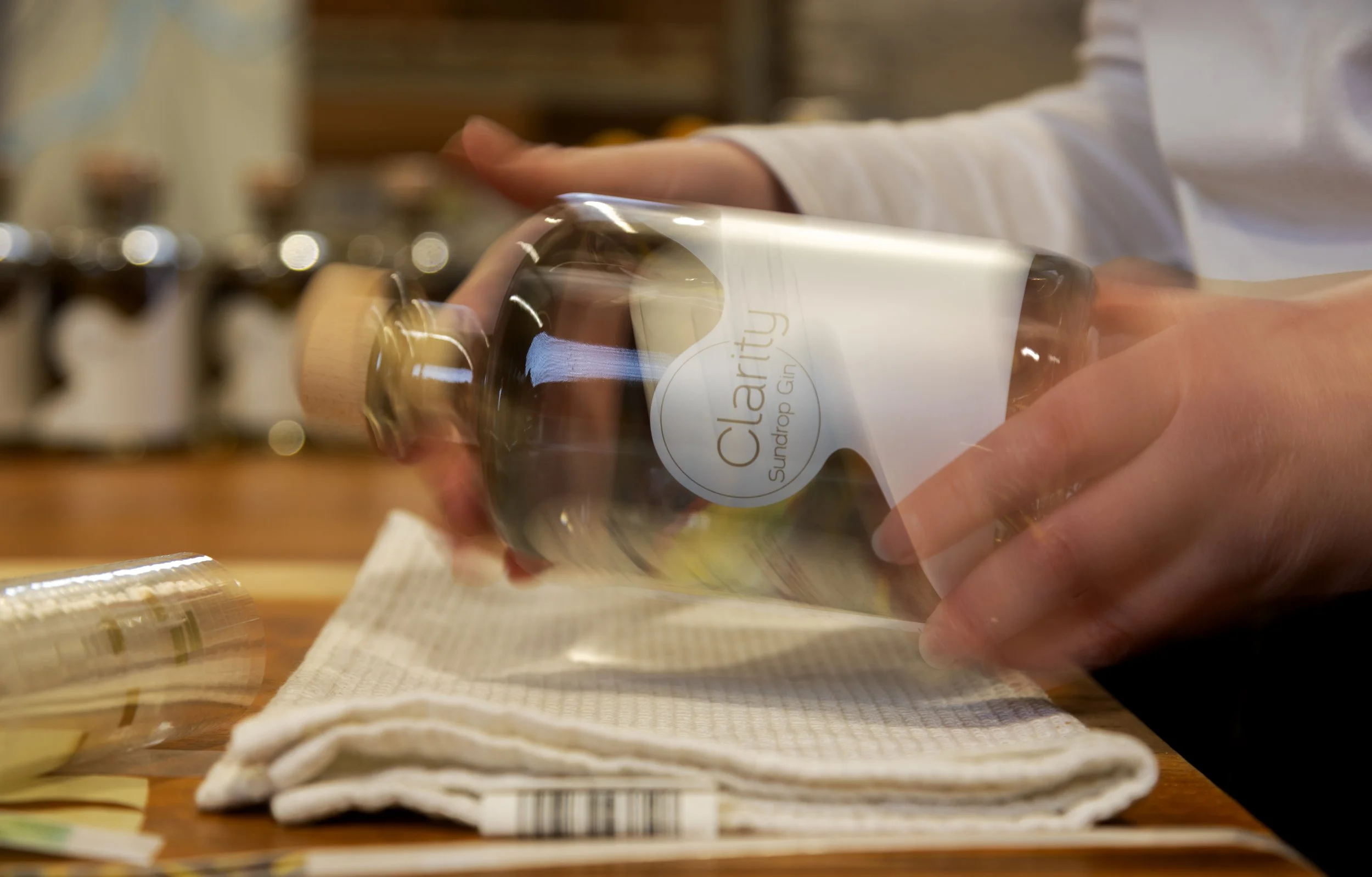
Clarity Distilling Company, Bay Distillery and Matahui Distillery are three local producers who are lovingly crafting world-class gin, right here in the Bay. While their approaches to gin differ, the three small batch distilleries share plenty in common. Each is run by a pair of hands-on founders who manage every part of the process themselves, from developing recipes through to distilling, bottling and branding.
Their gin may be internationally recognised now, winning back-to-back golds earlier this year, but Clarity started as a hobby for George White only a couple of years ago. It was something he’d do in his downtime away from the childcare centre he and friend Stephanie Downer had started.
“I’ve always been a guy that likes to cook at home and try recipes and create flavours,” George says. “Gin is open. There are no restrictions. You can do whatever you want. You can put anything into that still and create any flavour you want.”
It was George’s love of cooking that would become Clarity’s secret ingredient. Rather than traditional methods, which see all the botanicals distilled together, the pair instead steep each ingredient individually.
“When you make a gin, it’s like cooking, except you’re dealing with botanicals,” George explains. “When you cook a stew, you don’t throw your meat, herbs and everything in and shut the lid. You layer it. So why would making gin be any different to that?”
This meticulous process of distilling each element separately allows them to exactly control how much flavour is extracted and then added to their blend.
“We get the best out of every single botanical,” George smiles. “Because all that’s in our gin is the botanicals. That's where all of the flavour comes from.”
It’s proven to be a winning formula. In May, their Clarity Navy Gin was awarded ‘Spirit of the Year New Zealand’ at the prestigious 2025 London Spirits Competition. They also have multiple Double Golds from San Francisco, and took home ‘Best London Dry’ and ‘Best Navy Strength’ at the NZ Spirits Awards and NZ Small Batch Gin Awards this year.
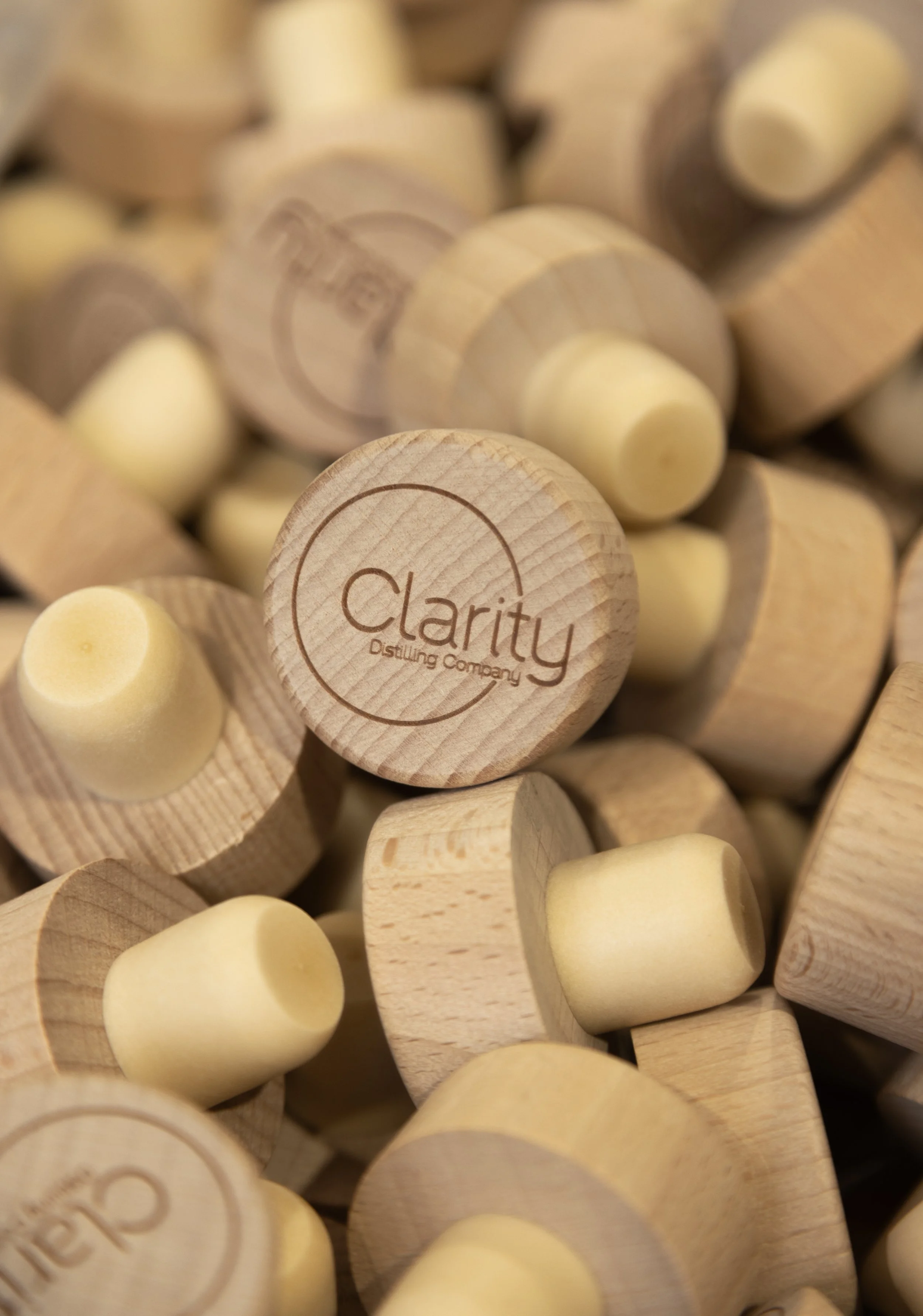
Just as much care has gone into Clarity’s look, with Stephanie handpainting the label’s distinctive artwork and even illustrating the ingredient list.
“That’s part of our ethos,” Stephanie says. “Essentially, if it's not on the bottle, it's not in the bottle.”
The operation has quickly scaled up, now with six distillers and upgraded bottling systems. But George says they don’t want to grow for growth’s sake.
“We want to be a household gin, not a special occasion gin,” he says. “We want to be affordable. If people are going to buy gin, we'd much rather let them buy a New Zealand gin.”
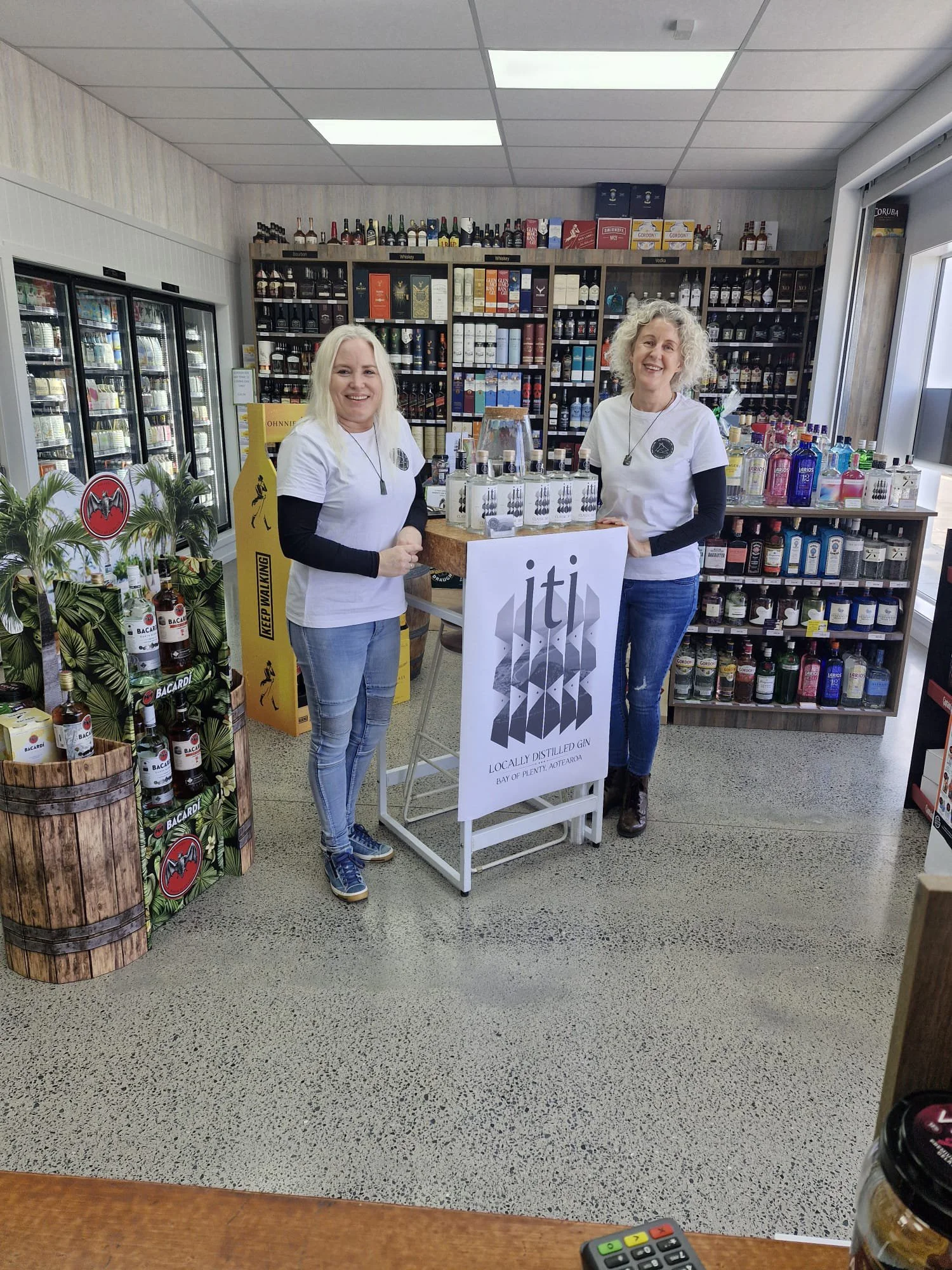
Gin makers Karen Hawkins and Denise Roscoe.
It’s a similar story over at Bay Distilling, where gin makers Karen Hawkins and Denise Roscoe launched their gin after running a coffee caravan in Ōmokoroa.
“We both like coffee, so we had a coffee business,” Karen says. “And then we sold that and thought, ‘what else do we like?’ Well, we quite like gin...”
They spent a year in the garage perfecting their dry gin recipe, encouraging friends to give honest feedback, though it was mostly glowing.
“We like a classic dry gin and really wanted to get that right,” Denise says.
Their gin iti recently took silver at the NZ Small Batch Gin Awards. Now in a commercial space, they handle everything from distilling to packing themselves, with a little taste-testing help from Karen’s husband. Their
branding is rooted in the local landscape, with a label designed by Karen’s daughter.
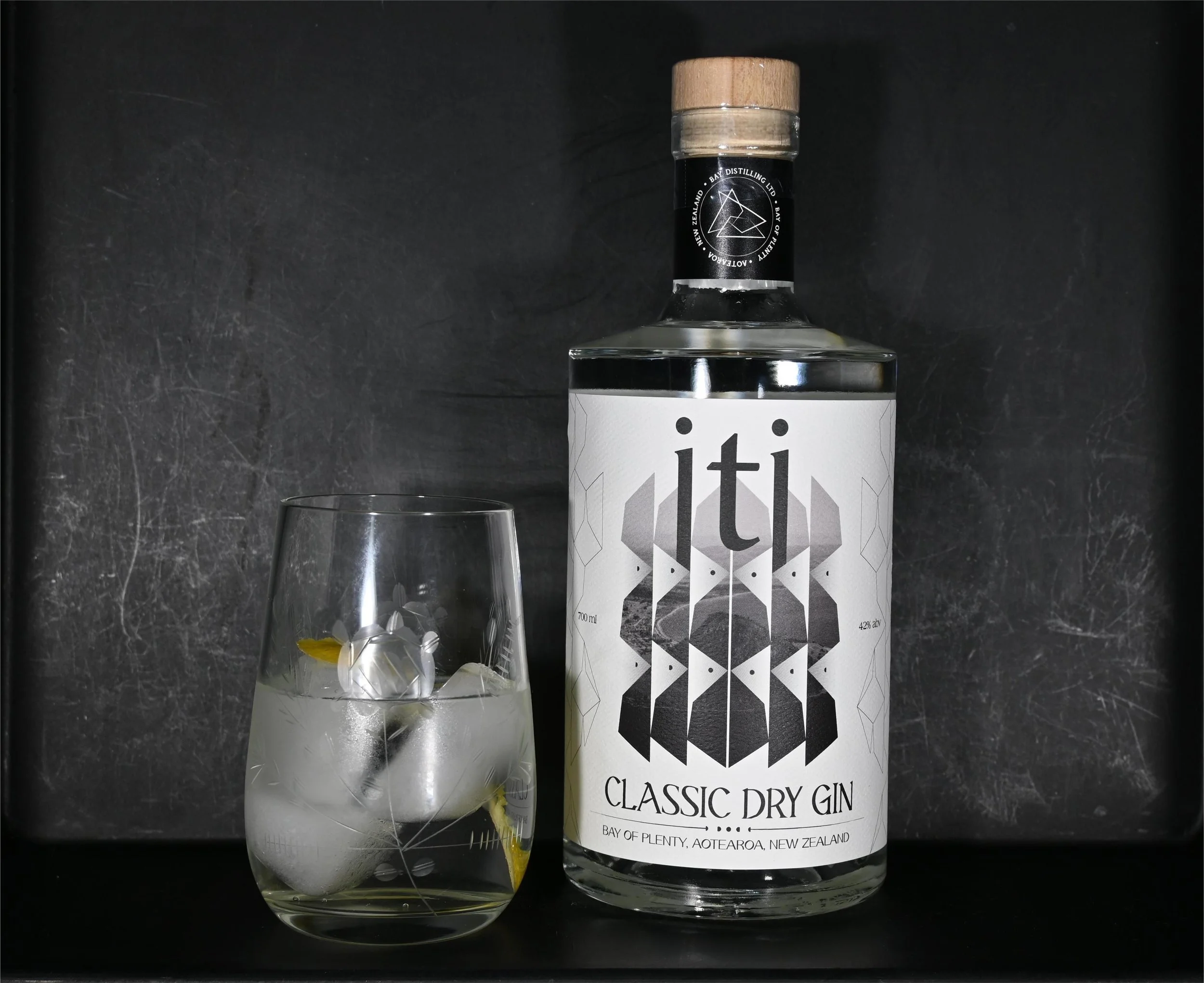
Meanwhile, just outside of Tauranga, Matahui Distillery offers something unique: a chance for people to create their own gin, and potentially win awards for it.
“Late last year, people who had come through our gin lab were asking for feedback on their creations,” says co-founder Paul Horak. “That’s where the Matahui Gin Lab Awards came from. It’s a bit of fun, but with proper base testing and scoring of their recipes.”
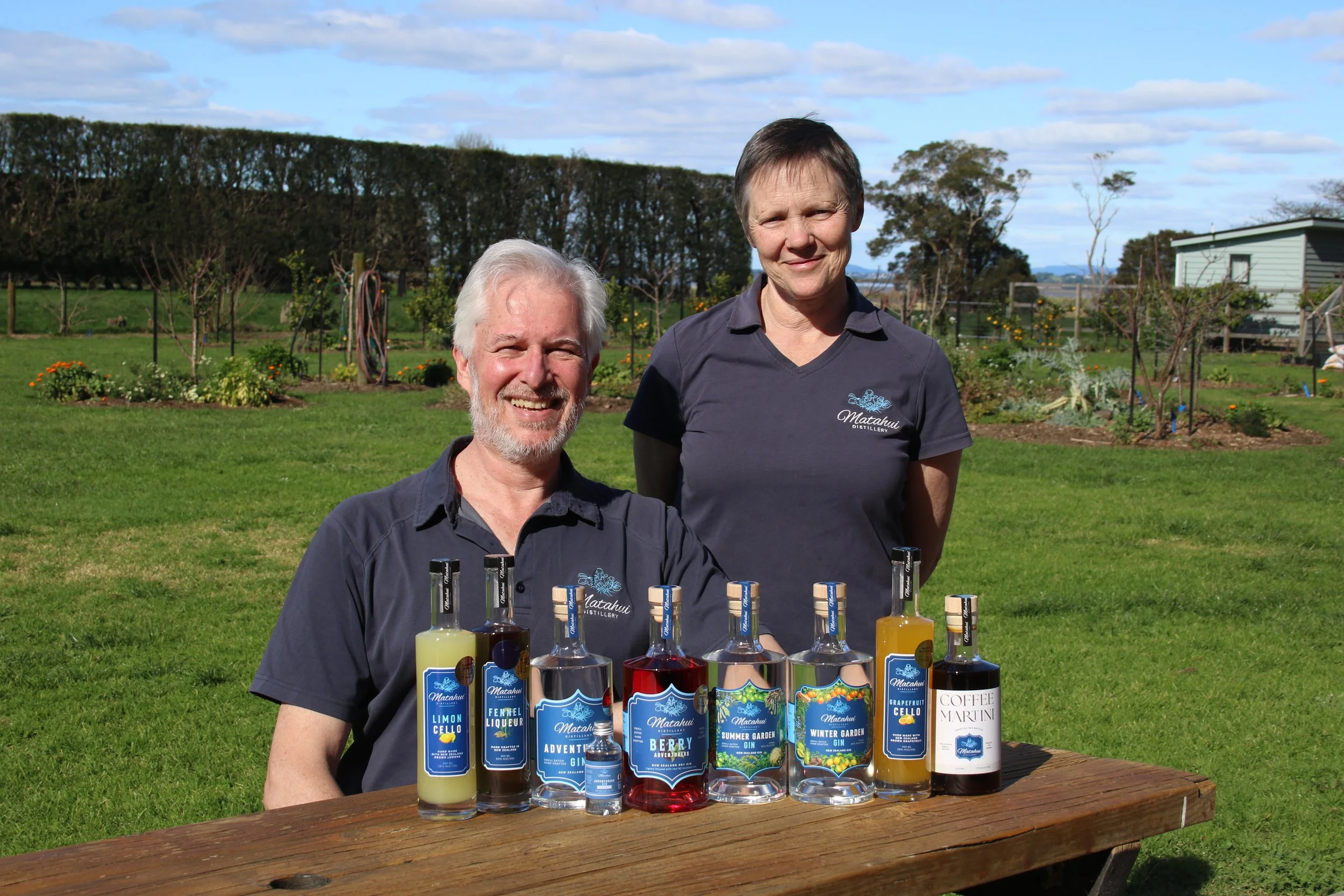
Matahui Distillery’s Paul Horak and Angela Howard with their handcrafted spirits.
The gins are created through blending pre-distilled botanical spirits, a process Paul says is used by commercial distillers like Hendrick’s. “It’s actually the best way to develop a recipe,” he explains. “You can quickly see what works, then adjust quantities until it’s perfect.”
Although their signature Adventurers Gin earned silver at the NZ Spirits Awards, the focus at Matahui is on the customer experience. “We’re not aiming to become a big factory,” Paul says. “Selling direct allows us to stay small, and our workshops help fund our own small-batch experimentation.”
The experience has evolved too. Originally participants distilled on-site, but council restrictions prompted a shift in method. “In hindsight, it pushed us to improve,” Paul says. “Now we focus on flavour — people still walk away with a gin they designed, but the quality is even better.”
They’re also working on home-blending kits, so people can recreate the experience themselves. “It’s something we want to launch in time for summer,” he adds.
While many come to Matahui for birthdays or hens’ dos, Paul says it’s just as often individuals with a curiosity for gin.
“New Zealanders are still discovering gin. Every gin is unique, and that surprises a lot of people. But once they learn more about it, they’re hooked.”
These three small-batch distilleries are proving that success in the competitive spirits market doesn’t require big investors or a corporate machine. Instead, it’s passion, ambition and a classic Kiwi ‘can-do’ attitude that are putting them, and the Bay, on the map.

Echoes of the giants
Moa bones, eagle claws and ancient wonders are sparking young minds in the Bay.
Moa bones, eagle claws and ancient wonders are sparking young minds in the Bay.
WORDS JO-MARIE BAKER
Photos courtesy of the Tauranga Museum collection.

Peter Jackson’s Jurassic Park-like plan to resurrect the moa is still a long way from reality but Tauranga students can literally get their hands on the giant bird’s bones, a replica moa egg and even a life- size Haast’s Eagle claw right now.
The objects are among the most popular items in Tauranga Museum’s Hands On Collection available for local teachers to borrow, free of charge.
“We have a set of real moa bones that were found in Te Puke and they’re some of our most popular objects,” explains museum educator Megan Hoskin. “We have 14 bones in all – three huge leg bones, ribs and vertebrae. It’s incredible that children can have these in their classroom and are allowed to handle them.”
The recent addition of a replica Haast's Eagle claw (which was big and powerful enough to kill an adult moa) is also grabbing attention. “The Haast’s Eagle is something children just have an innate curiosity about. We have roughly 250 objects in our education collection that teachers can borrow. It gives a zing to a classroom and sparks excitement, enthusiasm and curiosity. If a class is learning about space, for example, we have meteorites that are four and a half billion years old. Allowing children to hold objects and pass them around is a great way to hook them into a topic.”


The collection is available to schools within Tauranga City Council’s boundary. Teachers simply book objects online and Tauranga Museum will deliver and collect them. “It could not be an easier service for busy teachers.”
Megan, a former primary school teacher, is also available to run classroom lessons on topics such as The Elms, the Battle of Pukehinahina Gate Pa, the Rena disaster, kiwi, penguins and Tauranga-related aspects of World War One. She believes it’s more important than ever to put physical objects in our children’s hands to help balance learning off digital screens.
While two generations of children have grown up without a museum in Tauranga, the wait is almost over. The city’s new museum will open in 2028 and will feature two purpose-built education spaces along with a Discovery Centre that will focus on Tauranga’s marine environment. “It’s going to be all about the ocean, islands and marine life we have here in Tauranga, so very much a science and environmental Discovery Centre. It will be a very exciting, interactive play space.”

Valley of light
UNO editor Hayley Barnett sees Rotorua in a beautiful new light at Mārama, Te Puia’s unforgettable geothermal nighttime experience.
UNO editor Hayley Barnett sees Rotorua in a beautiful new light at Mārama, Te Puia’s unforgettable geothermal nighttime experience.
PHOTOS Graeme Murray + Supplied

As dusk slowly settles over the geothermal valley at Te Puia in Rotorua, the day’s steam softening in the low bask of the sun, the magic of this place becomes more and more apparent. Beams of light begin to burst through the haze while we sit in Pātaka Kai, Te Puia’s renowned restaurant, enjoying our dinner on the heated deck.
Laser lighting has been meticulously set up across the 70-hectare site, to showcase more than 500 geothermal features, many of which are usually only accessible during the day.

On the launch night of the Mārama Geyser Light Trail, the hush across the valley is about to blossom into an immersive interplay of light and music that will transform Te Puia from darkness into a world of light. But, I soon discover, this is more than a light show; it’s an experience which showcases whakapapa and years of culture.
“Everything we do here is to uplift te ahurea Māori,” says special events manager Reanne Poutama. “With Mārama, Te Puia wanted to create something magical that would reflect our whenua and our stories in a way we’ve never done before.”
It’s clear from the outset that Te Puia has achieved this lofty goal. From the moment you step through the entrance to the 1.5km trail, you’re guided by sound and story. Setting the tone is musician Maisey Rika’s ambient waiata. Her otherworldly voice follows us as we head down the path.

On this night, we’re lucky enough to witness Maisey herself singing atop a point that stands high above the valley, overlooking the geysers and geothermal activity, the lights flickering through the steam behind her. The effect is ethereal and spine tingling.
“Maisey’s songs are the soundscape for the whole experience,” explains Reanne. “We’ve tried to partner our lighting in a way that amplifies each waiata.”
The 10 scenes have been designed to reflect the natural environment, which is infused with Māori storytelling. The trail winds through glowing Māori artworks, bubbling mud and towering trees. At every bend, the valley becomes a theatre. Laser lights ripple like currents above Puarenga Stream, while geothermal steam is lit from within, mimicking ancestral breath. One of the most memorable scenes evokes Tangaroa, atua of the sea, his story told through undulating blue lasers and swelling sound. Standing there, it almost seems as if the sea has risen into the valley.

Midway, the geothermal terrace offers a natural pause. Beneath the steam, natural hot rock seats offer warmth and a moment to breathe, with Pōhutu Geyser in the distance.
Self-paced and child friendly, the walk is around 60 minutes, taking into account all the stops and meanderings. The trail features hosts at certain points along the way, which allows visitors to move at their own pace.
Family accessibility was always part of the vision.
“The inspiration first was to provide something for Rotorua at nighttime for families,” she explains. “But we also hope that it’s accessible to everyone, including locals, internationals and families. It’s priced differently to our usual offerings because we really wanted whānau to be able to come and enjoy it.”
Along the trail are a number of artworks created by Māori artists, including glowing light boxes designed by students from Te Takapū o Rotowhio (the National Stone and Bone Carving School) at the on-site New Zealand Māori Arts and Crafts Institute.
“They’ve designed light boxes that tell our traditional stories,” says Reanne. “We’re weaving in our people’s talents and creative flair.”
That includes Mikaere, a Te Puia guide who created a mural of the story of Mārama using glow-in-the-dark and metallic paints that come alive under UV light.
“He’s amazing,” Reanne says proudly. “He would never usually get to showcase this kind of work, and now it’s part of the trail.”

Another highlight comes near the end of the walk, towards Pikirangi Village, where a forest tunnel glimmers and soft lasers rain down like an aurora, creating a canopy of light. As we gaze upward, everyone around us slows their steps. This is the magic of Mārama. Resting in the final notes of Maisey Rika’s voice, we look out over the valley under real stars. In this moment, it’s hard not to feel connected to te ao Māori. It’s a reminder of how deeply this experience is rooted in wairua.
While Te Puia’s daytime experiences have long celebrated Māori culture through kapa haka and guided storytelling, Mārama is something altogether different.
“This is something very new here,” Reanne says. “We’re usually quite traditional... This is us mixing those traditional elements with modernity. And even if you come during the day, you won’t see any of this. It’s exclusive to Mārama.”
Having grown up in Rotorua, I know this area well, but the whole nighttime experience felt like seeing the valley for the first time. Mārama feels meaningful. It’s a walk through the unseen stories of the land, guided by light and music.
Reanne reflects: “It’s a way to feel connected to our place, to our people and our stories.”
Mārama runs until April 2026, with entry from 7:30pm (Sept–Nov) and 8:30pm (Dec–April). See the website for the Matariki 2026 relaunch. Tickets are $49 for adults and $25 for children.

Ahead of the curve
Salon G’s Shelley Pullar brings a fresh perspective this spring, with soft layers, natural texture and colour that enhances every angle.
Salon G’s Shelley Pullar brings a fresh perspective this spring, with soft layers, natural texture and colour that enhances every angle.
PHOTOS Deborah De Graaf | MAKE-UP ARTIST Sophie Garth | SUNGLASSES Secret Optics | STYLIST Robyne Dowdall

Spring 2025 is here, and this season is all about the cut. Bold pixie cuts, cowgirl layers and even bobs are getting a makeover with curved edges and feathered insides that feel fresh and not too fussy.
The best part is that haircuts are finally working with your natural texture, not against it. It’s all about enhancing what you already have and tailoring it to your face shape. Here at Salon G, we’ve been focusing on helping clients understand how their face shape plays into not just their cut, but their colour too. Think of it like contouring, where bright pieces (like baby lights around the hairline) highlight and add width, while deeper tones (like a soft root smudge or mid-lights near the cheekbones) create depth and really make your features pop.

Colour-wise, we’re steering away from bold, chunky blocks. Instead, we’re loving softer, more lived-in colour, with panelled ribbons, blurred roots and those sun-kissed, low-maintenance tones. Warm shades are big right now: think cherry cola, spiced ginger, rich caramels, espresso browns, and our forever-fave, teddy bear blonde.

Thinking of brightening things up for summer? Book a blow dry and mention this article to get a free Tailored Pre-Spring Hair Treatment, courtesy of Wella at Salon G. You’ll leave feeling totally refreshed and ready for the season.

Wild Eastern roadie
Somewhere past Ōpōtiki, where the coastline starts its slow exhale and State Highway 35 begins to wind and dip like it’s dancing, you’ll find a different rhythm. Welcome to Tairāwhiti Gisborne.
Somewhere past Ōpōtiki, where the coastline starts its slow exhale and State Highway 35 begins to wind and dip like it’s dancing, you’ll find a different rhythm. Welcome to Tairāwhiti Gisborne.

Need a change of pace? This East Coast loop from the Bay of Plenty to Gisborne and back through the Waioeka Gorge is the kind of trip that offers wide roads, coastline and a few surprises along the way. Give it three or four days, and you’ll get much more than you bargained for, along with some very decent stories.

DAY ONE: R IVERS , HORSES AND THE OPEN COAST
Hit the road early from the Bay and follow the coast east. By mid-morning, you're in Motu country, with its remote, green landscapes and winding rivers. Hop on a jet boat with Motu River Jet for a ride that’s part thrill, part history lesson.
Next, swap horsepower for actual horses at Standfast Horse Treks in Te Kaha. These aren’t your standard tourist trails. You’ll cross rivers, ride through native bush and get a salty breeze off the sea. Go for a short trek or stay overnight and wake up to birds and surf.
Stay: Stay in Te Kaha, Waihau Bay or Te Araroa, which has a range of accommodation options from hotels, motels, holiday parks and baches.

DAY TWO: A SLOW CRUISE TO GISBORNE
The drive to Gisborne along SH35 isn’t long, but you’ll want to stop often. The route passes through quiet bays and towns like Waihau Bay and Tokomaru Bay, where everything moves slower, but in a good way.
As you head down the coast, pull into St Mary’s Church in Tikitiki, then be sure to try a pāua pie in Tokomaru Bay before continuing south to walk along Tolaga Bay Wharf.
BONUS ADD-ON: If you’ve got time, book a guided tour up Maunga Hikurangi near Ruatoria. It’s one of the first places in the world to see the sun, and the mountain has deep cultural significance to Ngāti Porou. Stand among the sacred pou (carvings) and watch a once-in-a-lifetime sunrise unfold before you.

DAY THREE: INTO THE BLUE
Once in Gisborne, head to Dive Tatapouri for a close encounter with wild stingrays on the reef. No tanks or tricks, just wading into their world. Later, head inland to Eastwoodhill National Arboretum, home to over 135 hectares of diverse, world-class botanical collections.
Stay: From boutique motels and vineyard cabins to farm stays and holiday parks, Gisborne has a great range of places to stay. Or keep it coastal and fall asleep to the sound of the surf.

DAY FOUR: RAILBIKING
If you’re up early, start the day with a famous East Coast sunrise. There’s nothing quite like it. Afterwards, ease into a leisurely brunch at Flagship Eatery or Zephyr in Wainui, both beloved local favourites. Experience Gisborne Railbikes and pedal along a disused railway line, winding through orchards and soaking in stunning coastal views.

Enjoy an afternoon at one of the local wineries. Matawhero, Wrights and Bushmere Estate each offer unique tastings and mouth-watering food to enjoy.
Evening: Try one of the many amazing dining options, such as Crawford Road, Tahu or check out a unique evening experience at Dome Cinema.
HEADING HOME
Loop back to the Bay through Waioeka Gorge, where the road snakes between thick bush and river cliffs. It’s a scenic end to a trip that packs more into a few days than you'd expect.
TO P TI P S
• Bring layers, swim gear, decent shoes and a curious attitude.
• Choose your level of comfort. Accommodation ranges from campsites and retro motels to lodges.
• If you’re going during summer or school holidays, book ahead.

Unstoppable Women
The BWN Speaker Series 2025 lit up Tauranga with some big names, bold stories and infectious energy.
The BWN Speaker Series 2025 lit up Tauranga with some big names, bold stories and infectious energy.
WORDS CARRIE BROWN

Robyn Malcolm.
When actor Robyn Malcolm, global thought leader Cassie Roma, broadcaster Toni Street and fashion designer Kiri Nathan are all on one stage you know something special is about to happen.
This year’s Business Women’s Network (BWN) Speaker Series brought together an extraordinary lineup of inspiring women, each sharing stories of resilience, leadership, creativity and confidence. Held at Baycourt Theatre in Tauranga, the 2025 event was the largest and most dynamic BWN event to date, drawing 450 attendees for a day of insight, empowerment and connection.

Toni Street.
Toni Street opened the programme with a raw and heartfelt talk on navigating personal hardship, and how sharing your story can foster deep human connection. Kiri Nathan followed with her journey of cultural identity and purpose, offering a moving reflection on what it means to lead with authenticity.
Then came the laughs. Robyn Malcolm delivered a sharp, witty and candid talk that had the audience in stitches while also reflecting deeply on the power of living truthfully at every stage of life. Rounding out the speaker sessions, Cassie Roma brought electric energy to the stage with her call for women to lead with kindness and back themselves unapologetically.

Kiri Nathan.
The event theme ‘Unstoppable: Owning Your Story’ pulsed through every talk. Throughout the day, MCs Jase Reeves and Sam Wallace from Coast FM’s Morning Show kept the energy high and the atmosphere light, weaving fun and warmth through the entire experience.
Guests were welcomed with drinks and canapés before exploring the upstairs Connect and Nourish Hub, where a fresh, vibrant lunch was served alongside sponsor activations and tastings from local vendors.
Downstairs in the Style and Sip Lounge, the focus was on fashion, flair and indulgence.
Guests browsed Kiri Nathan’s garments and pounamu designs, enjoyed makeup touch-ups, sipped coffee and wine, and soaked up the relaxed, elegant atmosphere.
This year’s Speaker Series was more than just an event - it was a celebration of women showing up, owning their stories and lifting each other up.

Cassie Roma.
Tauranga Business Chamber offers a heartfelt thank you to the sponsors who made it all possible: principal partners Cooney Lees Morgan and Craigs Investment Partners, alongside partners Coast FM, KingSt Design, Hatch Consulting, Kale Print, Port of Tauranga, Rentlink Property Management, Toi Ohomai and Westpac. And to the hundreds of women who attended: thank you for being part of it.
The Business Women’s Network is a part of the Tauranga Business Chamber.

Style and space
Landmark Homes doubles the potential with a modern duplex design.
Landmark Homes doubles the potential with a modern duplex design.
WORDS Nicky Adams | PHOTOS Amanda Aitken

If you mention the horse paddock on Ngatai Road, in Otūmoetai Tauranga, most locals will know exactly where you’re talking about. Not many will have driven past at some stage without gazing across the lush field at the stunning view over to the Mount and harbour, and wondered how exactly you go about getting a little piece of this paradise. Just along from here, sharing this jaw-dropping view, is the brand-new Landmark Homes showhome.
With the water glistening as a backdrop, the clean, modern architectural style of the duplex property is eye-catching. At first glance it looks like a single dwelling, however on closer inspection it becomes clear it’s two homes. With an increase in demand for lower maintenance, easy-care living, New Zealand is quickly embracing the benefits a smaller section and a two-level design can offer. Carly Stewart, Landmark Homes Bay of Plenty franchise holder, explains the backstory behind the latest showhome.

“The location was prime real estate with an existing house on it, so essentially the project was a Remove and Rebuild. We loved the idea of a duplex, which, with a fully separate lower floor translates well to lots of different lifestyles. It can be used for anything from guest accommodation to housing extended family, to an Airbnb, which makes it well suited for someone looking for additional income. This obviously in turn increases the value of the property.”
In terms of the site itself, Carly points out: “With sourcing land getting trickier in key areas, we’re seeing more people looking at Remove and Rebuild as an option.”

From the outside the home is undoubtedly sleek; its look is one Carly describes as “contemporary but with the true Landmark Homes bones.” The cladding is pivotal to the appeal, combining an exciting mix of Hinuera stone, timber and brick. Adding a layer of individuality is the way the materials have been used – the feature timber is a Millboard from Forté, a brand known for its high-quality surfaces. In this case used as exterior cladding, it brings not just a unique, authentic timber grain, but – those magic words any homeowner loves to hear – the benefit of low maintenance. Equally aesthetically adventurous is the Premier brick; in this instance the blocks have been deliberately laid back-to-front to achieve a specific texture and colourway. This look has proved popular, and the suppliers now manufacture a Vintage range brick that replicates this exact texture. The overlaid vertical black screening slatting gives a sharp visual, as well as adding a layer of privacy to the interior.
Entering the home the immediate feel is light, bright and coastal. High ceilings and doors are a signature Landmark Homes feature, however there are elements that elevate this showhome to another level altogether. With a ground floor that could just as easily be used as part of the house or entirely separate from the main property, there is a fully equipped laundry, bathroom, lounge and two bedrooms. A kitchenette has been factored in, and access to this floor can be gained independently from the primary dwelling. A beautifully landscaped garden has been perfectly manicured by respected local designer Michelle McDonnell; the result is a juxtaposition of lush vibrant coloured foliage against the warm natural textures of this contemporary build.

All two-storey Landmark Homes either feature a lift or allow a shaft for retrofitting. This is no ordinary lift, step inside and the eyes are drawn to the beautiful walls, papered in a textured wallpaper that holds a subtle hint of metallic, adding that immediate element of luxe. The upper floor of the home combines a practical streamlined layout, with clever interior design features. From the floating wooden entertainment shelf to the unique concrete tiles used to create a distinctive kitchen island, the purposeful and decorative aspects unfold room by room. Attention to detail is obvious, from the tiles to the feature lighting; comfort is key, your feet sink into the softest Okiwi Bay cut pile twist carpet, while eyes are simultaneously drawn to the floor to ceiling windows, clad in beautiful quality white linen curtains. The neutral tones of the decor are the perfect foil to the dramatic view from the large deck, which, with its electric Louvretec roof will allow for maximum al fresco indoor/outdoor living and year-round use.
The design and layout without doubt work perfectly for clients of a spread of ages and stages. Two bedrooms downstairs along with large master and ensuite on the first floor allow for multiple living combinations from couples to families. Landmark Homes prides itself on attention to the little things as well as the construction. “Everything is well thought out for longevity. We factor in the client’s wants and needs when it comes to everything from sustainability to environmentally friendly aspects. There is extra time, care, money and details that all combine to make the end product feel more solid. You can see and feel the quality.”

Carly is clearly excited about the direction that the build has taken into the realm of premium duplex. She has seen, she mentions, more and more instances of people looking for innovative solutions to land or financial squeeze. This type of building, she believes, presents a very attractive option; with the solid build and premium acoustic properties ensuring optimum soundproofing, it really does become ‘two homes, one vision of luxury’.

A key service Landmark Homes provides is a no obligation meeting, either at the new showhome, the Tauriko office, the satellite office at Waihi Beach, or on site (even pre-land purchase), where it’s possible for Landmark to give an idea of feasibility. The tight team of trusted staff that her and husband Logan operate within is one that works together to ensure every aspect of the plan and build process is an exciting journey. In addition to the team itself there are the regular contractors who share the exacting standards that Carly and Logan set. The high finish is something that Landmark Homes Bay of Plenty absolutely stands by; in fact, Carly mentions, only half-jokingly, as she runs her fingers over the tile finish to check the grouting: “I’m borderline OCD!” A characteristic that might be considered a real asset when you’re trusted with the quality control of your client’s dream home.

Grounded and growing
Five years on, BCH Law continues to deliver trusted, down-to-earth legal support with a team clients know and rely on.
Five years on, BCH Law continues to deliver trusted, down-to-earth legal support with a team clients know and rely on.
WORDS JO-MARIE BAKER | PHOTOS QUINN O’CONNELL

From left to right: Jude Spicer, Holly Hawkins, Tom Castle, Nikki Burley and Brittany Ivil.
Walking into a lawyer’s office can often feel daunting. But for many who step out of Burley Castle Hawkins Law in Tauranga or Te Puke, there’s a noticeable sense of relief.
The team at BCH Law are known not just for their legal expertise, but for their calm, grounded approach to often complex and stressful situations. With decades of experience between them, they’ve built a reputation for solving tricky legal problems without losing sight of the human side.
“We are grounded, normal people who live grounded, normal lives,” explains director Nikki Burley. “We want our clients to know everything is under control and they’ve got someone on their side.”
Nikki is one of the most highly-respected and longest- serving lawyers in the Bay, and has been involved in several partnership arrangements during her 35-year career. But her dream was to own a firm that was bigger than just the name on the door.
“I wanted to run a law practice that wasn’t about any one person – a firm that had a good reputation and solid systems in place so every team member can provide excellent service to clients whenever they need help.”
Senior lawyers Tom Castle and Holly Hawkins shared that vision, and went into partnership with Nikki in 2020, followed by senior lawyer Jude Spicer in 2024. BCH is now celebrating its fifth anniversary, and while five years have zipped by, the firm has many decades of legal experience to draw on.
Several of BCH’s 34 staff members have worked together for over 25 years. The firm’s outstanding team of lawyers, legal executives, and support staff, handle business, family, property, trust and estate law along with litigation and mediation. “Our assurance to clients is ‘life is a journey – with you all the way.’ Whether you’re a first home buyer, a property developer, or someone who is in the midst of a complicated employment dispute or messy relationship breakdown, we’re here to support you.”
The four directors, whose ages span four different decades, each specialise in different areas of law and have a close working relationship. They are ably supported by senior associate Brittany Ivil and practice manager Deborah Palmer. “It’s wonderful having such diverse ages and opinions, and collective shared responsibility,” Nikki says. “I feel very lucky to work alongside such wonderful people and to see them grow wise and flourish in their own legal careers.”
While most staff are based in BCH’s Tauranga office in Monmouth Street, the firm also has a Te Puke office in Jellicoe Street. In 2018 Nikki's former partnership bought long-standing Te Puke law firm Manning Gibbs Brown, which now trades under BCH. “We are Te Puke’s only full service law firm and cater for everyone from elderly clients wanting to update a will, to clients needing to be represented in court matters, to multi-million dollar kiwifruit and farming operations,” she says.
“The thing I love most is that every single day is different. Every person and problem is different. You can learn so much from your clients and your staff. Law makes you think objectively and ethically, and many of my
clients have become good friends.”
BCH’s five-year milestone is also an opportunity for Nikki and her colleagues to reflect on where the firm is heading next.
Fellow director Holly Hawkins says stability and longevity are shared goals, and the firm is proud to offer such a wide and diverse range of legal services. “What I love is that we don’t pigeonhole ourselves. Every file is so different.”
It’s also significant that the majority of BCH’s leadership team is female. “There are lots of excellent female lawyers, but not many make partnership. We’ve got three female directors and we genuinely care about our staff and our clients. We provide a lot more flexibility than other law firms do.”
Community connections are also a priority at BCH, with all four directors actively involved in school boards, trusts, sports coaching and many other good causes. Nikki also holds a voluntary position with the NZ Law Society.
While she isn’t retiring anytime soon, BCH will be in good hands when the time is right for Nikki to step back from directorship. “She is well-respected and such a hard worker,” Holly reflects. “She set out to create a firm that serves clients well, where great staff can flourish.” She’s definitely succeeded in that, and we are all proud of the firm BCH has become.”

Good eggs
High in the Kaimai Ranges, a small farm puts chickens first, and lets the eggs speak for themselves.
High in the Kaimai Ranges, a small farm puts chickens first, and lets the eggs speak for themselves.
Photos Alan Gibson
It’s a riddle as old as time and one that has left the greatest minds in history scratching their heads. But ask Karlene McGirr what came first, the chicken or the egg, and her answer is immediate.
“The chicken has to come first because that's our priority,” she smiles. “If you look after the chicken, you get a good egg.”
This philosophy drives Kaimai Eggs, the family-owned egg farm situated in the tranquil Kaimai Ranges that was started by Karlene's parents, Otto and Vicki McGirr, in 2011. Now Karlene and husband Jim are continuing to grow the family business, along with all Otto and Vicki's daughters, who are involved in aspects of the farm. The health and well-being of their chickens is something that has been paramount to the whole family since the beginning.
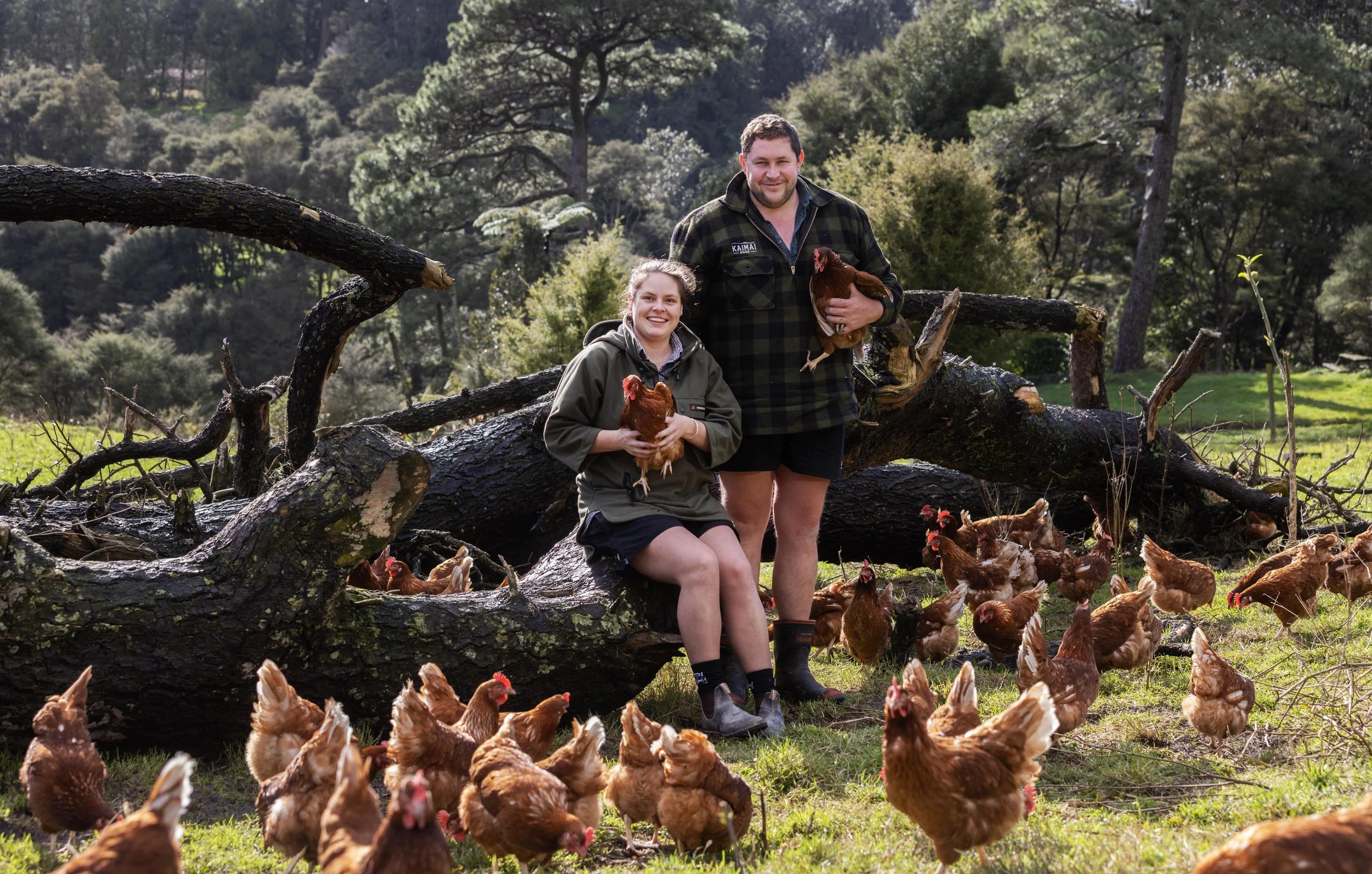
Karlene and Jim Brown.
“Dad's been asked ‘What makes a good egg?’ a few times over the years, and it’s simple: a good chicken makes a good egg,” Karlene explains. “There’s no other way around it.”
“You've got to have a healthy, well-fed, well-watered chicken in a good environment with good people looking after it and all the other stuff kind of just happens,” Jim adds. “Which makes sense. Of course, a happy bird is going to produce better eggs.”
Their farm, which produces free-range and barn eggs, is situated in the tranquil Kaimai Ranges, where the chooks enjoy a view of the hills that’s so stunning it’s printed on the egg carton. But spectacular views aren’t the only thing that sets Kamai Eggs apart.

Otto McGirr.
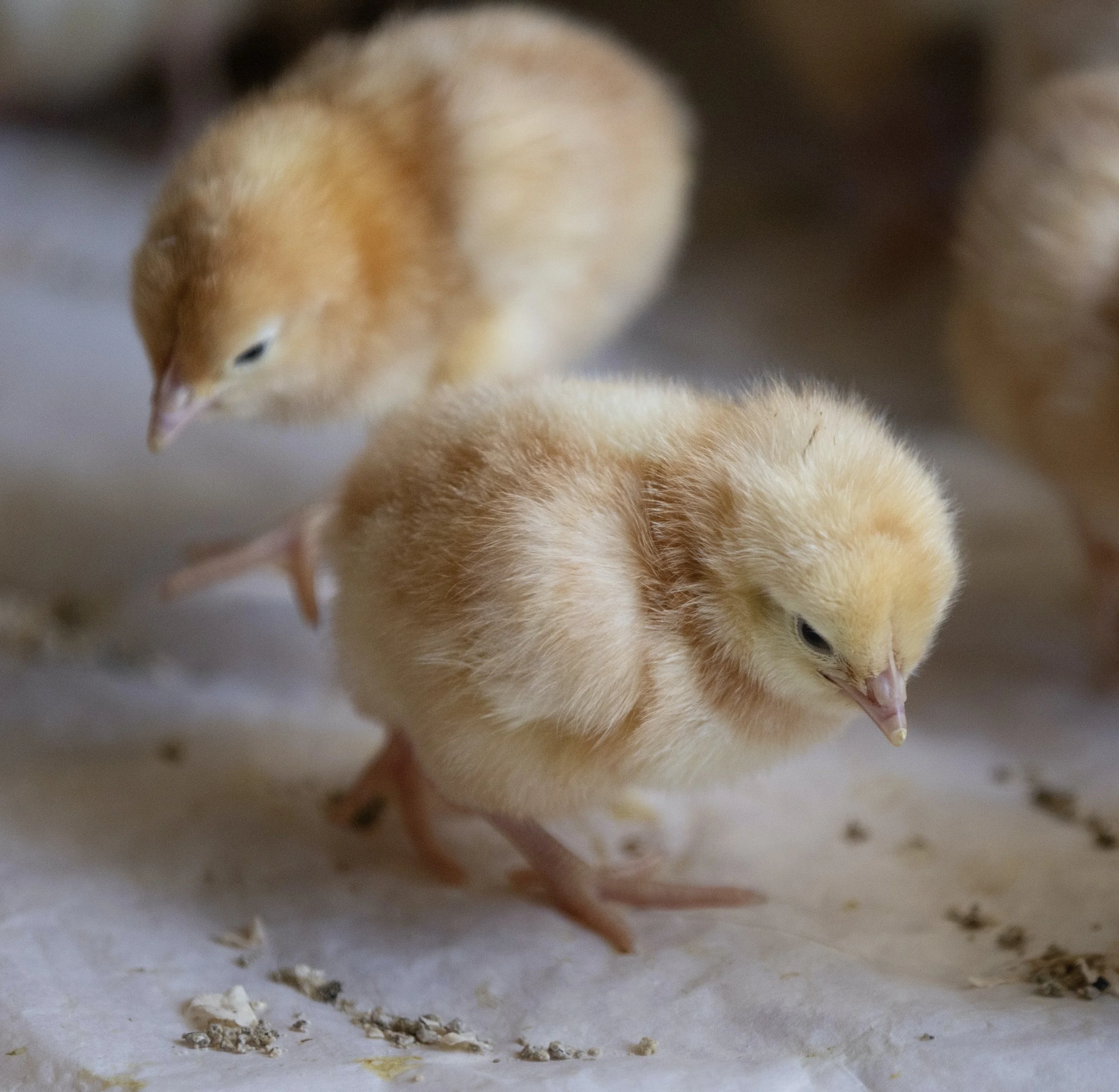
Unlike most egg producers, they look after their whole supply chain, getting baby chicks at just one day old and rearing them right up until they’re ready to begin laying eggs. From there, they’ll be moved into one of the farm’s laying sheds, where they’ll be able to run free, indoors and out, with the flock. The eggs that are produced are then packed by hand on the farm before going onto their “little truck” that leaves every morning, to deliver them fresh to supermarkets and cafés around the region. Their team even stacks the supermarket shelves themselves to ensure there’s no accidental breakage that goes unnoticed and could leave a bad taste in a consumer’s mouth.
“We’re only as good as the last carton that goes out. We believe, and it’s
true, that every carton is an individual customer,” Jim says, explaining why in this age of automation they remain hands-on. “If you have a bad experience with our eggs, you're not going to want to buy them again.”

The family don’t just talk the talk, they also walk the walk, out on the farm each morning checking on their chickens and jumping on the line to pack eggs.
“We have a great team who supports making this happen seven days a week,” Jim says, proudly.
Keeping the birds happy and healthy is a constant challenge, especially with free-range farming. The trick is finding the balance between quality of living for the bird versus the cost, so an affordable product is waiting on supermarket shelves.
“We’ve invested in some really high-tech monitoring systems for the animals and for people to spend time with the animals,” Karlene says. “And because we rear our own birds, we get to control those that are incoming. Birds never leave the farm. They come in at one day old, and they stay on the farm.”
“It's a low-stress environment,” Jim says. “Because we're not moving the chicken far. It just goes from that shed there when they’re chicks to that shed there when they’re ready to lay. You see in other animals, when they move long distances, they come under a lot of stress.”

The farm has philosophically and financially invested in ensuring their chickens' lives are as stress-free as possible. The chickens live in a big shed where they have 24/7 access to a grassy paddock.
“They can come and go as they please,” Jim says. “But typically they hang around the shed in the mornings.”
The birds are early risers, up at 4am for breakfast, before they start laying eggs at 5am. Around 8am is when the animal welfare team comes in to do their checks and make sure everything is hunky dory, and by 9am, the chooks' work is done for the day and they head outside to enjoy their day.
“The chickens are awake for 16 hours a day. And they get up to stuff,” Karlene says. “They break a lot, scratching and pecking and tapping away.”
“It can be chicken anarchy,” Jim laughs.
Rounding them up in the evening and herding them back into the shed before dark is a surprisingly easy task.

“They're scared of the dark, so they all come in willingly at night,” Jim laughs. “It's like a switch. All of a sudden, they all just start running for home. It's bloody amazing! They all come in, eat and roost, and hopefully give us an egg the next morning.”
Kaimai Eggs' slogan is ‘Your Local Farm’ and that’s something they take to heart. They support local schools in the area, as well as Bay of Plenty Rugby and local food banks and charities.
“We take our social responsibility very seriously,” Jim says. “It's our job to support quite a few organisations.”
“Words are cheap. We want to walk the walk,” Karlene says. “Dad is a big pusher of that, especially with supporting kids in sports and the local schools. It's not optional, it's just what we do. It's all good to go out there and tell everyone that we're local, but you’ve also got to put your money where your mouth is and support local organisations.”
“It's cool,” Jim smiles. “You get to meet quite a few local people doing good stuff in the community. It's rewarding to help organisations in the community. It makes you feel good.”

There’s only one last question for the egg farmers, and it could be the hardest of the lot; how do they like their eggs?
“That's the big question for the egg producers,” Jim laughs. “We've got loads in the shed and we always forget to take them home!”
“And we only get to take the ones that aren’t perfect,” Karlene adds.
“To be honest, it's quite nice to come to the cafés that use our eggs and get them to cook them for us,” Jim smiles, before Karlene jokes, “We're terrible at cooking them!”

A different kind of calling
A teacher, a doctor, a pilot, a movie star... Becoming a funeral director probably isn’t on many childhood wish lists. But for funeral director, Fergus Keith, it’s his most rewarding job yet.
A teacher, a doctor, a pilot, a movie star... Becoming a funeral director probably isn’t on many childhood wish lists. But for funeral director, Fergus Keith, it’s his most rewarding job yet.
photo MARK FRUISH @ MATCHING BLACK

With a calm presence and a passion for helping others navigate grief, Fergus Keith shares his insights into the surprising realities of his role, what makes the work so meaningful, and why it’s time we all started talking more openly about death – and life while we’re at it.
UNO: What did you want to be when you grew up?
Fergus: Honestly, a funeral director wasn’t on my radar. Like most people, I didn’t leave school thinking, ‘I’m going to work in the death care industry’. It’s a vocation that found me later in life.
Tell us a little about your work history prior to Legacy Funerals?
Before coming to Legacy Funerals, I spent time working as an ambulance officer and a church pastor, and I’m also a volunteer firefighter. Those roles have given me a deep understanding of how to relate to a wide range of people, especially during crisis and grief. My own personal experiences with loss as a teenager also helped me become more comfortable in that space.
What does a typical day look like for you?
We’re not just dealing with the deceased – we’re working closely with the living. There is a lot of variety within the role, from behind-the-scenes work planning funerals, organising logistics and working with celebrants, to supporting grieving families. It's a careful balance between organisation and event planning, and ceremony, ritual and empathy.
What surprises people most about your job?
It’s not all sad and sombre. There are lighter moments and laughter with families as we work alongside them to keep the stories of their loved ones alive. Funerals are about more than saying goodbye, they are a vital part of the healing process – not because someone has died, but because they have lived. And they’re not just for the front row of mourners. Friends, colleagues and community members also need that moment to reflect and grieve.
What do you find most rewarding about your work?
It’s deeply fulfilling to know that by taking the time to craft the funeral experience just right, it helps people grieve well. Helping families feel supported at their darkest moments is a privilege that feels more like a vocation of service rather than a job. Also, Legacy Funerals is owned by a charitable trust, so profits go back into our community.Being part of something bigger adds another layer of meaning to what we do.
Do you have any advice for those considering a career in this field?
In my role I am a guide, a storyteller and above all a listener. There is a certain level of maturity and life experience needed for the job. There is also on-call work – sometimes you're answering the phone at 2am when someone’s world has just fallen apart. But being that trusted person in those moments is incredibly humbling.
Any final thoughts?
As New Zealanders, we often rush grief and avoid talking about the inevitable. I encourage people to talk more openly about death, plan ahead and think about what their family will need when their time comes. At Legacy, we help people pre-plan funerals, not just to make things easier logistically, but to ensure the final farewell is a meaningful experience that enables their loved ones left behind to grieve and heal. After all, funerals aren’t just about death, they’re about taking the time to celebrate and honour life.

Progressive positioning
Coombes Johnston welcomes customers into a new era.
Coombes Johnston welcomes customers into a new era.
words NICKY ADAMS | photos JAHL MARSHALL

As Coombes Johnston marks 30 years representing the BMW brand in Tauranga, the timing feels fitting for a major transformation. The dealership has just completed a major showroom upgrade, designed to modernise not just the look, but the experience of buying a vehicle. The result is a space that feels less like a traditional showroom and more like an extension of the brand’s identity.
The second location in New Zealand to have undergone the international ‘Retail.Next’ initiative, the new showroom is overarchingly aspirational while reflecting the brand’s emphasis on customer centricity. “We have always had outstanding customer service,” says manager Kevin Pead. “We always had the DNA for that. Now we’ve lifted up the environment to match the level of service that we’ve been offering to our customers in the Bay of Plenty for 30 years.”
BMW has an undisputed reputation as a premium European luxury brand. The freshly renovated showroom, with its stylish interior and multi-functional spaces, is testament to this positioning. As I walk through the doors, the receptionist beams a sunny smile, radiating warmth on a wet winter’s day. Leading me to the inviting seated area, fresh coffee on the table, the feeling is less showroom and more lounge area. Glancing around I notice the stunning feature lights. These, Kevin explains, he initially thought may be overkill, but when they were installed, all was revealed. Without doubt purposeful, the pendants glisten over the seated area where they serve to create a cosy, intimate environment; meanwhile my eyes are drawn to the M wall where a feature white and red longline ceiling element is suspended over the latest highperformance luxury M3 model, the light showcasing the sleek contours of this beautiful vehicle.

The seating, while perfect for meetings, faces a screen which boasts the very latest in technology. The EVE – Emotional Virtual Experience – is an immersive experience that allows customers to digitally design and watch as their dream car comes to life. Even the more old-school customers are on board with this technology, as it helps to bring a real sense of confidence to decision making. “There are so many different makes and models we can’t stock all of them, so if someone wants to bespoke a car this allows them to see what the finished product would look like from the comfort of a lounge type environment.”
The brand concept behind the Retail.Next upgrade is, says Kevin, “to create a warm, embracing, relaxed atmosphere.” The days of the hard sell are long gone. Today’s experience of looking for a new car involves a more consultative approach. BMW considers itself a market leader in more than just its innovative car design and production. After all, Kevin points out, “BMW doesn’t follow, it sets the standard”. The ‘shop floor’ is obviously a part of this. From the moment someone arrives, “You want them to feel as though they want to buy a car; and whether it’s the latest and greatest or it’s an older model, the level of service is the same.” The split for new versus used vehicles is roughly fifty-fifty, but rule of thumb is that “used car buyers will one day become new car buyers.” I question why this is, and Kevin looks amused. “It’s a natural progression – it’s a great audition, isn’t it!”

Car enthusiasts will already be aware that BMW is considered the ultimate driving machine, and Kevin is excited about what’s coming, with product launches for 2025 set to defy expectations further – what’s on the horizon is “younger, fresher, more exciting; and our technology advances with each new model.”
We circle back to the fact that the customer journey is a key focus here at Coombes Johnston. This explains how, for two years running, BMW Tauranga were awarded Excellence in Customer Service nationally from BMW New Zealand. Kevin firmly believes that you have one shot at making a first impression. “The people that come have generally done their homework and are making a comparison. We are here to identify their needs and make sure they find the right vehicle.” Of course, he continues, “people want more from buying a car – they want, and deserve, a premium five-star experience.”
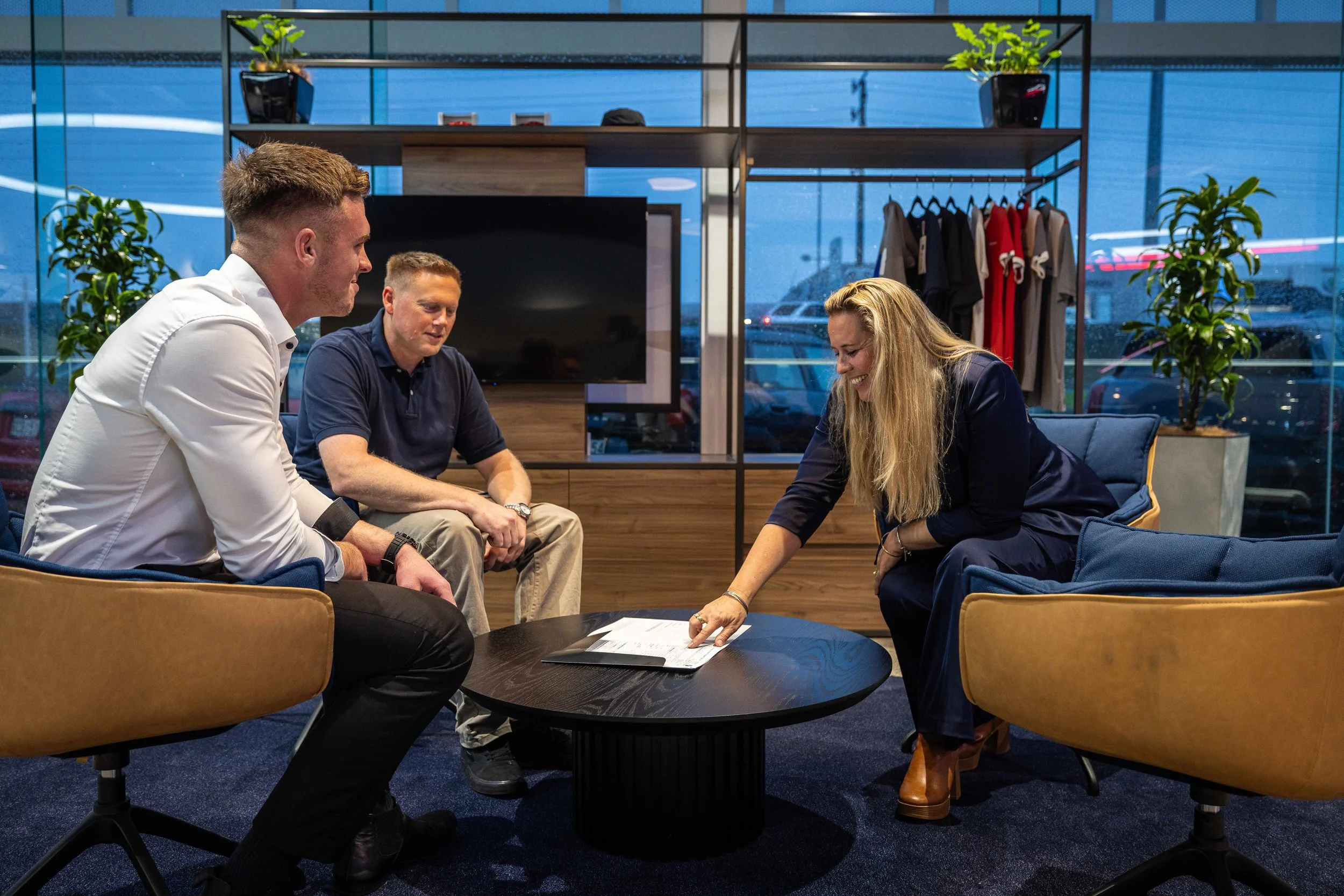
The service is wrapped up in so much more than excellent product knowledge. When dealing with uber high-tech models, to help bring a purchaser up to speed with the technology can often, Kevin says, involve up to five post-sale sessions. His customer handover includes happily giving his mobile number to each client as part of the aftercare. This is indicative of the way these relationships are cultivated and valued. The ability to form firm relationships is something, Kevin says, that is lost when people shop further afield. There is often a belief that if you go to a bigger city, you’ll get a better deal – not the case, Kevin assures me. “As soon as you’re out of the door, you’re just another number – here you will always be a valued customer.” And one which will be looked after as part of the Coombes Johnston family.
The team of 13 share the same passion – Kevin has been with BMW for 10 years, and Simon, the service manager is soon to celebrate 20 years with the company. Longevity relates not just to staff relations but also to customers, with, says Kevin, many of their customers holding longstanding relations. Indeed, when I speak to owner Richard Johnston, he tells me anecdotally that he has been selling to one customer since 1987, starting the relationship when he was a junior salesman. The new look of the premises, he believes, does justice to the BMW brand. “Over the years the showroom has evolved, but this is a massive change – a quantum leap to something truly spectacular for 2025.”
As for being a BMW ambassador, Richard is clearly as passionate as ever about the Group. “They strive for excellence, and they measure us on excellence. There is an understanding at all levels of our team that the execution is at a very high level. The design, innovation, BMW’s ability to pivot quickly – there’s a very strong focus on drivability and the passion and emotional experience that comes with being behind the wheel of one of these cars. That in itself, in my opinion, sets us apart – and as a small family run business it’s a real privilege to represent the brand.”

The talented tī lady
In another life, Amy Tihema-Madden would've been an expert winemaker but the Hamilton mother of four has spent the past five years perfecting the art of fermenting tea, and we are all better for it, as UNO columnist Jess Easton writes.
In another life, Amy Tihema-Madden would've been an expert winemaker but the Hamilton mother of four has spent the past five years perfecting the art of fermenting tea, and we are all better for it, as UNO columnist JESS EASTON writes.

Amy Tihema-Madden never set out to create an award-winning, life-giving drink of deliciousness. All she wanted to do was to make herself better.
With post-natal depression, grief and anxiety darkening her horizon, soon after the birth of her fourth child and just before Covid-19, forming a company and learning the intricacies of running a business was the last thing on her mind.
Thanks to her kindly Chinese GP, who convinced her to go back to her people and find traditional Māori practices to heal, Amy (Te Aitanga a Mahaki, Te Whānau a Kai, Ngati Kohuru) found herself on a vastly different path.
Soon, she was deep in the forest, learning about rongoā and how nature's energy could heal.
Copious tears soaked fertile soil and Waikirikau fermented tea was born.
Booze-free is big business these days. For various health and social reasons, many people are looking for food-matched flavours and boutique brews that don't have the age-old after-effects. Non-alcoholic shrubs and tonics are becoming ever-more popular, while kombucha and other fermented offerings are flourishing.
Amy soon found that the more she learned about the healing power of native plants, the more intuitive she became at combining them with herbs, leaves, fruits, barks and flowers. Fermenting them was a way to preserve their potency and bring probiotic benefits into play.

We've been using Waikirikau brews at our Kitchen Takeover events for the past couple of years and the likes of Hā Raumati – manuka-infused with cucumber, lime and juniper additions – pair fabulously with so many of our delicious courses. The spectacular ruby-coloured Ngā Taonga ā Papatūānuku is indeed a treasure, while Horopito Chai and Kawakawa Kaha are more recent offerings. But what we love most is that Amy hand-picks all her ingredients, using maramataka principles, and then caresses the flavours out of her produce in a small commercial kitchen in her Hamilton backyard.
Her small personal passion has indeed become a successful business, albeit one that is still boutique and hand-crafted.
And the most important ingredient in her arsenal remains her aroha, the care and the nurturing, which shines through in every mouthful.
Jess Easton is a director and owner of Kitchen Takeover and Saint Wine Bar, complementing her career as a Tauranga-based lawyer.

From Tauranga to the top
In just four short years, Tauranga’s hip hop dance studio Space has made a big splash on the international scene. Founders Summer Tyson and Cameron Smith tell us they’re just getting started.
In just four short years, Tauranga’s hip hop dance studio Space has made a big splash on the international scene. Founders Summer Tyson and Cameron Smith tell us they’re just getting started.
words KARL PUSCHMANN | photos NINAG PHOTOGRAPHY

Space Dance Studios may have only opened its doors five years ago, but time is running out. They only have 12 months left on the clock to hit their goal, Cameron Smith tells UNO. The goal is a simple one: become the best hip hop dance studio in the world.
Easy, right?
“There’s a Tall Poppy Syndrome in New Zealand, where it sounds super outrageous to say we want to be the best in the world,” Cameron says, before smiling and adding, “We’re currently third.”
After speaking with Cameron and partner Summer Tyson, their wildly ambitious target seems not just doable, but entirely feasible. They are determined and focused, they are putting the work in and then putting in some more work, and they are achingly close to hitting it. “We’re proud, but not satisfied,” Cameron says. “There’s a deadline. It’s really important for us to cram and work hard to make things happen.”
Opening their own dance studio was their dream. When that became a reality, they simply added to the dream.
“It was like a script to a movie. Just boom! Let’s make this happen. We always say that it not working wasn’t an option,” Cameron says. “Failure was not an option. It’s the only thing in life that we do. It’s the only thing in life that we’re good at. It had to work. There was no way it couldn’t work.”
The pair worked hard to ensure Space launched successfully. They offered anybody who wanted to dance, regardless of skill or ability, free classes for an entire term, and worked seven days a week in the studio.
“When you’re building something from the ground up, it’s important,” Cameron says. “Summer and I love it. We weren’t looking at the clock or time watching, like, ‘Oh, it’s five o’clock, I’m off now’. We were doing it from a place of passion and a place of fire.”
Their arrival didn’t go unnoticed. Their unorthodox approach influenced every decision. While everyone was zigging, they zagged.

“Everybody else’s studio was white, so we said, ‘let’s paint ours black’. Everybody else was doing exam work, we said, ‘let’s not do exam work, and run open classes’. Everybody was competing locally, we said, ‘No, we’re going to compete internationally’. We tried to do something that didn't follow that formula. It was either going to work or it wasn’t. But we were going to make sure it did.”
And it has. Last year’s third place at the World of Dance Competition was the greatest endorsement of their unique methods. Which also extends to their teaching.
“We do treat our dancers like athletes. From what they eat, to how they sleep, to their training regime. Some of these dancers are sometimes training up to 14 to 16 hours a day,” Cameron says. “It is unbelievable for dancers who are sometimes aged 11 and 12. We’re super fortunate to have an incredible community of parents who support these kids. Their parents are the grounding and the roots of what makes these kids successful. It is very normal for Space to train until sometimes 2am. The next morning, they go to school at 9am, so it is a wild, wild, wild world that Space lives in.”
And while it is extremely full on, competition for one of the 40 spots on the Space Pro Team is fierce, with people flying from all over Aotearoa to audition. Needless to say, even getting into the team is gruelling.
“It’s a relentless audition. They come in and they train for a weekend, and we select the top 40 dancers.
This kind of training regime is simply what it takes to reach the international standard. At the Worlds, which can be considered the Olympics of dance, there are 53 countries, with over 100 teams and 500 dancers all competing in brutal knockout rounds. Just the document that tells you what the judges are looking for runs 200 pages. This provides the necessary context for their approach.

“We consider dancing a sport,” Summer says. “Someone’s got to win at the event and someone’s going to lose.”
“Our job is to pour gasoline on the fire,” Cameron adds. “These kids come in with this raw fire, and our job is to make it go crazy.”
The pair are straight-up in saying a place on the Pro Team isn’t for everyone. They tell hopefuls what’s in store and the physical and mental pressure involved. “If people can survive a year in Space, they can survive a year anywhere,” Cameron grins. “We try to create an environment that pushes life skills, learning and that work ethic. We feel so grateful that people believe in what we do and trust us with their kids and with their growth. It’s a big responsibility to not just train good dancers but to train good humans as well. Dance is purely the form that we use to teach life skills.”
“We always say hard work always pays off, and that luck doesn’t exist to us. The hardest-working team will win.”
With only 12 months remaining for the pair to achieve their goal of winning the World’s, their international rivals better be working bloody hard. Because Summer and Cameron certainly are. And they have every intention of making sure the competition has their work cut out for them.

Rebranding the Bay
What makes a place truly unforgettable? Is it the golden beaches, the rolling hills, or the vibrant urban buzz? For Our Tauranga Region, the answer is something deeper. It’s in the stories of the people who live and work there. Now, in a bold move to express the essence of Tauranga and the Western Bay, the team is turning to the community to help define the region’s next big identity.
What makes a place truly unforgettable? Is it the golden beaches, the rolling hills, or the vibrant urban buzz? For Our Tauranga Region, the answer is something deeper. It’s in the stories of the people who live and work there. Now, in a bold move to express the essence of Tauranga and the Western Bay, the team is turning to the community to help define the region’s next big identity.
words HAYLEY BARNETT
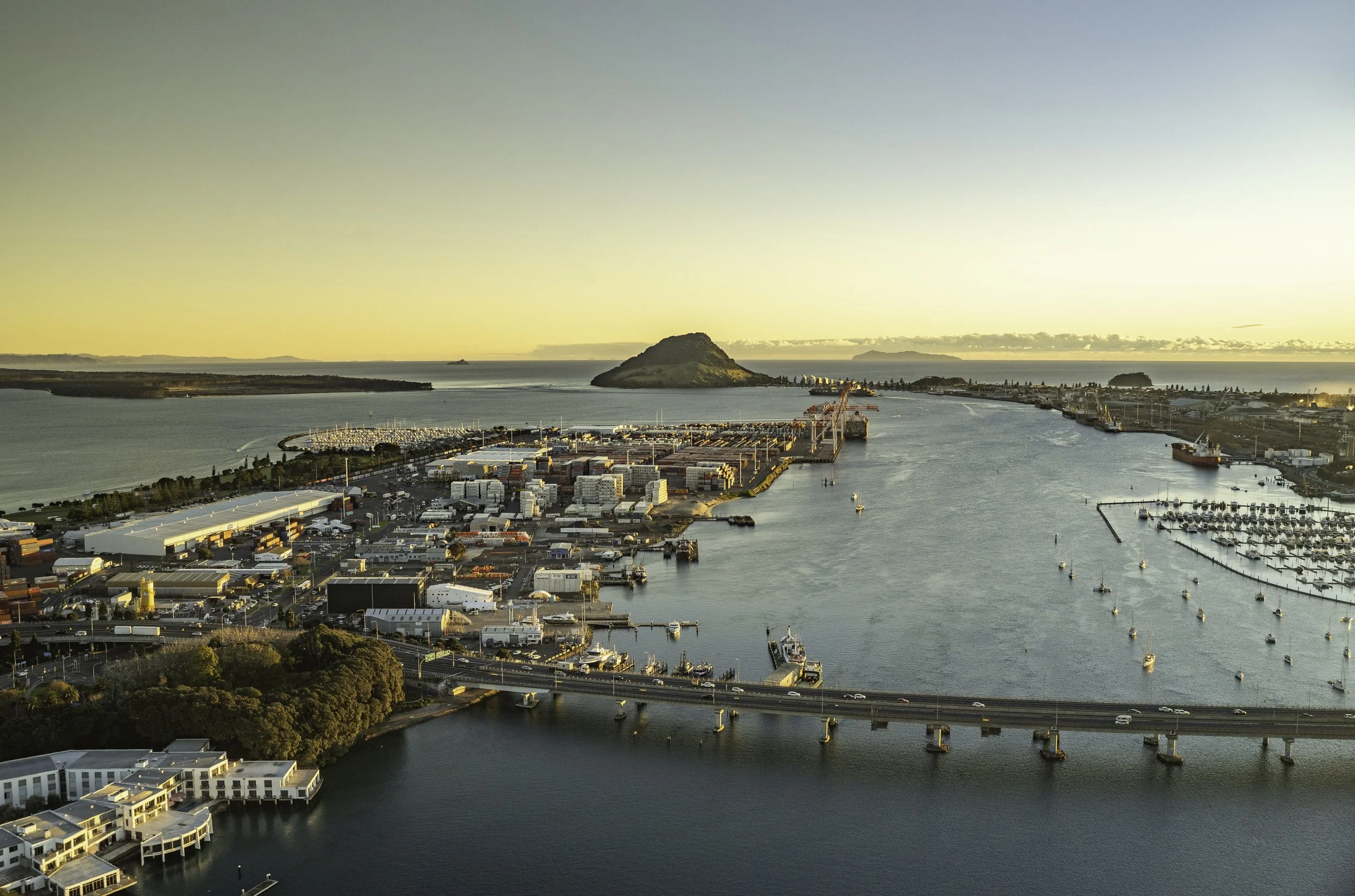
After years of watching Tauranga and the Western Bay grow in size and diversity, Our Tauranga Region has embarked on a journey to develop a new brand. In fact, it will be the first brand the region has ever adopted, and they want to make sure it’s one that genuinely reflects the spirit of those who call the Bay home.
“We’ve got this beautiful region, but the way we talk about it hasn’t caught up with who we are now,” explains Haydn Marriner, project lead at Our Tauranga Region. “We didn’t want to slap a logo on a postcard and call it a brand. It has to be a reflection of the people – our mana and values.”
Rather than relying solely on marketers or consultants, Our Tauranga Region is crowdsourcing the heart of the brand from its own community. They’re meeting with iwi, local businesses, artists, and residents to uncover what truly defines the region and its people. Nothing has been decided yet; even the term 'Our Tauranga Region' is a temporary white label identity that will be retired once the new place brand has been delivered.
“Branding is no longer a top-down process,” says Marriner. “It’s about co-creation. We’re not just building something for the community. We’re building it with them.”
One of the key principles guiding the project is authenticity. Our Tauranga Region is working closely with tangata whenua to ensure the brand is grounded in te ao Māori and the unique cultural fabric of the region. As Marriner puts it, “You can’t tell the story of this place without starting with the people who have been here the longest.”
While culture and heritage are central, the brand also aims to represent the region’s evolving identity and its entrepreneurial energy, creative spirit, and laid-back lifestyle.
The process has been anything but conventional. From community hui to online submissions, the brand development has become a dialogue, not a monologue. And it’s working.
“What’s been amazing is how much people care,” Marriner says. “There’s a sense of pride and ownership coming through in every conversation. Whether someone’s been here five minutes or five generations, they’ve got something to say about what makes this place special.”
The branding project is set to roll out over the next few months, with a visual identity and messaging platform expected later this year. But for Our Tauranga Region, the journey has already delivered its own reward, which is a stronger connection between the people and the place they call home.
“If we get this right, if we create something true to us, it'll resonate with locals, with visitors, with businesses – with everyone!” Marriner says. “Because it’s real.”
Have your say at: OURTAURANGAREGION.COM

Plenty under twenty
In part two of Plenty Under Twenty, Stacey Jones hunts out the best cheap eats under $20 that the Tauranga region has to offer.
In part two of Plenty Under Twenty, Stacey Jones hunts out the best cheap eats under $20 that the Tauranga region has to offer.
words STACEY JONES

Rikarika
I put the call out to the local community recently, asking for their favourite meals under $20, and the response was meatier than a pie from Patrick’s Pies — hundreds of recommendations flooded in.
So, after a fair bit of eating (it’s a tough job, but someone’s got to do it), here’s my pick of the best cheap eats in the Bay of Plenty this month. From dumplings to falafel, sushi to curry, these are the top spots serving up serious flavour without breaking the bank.

The Rising Tide
Weekday wins
If you’re happy to dine out earlier in the week, you’re onto a winner-winner dumpling dinner. Let’s start with a ridiculously good deal over at The Rising Tide on a Monday in Mount Maunganui – and now at their new spot in Ōmokoroa.
For just $15, you can treat yourself to five mouthwatering dumplings paired with a pint of craft beer. I’d recommend the mushroom dumplings, but they’ve also been branching out with limited-edition flavours like lemongrass and lamb. Yum.
East of the middle
Next up is one of my all-time favourites: Falafel Metro. They serve up the crispest falafel known to humankind, wrapped in a house-made pita softer than a fluffy white cloud for just $17. Total steal. Even the most die-hard carnivores won’t miss the meat here.
Japanese feasts
If Japanese is your vibe, Chidori Ramen might just take the crown for the best meal under $20 in the BOP. I’ve been going there since the day they opened, and my go-to is the patina ramen with extra chashu and a ramen egg — it never lets me down. Pro tip: their set meals are a great deal too, and the chicken karaage is a personal favourite.
Happy Fryday
Right next door is Chicken Fryday, a fried chicken lover’s dream. Half a Korean-style fried chicken sneaks in at $19.50. Slather it in wasabi mayo for a flavour punch, or, if you’re feeling brave, go for the hot and spicy sauce — it’s hotter than Satan’s breath and will leave you sweating like you’ve just run a marathon.

Rikarika
Sushi secret
Still in the Japanese lane, pop into Rikarika — the new spot where Falafel Metro once stood. Their sushi is arguably the best in the Bay, thanks to husband-and-wife team Brian and Rika, who take a near-religious approach to perfecting their rice. Grab a sushi set for just $15, or if you’re after something lighter, a mini rice bowl for $12. I’d recommend the tofu teriyaki. Plus, the owners are some of the nicest people you’ll ever meet.
Bananarama
Just a hop, skip and jump from Rikarika is the wildly underrated Banana Blossom Café, serving up Malaysian Cheesy Chilli Fried Eggs for $18.50 — a fusion combo of absolute yum. And if your wallet can stretch just a smidge over a crisp $20, their laksa at $29.50 is all manners of “fork yeah”.
Best of the rest as voted by locals
• For the locals in Matua, Head Loco got plenty of shout-outs for its Japanese grubs.
• Kebab lovers, Kebab Istanblue in Mount Maunganui is a go-to.
• Early risers, Pronto Burger does a $9 breakfast combo, including coffee – absolute steal.
• Curry cravings? House of Spice in Fraser Cove serves up generous portions, and all their curries are under $20.
• Vietnamese food enthusiasts, Pho Vina (just off Wharf Street) dishes up authentic, soul-warming goodness for under $20.
The secret’s out — I’ve taken over @bop.eats, and I’m officially dedicating my life (and my stomach) to uncovering the best eats in the Bay. That means I’ll be diving even deeper into the best eats across the region, starting with another round of budget-friendly bites that prove you don’t need to spend big to eat well.

A bold return
Always underpinned by excellence, the Sandersons are redefining luxury retirement living with a project set to impress.
Always underpinned by excellence, the Sandersons are redefining
luxury retirement living with a project set to impress.
words NICKY ADAMS | photo ALAN GIBSON

Fraser and Donna Sanderson.
With a life’s work spanning 38 years developing in the luxury retirement and care home facility sector, Fraser Sanderson made front page news in 2019 when he sold off three of his retirement villages, at the time quoted as saying he was going to ‘give retirement a go’. Clearly ticky-touring about in his campervan didn’t cut the mustard because roll on a few years and Fraser has returned, and returned with style. The project that has brought him back to the fray is the most exciting and prestigious one of his career, The Pitau in Mount Maunganui.
As the face of the Sanderson Group – family owned and operated nationwide with a portfolio of diverse developments under its umbrella – Fraser is well known to be an astute businessman, but one who holds the values of honesty, loyalty and family at the heart of it all. His children all have exciting ventures underway themselves in the retirement and development sectors and are excited by this latest turn of events; wife Donna is equally supportive, understanding that The Pitau is very much Fraser’s passion project. A concept too compelling to resist, the luxury and magnitude make it groundbreaking in New Zealand, and even on an international scale it would be considered trailblazing.
Fraser is no mere figurehead. His involvement has always, and continues to be, more than just in name only; a driving force from the ground upwards, he notoriously dives into every single aspect of a development. From overseeing the selection of the Travetine cladding of The Pitau or obsessing over the correct placement of the cabling in the building’s basement, Fraser prides himself on being a part of every feasible decision. He is lauded for his meticulous attention to detail, as well as the speed with which he ensures everything is executed. A friend of mine once sat next to Mick Jagger at a cricket game, and said she could feel the energy fizzing from him for every second of the match. Fraser has the same kind of sizzle – always on the move, it’s hard to even get him to sit down for an interview.
When Fraser does sit down, he is reluctant to wax lyrical about his achievements, but it’s hard to deny his significant impact on, and shaping of, the luxury retirement sector. I wonder which aspect of his legacy he is most proud of, to which he replies: “For me, it’s having been instrumental in raising the bar for luxury retirement living, and creating spaces where people can enjoy the highest standards of comfort, service and lifestyle. It’s all been about giving people the freedom to truly live well.” I comment he already has such a peg in the ground, so it’s intriguing as to what exactly it was about the concept of The Pitau that tempted him out of his brief retirement. He tells me: “It was really the opportunity to push the boundaries of what a luxury retirement village can be. I knew it would be something extraordinary in both design and lifestyle.”
Was it, I wonder, an idea that had been bubbling away for years, or was it simply circumstantial as the location presented itself? “I’ve always believed that people who have worked hard their whole lives deserve something truly exceptional. When this prime location became available, it was the perfect opportunity to create something that sets a new benchmark for luxury and excellence. Now, people who never would have considered a traditional retirement village are considering The Pitau”.
While The Pitau is an ambitious and prestigious venture, it is not out of character for Fraser to be ‘thinking big’. His visionary approach was apparent from the start when he embarked upon his first retirement village in Ōmokoroa, bucking the trend of the time when it was believed that retirement living needed to be centrally located. Conversely, when he did go into the city, he initiated industry change by developing at height in the Avenues. Taking his ‘out-of-the-box’ approach to Queenstown, he spearheaded development on Ladies Mile where he established a country club and built a hospital. Fraser’s trademark is rolling out projects that present with challenges. Over the years his undertakings have been diverse – from retirement villages and residential subdivisions, to specialist medical facilities, and hospitality to retail – however, the common thread is the uncompromising commitment to quality that remains steadfast. Fraser firmly believes that quality pays dividends in the long-term, and for him there is no budging on delivering the highest calibre product.
There seems to be a genuine passion for helping people in the retirement space. A question Fraser says he asks himself about every undertaking is, “Is this somewhere we want to spend our twilight years, or, is this a place we want our children to spend their formative years?” It’s clear an impetus for Fraser is creating an environment where people who have worked hard their whole lives can relax and enjoy the next phase.
With retirement villages now offering resort-like facilities, I imagine the concept is very different from how it was 40 years ago. Has there been a shift, I wonder, on when people feel ready to move to the ‘golden years’ of relaxation? “Absolutely. It’s no longer about slowing down – it’s about upgrading your lifestyle. People are moving in earlier, not because they have to, but because they want to enjoy everything a luxury community has to offer while they’re active and independent. It’s a shift from necessity to choice.”
Despite the allure of the wonderful quality of surroundings, luxurious facilities and stunning landscaping that all make up the core of any project under the Sanderson Group, Fraser still must come across many people who just aren’t sure if this next step is the right one for them. What, I wonder, would he say to people who are teetering on the edge of the unknown next stage? “I’d say, don’t wait until you have to move - move while you can truly enjoy it. This isn’t about giving anything up; it’s about gaining more – more freedom, more connection and more time to focus on what really matters. The sooner you step into this next phase, the more rewarding it becomes.” And with that, it’s beginning to feel as though there’s no such thing as too soon.
Introducing
The Pitau
Mount Maunganui’s five-star lifestyle retirement
offering promises uncompromising luxury.
words NICKY ADAMS | photos SUPPLIED

A welcoming and cosy guest lobby space.
When Fraser backtracked on his well-deserved retirement plan, it was because he couldn’t pass on the opportunity to create something totally unique. The Pitau was born of a desire to take luxury to new heights – quite literally.
A unique multi-level triple tower design, the outlook across the mesmerising beauty of the twinkling Pacific Ocean naturally is spectacular. But plonking an architectural wonder in a stunning location and simply signing off is not Fraser’s style. For him the devil is in the detail; the layout of the building has been designed to maximise both sunlight and views, the high room stud, thoughtful indoor/outdoor flow and optimised privacy all tie together seamlessly. The architectural mastery is apparent; curved edges and the neutral palette leans to an elevated aesthetic combining form and function. Investing in exceptional landscaping is part of the charm of Sanderson Group developments, so it’s no surprise to see the balcony edges are green planted – softening the form of the building and factoring in the need for foliage.
While the architecture is exceptional, both the exterior (which incidentally is clad in beautiful Travertine tiles imported from Turkey) and interiors are a work of art. It’s obvious that no expense has been spared to create homes that Fraser and Donna would want to – and be proud to - live in themselves; so it stands to reason that they have already earmarked an apartment for their own ‘golden years’. The apartments themselves vary in size and configuration, and the inclusion of a dedicated care facility with Memory Care and hospital-level care suites ensure that future additional medical needs can be met. It's hard not to get excited when you look through the spec – which in many ways feels more as though you’re flicking through the details of the most exclusive five-star-plus resort. Tasteful opulence at every turn you might say.

Then there are the lifestyle opportunities. If you’ve ever been through a Sanderson Group retirement village, you’ll be aware that the facilities are the lynchpin of luxury living, and The Pitau takes this premise to a whole new level. The facilities alone will make most people – myself included – stop in their tracks. There is, frankly, what feels like acres of premium amenity space; all created with the understanding that, firstly, the residents will be in their prime ‘post work’ years, and secondly, life within the building as a whole should feel like a continuation of the luxury of their apartment living. A massive swimming pool, expansive high-tech gym, yoga studio, sauna and spa will all be part of the active offerings.

Luxurious penthouse bedroom in the Rockpools interior scheme.
If you want time out, then there is a boutique cinema and library; if you feel like pampering, then head to the salon. If a billiards room sounds appealing, then take a breath and visit the Wine and Whisky Bar; oh and of course there are multiple café and restaurant areas.
This is not a traditional retirement plan, instead it is a five-star lifestyle offering – and it is here that The Pitau is elevated into a league of its own. Managing to be swanky without crossing the line to ostentatious, there is a huge main lobby area that opens into an internal courtyard, complete with water feature and reflection pond for just the right amount of Zen. A resident concierge service is available, because this really is a time of life when you deserve to delegate your life admin, and even better, there’s a chauffeur service on hand to whizz guests to the Golf Course, the airport or just to run errands. Those that like a little more independence can dip into the complimentary fleet of e-vehicles or borrow an e-bike if they have had one too many at the Whisky Bar.

A striking architectural view from Pitau Road.
Operating at a unique level unseen in New Zealand, The Pitau brings an international flavour. Many aspects were the result of endless research into what was missing from the premium retirement sector, not just in New Zealand, but globally. It’s fair to say that this concept will be market leading on completion. There really couldn’t be a more perfect location than the Mount. As Kiwis, we flock here, and it’s well known internationally as an incredible coastal location.
Naturally this level of living comes at a price, and with this, intended residents are putting a huge amount of trust into the Sanderson Group. A proven track record goes a long way, and additional reassurance is provided by the way the Group operates. Unusually for this type of development, the Sanderson Group controls all the main aspects of the build, with an internal team in place for everything from the architects to the civil earthworks and internal joinery. By acting as the main contractor, Fraser and his team are afforded greater control over quality and delivery.
This really does back up the realisation that nothing is accidental with Fraser. The Sanderson Group is based around the premise of delivering on the promise of uncompromising luxury, quality and good living.
Every single aspect of any development undertaken has been considered in micro detail, so the perception of unparalleled comfort is not just an illusion, the evidence is there to back it up. As Fraser said, when it comes to this type of lifestyle change “People are moving in, not because they have to, but because they want to.”
Completion dates:
Tower 1 – December 2026
Tower 2 – December 2028
Tower 3 (Care) – December 2029
To view, visit:
227 Maunganui Road
Mount Maunganui
Bay of Plenty

More than skin deep
Anna Hayes from Skinvae might be new in town, but she’s an expert in her field – and knows how to build a successful business from the ground up.
Anna Hayes from Skinvae might be new in town, but she’s an expert in her field – and knows how to build a successful business from the ground up.
words DEBBIE GRIFFITHS | photos KATIE COX

Anna Hayes.
It’s common knowledge that the sun causes skin damage, but did you know modern phones also contribute to premature aging? Anna Hayes does – and with 18 years specialising in skincare, pearls of wisdom like that are common when chatting with the founder of successful brand, Skinvae.
“I’ve been in beauty since I was fresh out of school,” she says. “I grew up in Te Kuiti, studied in Hamilton when I was 18, and by 19 I had opened my first business. Before that, I worked for one other business for six months and that was Mount Skin and Body.”
It’s a full circle moment, with Anna recently adding that clinic to her string of businesses alongside Taupo and Cambridge. Recently she took over SELF_ in Mount Maunganui and rebranded it as Skinvae.
“It was a little nerve-wracking taking over the Mount clinic,” she admits. “My other two I started from scratch and picked my teams, but this was established and already doing well. When I told the girls what was happening it was great because they’d heard of my brand and were super excited to get our technology into their clinic. We put an emphasis on training, so the girls are upskilling weekly, which adds to their already huge knowledge.”
To say Anna has grit and determination is putting it lightly. A mum of two and Crossfit enthusiast, the 37-year-old entrepreneur rarely has downtime and loves it that way.
“I’ve grown up very driven in sport, representing New Zealand in triathlon for a few years, so I trained hard and worked hard. I had two jobs from the age of 14. My dad and my sister both had their own businesses, so could see that’s what I wanted to do too. I also like to call the shots; to be able to provide the treatments I want and to make sure I’m ahead of the game when it comes to trends and machinery.”

Skinvae in Mount Maunganui.
Anna makes no apology for focussing on skin – in fact, she takes great pride in being the ‘go-to skin clinic’ for her clients.
“We launched the Skinvae brand in Cambridge 11 years ago and that’s when we started specialising in skin. I love to see results and to take clients on a skin journey, particularly for people looking for non-surgical, non-injectable options,” she says. “We use DMK, Nimue and Pure Fiji, which have some amazing treatments. With skin, it’s never a one-session fix – especially with acne and pigmentation which can look worse before they get better – so we recommend clients sign up for a six-month plan to see real change.”
It’s more than skin, though, it’s the sense of connection, calm and confidence that’s infused during treatments.
“We have a lot of mums who come for the experience and it’s almost as though great skin is just an added bonus,” laughs Anna. “We like to educate about the importance of home care. Mums are often running around like headless chickens after everyone else, so their own ritual in the morning and night allows them to take a moment for themselves.”

Skinvae is at the forefront of innovation, attracting clients looking for cutting-edge solutions. Anna describes a new stem cell treatment from DMK, Stemzyme, as ‘revolutionary’ and says there’s been a big demand recently for body sculpting and tightening options.
“They call HIFU (High-Intensity Focused Ultrasound) the non-surgical facelift,” she explains. “As we age, we lose fat in our cheeks and our face drops. HIFU is a great alternative to Botox or fillers on either the brow or jawline, and you can use it on any part of your body – loose skin on your tummy, arms, or legs. It uses ultrasound energy to penetrate deep into the skin to tighten. It doesn’t get rid of fat, but it does work on the muscle and to stimulate collagen and elastin. You see instant results, but it takes three months to see the full effect.”
Anna urges teenagers, in particular, not to take advice from social media, which may result in them using products like Retinol that are too strong and could eat away at their skin barrier.
And her number one skincare tip?
“Use sunblock,” she says, without hesitating. “Our sun is horrific. If you’re going to buy one product, get a good SPF and make it one that also protects against blue light from phones and computer screens. We see a lot of people with more pigmentation and crepey skin on the side of their face they hold their phone up to. Even if you work in an office, wear sunscreen every day.”

After almost two decades in the industry, Anna knows that 80 percent of skincare results come from what people do at home and their professional treatments simply provide the extra 20 percent that push it further. With that in mind, her vision is to expand her chain of beauty clinics.
“We’re ready to be the number one brand for skin in New Zealand, but all I can say right now is watch this space.”

It’s all Goode in the hood
Auckland’s popular gastropub Goode Brothers has left the nest to land in Bethlehem. UNO pops in to see what makes it so special.
Auckland’s popular gastropub Goode Brothers has left the nest to land in Bethlehem. UNO pops in to see what makes it so special.

Goode Brothers has always been about family. It’s right there in the name. Across its four locations in Auckland, the popular gastropub has been a place where you can be equally comfortable having a meal with your loved ones or a night out with your family or friends.
This is why UNO was excited to hear that Goode Brothers had not only welcomed a new addition to their family but that it had also left the Auckland nest.
“We’re super excited to be part of the Bethlehem community,” Jamie Freeman, Goode Brothers’ head of operations enthuses from the freshly opened venue. “We believe Goode Brothers “There’s space for everyone here,” Jamie smiles.

The spot, which was once just a glint in the eye of Goode Brothers’ expansion plans, certainly makes a lasting impression. So much so that it’s already proving itself a welcome addition to the local community’s dining scene.
“It’s really great here,” Jamie continues. “The location is prime, right in the hub of Bethlehem, and this area has so much potential. We believe it aligns perfectly with what we do.”
It’s a busy Saturday afternoon and the buzz is palpable. The bar staff are working the impressive selection of tap beers, which offers both premium and craft, and the sizzle from the open has the potential to become a local favourite, and we're already seeing how the community vibe is shaping up.”
Situated on a prime corner spot in Bethlehem Town Centre, Goode Brothers is hard to miss and ready to welcome you in with open arms. Once inside, it’s spacious and inviting. Like its Auckland siblings, the space has been carefully designed into subtle sections that allow for versatility. You can make yourself at home hosting a family celebration in one of the large booths, enjoy a meal out at one of the stylish dining tables (that along with traditional condiments also comes complete with a pot of fresh basil) or just pop in for a casual drink and a catch-up at one of the high-top areas.
“There’s space for everyone here,” Jamie smiles. The spot, which was once just a glint in the eye of Goode Brothers’ expansion plans, certainly makes a lasting impression. So much so that it’s already proving itself a welcome addition to the local community’s dining scene.

“It’s really great here,” Jamie continues. “The location is prime, right in the hub of Bethlehem, and this area has so much potential. We believe it aligns perfectly with what we do.”
It’s a busy Saturday afternoon and the buzz is palpable. The bar staff are working the impressive selection of tap beers, which offers both premium and craft, and the sizzle from the open kitchen is sending out incredibly enticing aromas along with the fresh, Kiwi-Italian-inspired favourites that make up the menu.
Along with traditional favourites like pizzas, pasta, fish n’ chips and burgers, all freshly prepared from quality ingredients, Jamie is particularly proud of the fun elements that are woven into the dining experience.
“Our food is ideal for those seeking a casually elevated dining experience,” he says, citing their hero dishes like the Pork and Wagyu Brisket Meatballs. This showstopping dish offers a touch of drama by being lit with flames as it’s served. Another dish we’re dying to try is the Spaghetti Cacio e Pepe, which is also served flaming, only not from a plate. Instead, it is served at your table from an absolute behemoth of a parmesan wheel.
But it’s not all about the theatrics. Goode Brothers prides itself on its fresh, handmade pasta.
“Everything here is handmade from scratch,” Jamie says. “We have a pasta machine on-site.”
You can even have a go at it yourself by attending one of their famous pasta-making classes. These are held in a private room with the adult classes offering a fun evening out, and you get to leave with your own little bundle of freshly made pasta, while the school holiday kids’ classes teach them how to make their own pizzas.
“It’s something different. You can come down with your partner, have a glass of wine or prosecco and enjoy that,” Jamie says. “I think people are looking for experiences as well as good food. We want our customers to have fun with food. It’s about fresh, modern, and exciting dining, yet still grounded in the Kiwi classics.”
The jewel in the crown of the new gastropub has to be its large outdoor area. Equipped with a playground to keep the kids busy, the large deck offers plenty of seating, perfect for sunny afternoons and evenings.
And on big sporting occasions there’s plenty of screens inside and out for catching the big game. The secret ingredient in the sauce is this flexibility. Goode Brothers want to bring people together, whether that’s an intimate couple on date night, family celebrating a milestone, mates popping in for an after work drink or a group of friends on a night out, they’ll all find a home at Goode Brothers.
“We’re trying to offer something for everyone here,” Jamie smiles. “It’s all about creating that sense of togetherness.”