

Meaning & the madness
He’s exposed hypocrites, taken on bullies, released a Netflix series and topped the box office with his two feature-length documentaries. Tauranga’s David Farrier reveals to Karl Puschmann the secret to his success, his one regret, his philosophy on life and how breaking his brain was the best thing he ever did.
He’s exposed hypocrites, taken on bullies, released a Netflix series and topped the box office with his two feature-length documentaries. Tauranga’s David Farrier reveals to Karl Puschmann the secret
to his success, his one regret, his philosophy on life and how
breaking his brain was the best thing he ever did.
Words Karl Puschmann | Photos Shayan Asgharnia + supplied

“All the best things that have happened to me – I’ve never planned them,” says David Farrier, his face scrunching into a look of quizzical bemusement. “If ever I do plan something, it usually goes disastrously wrong.”
It’s funny to hear him talk like this. From the outside, his life has seemed a steady, determined rise to the top. His media career began in the early 2000s, when as a fresh-faced journalism graduate, he took a job behind the scenes at 3 News. Passionate about pop culture, he began volunteering for entertainment-based assignments, eventually moving in front of the camera full-time as TV3’s entertainment journalist in 2006.
Even that wasn’t enough to occupy him, though, so he began a variety of side hustles, including acting, radio, writing for magazines and generally reporting on anything that tickled his fancy. The stranger, the better.
Deeply engaged with internet culture, David’s trajectory changed when he discovered the world of competitive endurance tickling. Originally, he thought he’d found a typically quirky story for the nightly news; however, the tale took a dark turn when his jovial request for an interview with the US producers resulted in a shockingly hostile email response.

Correctly inferring they had something to hide, David began seriously digging into the subject, leaving his role at TV3 to pursue it. He chronicled the twists and turns of his investigation in Tickled, his first full-length documentary feature.
With its unusual and taboo subject matter, its crooked antagonist and David’s underdog fight to get to the truth behind the fetishistic videos while facing a barrage of life-destroying legal and implied physical threats, Tickled got the world talking. It premiered at the esteemed Sundance Film Festival to critical acclaim, topped the New Zealand box office and announced the arrival of a new force in the documentary arena.
Since Tickled, David has produced and starred in the 2018 Netflix docuseries Dark Tourist, which saw him visiting places around the world
that you really wouldn’t want to; released his second feature documentary, 2022’s brilliant and bizarre Mister Organ; and created the ongoing podcast Flightless Bird with David Farrier for Hollywood actor Dax Shepard’s popular Armchair Expert network.
But the project he’s most passionate about, and the one that connects him directly to his audience, is Webworm. This is his online newsletter that lands directly in your inbox and sees him flexing his considerable journalistic muscles in tackling the delightfully strange and quirky as well as the heavy and newsworthy. He has a particular and devastating focus on bullies, conmen, hypocrites and false prophets.

David says this astounding career arc was all completely unplanned. In fact, growing up in Tauranga’s leafy Bethlehem, he didn’t even want to be a journalist. Instead, he’d meticulously plotted out his life in an entirely different field.
“I went to Auckland University to get into medical school,” he says. “To get into med school, you’re competing with all the smartest people. I felt so dumb because I was dumb in comparison. It was a stressful time.”
Even though it had been his dream, he quickly realised he wasn’t built for medicine when he had to dissect a rat and experienced a visceral reaction. “I wanted to vomit,” he admits with a grin. “I didn't have the brains or the stomach for medicine. I would have been terrible. I care about people, but not in that capacity.”
Then, more seriously, he says, “That year completely broke my brain. It made me reset. I stopped caring about having to reach a goal or do a thing.”
Faced with this harsh awakening, he dropped out of university, tore up the blueprint he’d mapped out for his life, threw caution to the wind and enrolled into AUT’s journalism course. “It was one of the best decisions I ever made because, from that point on, I tried to walk through doors that opened with the idea of seeing what happened and not being afraid to make mistakes,” he says, then smiles and adds, “So far that’s worked okay.”
David’s now a world-renowned documentarian living comfortably in Los Angeles, so the evidence agrees with him. Yet it’s hard to miss the irony in his origin story: in wanting a career in which he could fix people, he ended up breaking himself.
“Absolutely, it really did,” he says. “I used to be really stressed out, and over-plan everything. I’m still an anxious, uptight person, to a degree, but not to the level that I was. I’m a lot better at chilling than I used to be.”

“That year completely broke my brain. It made me reset. I stopped caring about having to reach a goal or do a thing.”
In his two documentaries, David’s stress manifests in real time – unsurprisingly, considering the intense and unsavory characters he’s documenting, especially Mister Organ’s psychologically manipulative antagonist Michael Organ, a man with an unnatural talent for picking his way unwanted into people’s minds. Off-screen, however, for the 15 or so years I’ve known him, David has only ever been a chilled-out customer. Cool as any number of cucumbers. Someone seemingly unphased by life’s general hang-ups and cruising through the world with a welcoming aura, an infectious smile and a genuine enthusiasm for whatever’s happening around him.
It’s an outlook all shaped by that devastating year, and the mental reckoning that followed. Indeed, the secret of his success, he reckons, is simply going with the flow.
“All the best things have come from completely random events, like Dax Shepard reading something I wrote for The Spinoff that now means I have a job and a life here. You’ve just got to be ready to respond to things that open themselves up in front of you, which sounds a bit airy-fairy, I know, but I’ve always tried to be open to random opportunities that came up.”
Even half a world away, David is still very much on top of the goings-on in Aotearoa. Through his Webworm investigations, he’s regularly ruffling the feathers of the unruly and setting the mainstream news agenda.
Webworm made headlines with David’s scrutinisation of the Arise megachurch, which uncovered the emotional and physical abuse carried out by its leaders; with his deep dive into Destiny’s Church, which saw them labelled a cult; and when he found himself in a legal tussle with extremist broadcaster Sean Plunket. This resulted in Plunket being forced out of his job at Mediaworks and facing two police charges, although they were later withdrawn.

Ask David why he’s still so interested in what’s happening here and he has a simple answer. “I care about New Zealand a lot,” he says. “It’s like this little petri dish of five million people trying to figure things out – like we all are. There are amazing stories there – good and bad.”
Although people generally associate him with the weird and quirky, his work on Tickled, Mister Organ and especially Webworm has seen him diving deep into heavy topics with people who experienced awful things and are deeply traumatised as a result. His exposé of Arise Church alone saw him contacted by hundreds of people detailing the evil they were subjected to.
Their stories can be harrowing, but ever since his brain reset, David says he’s been a fairly upbeat person. “I haven’t had any major mental health
swings. The megachurch stuff became overwhelming because it was a lot of people and it was about something really sensitive. There’s a pressure to give people what they need and support them as they’re telling the story, and that does add up. But I’m lucky that I’ve got a good group of friends around me. I never feel like I’m on my own in it.”
He also looks after himself by turning off the computer and “getting the f**k outside”. He enjoys walking around his neighbourhood and spending time in a nearby park, where he delights in seeing baby skunks and deer. He can spend hours there – although he has to remember to be back indoors by 11pm, because that’s when the coyotes stir.
“Getting outside in nature is the ultimate reset,” he smiles. “As long as I do that, I’m fine.”
His go-with-the-flow philosophy has led him to the darkest and most dangerous places on earth and to interact with the most loathsome and evil people. Reflecting on his wild journey is almost as surreal for him as it is for those who have vicariously tagged along.
“Each project feels like a different life or a different person,” he says with detached bemusement. “It’s partly the way my brain is wired. I’ve got a bit of a spicy brain.”

That said, there’s one moment he can never forget, and can only look back on with deep regret. “Swimming in a radioactive lake in Dark Tourist,” he says, referencing one of the most jaw-dropping scenes in a show chock-a-block with them.
This happened while he was travelling through Kazakhstan. His guides took him to the Atomic Lake and convinced him to join them for a refreshing dip in its nuclear waters.
“That was dumb,” he says, failing to hide how exasperated he feels with himself. “It was f*****g stupid to swim in that lake. If I could have my time again… It wasn’t worth it. But you know, we were a bit drunk at the time and there were some fun Russians who encouraged us. Objectively, it was really good TV and it felt exciting, but I look back on it and think
I should have skipped that one.”
Regrets, we all have a few. But David has come a long way from the self-described “uptight teen” he was growing up in Tauranga. He was born in Bethlehem on Christmas Day, which perhaps explains the holy fervour with which he pursues his subjects, and his devotion to battling bullies and sticking up for those in unfortunate circumstances. His Baptist parents homeschooled him until sending him to Bethlehem College when he hit his teens. With his med school plan firmly in mind, he studied hard, becoming head boy in his final year.
“I love the Bay,” he smiles, thinking back to his youth. “I’d regularly run up Mount Maunganui to try to get fit with my dad. I loved the beach. I wish I was a surfer – I’d just roll around in the waves.”
His beachy upbringing still manifests to this day. Rather than shorts, he favours wearing togs, bought in bulk during the winter sales at surf shops.
“I wear togs a lot of the time because I always think you should be prepared to jump in an ocean or any good body of water,” he once told me when I interviewed him a couple of years ago.

He says he’s due a home visit. He likes going to the hot pools, spending time on the walking tracks and tumbling around in the frothing surf. The last time he was here, he got a wave of nostalgia and went to the house where he grew up and knocked on the door.
“I thought they might be a bit like, ‘What the hell are you doing here?’” he laughs. “But they were so nice and took me inside.”
This would be a warm, fuzzy way to end our interview, with David warmly reminiscing about his childhood budgie and Chandler Bing, his favourite cat, but there’s still one last question to ask.
Few people have thoroughly engaged with both the best and worst of humanity in the same way David has. If anyone has a hot take on humanity as a whole, it has to be him.
“I meet so many people doing so many good things, wanting good out of life and being so genuine and kind and thinking about others, but there’s also a lot of horrific, terrible stuff going on out there,” he says. “Both things are true at the same time, right? It’s the joy of humans. But essentially, we’re all the same. We’re all just trying to understand this weird rock we’ve woken up on, with no idea of why we’re here.”
Sensing bigger topics of life, philosophy and enlightenment, I ask if he’s found any deeper meaning to life’s existential and eternal mystery throughout his explorations into good and bad, right and wrong, justice and evil.
“No,” he answers flatly. “I wish I had. I think my life is ultimately meaningless. It is all ultimately meaningless.”
Grinning he adds, “I know that’s not a very positive quote for you,” before flashing a reassuring smile.
“But this doesn’t mean life is hopeless in any way,” he continues. “It just means we’ve got to be really careful about how we use that time. We don’t have long here. It’s a matter of making the most of it.”
Then, with the accumulated wisdom of a man who has trawled the depths of humanity and survived, he says, “Ultimately, that’s the joy of it all.”
To sign up for David’s online newsletter, visit WEBWORM.CO

In full flight
Feel the need, the need for speed? Channel your Top Gun fantasies on this international-level adventure.
Feel the need, the need for speed? Channel your Top Gun fantasies on this international-level adventure.
words Cameron Scott

If we want a world-class flying adventure, Bay locals are lucky – we need only go as far as Tauranga Airport. Owned by international airline pilot Craig Mossman and his wife Annie, Fighter Jets NZ is one of just a handful of ventures globally that offer clients exhilarating rides in a rapid and nimble two-seater jet fighter, and as the only business of its kind in this part of the world, it is attracting thrill-seekers from here, there and everywhere.
Of course, the experience of a lifetime doesn’t come cheap, but it’s not something you’re ever likely to forget, and neither is it over in a flash. The actual flight, which lasts around 30 minutes or so, can be customised to suit you. It’s the high point of a two-hour adventure that begins at Fighter Jets NZ’s base at 15 Dakota Way, a lane next to the Classic Flyers Museum, just down the road from the airport terminal. Here, you’re given a detailed briefing about your flight, including all-important safety procedures, before being kitted out with a flying suit, helmet and life jacket. You’re also shown how your helmet works and how to strap yourself into your seat, so no time is wasted before take-off (the ejection seat has been disabled, in case you were wondering).
If you want to bring friends or family along to watch, you’re welcome, says Craig. The record so far belongs to a customer who arrived with 35 people in tow.

Fighter Jets NZ owner Craig Mossman.
Fighter Jets NZ operates three high-performance Albatros military trainer jets designed in Czechoslovakia. Craig purchased the 901km/h aircraft in the US, where they’d been “Westernised” for civil ownership after being sourced in the Ukraine and Russia. He bought the first 12 years ago and used it recreationally before launching Fighter Jets NZ in 2017. He later added to the fleet and put together a full support team when it became clear there was a demand for commercial flights.
Fighter Jets NZ also has an unusual side hustle – participating in war games exercises with the Royal New Zealand Navy. Our air force hasn’t had suitable aircraft for the task since the government disbanded the RNZAF Air Combat Force’s three squadrons of fighter jets back in 2001.
When you’re on board, you’re in the best hands; five international airline pilots share flying duties and two are former RNZAF Skyhawk fighter pilots. The ground crew includes a maintenance controller, a marketing manager and even a Japanese interpreter. As well as handling customer liaison, Annie also manages special events. As for safety, Fighter Jets NZ runs under the close scrutiny of the Civil Aviation Authority of New Zealand and is fully certified.
Passengers can choose from three adventures, among them a 30-minute Top Gun experience that’s aimed at adrenaline junkies and tailored to individual requirements. Craig describes it as “pretty intense”, as it involves a serious aerobatic routine, pulling hefty G-forces. Then there’s the similarly priced and timed Thermal Recon, involving a sightseeing visit to the Rotorua Lakes district (just five minutes’ jet-speed flying time away), with a celebratory roll or two thrown in on the way back.
If you like your flying action slightly dialled back, there’s the 20-minute Buzz & Break, which by all accounts is no less amazing and includes spectacular low-level flying over the lakes. And you needn’t worry about bad weather clouding any of these experiences, as flights are scheduled only for fine days.
Since the business took off, so to speak, there’s been steady demand from around New Zealand and further afield – and not one person has said they didn’t enjoy their flight, says Craig. Some go to extraordinary lengths to get their jet-fighter fix. Annie recalls two Japanese passengers, close friends, who flew to New Zealand with the sole purpose of flying in a fighter jet, making the return trip over a single weekend.

Jet flights make an out-of-the-ordinary birthday or special occasion gift – and if several people chip in, as often happens, the cost becomes quite affordable.
Gift vouchers also make a memorable reward for corporate staff or their clients. Craig says one company liked the idea so much, it bought four flights, and Fighter Jets NZ has flown up to 10 corporate customers in a single day. They’re flexible too. If you’re given a voucher for the Top Gun experience, for example, but aerobatics aren’t your thing, you can swap it for another option.
Videos are available, so you can vicariously share the fun with others, but almost anyone who’s reasonably fit and no more than 145kg can enjoy the experience. So far, the youngest passenger to fly with Craig and Annie’s team was 16, and the oldest a game 94.
As far as thrills go, a flight in a fighter jet might be the ultimate, but for those who prefer to get theirs on solid ground, the Tauranga jets take part in major airshows too. Flown by highly skilled US pilots, they were a highlight of last Easter’s spectacular Warbirds Over Wanaka event, which attracted a crowd of around 65,000 people over two days.

Style status
Stay cool on the outside, toasty on the inside.
Break out a new look this autumn.
Words Nicky Adams

Cos Belted double faced wool coat, $450
Winter warmers
Some people absolutely love winter fashion – the cosying up, full cover or layering are all considered seasonal techniques that are tried, tested and nigh on always a success. The appeal of the winter palette is another drawcard for many when it comes to staple pieces for those that happily gravitate towards classic darker tones. The big advantage that I see in a winter wardrobe is the ability to really explore beautiful fabrics. New Zealand has access to an abundance of natural fibres – wool in multiple forms such as Merino, as well as cashmere, beautiful silks that all make for stunning winter wear. For 2024 texture is a trending look, and nothing makes for a better textural visual than a combination of fibres – silky satin paired with leather, a super soft fine cashmere skirt matched with a heavy woollen cover up. A longline coat (or floor sweeper) is a definite staple must-have for winter. Often worn oversized with room for plenty of layers beneath, a tailored coat is something that
will never date. A strong look has been the incorporation of loungewear, which many A-listers have styled for colder months under tailored outerwear. The juxtaposition of hoody and sweatpants under a beautiful coat is a love it or hate it look. Meanwhile, the ultimate piece of winter footwear has to be the Ugg boot. A Southern Hemisphere staple for decades, it had a peak fashion moment in the early 2000s, which while it dipped back to lingering in the background, certainly seems to have come to the fore again this year.
And what’s not to love – comfort and practicality rolled into a squishy package. Leaning into brown colourways will be huge, from chocolate to chestnut, and as luck would have it brown pairs beautifully with the other hot seasonal colour of red.

Camilla & Marc Litha Dress $660. nz.camillaandmarc.com
Mix it up
Over-the-knee and thigh-high boots have been begging to be let back in the wardrobe for a while now. At first glance they may seem better suited to the streets of New York than the Bay of Plenty, but they can be more versatile and low key than first appears. If you don’t think you can make it work for you, then a pointed toe kitten heel ankle boot or a pair of Mary Janes should be a must have. Another hot ‘outfit maker’ would be a good piece of hardware. Adorned belts straight away become a statement piece – elevating a white tee shirt and jeans from blah to bling. There is going to be a lot of fluff around, particularly with coats and jackets – whether feather, fur or teddy – it can take a brave person to go head to toe, so if this is daunting then stick with the trim. If you go for fuzz, then contrast with something silky, or accessorise with a pair of leather gloves – a really stylish mix of textures. Whilst I hate to say leather again, it’s hard to avoid, because leather/faux leather has been so huge on the runways. Rather than rugged, the leather this season has a more feminine feel. A classic leather dress need not be a bank breaker, and a sleeveless slip style is ageless. If you want a wow separate, then sheer is the way to go. It’s everywhere, and it doesn’t have to be revealing – Rita Ora most of us are not. So pop a cami under a mesh top or bodysuit for modesty or a slip under a sheer dress and away you go. Oversized is the way to wear your knitwear, from turtleneck to crewneck – if it feels overwhelming then ‘knotting’ has become a styling technique. Equally the knotted look has carried over onto tops and dresses, which takes a shift style into something with a more flattering silhouette as well as adding to the aesthetic.

Gotta have it
The trends amplified by algorithms.
The fashion industry has had a makeover, embracing the concept that this is the age of wearing what suits us, and what makes us feel good. Nevertheless there will always be trends – the question is, who actually sets them?
We have entered an era where there is no clear authority. Previously fashion influences were straightforward, coming directly from the runway to the Highstreet to our wardrobe, with trends glamourised by A-list celebrities. Now we have social media, and with it an entirely different force to be reckoned with. The generational split of Tik Tok is narrowing, and now trends that rock on this platform are pitched not just at youth culture, but are more inclusive, finding different corners of the platform for the more mature audiences. With everyone from ‘Jo Public’ posting to highly strategised marketing campaigns being rolled out, it’s a forum for everyman. Even low-level social media followers will find they are exposed to various influencers aligned with clothing brands, designers and stores, opening our eyes to looks and styles we might otherwise have missed. The more we identify with someone, the more we’re likely to try out a trend.
So it’s little surprise that the latest looks come not just by way of the catwalks, but also through your feed. The interesting thing about the latest viral trends is that the fashion it's bringing to us are ‘upcycled’ – looks that we’ve not just seen before, but that are achievable with a bit of a dig around Depop, and perfectly suited to the current pared back economy.
Whooshing through 2024 is the Mob Wife aesthetic. Sweeping Tik Tok it’s everything you imagine and more. Grab your hairspray for bouffant hair, heavy make-up, big furs (real or fake) and show-stopping jewellry; it’s The Sopranos meets The Godfather meets Casino. Seen as a more grown up look than perhaps the Barbiecore craze, it personifies a woman who knows what she wants and who means business. Despite being popularised on the internet, it’s not a concept that has arrived from nowhere. Look to the runway and there will be elements with multiple designers: leather, bodycon, the theatrics of fashion beloved by the Italian designers from Dolce & Gabbana to Gucci.
The flamboyance of the Mob Wife is an extension of a trend that may have come to us via the fashion houses, but it’s also an iteration of what we find around us in pop culture. And pop culture is where it’s at. One of the biggest star power influencers, Zendaya, has just released
a film based around tennis. No surprise that ‘Tennis core’ is now raging, with mini pleated skirts and sporty chic silhouettes a huge look. Likewise the recent Amy Winehouse film introduced her kitsch unique style to a new generation. The key to embracing the essence without looking as though you’ve delved into a dress up box are to stop short of tacky. Each of these trends will resonate with anyone who loves to reach into the archives of their wardrobes or charity shops where large sunnies, vinyl skirt suits and musty furs are aplenty.
Sitting alongside this over-the-top dopamine dressing is Loud luxury. This again rejoices in the bold – leopard, polka dots, colour and edgier silhouettes – and if you want to indulge in a little logomania, then do so. Seen as the anti ‘old money’ and ‘clean girl’ look, Loud Luxury is overtly glamorous, but always tasteful. Drama, creativity and exuberance are key words – all of them conjuring up a more playful attitude towards fashion.
If all this sounds a little too out there, then fear not . Quiet Luxury – the head to toe of creams and neutrals, beloved by the likes of Gwyneth Paltrow – still simmers away, a low-key look that suits the fashion lover who longs for a wardrobe packed with understated elegance. So while searches for leopard print and faux fur coats have gone through the roof, the power of trend setting becoming more of a democracy means that there is room for everyone at the fashion table.

Victoria Beckham
Fashion forecast
Get ahead with the latest summer fashion trends.
Sheer Delight
While sheer fabrics have successfully bridged the gap between day and evening wear, as a rule they tend to be dark tones, predominantly black or slate grey. Spring will see sheer white dresses making their way from runway to street. Eek – the mind boggles with just how many ways this could be a fail.

Alexander McQueen
Rose Tinted Glasses
With a Garden Of Time dress code for the 2024 Met Gala, which has long been considered the highlight of the fashion calendar, it’s perhaps not surprising some of the designers doubled down on their floral creations for their Spring/Summer 2024 collections. However, it’s a very specific nod to Roses. Long thought of as the most romantic of the blooms, it fits with some of the feminine themes that are headlining for this season.

Gucci/ JW Anderson
Sport of Course
Sportswear has been elevated to new heights over the last few years, with the lines blurred between leisurewear/loungewear and sportswear. It’s hard to know if activewear with heels will really take off, but it’s easy to see the appeal of oversized hoodies worn as dresses, or trackie tops with jeans.

Stella McCartney
Ice Ice Baby
Soft icy blue is a welcome colour for spring – limitless in its pairings, with black it feels bold, with brown there’s a bit of a retro vibe, or with beige for elegance. It’s a very versatile shade as it can be worn head to toe without being overpowering and looks good on blondes and brunettes alike.

Primed to perfection
Step into a fully furnished, three-storey townhouse offering stunning beach and bay views. Recently renovated with industrial-chic design, smart technology, and a separate two-bedroom flat — this home is truly one-of-a-kind.
Step into a fully furnished, three-storey townhouse offering stunning beach and bay views. Recently renovated with industrial-chic design, smart technology, and a separate two-bedroom flat — this home is truly one-of-a-kind.
Words Jo Ferris | Photos Amanda Aitken

Today’s trend of dressing a property for sale has a personal input with this home. It’s already dressed — ready to go — what you see is what you get. Bar the artwork of course — particularly one striking piece that dominates a feature wall in the top-floor living area.
In a move to downsize, this vendor is leaving all the furniture and much of the equipment behind — taking only personal items before closing the door on this intriguing venture. This is the heart of downtown Mount — views towards the beach on one side and Pilot Bay on the other — within walking distance of everything.
This three-storey townhouse received a head-to-toe renovation when bought. New roof, new insulation, double glazing, new gib, new open stairwell, new decor and sophisticated technology throughout. If one word were to describe this home, personality would be it. Maybe one more; personality plus.

The home goes beyond imagination in its approach. It introduces industrial influences with a sense of smoky-bar nightclub; cigars allowed and bourbon on tap in top-floor living. Either stepping up the flight of stairs — railings lit beneath and sensors showing the way; or taking the lift — the welcome is immediate. The kitchen sits centre stage — casual living at the front with balconies either side, dining booth in its own zone and a TV lounge at the rear — Mauao in all its glory in full view.
Party central in the middle houses a chef’s domain for serious cooking and separate stations; complete with a drinks’ bar cocktail mixers dream of. By day, perfect, by night, lights set within quartz counters highlight the brilliance of the detail – ready to set the mood.
Moods define this entire home – from the darkness of the dedicated theatre to every bedroom. One cleverly doubles as a bedsit office, thanks to the pull-down bed within closet cabinetry. Bathroom personality doesn’t disappoint either. An industrial look in the family bathroom strikes a chord with heavy-metal style tapware and cast-iron vintage bath — complete with ceiling spout. The master bathroom follows suit
with a ceiling spout dropping water into its elegant oval bath.
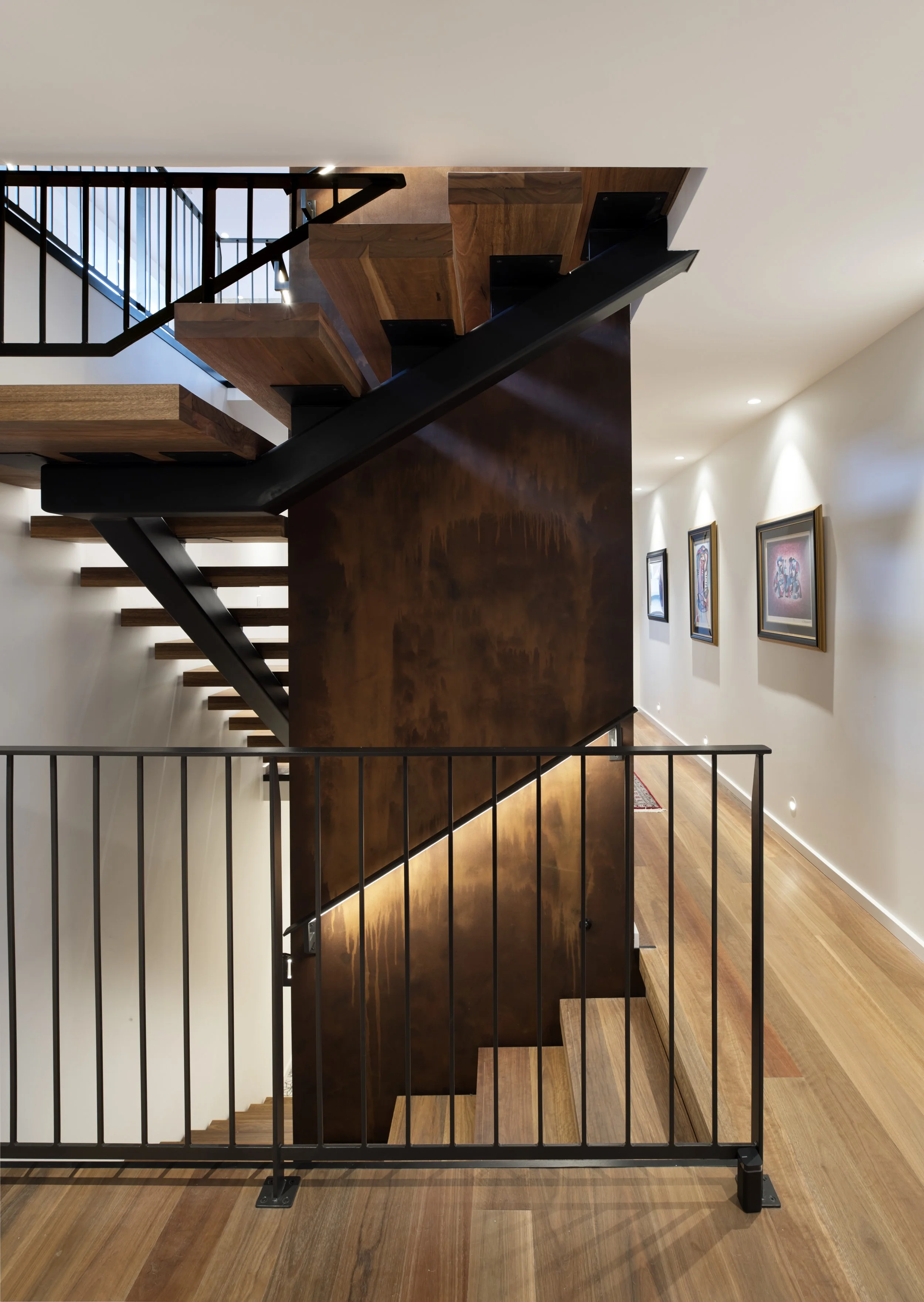
Masculinity meets femininity in ways that appeal to personal tastes. Underpinning it all however, is state-of-the-art functionality. Smart technology includes wireless internet on every floor, Sonos surround sound, a talking fridge, sensor lighting, 16 solar panels, Tesla battery. All the bells and whistles; plus the bonus advantage of a separate, two-bedroom flat — complete with a tenant.
Personality plus.
13A Commons Ave, Mount Maunganui

A classic twist
Adding another dimension to an established brand.
Adding another dimension to an established brand.
Words Nicky Adams

There’s lots to like about husband-and-wife team Paul and Corina Taylor, particularly if you enjoy good humour with a side order of honesty. Paul is articulate and animated, plus he makes a mean cup of tea. Corina’s warmth and gentle manner put you at ease straight away. Together with Paul’s brother David they hold the licence for and are owner/operators of Classic Builders Rotorua and Taupō.
To unravel what exactly this means, I double check with Paul, who clarifies: “We hold a licence agreement to build within the Rotorua and Taupō councils and we work under a licence manual… Classic provides a back-of-office service for us with our design work, accounting, marketing, health and safety.” Essentially, Paul, Corina and David are very much Classic; “We’ve got the brand; together we’ve got 28 years’ experience of working with the brand, we’ve got the national supplier agreement, the systems, the processes – the aftercare service and warranty – all the stuff that’s always at the forefront. We bring our customer service, excellence, and quality. Our biggest added value is our experience.” The formula is clearly working, as, for the second year running, the team has just scooped a slew of accolades at the Classic Builders National Awards.

Paul has been with Classic for 19 years, moving from operations to licence holder; Corina joined the business 11 years ago with a strong background in sales and real estate, and found her true passion as colour and design consultant. Brother David came up from Palmerston North and in 2014 jumped on board the Classic ship, starting as construction manager and moving up to branch manager before taking on regional manager of Rotorua and Lakes. This powerhouse combination has a real confidence that only years in the game can bring. Corina points out: “There wouldn’t be too many areas of building where we haven’t got experience or a situation we haven’t come across before. Between the three of us we’ve got a tonne of expertise. With Paul, you’ve got the land acquisition, business/finance acumen and supplier relationships; David’s got the operational and building brain and I’ve got the face to face with the clients – refining the look they want, the colours, materials and specifications.” Paul chimes in: “We know our lane; we know where our strengths are”. Corina agrees, “there’s strong leadership in all three of those areas, and that filters down to our team, so they’ve got clear, strong direction and leadership and they really feel like we’ve got their back. Talia (our building co-ordinator) always says, “it’s like we’re in one big wāka rowing in the same direction.”
The impetus to branch away and establish their own part of the company was an organic progression. As Paul clarifies; “After being within the brand for 19 years I wanted to use all that expertise that I’d learnt to continue my journey and bring that to a different region. I had a vision of how things could be done at a grass-root level and wanted to get back to being more customer facing.” They both get animated as they explain how they could see the potential and growth in this area, which they have created and generated with the help of their team. Corina reiterates how adding value to the community has spurred them on, and Paul relishes the relationships they have built with land stakeholders, local iwi, various land developers and other members of the community supply chain.

Corina’s sideline passion is her role as work events coordinator. Laughing, they both agree her love of organisation enables her to excel in this position. Joking aside, they go on to talk about how hugely important the sense of ‘team’ is to not just them personally, but to the success and growth of the business. The social side is huge: “We always celebrate our wins, our birthdays our anniversaries.” Paul sums it up: “We work together, play together, stay together.” Talking of events, the team is about to celebrate its fourth anniversary, which is a milestone the trio are hugely proud of. Within that time the team has grown from three to 12 and is still expanding. In a flat market it’s definitely bucking the trend to be experiencing growth. I wonder what Paul and Corina would consider has helped with this. Paul is hesitant, as he’s aware it’s not something that’s currently experienced across the board. “I suppose we’ve read the market, and we know how to deliver to these conditions. We’re adaptable: that’s what a small team brings.” Corina agrees. “We’re able to reduce square meterage to bring a price down – we know how to deliver a price point product of spec and looks. What we do well is very targeted to suit the market.” Paul adds: “And we deliver what we say we will. There are no hidden exclusions.”
They also pride themselves in managing to cater for a broad demographic, from duplexes for a couple, to four-bed family homes, to investor properties. Repeat custom is something they’re excited has started to happen – there’s real pride when they mention people who have returned, a testament, amongst other things, to their relationship building.

Client relationships, they say, are crucial to the whole team. Their carefully crafted ‘Wall of Fame’ in the office has a photograph of every handover they’ve ever done. “There’s detail,” says Paul. “We haven’t just slapped it up.” Corina adds: “We really celebrate with our clients. It’s such an emotional process – you’re a huge part of each other’s lives for the duration of the build process. We love the handovers, it’s a big deal”. The Classic Care policy ensures the continuation of the relationship, even after completion. The Rotorua-based design centre reflects the blend of Corina’s systematic and creative personality. Purposely built for the client experience, it’s a visual space where the products are almost artworks. The layout of the room follows a build schedule, enabling clients to place selected swatches on the table, ultimately creating the home they will build. Corina thrives on her role: “I love helping people create the vision they have for themselves and their home; pulling all their ideas together and giving them different options in a budget-conscious way that fits within their build and our brand. Knowing they can have a beautiful home that they can be really proud of, but that fits within all our standard specs.” Operating from the hub, the team all hail from different parts of the region, and understand the value of ties with the community. That reaches beyond the clients to every part of the build chain, from the land to the carpet layers to the kitchen supplier. Every team member, according to Corina, gives their absolute all, “the work ethic of our people blows me away.”

Client relationships are of course integral; once that bond is established the trust follows. Transparency is their currency. Paul stands by his word: “We have a fixed price; we don’t have any escalation clauses. Within the contract – if we’re in control as the build partner we can give you a fixed price contract. But also, there’s flexibility if you want to have a provisional sum where you may want variations. You sign off everything first. We have a design and build contract, or house and land where we control the overall package. We’ve got flexibility – but again, it comes to a fixed price.” Adaptability, value for money, honesty and integrity are all central to what makes the wheels turn. “And positivity,” enthuses Paul.
What advice would you give someone looking to build?
Trust/understand your build partner. Do your research. Make sure you’re comparing apples with apples – go through the details.
Why would people choose to build in this market?
You end up with a healthy home with all the new standards (better insulation/ better joinery/heating etc). Better funding options with building new. There are good options out there, and you’ve got time to research as it’s not a flooded market.
How to avoid common mistakes?
No two sites are the same, so get down to the detail. Go with a reputable brand with experience.
What should be the primary focus on a build?
Focus on the needs – add in the wants/wishlist. Be honest about what you have to spend.

Pull back the curtain
At the helm of Guthrie Bowron Tauranga, Margaret Gill knows interiors. Here, she shares an insider’s guide to window coverings.
At the helm of Guthrie Bowron Tauranga, Margaret Gill knows interiors. Here, she shares an insider’s guide to window coverings.

Window coverings have a major influence on a room’s functionality and ambience — a fact that’s both exciting and makes knowing what to choose a little daunting. The following insider info might help you decide what’s best for you.
Your first consideration? Function. Living spaces may need a sun filter treatment to manage glare during the day. Bedrooms benefit from blackout curtains to aid sleep. Window treatments will also offer additional insulation if your home is lacking in that department.
Will curtains or blinds be best? Curtains visually soften the hard edges of a room, while providing warmth and privacy. Roman blinds provide a streamlined look for the minimalists among us, and are ideal for high or small windows.
What size are your windows and how much wall space is there on either side? The answers may lead you to floor-to-ceiling curtains for spacious rooms, while blinds will be great for small, narrow or awkwardly placed panes.
Keep roller blinds, venetian blinds, vertical blinds, honeycomb blinds and shutters on your radar too. All have their advantages and limitations, depending on your home’s unique requirements and the look you love.
Enjoy using your window treatments to express your creativity. Whether
you gravitate towards soothing neutrals, energising bright hues or statement-making bold patterns, there’s such a wide range of fabrics available that you can take your pick when it comes to style, colour and texture. Most curtain fabrics can also be used for roman blinds, allowing you to maintain a consistent scheme throughout the house. Then tie it together with other soft furnishings such as cushions, throws, bedding and upholstered furniture. Or make a feature out of an exceptionally special textile. For example, a printed velvet, intricate jacquard or highly textured boucle.
The secret to your success lies in talking to an experienced curtain and blind consultant at the beginning of your decorating project. At Guthrie Bowron Tauranga, you’ll find all the latest collections from UK textile brand ILIV, as well as top-notch New Zealand suppliers. Are you ready to get started?

Let your hair down
Feeling ready to enjoy a new ’do? Sam Henry of Shine and Studio May salons reports on the season’s most sophisticated trends.
Feeling ready to enjoy a new ’do? Sam Henry of Shine and Studio May salons reports on the season’s most sophisticated trends.
photo Salina Galvan + supplied

Sam Henry
Coming in hot this winter is the trend towards quiet luxury. Just like the no make-up make-up look, it’s all about hair that appears naturally, effortlessly beautiful. Here are five ways to wear it well.

1. For a soft yet bright lift, consider lightening those baby hairs around your hairline just one or two shades lighter than your natural hair colour, but always remember to keep the health and integrity of your hair in mind – never overprocess!
2. One of the most requested colouring styles in many a salon, balayage isn’t going anywhere, but now there’s a new technique to try – camou-lage.
This creates beautiful dimension in an even more subtle way, without any visible lines. Think shiny, healthy hair with golden tones – buttercream blonde or latte-hued babylights enhancing your natural locks.

3. For the cowgirl copper lovers out there, golden amber is bringing the heat for the chilly season. It’s the perfect tone to complement those with green or blue eyes.

4. A brighter take on the mocha brown look, new-season cappuccino browns blend a warm base with cool caramel babylights.

5. Still high on the hit list for hairstyles is the timeless bob, and there are various interpretations to try. Depending on where your mood takes you as you slide into your stylist’s chair, the bubble bob might take your fancy. It’s still going strong from early 2023, and with the length curving around the chin, it’s full, floaty, bouncy and fun. Meanwhile, the micro bob is the shortest of them all – just brushing the jawline, it’s blunt and edgy. Or perhaps you want to get nostalgic with a ’90s bob, featuring va-va-voom volume and hair blow-dried like you’ve just stepped off a cruise ship.

Plant life
The Centre For Health’s Dr Anna Rolleston sits down with two of her clients, Carrie and Sarah, to discuss how a plant-based way of eating works for them.
The Centre for Health’s Dr Anna Rolleston sits down with two of her clients, Carrie and Sarah, to discuss how a plant-based way of eating works for them.

Anna: What’s the deal with plant-based eating, and how does it differ from being vegetarian or vegan?
Carrie: Think of a plant-based diet as a colourful celebration of fruit, veggies, grains, legumes, nuts and seeds – it’s like a garden party on your plate. Unlike vegetarians, who may still eat dairy, and vegans, who steer clear of anything animal-related, even honey, plant-based eaters mostly skip the animal products but might have a ‘cheat day’ here and there for some meaty or sugary indulgence. It’s not about a strict approach – I’ll have up to four eggs a week, for example – it’s about eating mostly plants.
Sarah: For me, it’s 80 percent plants and also about reducing the amount of processed foods and refined sugar I eat. I used cheat days heaps initially but don’t so much now, because my body doesn’t really like that other kai anymore.
Anna: Why do you think people jump on the plant-based bandwagon?
Carrie: For their health and wellbeing. Health perks like controlling cholesterol, shedding a few pounds, and dodging things like heart issues and diabetes are big reasons.
Sarah: Then there’s the eco angle. Plant-based eating is better for the environment, reducing your carbon footprint and saving resources. It feels good to be plant-based if you’re environmentally minded.
Anna: What are the other benefits of eating this way?
Carrie: There are heaps! You get a nutrient boost, improved digestion and I reckon my immune system is way better than it used to be. I know there’s also some research that says it could dial down the risk of certain cancers and add more candles to your birthday cake.
Sarah: I have more energy, my gut isn’t as gurgly, and I feel lighter in my body. I’m not sure it’s all down to the plants, but I feel happier.
Anna: Who do you think is the ideal candidate for trying a plant-based diet?
Carrie: Everyone!
Sarah: Definitely people with health conditions, and athletes too, and if you’re keen to help look after the planet and save some money, then it’s a go for you as well. I think it’s cheaper in the long run, as meat is pretty expensive at the moment.
Anna: Any pro tips for easing into it?
Carrie: Start by swapping a few meals a week with plant-based options. Brush up on your nutrition knowledge to make sure you’re getting all the good stuff like protein and iron, and don’t forget the plant-based remixes of your usual meat dishes – like veggie burgers, or tacos filled with jackfruit.
Sarah: To be honest, just do FastTrack Kai ā Nuku – it’s the easiest way to understand everything and eat yummy food. Getting the whānau on board is a biggie – although if you’re the main cook like me, they just have to eat what you serve!
For more information on adopting a plant-based diet, visit fasttracknz.co.nz

Inner talent
Sarah Parry, the creative force behind Testament Interiors, shares her design principles, lets us in on the latest trends and explains how an interior designer’s expertise can lead to cost-effective solutions.
Sarah Parry, the creative force behind Testament Interiors, shares her design principles, lets us in on the latest trends and explains how an interior designer’s expertise can lead to cost-effective solutions.
interview Hayley Barnett | photo Giselle Brosnahan | hair + make-up Michelle Olwagen

Interior design is one of those things we all think we can do, but realise quickly, in the throes of a project, just how difficult it really is. This is where pro designers come in. UNO is lucky enough to introduce our very own designer, Sarah Parry from Testament Interiors, who is here to answer all your pressing questions around interior design.
A passionate designer and right-sizing expert based in Tauranga, Sarah recently launched her business as a way to share her incredible creative skills, alongside her floor covering business with husband Jason. They have a blended family of four young adults, one grandchild, two fur babies and a pond of goldfish.
Here, she offers some helpful advice to those looking to overhaul their living spaces.
UNO: Where do we start when designing a new space?
Sarah: Working out your budget is really important to establish. Then, ask yourself who will live in the space. If it's your own home, that's different, for example, to an Airbnb or a rental. Once you know how much you have to spend and who the space is for, it’s time to decide what your design style is. It could be a combination of styles. Pinterest is ideal for this. The algorithms work out exactly what you like and you can file these away to look at for inspiration or to show your interior designer. From there, it’s best to start with your floors first and work your
way up to the walls, then lighting, then styling. Always sort your fundamentals before you dive into styling. It’s from this stage that I will sort a mood board for clients, to check we’re all on the same page, so that we can start organising a sample board.
You can incorporate aspects of trends into your project, but it’s important to keep in mind that trends can easily go out of fashion in as early as a year. You don’t want to spend money on big ticket items, only to regret the purchase a short time later. Go with something you're going to love for a long time. Incorporate trends in items that are easy to replace, such as throws or decor items. The last thing you want is to have a show home style that looks amazing but is completely impersonal.
Work out what’s important to you as a person, a couple or as a family. Choose the ideas that will work for you collectively in the living spaces.
UNO: What are some new trends in interior design for 2024 and how can I include elements of these in my home?
Sarah: Standout colours for 2024 include earthy greens, golds and natural shades. Minimalist is definitely out, and maximalist is in. Bright colours and patterns mixed together are making an entrance this year, which is not for everyone, but when done correctly it can really liven up your living space. The trick is to not make it too overpowering.
Another trend is the mixing of metals in fittings and fixtures, such as taps and handles. No longer is it all one colourway. You can mix brass with platinums and blacks, but it does take a bit of know-how to prevent it from looking tasteless.
Organic design is huge right now, and Japandi falls under this style. It's a lot of natural shapes and textures that are light, earthy and very calming, but not minimalist. It uses a combination of biophilic principles.
UNO: What is biophilic and sustainable design?
Sarah: Biophilic design principles are not new. They've been around for a long time. However, they are becoming increasingly important in helping us connect with nature and whenua, the land. Waiora, a core concept in Māori culture, connects people and the environment. When done well, it provides nourishment and energy to sustain our wellbeing. Biophilic design uses natural elements, whether that's plants or movement, into your interior space so that you have a connection between the earth and the land. It's one of my key concepts. I love plants and adding as many natural items into a house as possible, because it creates life.
Sustainable design uses products that are either sourced locally from natural materials within your environment, or manufactured from sustainable resources like recycled products or materials that are farmed in a sustainable way. So if it was a wood, for example, it would be from a sustainably grown tree that is renewable.
UNO: Why would I use an interior designer?
Sarah: By using an interior designer, the client has access to suppliers at commercial designer rates. So the cost of using a designer will offset the designer fees and you'll get far better value for money across the project. The bigger the project, the bigger the savings.
But the most common reason I get called in is to maintain a design cohesiveness across the project so that it flows.
And, of course, it's important for preventing costly mistakes such as choosing the wrong paint colour or fittings. It saves money all round!

Savour the Bay
The BOP’s Plates of Plenty Challenge saw chefs from all over the region competing for the best dish. Here, some of the competitors – including the winners – share their divine recipes.
The BOP’s Plates of Plenty Challenge saw chefs from all over the region competing for the best dish. Here, some of the competitors – including the winners – share their divine recipes. Enjoy!

Cadera’s Blue Cheese Jalapeño Poppers
Mount Eliza Blue Cheese Popper in a Mount Brewing Co. High Line Hazy Pale Ale batter with Nana Dunn + Co curried onion chutney.
Makes 25 pieces
INGREDIENTS
Whole marinated jalapenos – we use La Morena
350g cream cheese
150g Mount Eliza Blue Monkey cheese
1 can Mount Brewing Co.
Hazy Pale Ale beer
1½ cups self-raising flour
Nana Dunn + Co’s Curried Onion Chutney to serve
METHOD
Slice the jalapenos lengthways making sure not to cut the whole way through. Remove all the seeds.
Combine cream cheese and blue cheese.
Using a piping bag, fill the poppers with the cheese mixture being careful not to overfill
- about three-quarters full.Mix beer and flour until smooth in texture.
Dip the stuffed jalapeno into the batter to fully coat it and transfer straight into the deep fryer or oil at ideally 180°C.
Cook until golden brown.
Serve with the curried onion chutney.

Pearl Kitchen’s Pie & Beer
Smoked fish pie with blue cheese potato, curried onion chutney and smoked fish gravy, served with a beer.
Makes 10-12 pies.
INGREDIENTS
Blue cheese sauce
25g butter
1 tbsp plain flour
150ml milk
50g Mount Eliza Blue Monkey cheese, chopped or crumbled
Fish pie mix
1 onion, finely chopped
2 celery stalks, finely diced
1 carrot, chopped/diced small
250ml cream
1 tsp Dijon mustard
100ml of Mount Brewing Co. low carb ale
Olive oil for frying
1 small handful of flat-leafed parsley, finely chopped
500g-650g smoked kahawai, cut into biggish chunks
Pastry + egg wash
750g frozen puff pastry
2 egg yolks
15ml milk
Charred pearl onions
100g pickling onions
50ml sherry vinegar
METHOD
Blue cheese sauce
Melt the butter in a pan over a medium heat, then stir in the flour and let cook for 1 min or so. Gradually pour in the milk, stirring constantly, until the sauce is smooth and all the milk has been added.
Bring the mixture to a simmer and stir in the cheese. Cook until the cheese has melted, and the sauce has thickened slightly, then season to taste.
Fish pie mix
In a pan, fry the onion, carrot and celery for about 5 minutes in the olive oil then add the ale, cream and bring to a boil. Add the spinach leaves and Dijon and stir to wilt.
Add your chunks of smoked kahawai to the mix at the end as it's already been smoked.
Pastry + egg wash
Cut your puff pastry into small circles or desired shape. Brush egg wash onto the bottom and add your fish pie mixture into the centre of the pastry leaving enough room at the sides so you can add another layer of pastry on top and can seal the sides. I used a fork on the edges to make sure the pastry was pushed down and sealed properly.
Before baking, egg wash the top of the pastry. Bake at 175°C for 15 minutes.
Charred pearl onions
Boil onions with skin on in vegetable stock or water until onions become soft.
Let them cool down completely and cut them in half.
Get a smoking-hot pan with a little olive oil and place the onions cut side down for about 30 seconds. The onion should start to char and go black — this is when you can add the sherry vinegar to deglaze the pan and the onions will soak up all that flavour.
When the onions have cooled down, you can take out the middle heart of the onion (we will use this in the chutney) and start to take out the onions’ petals. They should be charred on the outside.

The Trading Post’s Agnolotti del Plin
A handmade pasta in a typical Piemontese shape, filled with Mount Eliza Blue Monkey cheese in a Noble & Sunday Earl Grey-infused butter sauce with Mama Kali's Farm microgreens.
Serves 5
INGREDIENTS
Pasta
350g flour
150g semolina
200g eggs
100g egg yolk
8g cocoa powder
Filling
300g Mount Eliza
Blue Monkey cheese
150g cream
1 egg white
Pinch of salt
Sauce
50g butter
Pinch of Noble & Sunday
Earl Grey tea
Fresh Mama Kali’s Farm microgreens
METHOD
Pasta
In a bowl or on the table, place the dry ingredients, then in the centre place the eggs and yolk and knead to a smooth dough texture. Set aside in the fridge for 1 hour.
Filling
Blitz in a food processor the cheese and cream quickly then add egg white until smooth and thin but not whipped. Place in a piping bag and refrigerate until use.
Pasta continued
With the help of a pasta machine or rolling pin, laminate the pasta dough close to 1mm thickness and cut in long strips.
Then pipe a small amount of filling along the longer side on the pasta strip (you want the filling to be one finger apart from one another).
Proceed to fold the pasta over itself and pinch the pasta with your index and thumb between the filling – squeezing a touch towards the centre of the filling.
With the use of a zig-zag cutter, cut between the pinched pasta and the “plin” will look like little lollies. Cook the pasta in salted boiling water for about 3 minutes.
Remove and toss in a pan with butter and a pinch of Earl Grey to emulsify the sauce.
Add cooking water a little bit at a time and continue tossing to avoid the pasta getting stuck to the pan. This also gives a velvety look to the sauce.
Plate and garnish with microgreens and add grated cheese as per your liking.

But First Dessert’s Biscoff Cheesecake
If you haven't tried Biscoff yet – this is your sign to run to your nearest supermarket, grab some Biscoff and whip up this delicious cheesecake.
Serves 8
INGREDIENTS
Base
240g Biscoff biscuits
80g butter
Cheesecake
450g cream cheese
200g Biscoff spread
250g cream
Topping
200g white chocolate
50g Biscoff spread
100g cream
METHOD
Line a 20cm x 20cm cake tin (or individual cake rings like we use) with baking paper.
Crush 240g Biscoff biscuits in a bowl, pour melted butter in and mix together well.
Press into the bottom of the cake tin, place in the freezer to set and begin to prepare the cheesecake mix.
Add cream cheese, cream, and Biscoff spread into a bowl. Whisk until nice and thick. Spoon this on top of the biscuit base and use a spatula/spoon to make sure it's nice and smooth for the ganache topping.
Pop the cheesecake into the fridge for at least 3 hours to set before adding the ganache topping.
Put the white chocolate and Biscoff in a bowl and set aside. Heat cream in a pot, stirring frequently to ensure it doesn't burn. Pour the hot cream over the chocolate and Biscoff. Whisk until nice and smooth. Gently spread the ganache over the cheesecake.
If you have any remaining cream or crushed biscuits, whip the cream and pipe swirls on top of the cheesecake (if you have piping bags/nozzles) or sprinkle over the crushed biscuits.
Pop the cheesecake into the fridge for at least another hour or two before slicing.

Start anew
Cashmore Clinic’s Leanne Cashmore on a treatment that can help you gain a firmer foundation.
Cashmore Clinic’s Leanne Cashmore on a treatment that can help you gain a firmer foundation.
photo Salina Galvan

At the Clinical Aesthetics Symposium I attended in Auckland recently, the talk was firmly focused on skin treatments. There wasn’t a single presentation on botulinum toxin and not much at all about dermal fillers.
So many new and exciting treatments and applications have arrived in New Zealand, making the Australian injectors very envious, as many of them are not yet available there.
Getting things across the line in Australia is more difficult than it is here, so we get to benefit from them a good couple of years before our trans-Tasman counterparts do.
I want to talk about the RF microneedling device that was a hot topic of discussion at the symposium. We’ve had such a device at the Cashmore Clinic for a couple of years now and it’d have to be one of our favourite skin treatments. ‘RF’ stands for ‘radio frequency’.
The treatment is designed to remodel collagen from the inside out and is used for scars, sun damage, wrinkles, stretch marks, pores and improving overall skin quality.
The radio frequency (heat) delivers controlled energy at various depths (via the needles) depending on what we’re treating, to tighten the skin and promote the production of collagen and elastin. It can penetrate deeply to give much better results than your standard needling, which treats only the superficial layers of the skin.
We recommend having RF needling in winter (because avoiding sun exposure is advised post-treatment) and scheduling a series of sessions for optimal results. The treatment takes around an hour. A strong anesthetic cream is applied to the skin and left to take effect, then the needling itself lasts for around 20 minutes. Your skin will be only mildly pink when you leave the clinic, and you can apply make-up and follow your normal routine the next day. Four weeks later, you’ll have a second treatment, then a third treatment a month after that. Three is the minimum we recommend; four to six is even better.

Before and after RF needling.
With RF needling, skin continues to improve for three months after your final treatment. You also have the option to have topical growth factors infused immediately afterwards, such as PRP (Platelet Rich Plasma), where your own blood is separated into red blood cells and plasma, and the plasma (which is full of goodness that further enhances luminosity and improves skin texture) is infused into your skin.
The latest technology to infuse is exosomes. They pack even more of a punch than PRP and are more predictable. Extracted from young human adipose (fat) tissue, this is cutting-edge technology and a good option for hair restoration as well. They’re another whole topic, so I’ll go into it in more detail in a future issue.
People often want a quick fix, like that achieved by botulinum toxin and fillers, but remember, we also need a good canvas to work from. RF needling has limitations. It isn't a face lift, it’s a skin treatment. A full consultation will help us determine if it’s the right procedure for you.

Reach for the sky
This exceptional home is a haven of privacy. The property's sleek design and breathtaking sky views add to what is the height of modern luxury - and to top off its impressive features is a truffle orchard of hundreds of oak trees.
This exceptional home is a haven of privacy. The property's sleek design and breathtaking sky views add to what is the height of modern luxury - and to top off its impressive features is a truffle orchard of hundreds of oak trees.
words Jo Ferris | photos Hunter Studios

Situated in the Oropi hills, this serene, minimalist home is surrounded by nature and designed with ultimate privacy and security in mind. Nestled within blissful seclusion at the end of a private road, the property offers gated vehicle entry and a helicopter landing option for increased anonymity.
The home was built by multi-award-winning Shaw Builders and designed to a specific brief. Beautiful in its simplicity, the home disguises the extraordinary complexity behind its creation. It embraces 800m² of understated luxury to combine modern design with meticulous craftmanship.
Floor-to-ceiling windows, all-day sun, and views as far as the eye can see blend to create airy, light-filled spaces. Lush, sub-tropical gardens surround the home to instill tranquility and provide intimacy in various rooms and outdoor settings.

Architectural design wraps this home around a swimming pool with waterfall to create a resort worthy of a tropical escape. Views stretch out to embrace Mauao, Tauranga and offshore islands beyond – a reminder that this stunning setting is a discovery of true surprise.
The interior design features clean, bold lines, negative details and high-end finishes with top-of-the-line appliances. A cosy wood fire in the dining room is perfect for intimate occasions, while the chef’s kitchen and lounge serve as the central hub for gatherings.

Equipped with Crestron home automation, this home provides comfort and privacy with ensuite bedrooms for family and guests, together with a separate apartment for extended family. With its own entry, private patio and personal garage, this suite has also been designed to double as an executive workplace. Completing the home’s forethought for work and leisure, it includes a dedicated gym, office and media hideaway.

Once farmland, this 12-hectare estate has been transformed into a sanctuary for birds and nature playground. Walking and riding trails wind through native bush, with streams and springs. Along with the tropical gardens and grasses embracing the house, specialty plantings throughout the estate reinforce how the micro-climate has rewarded this property’s development. Stands of redwoods, specimens and berries, fruit and nut trees – nature thrives here.
Of particular note is the truffière – 750 specialty oak trees on park-like slopes that add peace, tranquility, and a potential future income.
This unique Oropi retreat combines luxury with natural beauty to highlight how thoughtful design can blend with nature to be at one with the world and offer an unparalleled living experience.
Nga Parae Rd, Oropi

Surf’s up!
One of Tauranga Museum’s first exhibitions will celebrate the region’s pivotal role in Aotearoa’s surfing culture.
One of Tauranga Museum’s first exhibitions will celebrate the region’s pivotal role in Aotearoa’s surfing culture.
words Karl Puschmann
boards Dusty Waddell Collection

Mount Maunganui is world-famous in New Zealand for its rolling surf and golden sands. Each summer people flock to the beaches to hang ten or catch rays. But, outside the surfing community, not a lot of folks know about the region’s rich history and contribution to Aotearoa’s surfing culture.
That’s all about to change. The Tauranga Museum team is hard at work putting together one of the first exhibitions to go on display when the long-awaited new museum opens its doors in 2028.
“The exhibition on surf and beach culture will be one of our earlier exhibitions on display when we open,” museum curator Fiona Kean enthuses.
It will certainly be hard to miss. Following the museum’s acquisition of local surfing icon Dusty Waddell’s legendary surfboard collection, the museum is already preparing 120 surfboards for display. These all hold national significance and physically chart the evolution of surfing in New Zealand.
“There’s shortboards and longboards, and in addition to those there’s boogie boards, belly boards, skim boards… there's probably another 50 of those,” Kean says. “We’ve even got 40 skateboards. We've had to create a special space at our storage facility for it all.”

Through the various shapes and sizes of the surfboards, you’ll see trends come and go as you progress through the years. It will also highlight beach culture with displays of fabulous local swimwear, wetsuits and ephemera like surf posters. We have an amazing hollow board that is over four metres long. It was made at the Mount in 1952 by Ron White and Jock Carson using the famous Tom Blake design. Kean is also in discussions with a local shaper who makes surfboards from – of all things – wool.
“It’s an exciting idea because most surfers are really interested in their environment and in cleaning up and preserving the water they swim in,” Kean says. “Surfboards in the past have been made of foam and more toxic materials, so innovations like that look at how surfing can be more environmentally friendly.”
While we all recognise the region for its good surfing, its epic contributions to the sport aren’t as well known. Surfing and surfboard manufacturing in Tauranga goes all the way back to the early 20th century. Through her research, Kean discovered there were, in fact, two surfboard makers here in the 1930s making, selling and hiring their boards out to summer beachgoers in that era.

Once established here, surfing never left. In the 1940s and ‘50s more shapers arrived and the era of plywood boards began.
“Plywood is an important story for Tauranga,” Kean says. “That takes you down a whole other rabbit warren of the people making hollow surfboards out of plywood. And then you have the leap into foam-core or surfboards made with foam blanks. You've got probably one of the biggest names in surfboard making, a man called Bob Davies, who comes to Tauranga and sets up a factory here, and at the same time another local guy, Ted Davidson, owns a sports shop on Cameron Road and he starts making surfboards out of that shop.
From there, it’s honestly like a wave of shapers and makers around the country flowing in and out of each other’s lives and businesses and the Mount and Tauranga were an important part of that scene.”

It’s fascinating to hear her talk about how huge Tauranga’s impact on New Zealand surfing actually was. It will be even more fascinating to see it. Surfboards are big items, especially the older longboards, which on average stand at a towering 12 feet tall. The scale of the exhibition is going to be awesome.
Kean is excited about the project and can’t wait to share everything being discovered about Tauranga’s rich surfing history when the museum opens.
“We want people to have a greater understanding of surf and beach culture and its significance to where they live. We’re a really important piece of that overall surf culture puzzle. For example, the first surfing nationals were held at Mount Maunganui in 1963,” she says. “The museum hopes to give people a sense of belonging to this place. I’d love for locals to feel pride in our role in the surf industry and to come away with a sense of enjoyment. It will be a fun exhibition but one that does have moments for reflection and moments where you’ll feel challenged.”
For those who simply can’t wait until 2028 to see what’s barreling down the pipeline, Kean reveals how you can get a sneak peek at the surfboards and, essentially, the Bay’s surfing history on Tauranga Museum’s website.
Kean says the exhibition will appeal to non-surfers just as much as those who like to hit the waves, as the experience the museum team is curating showcases not just surfing but wider beach culture.
With a few more years of prep work, research and collaboration with the community before it opens, Kean has a very simple objective for the exhibition in mind.
“We want it to blow people away,” she laughs.

Well advised
When it comes to money matters, expert guidance is more important than ever in today's tough economy.
When it comes to money matters, expert guidance is more important than ever in today's tough economy.
photo Jahl Marshall

As a lender for more than 20 years, Brooke Reynolds has certainly worked her way up through the finance world. She started as a full-time casual teller and worked in almost every bank position imaginable. She then went on to work as a mobile mortgage lender and later studied conveyancing. Today, she has extensive, well-rounded knowledge of the whole banking process, not just lending, and owns half of Rapson Loans and Finance in Tauranga. Brooke loves using her valuable and vast wisdom to help others. Here, she tells us why a financial advisor is an important asset to have, and what to expect from them in terms of advice, knowledge and assistance.
Financial advisors are the go-between with individuals and the banks/lenders. They get to know you and understand your needs and then relay that information to the lenders. The relationship you form is important as the more they know their clients, the easier it is to achieve exactly what you want. Everyone has different needs − no two people are the same − and your adviser needs to be able to manage that and not take a ‘one fits all’ approach.
But can’t I just do that myself, you ask? Yes, absolutely you can. If you don’t mind making the appointments with lenders, taking time off work and then following up with further information and research. It all costs you time and effort, and then if they say no, what do you do? Advisers are able to go to multiple lenders and will be able to tell from the conversations you have had which banks have the policies and products that would best suit your situation. Banks have different policies and products. They are not all the same. Advisers know this and can navigate it all for you.
The majority of the time, it costs you nothing to consult a financial adviser; however, in the situation where you are using a second-tier lender/commercial lending/equity lending, there may be a fee. Most of the time this can be capitalised onto the loan. The banks will also claw back any commission paid if the loans are repaid and closed prior to 27 months (this varies with lenders, some are less) but this is a conversation to be had at the time of engagement.
Financial advisers are highly regulated. Absolutely everything must be disclosed, from what we are paid, to complaints and clawbacks, and so on. Our files are reviewed and we could get a visit from the FMA at any time. This includes any email correspondence, text messages and phone calls.
All in all, financial advisors are a valuable resource and tool to lean on for knowledge, advice and help with applications. Look out for my column in the next issue if you’d like to learn about different types of loans and the importance of structure.

Twinkle toes
Liz French skied the slopes of Canada’s Sun Peaks and Big White resorts, and it made her feel like dancing.
Liz French skied the slopes of Canada’s Sun Peaks and Big White resorts, and it made her feel like dancing.
photos Liz French + Lindy Ellison + supplied

“Skiing is like dancing; the snow is your music,” said Olympic gold medallist Nancy Greene, who calls Sun Peaks home and is a wonderful ambassador. I was privileged to ski in a group with the woman named Canada’s female athlete of the 20th century in 1999 for her prowess and contribution to the sport.
Nancy’s 80 now, but she still skis like a teenager. She generously shared her story and tips for improving our skiing (“Stay on the balls of your feet”), taking us where we might not have otherwise gone – notably the ski cross course, on which you bounce over humps and race around well-cambered corners.
After a couple of cloudy but satisfyingly snowy days, Sun Peaks lived up to its name with bright blue skies and gloriously groomed pistes. My partner and I arrived there from Big White, which also lived up to its reputation as ‘Big Whiteout’. We had six murky days, but the payoff was snow you float through. It’s not like in New Zealand, where heavy cloud cover means skiing by braille. The trees provide definition and the wide, obstacle-free pistes instil confidence.
The slightly eerie feeling of skiing in the mist was enhanced by the sight of ‘snow ghosts’. Big White’s known for these trees on the upper slopes that get so snowbound they take on a sculptural form. To add to the sense of surreal, we went night skiing one evening. One long run is illuminated by lamps that throw pools of light on the snow, the patches of dark between them slightly disconcerting till you get the hang of it.

Members of Liz’s tour group - fast and furious meets sedate.
Skiing in Canada is delightfully different to skiing in New Zealand. Think long, wide, tree-framed pistes groomed to perfection, often with several centimetres of powder laid seductively on top. Sun Peaks has a signature trail, five miles (that’s 8km) from Top of the World to the base. The colder, north-facing side of the resort, Morrisey, has lots of glade skiing; on the south-facing side, Sundance and Sunburst have longer, sweeping trails. If Big White is whiting out, skiing the Black Forest side affords ample visibility. When the sky clears, it’s great to head to the Gem Lake area and the powder runs, most of which we skied without much visibility but with good guides.
The only queues we saw were on the main chairlifts when they opened in the morning, especially on a powder day. Most lifts allow skiers to take green (easy), blue (intermediate and so much fun) or black (advanced) trails down, meaning even amateur skiers can reach the top to enjoy the view.
We book our snow holidays through Auckland’s Ski Travel Specialists, and this year joined one of their group trips that come with the benefit of tour leaders. Ōhope couple Linda and Stephen Clews have been hosting ski trips for years and, as well as facilitating fun, share their knowledge of the fields. I mostly chose to ski with them, as they split the group into fast and furious (usually me!) and slightly more sedate skiers. We also took advantage of the snow hosts.
These usually retired, keen skiers volunteer their time to take visitors on tours of the fields they know and love. The ones we met said they enjoy Kiwis, who they find are usually game for anything.
Skiers need fuel, and both resorts offer a good range of eating, drinking (and shopping) options, though Sun Peaks’ village is more extensive than Big White’s. We even found good coffee, becoming regulars at the Tea Bar at Big White, and Bolacco and Vertical cafés at Sun Peaks. Costs escalate with tax and tips, but hey, you’re on holiday.

There’s plenty to do if you want a change from skiing or snowboarding. We could have gone ice skating, snow shoeing, tubing, sleigh riding, fat biking and axe throwing. I bowed to my partner’s desire to go snowmobiling and spent two hours squawking from the back seat as we shot along the trails, stopping to admire views and to thaw out at a warming hut also used by cross-country skiers. I much preferred dog sledding – sitting in a low-slung sleigh with a musher behind us to ‘steer’ the seven enthusiastic, well cared for canines swooping us along tree-lined trails and out to a frozen lake.
Skiing in Canada gives me a heady mix of ego-boosting snow and spectacular scenery, the adrenaline rush of gravity-enforced speed curbed and increased by skill, and the company of like-minded people. I can’t wait till I get to dance on snow again.

Careering through life
UNO talks to Bay experts about shaking it up in the workplace.
UNO talks to Bay experts about shaking it up in the workplace.
words Nicky Adams

Like most anecdotes it seems there’s more than a little truth behind the old expression ‘a change is as good as a rest.’ When it comes to a career choice, we’re living longer, legal retirement ages are rising, and we’re staying in the workforce for greater periods of time. Consequently, a decision we made at 18 may not still suit where we are or who we have become at 45. The good news is that evidence points towards the fact that switching it up can be a positive. A recent report conducted by the OECD (a global collaboration between 37 governments to promote economic growth) entitled ‘Promoting Better Career Choices For Longer Working Lives – Stepping Up Not Stepping Out’ indicates that change, in multiple aspects of your life is actually good for you.
Older workers undoubtedly play an important role in the labour market and are increasingly engaged in developments in digital technologies as well as cultural change. Nevertheless, many find that careers they may have considered were to be for life, may now have morphed beyond recognition, meaning for job longevity mobility might be the key word. Considering a career change is a daunting prospect, and sometimes transitioning means considering restrictions of age and ability. But a little poking around will show there are more resources to hand to help with this process than you might suspect.
Miriam O’Connor from Career Solutions is an expert in the field of mid-life moves. With a business based around helping people of all ages find career pathways through job search coaching, CV writing and careers advice, she has assisted many transitions, helping people who may want to navigate change.

Miriam O’Connor
I wonder if she has seen an increasing uplift in the desire for career shifts: “I think in these times change is a constant thing that people need to be ready for; to be adaptable and prepared to take different opportunities at different times. We’re seeing now with the (downturn in) economy, organisations are restructuring or altering the way they do things. Some jobs, for example, are overtaken by technology.” The key is to embrace advancements as much as you can. “My advice to people is to keep upskilling, keep up to date, keep looking at your own skillset and where you might be able to move if you feel like you need, or have to make a change – in general it’s good practice to be ready for shifts.”
The job landscape, as we know has changed dramatically post pandemic. Miriam agrees: “Covid changed a lot of things – but opened opportunities. People are considering lifestyle; they can work remotely – be a digital nomad.” Whilst there have been more opportunities for job fluidity, the job market itself has altered. “There’s also changes with different sectors in terms of the growth. I’m seeing people all the time that need to think about things differently and put themselves in an alternative mindset to get into another type of work – take their skills into a different industry.” I wonder how common it is to just want change. According to Miriam, “It’s much rarer now to see people on a linear career path, because a career is longer – other opportunities come up.”
Equally the job search itself is dependent on the economy. “A couple of years ago there were jobs left, right and centre. Now it’s really competitive. I’m seeing a real uptake in enquiries from people who want a career change but getting no response. How people present themselves in that process is important, on paper, in interviews.” I question how much AI is affecting this. “AI is evolving fast so it’s a case of getting on board, learning some skills and seeing what you do better. Keep up with change.”
Discovering what you might like to do is very much the start point of change – and proactively seeking resources to help is part of that process. In early August Tauranga will host the Canvas Careers Expo, which offers representation from a combination of over 70 tertiary providers, local businesses representing their industry, and large companies coming to actively solicit for staff. Event organiser, Sue Boyne, is passionate about introducing both students and jobseekers to the spectrum of career options that are out there. Relating to every age group, the expo is all about planting the seed, igniting the spark, making connections and exploring new opportunities and ideas.
Sue points out that the difference between a job and a career is something we often don’t make a distinction between, which is one of the reasons she’s so driven to get as many industries represented as she can. She firmly believes in the importance of being informed.
Partnered with Priority One, who recognise the benefit of this event, many of the companies get onboard to support the Priority One initiative, and together they help showcase the types of industries and organisations that we have in the Bay of Plenty. In addition to the businesses, there is representation from universities and tertiary educators who can answer questions not just about courses but also about the system itself. Attracting local students and their parents, as well as opening up possibilities to the kids who need incentivising to stay in education, importantly the event is also aimed at those looking for a change of career. “A lot of people have been forced into a direction they don’t want to go in. They want something different, or even want further education that their current employer can’t offer them.”
Sue has seen an uptake in mid-life change before: “When the economy is unstable people are looking for new options and ideas, and that’s when people question whether they’re in the right industry, if they’re doing the right job for their skillset, or if there’s another direction they should be going in. The whole outcome might be that they’re OK where they are… But for those questioning, ‘am I doing what I thought I’d be doing at 45?’, the exhibitors want to educate you, help you and give you information. If you’re changing direction, there’s nothing but admiration for people, and your age is irrelevant.”
What can attendees expect, I ask. Sue is animated as she lays it out: “They can expect to have questions answered and discover if their idea of potential careers exist. Come with an open mind to explore the possibilities, and to talk to people.”

Onwards and upwards
Vicky had worked as a flight attendant for 17 years, but redundancy post COVID led her to explore other career options. Having really enjoyed shiftwork, and with a supportive partner behind her, Vicky landed on nursing as her next step; as soon as she started training she felt fulfilled. “Straight away I knew this is what I should be doing.” It had been a long time since she’d been a student, and a six-month study and career prep course was mandatory, which, Vicky reflected was worth its weight in gold. Once the course began, Vicky quickly realised, “I was a much better student with maturity – you realise you need to stick at it, and I did my studies with extra motivation to get it done.” Feeling well supported through Toi Ohomai helped. The guidance, she says is fantastic. Excited by her new chapter, she notes, “When you’re in a job for a long time you can go on autopilot – it’s really refreshing to learn new skills.”
Having moved from Auckland to Tauranga, television line producer Angela Burgess initially planned to continue in her field by combining working remotely and commuting back to Auckland. Eight years later she has retrained and is now with KPMG Accounting. “I went to see a Career Psychologist which was really fascinating – she really focused on not so much what jobs you want to do, but what you value in the workplace, what makes you excited to go to work. I realised it was a lot about the people around me, and working in a corporate structure was something that interested me. I knew that I liked numbers… so I started looking at options and came across the Masters of Professional Accounting at the University of Waikato.” Study was full on and the financial burden was hard. Although the costs of studying had been factored in, Angela is honest about the fact that she and her husband hadn’t considered how long it would take to build back up to her previous earning level. The pros of undertaking a change with maturity are multiple. “What really did help when I started at KPMG as a grad was that I was immediately able to pick up the phone and call a client, or hold a meeting or write an email…General business skills have been really helpful, and being able to manage stress and learning how to prioritise – that’s all transferable. Just working feels like you’re learning every day.” The prospect of career progression within the company and a stable future has, for Angela, paid dividends: “KPMG has excellent values in terms of work-life balance and wellbeing, which as a working mum starting from scratch again has made things a whole lot easier.”

Building blocks
If you think concrete is mundane, you’ll need to think again. The Bay’s award-winning builders Gudsell Builders are redefining the artistic possibilities of this overlooked material to create their stunning, acclaimed homes.
If you think concrete is mundane, you’ll need to think again. The Bay’s award-winning builders Gudsell Builders are redefining the artistic possibilities of this overlooked material to create their stunning, acclaimed homes.
words Karl Puschmann | photos Amanda Aitken

Concrete and nature don’t always live in harmony. But Matt Gudsell sees this material completely differently.
He sees the artistic potential and architectural possibility inherent in concrete. As he explains to UNO, his company Gudsell Builders views concrete as a reflective material that’s able to mirror, enhance and blend into the environment it’s used in. Just as long as you have the skills, experience and creativity necessary to do so.
Gudsell Builders has been working with and reimagining the artistic scope of concrete for over four years to award-winning effect. Just last year the company won the Registered Master Builders National House of the Year.
For an example of concrete’s possibilities, Matt highlights the understated elegance of their latest build on Matua’s tree-lined Beach Road. With its stunning waterfront views and sophisticated living, the home is a tranquil retreat from the hustle and bustle of everyday life. With its attention to detail, natural flow and spacious luxury there’s a calming mindfulness.
“The whole idea of this house was to make it look like a pōhutukawa tree because it's surrounded by them,” Matt says of the desirable property. “This house is all black concrete with a pink and red effect. We’ve aged it to get that ruggedness and create that look of bark on the tree. It’s very complex detail and a real showcase of the work that can be done using this system.”

The effect is striking. But like all things that look effortless, a lot of hard work was required to achieve the desirable result. Not only is it an advanced process, it’s also one that demands experimentation away from the site.
“To get this look we trialled different samples, from the materials used to create the pink and the red effect on the concrete to creating the ruggedness and mixed design of the concrete,” Matt says.
“It took us about five trials to get it right before we poured these walls on this house.”
Then he smiles and adds, “But that's the beauty of concrete. The world is your oyster. Whatever you want concrete to look like, we can do it.”
The results speak for themselves, and the many awards Gudsell Builders have collected over the years. Innovative thinking transforms an otherwise overlooked aspect of a build into a graceful and subtle design feature that reinforces the overall design aesthetic and mood of a home.
Returning to this Beach Road home, Matt’s idea was that it would feel like a batch - albeit a luxurious one - that blends in and complements the surrounding pōhutukawas and its seaside environment. This thoughtful design philosophy extends into the home’s interior which has been lovingly crafted in timber with an artisan’s eye for detail to create an ambience of warmth and refinement.
“In my mind, I couldn't be bothered building if I didn't care about the end finish of it,” Matt says. “It's going to be done right the first time, to the highest level of detail and to the highest standards.”

While concrete is not usually considered a glamorous material, Gudsell Builders is challenging that perception as people begin to get their heads around its architectural potential.
“I've got examples I can show people,” Matt laughs when asked if he’s had to sell people on the idea of using concrete as an artistic element of a build. “Once they see examples of what we can do, that convinces them to go ahead. But you have to show them.”
The other benefit of concrete is its unparalleled longevity and hassle-free maintenance.
“It's not going to rot or fall down. It's going to be there for a hundred years. That's what gives people who are looking to build a nice architectural home peace of mind. They’re not going to have to get up and stain the cedar every two years, it’s not going to twist. It's permanent.”
While the process Matt and his team of 15 use to create these desirable results is a trade secret, he does reveal that after experimenting to get the final look, the actual pour is relatively quick.
“We've invested in our own infrastructure. It makes the speed of construction a lot faster. We can also consult with engineers and offer advice on formwork placement and finishes for other builders' jobs,” he says, adding that builders can hire out Gudsell's specialist equipment.
With concrete, the sky really is the limit. He’s excited not only by the design possibilities but also by the thought of what ideas clients may bring to the table.
“If you think of anything that you want to do, it's only a matter of playing around with it and trialling stuff to be able to create that artistic effect,” he says.
Then he smiles and says, “If a client comes to us with some out-there design that they want on their concrete, it’s not a problem. We can do it.”

Comfort in the dark
Author and former palliative care nurse Janet Whiteside reveals
the lessons she’s learned from a lifetime of dealing with death.
Author and former palliative care nurse Janet Whiteside reveals
the lessons she’s learned from a lifetime of dealing with death.
WORDS Hayley Barnett | PHOTOS Katie Cox

At 83, Janet Whiteside has experienced far more than her fair share of tragedy and heartbreak – mostly by choice.
The palliative care nurse worked in numerous hospices around New Zealand and Australia for 27 years, supporting and caring for those suffering from terminal illnesses at the end of their lives. In her last few years in the job, Janet worked at Tauranga’s Waipuna Hospice. Having retired full of stories and wisdom and at a loss as to what to do with her spare time, she took her husband’s advice and decided to write a book. Released late last year, she named it Deeper Engagement:
A Conversation Worth Dying For. It includes the stories of her most memorable patients and the lessons she learned from caring for them.
“I felt I needed to do something,” says Janet of her book. “There seems to be increasing fear and uncertainty about getting ill with the possibility of not recovering. People have the feeling that death has to be so difficult and so painful, but although it is difficult, I believe sharing the experience makes it that much easier.”
Janet has fought her own battles with cancer – twice, in fact. In 2003, she was diagnosed with breast cancer and underwent radiation therapy to treat it. The cancer returned in 2008, at which time she had a bilateral mastectomy. Since then, she’s been cancer free.
“Writing the book was actually very cathartic,” she says. “I have to be grateful for what I’ve learned over the years. People would ask me whether being a hospice nurse made my cancer diagnosis any easier to accept. It didn’t, but was it easier to recover from because of my experience with other people? Yes, it was.”
It was from her own learning that she realised knowledge really is power, and other people’s experiences can have a lot to offer those who are facing and fearing the unknown.
“Being in the presence of someone who’s at the end of their life is a gift,” says Janet. “If you can learn to stay rather than run from it, to not be afraid of it, then you have some power there. Supportive care is about putting that cloak around you, and for the people suffering from an illness, it’s so important to let people in and just be open. Over the years, what I gave of myself was rewarded tenfold by the trust instilled in me by those whose lives I had the privilege of entering.”
Janet’s husband passed away four years ago, leaving behind herself and her two sons and their families. “We’re all very open with one another,” she says of her close-knit family. “We can talk about anything and everything, and that helps a lot. The ability to converse with people is so important, and to just shut up and listen at times when they need you”.
Janet’s a firm believer in palliative care both during and beyond the life of the patient. She says death can affect the people around a patient more than the patient themselves, and it’s important for everyone to remember that.
“When someone gets sick, it isn’t just about them, it’s about the whole family unit. That’s the real beauty of palliative care – that it embraces that. Illness and death is ongoing for the family, so palliative care and support isn’t just for the person who’s received the diagnosis, but also for those families, to help them stay connected, because they need each other.”
Even at 83, Janet isn’t afraid of adventure. Right now, she’s in the process of selling her beautiful, big house by the sea so she can move from the Bay of Plenty to the Blue Mountains near Sydney to be closer to her sons and grandchildren. When I mention it’s quite a big change to make late in life, she nods. “It is, but I’ve always said I’m most comfortable on the back of a Harley-Davidson than anywhere else! My sense of adventure hasn’t changed with age.”
I ask if her work has encouraged her zest for life;if being around death makes her that much more aware of her own mortality.
“I’m not counting on living long,” she says with a smile. “I think considering my experiences, I’ve done very well to get this far. But a lot of time for people there is the fear, not so much of dying, but about how they’ll die and how much they’ll suffer. The word ‘suffering’ is so misunderstood, because you can suffer for a lot of different reasons – mentally and emotionally too. Finding a way around that and living life right to the end is so important.”
Six lessons I learned as a palliative care nurse
Things are not always how we wish them to be. The only certainty we have is in this very moment; meaning comes from everyday life and isn’t something we seek at the end of it.
Communication is at the heart of everything. Our voice can be lost when receiving devastating news, but never doubt your inner strength, for within lies the real you.
We worry about time, but it’s what we do with it that matters.
Forget the ‘bucket list’ – be spontaneous.
The only death in life is death itself. It’s the living that counts.
Cancer can destroy your life, but it can’t destroy the uniqueness of you.

Body in balance
Rotorua’s Polynesian Spa is the perfect place to learn the incredible benefits of calming your mind and healing your body.
Rotorua’s Polynesian Spa is the perfect place to learn the incredible benefits of calming your mind and healing your body.
Words Hayley Barnett

“Find your dimmer switch,” our mindfulness teacher murmurs soothingly.
Meditation expert and aromatherapist Helena Keenan’s constant calm demeanor is a result of 30 years of meditation practice at some of the Pacific’s most luxurious wellness centres. Right now I’m sitting in the newly refurbished Mahoney Wellness Room at Rotorua’s Polynesian Spa for their Mindful Moments Retreat in the hopes that some of that calmness will rub off on my frazzled, stressed-to-the-hilt self. But finding my inner dimmer switch isn’t something that comes naturally. In fact, at this point, I’m not even sure I have one.

For the past seven years Helena has been guiding visitors through two-day retreats to reset their intentions and commitment to wellness – both mentally and physically – to come away feeling calm, inspired and recharged. Over two days we will bathe in geothermal mineral waters, practise yoga, walk in nature, undergo spa therapies, learn about nutrition and meditate our troubles away. It’s the kind of thing a tired mother can usually only dream of.
When I drag myself in on the first day after a terrible night’s sleep I’m met with the friendly, energetic yoga teacher, Nadine Prinsloo. She introduces the group to simple movements designed to stretch and relax our bodies after a soak in the world-famous geothermal spa. She gives us a rundown on the history of yoga, why we should do it, and what sort of benefits we'll receive from stretching our bodies at least three times a week. We learn how to breathe with our stomachs and how breathing in through one nostril and out the other will instantly calm your nervous system. Nadine has gone through her fair share of body trauma over the years, which is how she got into yoga in the first place, and educates us on how to listen to your body. “If you listen to the body when it whispers, you won’t have to listen to it when it shouts,” she explains wisely.

Though the yoga session wasn’t at all strenuous, the group had certainly worked up an appetite. Which was just as well considering the enormous lunch laid out for us. The delicious, healthy and balanced meal set us up for our silent trek through Rotorua’s Redwoods forest.
After an hour of fresh air we were back in time for our talk on maintaining a healthy gut, led by resident naturopath, Jessica Tumata-Lane. The miracles that can happen just by making subtle changes to your diet are not only proven by science, says Jess, but also in the mental clarity and the body’s energy, which you will notice almost immediately. I almost feel bad for the gelato we’ve just consumed from the spa café beforehand.

The next day we’re led directly to the spa for what I thought would be some relaxing R&R. This time, we’re on the retreat side, which of course includes a cold plunge pool. With Nadine’s words ringing in our ears about listening to your body before it shouts, we instead plunge forth and hold ourselves under for what seems like an eternity but is really just 30 seconds. We then run straight into the now-prickly 40-degree Celcius pool to warm up. Apparently this is good for you.
It’s just as well that our spa treatment is up next. I’ve chosen the spa’s signature Himalayan Salt Polish and Herbal Oil Massage, a treat for my tight muscles and dry winter skin. Then it’s straight into meditation with Helena, where I nearly fall asleep in the middle of the day. This has never happened to me before. I can barely sleep at night.

Our second delicious lunch brings me back to earth, before venturing out for a walk around the geothermal springs of Lake Rotorua. We’re back in time for some blueberry lemon cake with coconut yoghurt before heading home, our gift bags filled to the brim with lotions and potions to keep our skin looking and feeling its best. I can’t think of a better way to rest and recharge, and I’m already planning my trip back to this geothermal healing centre of wellness. The next retreat goes ahead in July 2024 and I'm very tempted.
What were my greatest takeaways, Helena asks? It’s not until I’m in the car heading home that I can think of this answer clearly. Always take the time to stop and recuperate, even if you don’t feel you need it. It’s not until you stop that you can really hear your body and mind shouting. That’s when you find your dimmer switch.

This is the place
Pāpāmoa’s renowned lakeside retirement village is about to go even further with their impressive offering.
Pāpāmoa’s renowned lakeside retirement village is about
to go even further with their impressive offering.
Words Monique Balvert-O’Connor | Photos Jahl Marshall + supplied
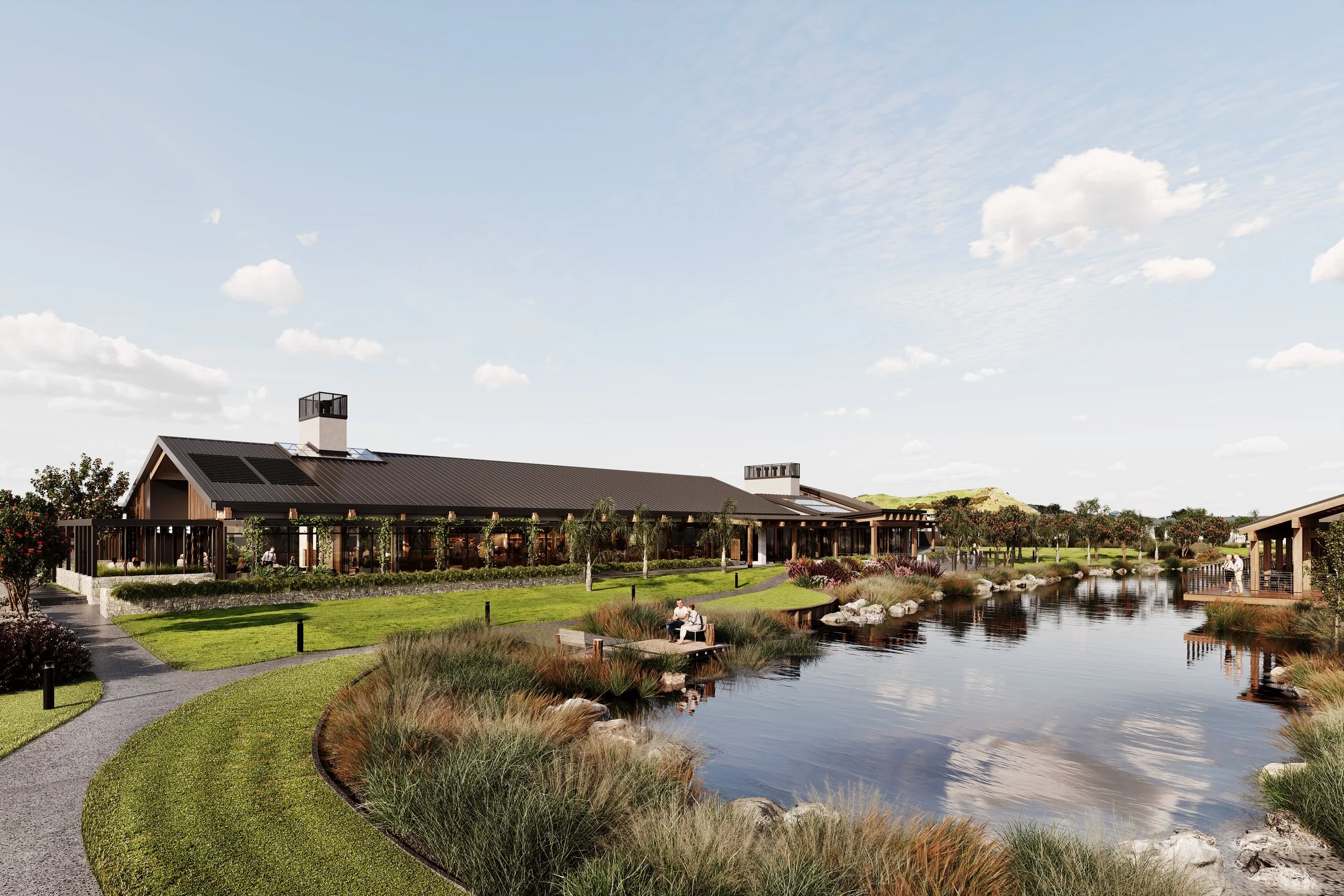
On the coastal stretch between Mount Maunganui and Pāpāmoa, you can feel the excitement building at Pacific Lakes Village, as the forward-thinking lifestyle village continues to expand. Designed to serve as a central hub, The Pavilion, currently under construction, is set to open in spring next year.
The design of this 2,500m2 community facility has been carefully considered. The teams at architectural practice Peddlethorp and interior designers Space Studio have come together on the project, resulting in a classic, sophisticated building that will stand the test of time.
Spearheaded by David Sweatman of Space Studio, the selected interior focus is on “natural materials, warmth, character and familiarity. The decor will be modern, with hints of mid-century”, David says.
Other design highlights will include the extensive use of timber as interior cladding, together with natural stone; parquet flooring, and the inclusion of extensive skylights to maximise natural light. Pacific Lakes purposely selected a main structural frame of LVL timber rather than steel to align with the village’s sustainability ethos. These components were all fabricated in Auckland and transported to the site for a seamless construction methodology.

Part of the Generus Living Collection, Pacific Lakes aims to offer a unique, modern and engaging community with facilities more like an upmarket resort. “Our intention has always been to offer our residents choice. That’s one of the great things about the village model, choice is possible, and we position ourselves to provide facilities, service and amenity at the highest level,” says Graham Wilkinson, the director of Generus Living. “Like the Lake House, which opened in 2022, The Pavilion is an integral part of that picture. Our model is firmly rooted in hospitality and The Pavilion will be a true reflection of that concept.”
With an estimated cost of over $40 million, it will be one of the largest and most comprehensive community facilities in any New Zealand retirement village. It will provide communal areas for a variety of activities and incorporates a stylish eatery, lounge bar, library, art studio, billiards room, beauty salon and a wellness suite for visiting consultations (for example, to cater for podiatry, acupuncture, physiotherapy, massage and village nurse health checks).

The Pavilion will also feature an impressive and spacious multi-purpose recreation space that has been designed with flexibility in mind. Operable dividing walls will enable smaller gathering spaces, yet, when used as one large area it will be perfect for large gatherings. A similar desire for flexibility is evident in the design of the restaurant area to cater as a daytime café as well as evening dining. Highlighting the village’s garden to table ethos, a chef’s garden with raised garden beds and a glasshouse will enable the restaurant to embrace a local and seasonal approach to sourcing ingredients.
In short, The Pavilion will be perfectly suited to hosting a wide range of events, private functions and resident activities and will truly enable the village community to come together.

Adding to its appeal is its location – on the lake’s edge opposite the popular smaller community facility, the Lake House. The two buildings complement each other beautifully. The Lake House includes sweeping decks and a barbecue area overlooking the lake, as well as the village’s Little Green café, a perfect place for socialising. Positioned alongside it is a full-size, green-weave bowling green.
Over the past year, the village has seen further development, the newest addition of pickleball courts (which also acts as a full-sized tennis court) is proving very popular. The on court pickleball action has included “try and learn” sessions that have progressed into games and then competition matches. It’s understood that pickleball courts are a first for
a New Zealand retirement village.
The Village Common, a serene area with bench seating amidst the greenery, has also been a wonderful addition to the village amenities. It features a winter garden glass atrium as well as a community garden with raised planting beds and a greenhouse.

“It’s there for residents to use at their leisure,” says Mark Vincent Pacific Lakes Village manager. “The idea is that it offers another spot to enjoy a cuppa with a neighbour or friend, host small gatherings or
a meeting, or simply to enjoy a moment of solitude.”
The burgeoning Bay of Plenty population is watching developments at the village with interest. With its park-like grounds, beautiful waterways and eco-friendly lifestyle, it’s proudly the first Generus Living village to take a comprehensive approach to sustainability in design.
All building materials throughout have been carefully considered, and environmentally preferred solutions have been front of mind throughout the village’s development. For example, solar energy is utilised at the Lake House, LED lighting has been selected for both street and internal lighting, there are EV charging stations, and Pacific Lakes has also used
every effort to adopt best practices and demonstrate good stewardship of the water resources from irrigation to stormwater management.
Pacific Lakes is also part of the Tauranga Council Resource Wise Business Programme – a programme supporting local businesses to reduce the amount of waste they send to landfills. The Village has achieved remarkable Green status with over 98 percent of operational waste being diverted from landfills.
These are only a few examples of an impressive list as the village is steeped in sustainable ways of living with a strong support from the residents. “Resident surveys have illustrated that a sustainable lifestyle is either important or very important to over 94 percent of village residents and over half of the respondents said that the village's approach to sustainability contributed to their decision to purchase at the village,” says Graham.
Pacific Lakes is a growing community. There are currently 190 residences, catering for just under 300 people, and when completed, the village will comprise 250 homes. Villas and terrace houses are selling now. “We are delighted but not surprised by the positive feedback being received as the village continues to grow from both happy residents and
from those hoping to make it home, says Mark. The village is already in high demand, and the addition of The Pavilion will only increase its desirability.”