
HOLE NEW WORLD
Pip Crombie discovers a unique golfing destination with a dash of culture on the side.
Pip Crombie discovers a unique golfing destination with a dash of culture on the side.
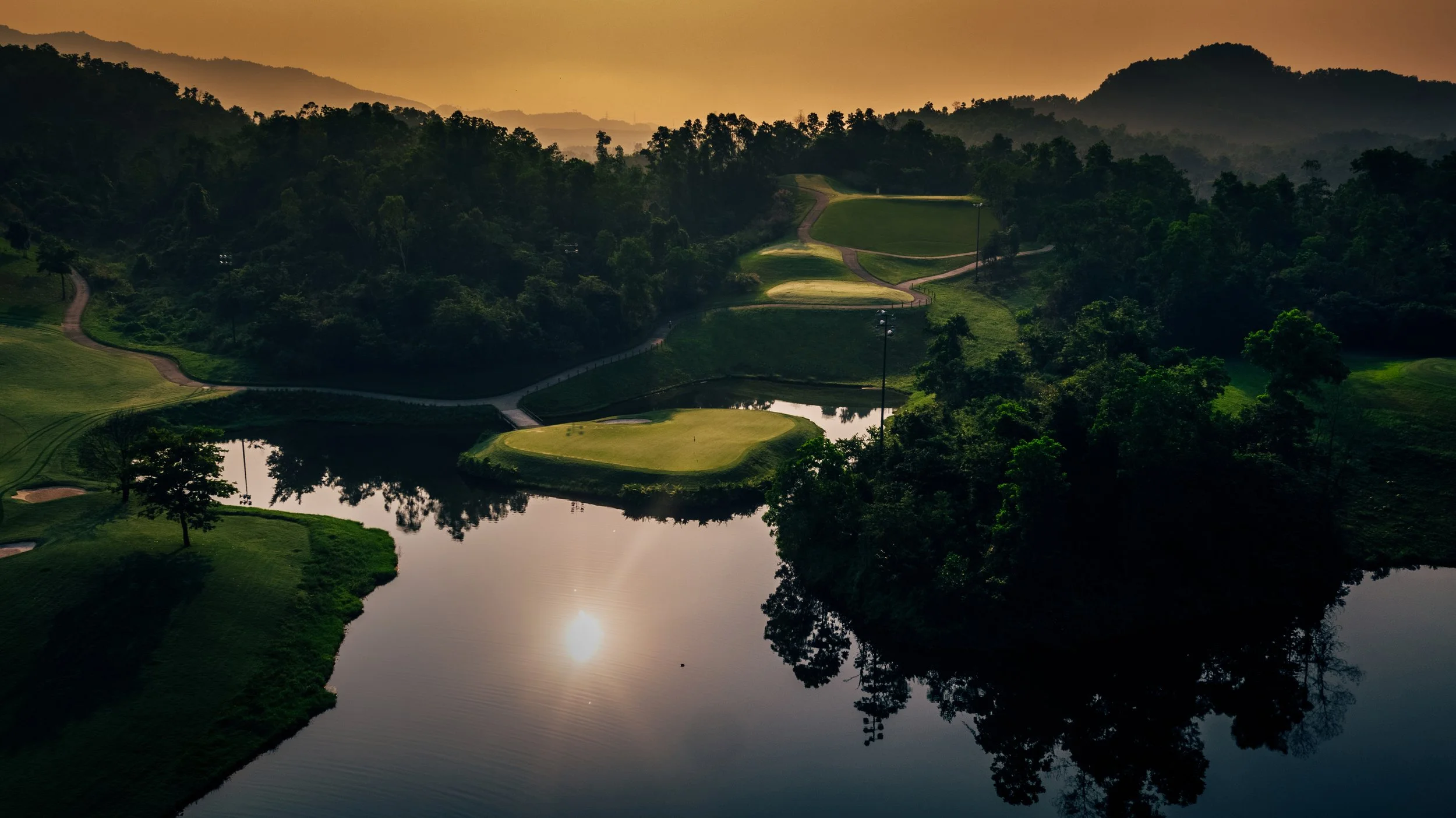
Bà Nà Hills Golf Club’s signature par 3, 16th hole.
St Andrews may be the centuries-old home of modern golf, but the game – protocols intact – has not only survived, but thrived globally, becoming a powerful drawcard for international travellers. Serious golfers and social hackers alike find an exquisite anticipation in packing clubs into a bag sturdy enough for the cargo hold, plotting which courses to conquer and how best to enjoy après-golf. A half day on the greens, balanced with time spent exploring local culture and cuisine makes for the perfect mix – even when non-golfers are along for the ride.
You might be surprised by which countries deliver exceptional golf experiences. Having played in several overseas locations, a standout for me is the Central Coast region of Vietnam.
The major hub of Da Nang is an easy gateway (with Air New Zealand codesharing with Singapore Airlines), and offers access to more than a dozen courses. Expect diverse terrain, from mountain-top championship layouts to links-style seaside experiences, with scenic backdrops featuring lush vegetation and striking elevation changes, or dramatic ocean views and coastal winds.
Fair warning: it can all be wonderfully distracting – and a convenient excuse for the state of your game. Although some courses are attached to larger resorts, basing yourself in Da Nang or the historic town of Hoi An offers a more authentic Vietnamese experience. Most courses are within about an hour’s drive and feature excellent warm-up areas, well-stocked pro shops, quality amenities and solid dining options.
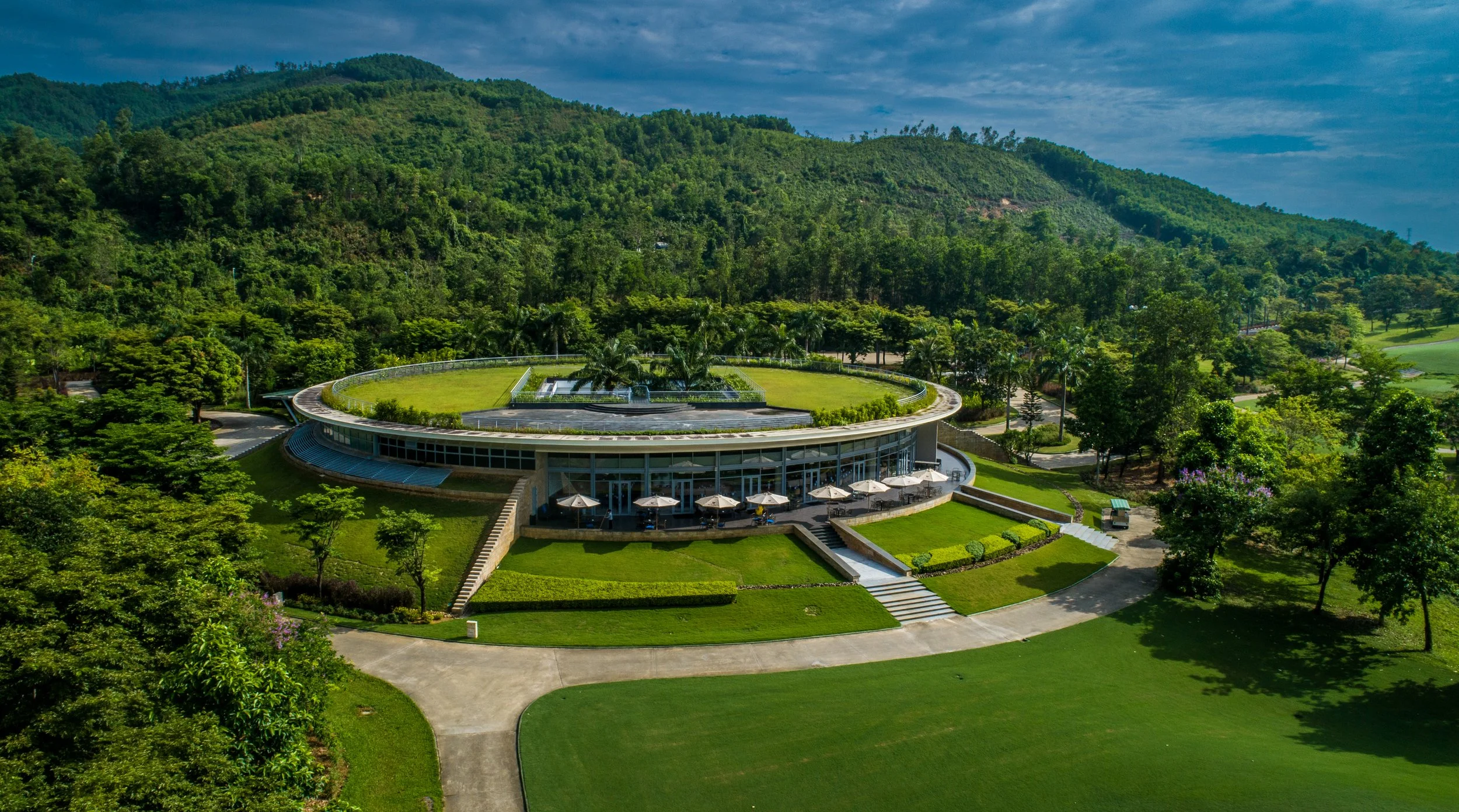
In Bà Nà Hills’ circular clubhouse restaurant, excellent local and international cuisine is served with panoramic views of the course.
Fairways and greens are immaculately maintained, with well-spaced tee times and good on-course facilities.
If time allows, aim for a varied line-up of courses. For me, two rise to the top. The mountain championship layout at Bà Nà Hills Golf Club sits at the foothills of the famed Bà Nà Hills, just 25 minutes from the city. Set among some of the region’s most impressive ranges, this lush, green course was designed by Luke Donald and feels distinctly Vietnam.
If you’re tempted to squeeze in two rounds in a day, a state- of-the-art floodlighting system illuminates all 18 holes after dark.
My second pick is Hoiana Shores Golf Club, a traditional links course by Robert Trent Jones Jr, who’s known for integrating layouts seamlessly into natural landscapes. Here, you’ll contend with firm, sandy turf on a scenic coastal routing, seasonal (but warm) winds, and classic links bunkering – a mix of wasteland and pot bunkers that demand strategy as much as skill.
Closer to Da Nang, our group also enjoyed the Legend Danang Golf Resort (formerly BRG Danang Golf Club), a 36-hole complex featuring two distinct championship courses. The links-style layout by Greg Norman delivers sweeping coastal views, while the parkland course by Jack Nicklaus offers wide fairways, river vistas and strategic bunkering. Golfers of all levels can take on these courses, choosing tees that suit their game and appetite for challenge.
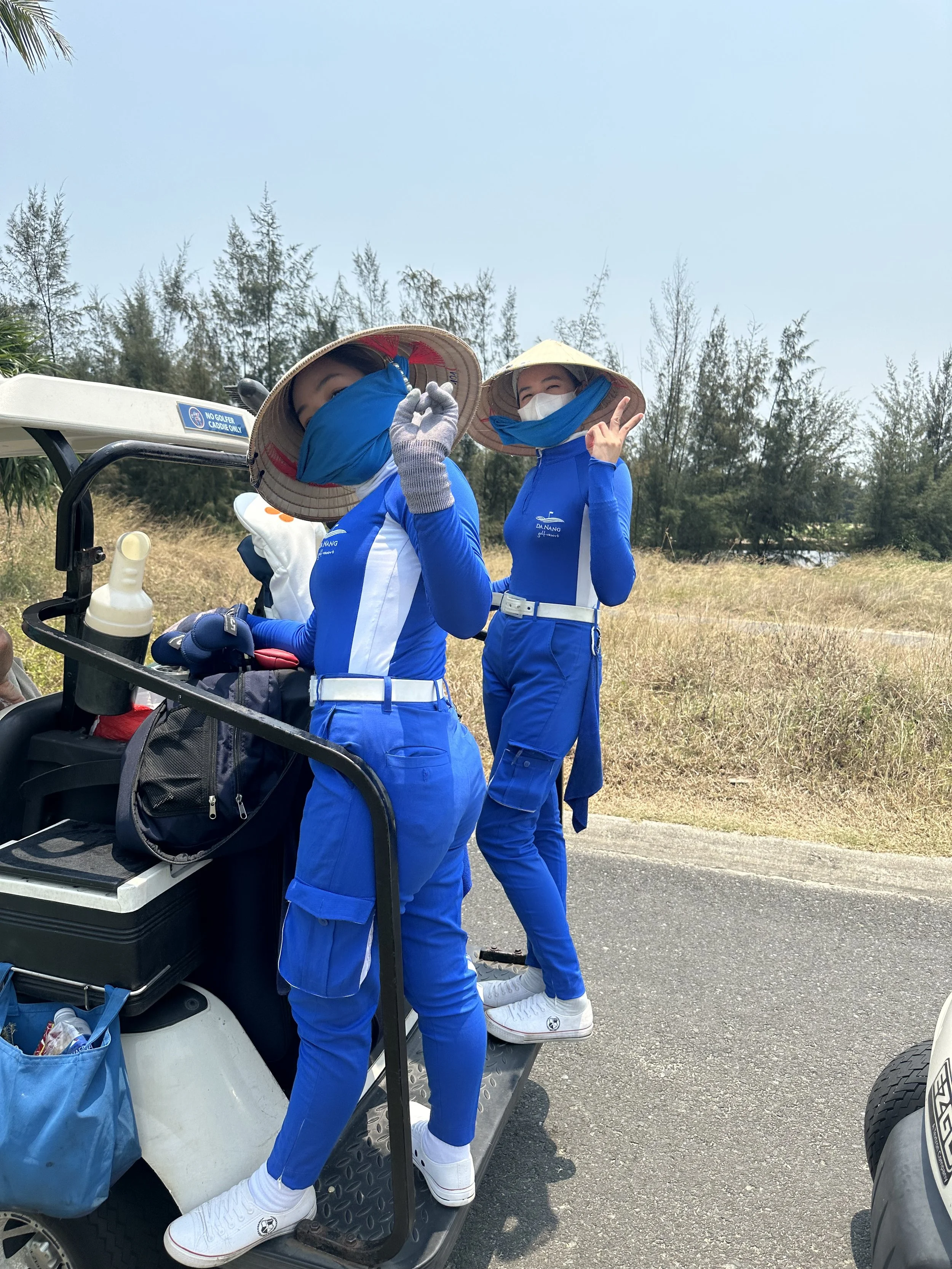
At the Legend Danang Golf Resort, the caddies are clad in sporty blue.
Caddies are compulsory in Vietnam, with one assigned per player. Typically local Vietnamese women, they perch on the back of the golf buggy as you move between shots. Most are highly intuitive, quickly assessing your ability and reading greens with impressive accuracy – the rest, of course, is up to you. Expect to pay around NZ$40 per round, although a good day on the course may loosen the purse strings.
Golf in Vietnam isn’t exactly cheap. As part of a casino complex, Hoiana Shores sits at the top end of Central Coast pricing, at around NZ$500 per round. However, accommodation, dining, shopping and transport are all relatively affordable, which helps to balance your overall spend. If you’re flying domestically, local airlines will often carry a second (golf) bag free of charge. What’s not to love? Time to swing into action.
Best time to go: March–April (warm but not overly hot or wet). August can be extremely hot, while October November often brings heavy rain and flooding.
How to book: Booking direct via golf club websites is possible, although you may be asked to provide copies of credit cards and passports. Language barriers can occasionally complicate things, but many clubs communicate via WhatsApp. Golf booking agents can simplify the process by arranging tee times and transport, though they often quote in US dollars, take a margin on exchange rates and require upfront payment. Always check cancellation policies carefully.
Where to stay: Da Nang offers a wide range of accommodation, from beachside resorts to quaint, authentic boutique hotels.
Other tips: Bring US dollars for tipping, use a Wise card or similar for payments, and download Bing, widely used in Asia for ride-hailing services.

No reservations
Reliving the spirit of their 20s, with fewer compromises and more surprises, mid-life travellers Sue Hoffart and her husband discover the beauty of making it up as they go along.
Reliving the spirit of their 20s, with fewer compromises and more surprises, mid-life travellers Sue Hoffart and her husband discover the beauty of making it up as they go along.

Reflecting on the Con River, Phong Nha.
There is no good reason to leave Tan Son Nhat International Airport the
way we do, that Wednesday morning in May. My spousal travel buddy cannot explain his urge to wave away perfectly good buses and taxis in favour of lugging our backpacks 8.5km to downtown Ho Chi Minh. After 22 hours of travel. In 38°C heat. C’mon, my normally sensible husband insists. It’ll be fun. I’m so shocked – the ill-advised ideas are usually mine – that I agree to mark the untethering of our middle-aged, middle-class lives with that long, hot walk.
When we reach our $50 a night hotel, red-faced and grimy, the sole visible employee is dumbfounded. The man has never heard of anyone walking from the airport. Ever.

Uniformed guard outside a government building in Hanoi.
Our four-hour schlep is a bewildering, exhausting, outlandishly sweaty and strangely satisfying way to acclimatise to the frenetic rhythm of Vietnam’s largest city. Crowds and wonder slow our steps. A verdant park gives way to a tangle of black power lines and concrete jungle. Our first purchase feels like a medical necessity; hydrating fresh coconut
water is urgently guzzled through a straw in an alleyway, flesh scooped from the shell with a plastic spoon.
Every road crossing is an act of faith, only slightly less terrifying each time we step into the beeping, unregulated swirl of traffic and trust drivers to veer around us. Motorbike riders wear masks against the pollution while we suck it all in, teetering on the edge of footpaths crowded with yet more motorbikes.

Breakfast fruit at Mekong Pottery Homestay in Vinh Long.
The city is also home to an ornate French Colonial opera house and a deeply sobering war museum. One street is lined with book vendors, while the vast, vibrant flower market is busiest after midnight. At another market, a woman sells dozens of kinds of edible orbs; humble brown hen’s eggs and tiny speckled eggs, preserved eggs, eggs coated in some kind of black crust and eggs wrapped in red and gold.
Saigon – the city’s official Ho Chi Minh moniker hasn’t really caught on with locals – is where we fall back in love with backpacking. Almost three decades have flown since that fat yellow Lonely Planet guide book was hauled through other corners of South East Asia on our backs. In those days, blue Aerogram letters were dispatched with stories from a prison visit in Bangkok, hitchhiking in Malaysia, island hopping to see dragons on Komodo.

Thung chai, or ‘basket boats’, beside the sea in Mui Né.
The in-between years have brought all the trappings of adulthood, from marriage, mortgages and children to appointment diaries and well-planned holidays with wheeled suitcases.
Now that our grown-up lives are on hold, needs have been pared back to overhead locker size, maximum 7kg. No itinerary, no responsibilities, no proper plans for 36 days.
It turns out independent travel has become a whole lot easier since we last attempted it, thanks largely to phones and ubiquitous Wifi. Google Maps gets us to the Hue train station without fuss, and locates the ferry to Cu Lao Cham island.

Lâm Đong Province.
In the mountain town of Da Lat, a translation app helps us discover more about our Russian-speaking hostess. The new travel card leaves old school traveller’s cheques in the dust, with its instant exchange rate calculator and access to automatic teller machines. It also links seamlessly with the same local transport app that Vietnamese city dwellers use. Meanwhile, online booking sites ensure we can always find a bed before arriving in a new town. Sometimes, we change tack and move on quickly. More often, we linger for an extra day or three, choosing a new route for exploratory morning cycle rides through surrounding streets or rice paddies, past incense-scented temples and coffee stalls. Mostly, we stay in inexpensive small hotels with pool, ensuite, bikes, buffet breakfast and beautiful service.

French Colonial architecture, Saigon.
Because this is very definitely not the “please let there be one clean sheet and no fleas” version of backpacking we knew. It feels a little like cheating, with all the joys of making-it-up-as-you-go travel, and none of the hardships. Our budget has improved but so have the roads; plenty are better than highways back home. On local buses, we meet a Filipino mother teaching English in Vietnam, and a delightful medical student from the provinces. The reclining seats and individually curtained cubicles are a far cry from terrifying rides of old, shared with chain smokers and live animals.
In other ways, nothing has changed. Thankfully, my fellow backpacker and I still journey well together and continue to find this type of travel liberating. We both strive for snippets of the language and quiz new friends about politics and religion, history and their family stories.

Bich Dong Pagoda.
At mealtimes, we turn to the street to perch on child-sized plastic stools in bustling little shacks. When language fails us, we point to whatever a neighbour is eating. Then the neighbour will show us how to fold herbs and salad leaves into a particular dish, or extract a spicy stuffed snail from its shell.
Travel tips are still traded with fellow travellers. The motorbike street food tour in Saigon is a must-do, we tell our bright young backpacker friends. Vinh Long, in the Mekong Delta, is wonderfully devoid of tourists. It’s worth rising early there, to bike 10km down a dusty road and watch the sun rise over brick kilns that look like giant terracotta beehives. Quy Nhon is far more popular with Vietnamese tourists than Westerners but it has some fascinating Kiwi links courtesy of medics who have been helping in hospitals since the Vietnamese-American war. Nha Trang, on the other hand, feels far too much like Las Vegas by the sea.
In the north, Hanoi is a heady mix of lakes and leafy boulevards, Old Quarter tradition, glitzy contemporary shopping malls and communist glory. We splash out on a restaurant meal. This one specialises in duck and the balcony is so tiny it can hold only our table for two. On our last night, an impressive downpour clears the crowded streets; monsoon season has begun and it’s time to fly home. For now, though, this place has washed away the years and made us young again.