
CHASING THE LIGHT
For Tauranga artist Tracy Stamatakos, the Bay of Plenty is a constant source of inspiration. Her photography transforms local land and seascapes into atmospheric works that invite viewers to pause and look again.
PHOTOS DEBORAH DE GRAAF
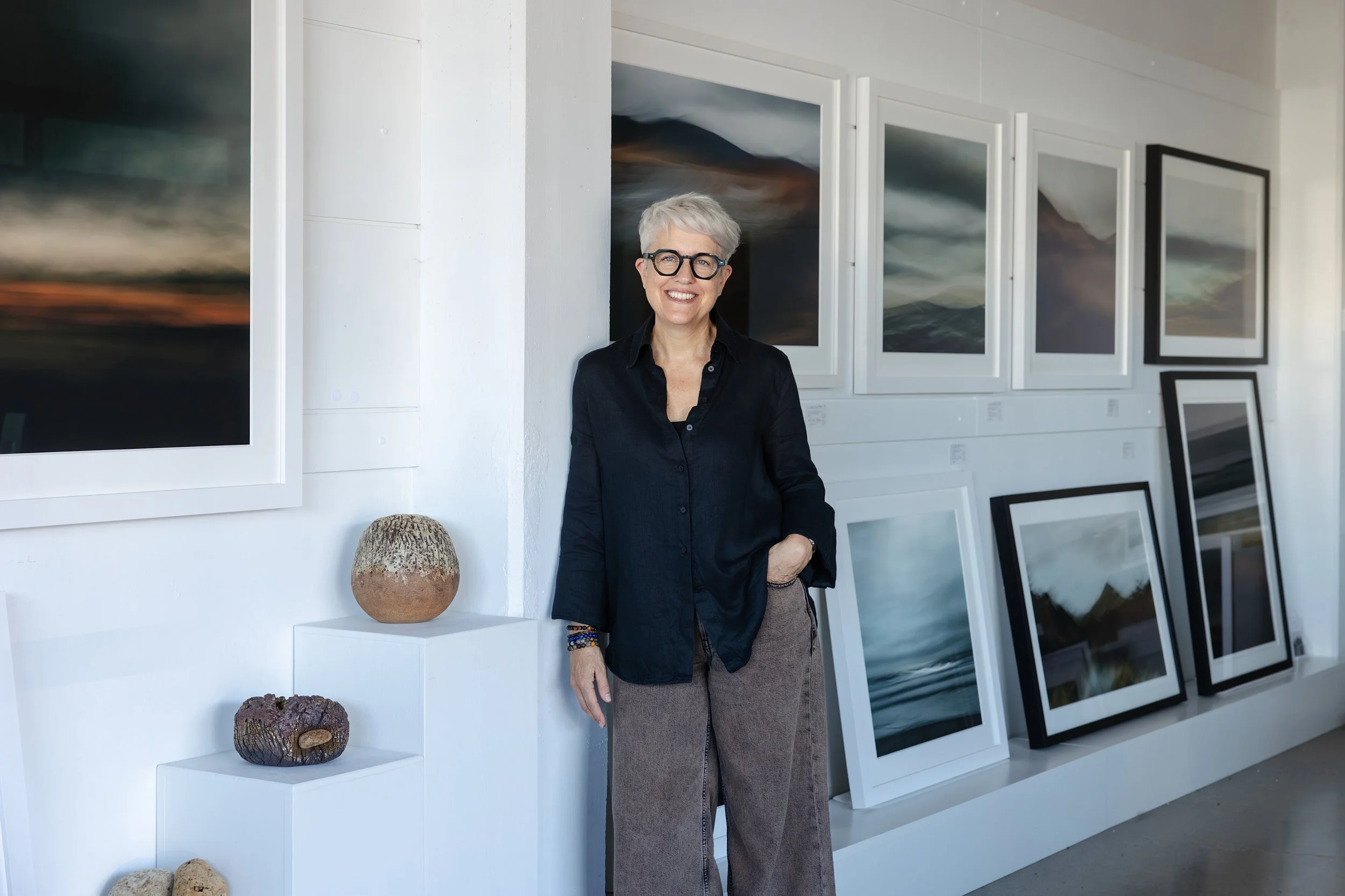
UNO: For people who might be seeing your work for the first time, how do you describe what you do?
Tracy: Sometimes there’s confusion at first glance. What is it – a drawing or a painting? It’s photography, but not in the literal sense. I use single-capture long-exposure techniques to record light, colour and shape, moving the camera while the shutter is open to achieve the desired result. I also create new lines and shapes by recording the movement of objects or specular highlights. I believe art can act as a transfer of energy from the unseen into the physical world. My images are imprinted with my energy, the energy of movement and the grounded energy of a place. My hope is that the viewer feels this too. You talk about “painting with light”.
What does that actually look like when you're out shooting?
I’m sure it looks really odd! Sometimes it’s fluid movements, other times it’s following shapes. It feels meditative to photograph this way. I love remote locations where I can be fully present and recharge at the same time. In contrast, trains can be fun to shoot from – scenes approaching and disappearing just as fast. I can spend six to eight hours in an outside carriage, and love the challenge of having to react quickly with no way to refine the scene. The funniest response I’ve had was on the Northern Explorer. A woman who had watched me for hours finally said to her husband, “I don’t know what she’s doing, but her photos aren’t going to be sharp.” I just smiled.
What is it about the Bay of Plenty that inspires you?
There’s beauty everywhere, but I tend to find it between the sun and the rain, where the pressure builds and the light breaks through. We’re blessed to have the ocean, rivers, hills and mountains on our doorstep, changing minute by minute. It’s a spectacular show.
Do you tend to head out with a clear idea of the image you want, or is it more about responding to the moment?
“Responding to the moment” is a perfect description. Most of the time, I leave it up to the universe to present me with options. Sometimes there are certain images that make my heart race, or I can see the opportunity to develop an idea. In that case, I’ll make a clear plan to capture a series. That might include returning to a certain location, choosing another one with more potential, planning to shoot at the optimum time of day, or waiting for the weather gods to sprinkle some magic. I’ve learnt that booking 10 days in the South Island in the middle of winter doesn’t guarantee moody weather. Full sun is not my friend, but I’ve accepted the challenge on many occasions. I guess that’s how you move forward.
You've been working in photography for decades now. What’s changed the most in how you see things?
This industry is all I’ve ever known. My first job was with Bob Tulloch at No 1 The Strand in the early ’90s. I hadn’t set out to be a wedding photographer. I fell into that quite by accident, but quickly realised it’s some of the best training you could ever have. Twenty years of constant pivoting, catching curveballs, working under time restraints, learning to breathe under extreme pressure… but somewhere in all the madness, you create magic and you keep going. Photography was a love, and then it became a job. It’s also highly technical, with lots of components to control and briefs to stick to, especially commercially, so it began to feel clinical and suffocating. I found the love again by shooting for myself, by throwing out all those rules in 2006 and creating emotionally charged imagery, which is dark, moody, soft and serene. With age, I think you become more aware of self. There’s also an element of knowing we’re all on borrowed time – although I’m putting it out there that I’ve only reached the halfway mark and am keen for another 50 years. You start wearing your heart on your sleeve and caring less about what other people think, not worrying so much about mistakes because you understand that’s how growth happens. Making art connections outside the photographic industry was also key for me. Being able to bounce ideas around with people working in different mediums was refreshing.
What’s it like being based in Tauranga and running your own gallery space?
I took over the 9th Ave space 11 years ago, when my business switched to focusing on commercial work. The signage on the window has always read “studio + gallery”, but it’s only been in the past 18 months that the gallery has had regular hours. I have to thank my talented ceramic artist friend Lynn Ross for backing me and sharing the gallery hours to make this possible. We’ve always had an appreciation for each other’s work and visitors enjoy the way it intersects. It’s delighted us recently to have people waiting for the doors to open. That sure makes up for the quiet days, but that’s the nature of retail.
When someone stands in front of one of your pieces, what do you hope they feel?
A moment of pause, and space for their own memories and interpretations to surface. It’s also a direct transfer of energy. For example, I have one image that has been purchased four times as a remembrance piece, and it was photographed in that spirit. That makes me smile, to know my visual communication is working. I think it’s very important to connect emotionally with a piece for longevity. Will it still mean something to me when my surroundings change? Art can create future memories too. An image you live with becomes a backdrop to everyday life.