

The Olympians of UNO: a look back at the stories from some of our local sporting heroes
We take a look back at some of our local sporting heroes that have graced UNO, and are currently involved in the Tokyo 2020 Olympic Games.
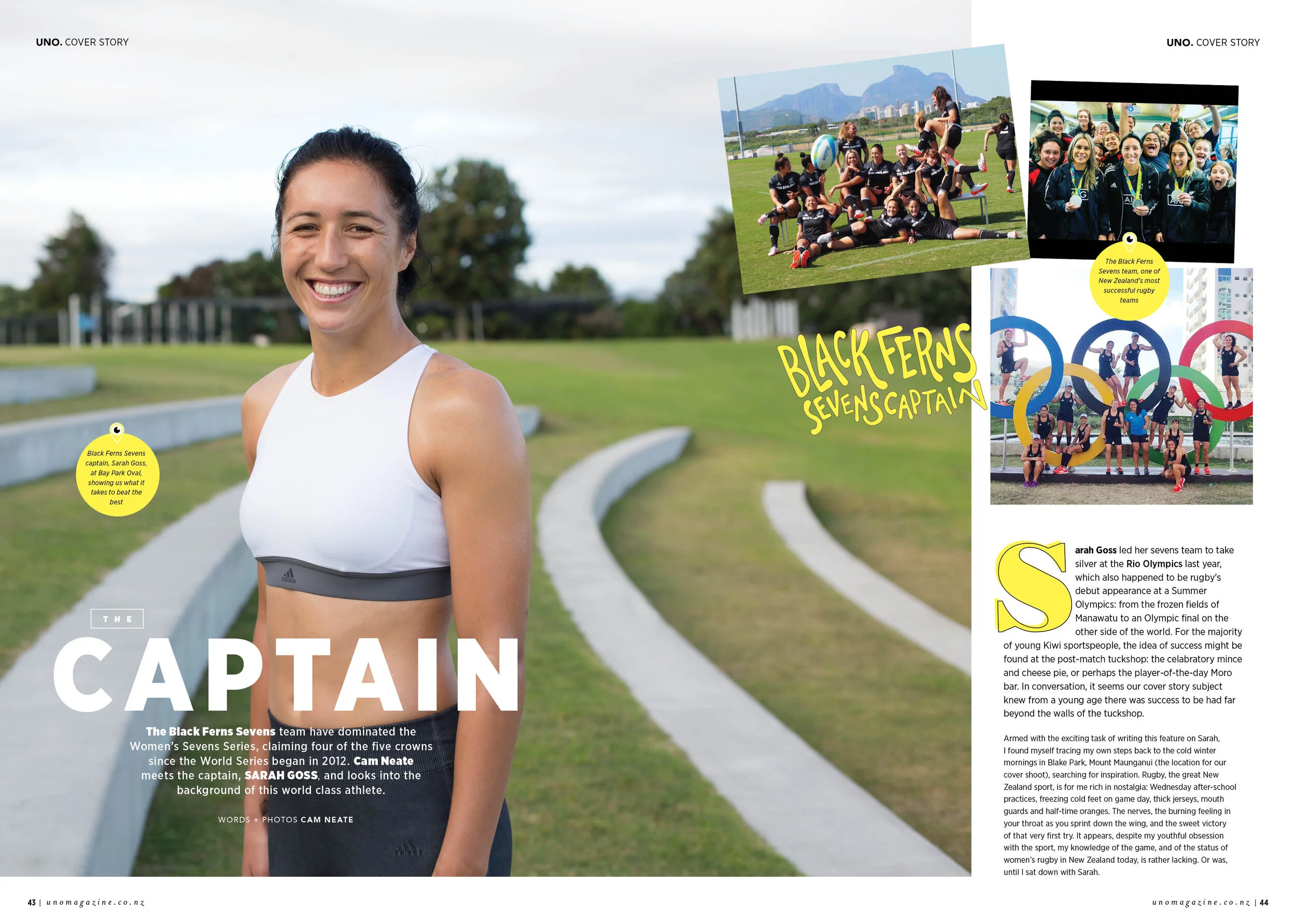
Sarah Hirini (neé Goss)
Sarah Hirini (Goss) carried the flag for New Zealand in the Tokyo 2020 Olympics opening ceremony and is playing in our women’s sevens rugby team but back in 2017 she was on the cover of UNO Magazine.
“It meant I was able to play whatever sport I wanted without my parents having to drive me around everywhere. It was all just there”. Gymnastics and netball transitioned into competitive hockey, and ultimately rugby in her final year at school. At the time, Sarah’s coach had recommended taking up rugby to help improve her fitness for hockey but she soon found the full contact and competitiveness of 15-aside rugby much more stimulating than hockey and as a result, traded her hockey stick for a pair of rugby boots. However, it was not a completely smooth transition into her newfound passion.
“I hid it from my parents for about three months, thinking they were going to tell me off for playing rugby. I felt like back then, there wasn’t much support for women’s rugby despite my family being massive rugby supporters.” But once Sarah decided to tell her parents of her new secret love, they were only disappointed they had missed watching her games and according to Sarah, “they’ve watched me ever since. I remember telling my parents back in the seventh form when they asked what I was going to do the following year and I remember saying I’m going to become a professional rugby player and back then they kind of laughed, but I am someone who will just go after it and I will do everything I can to prove people wrong. I’m stubborn, and it ended up happening.”

Read the full story on Sarah’s rise within rugby.
Peter Burling
Peter Burling has reached incredible heights since his cover story in UNO in spring 2017 and is currently sailing in Tokyo.
“At the Olympic level,” he says, “a lot of it is just a seat-of-your-pants kind of thing, because today you have a single platform that you can’t really change or improve.”
This is, after all, essentially a one-design race and everyone uses virtually identical equipment, so – as Burling says – “It’s a question of how you set it up and how well you can sail it!” But in something like the America’s Cup it’s different; the variables are almost infinite and change – literally – by the hour. And in that fast moving, high-tech environment, knowledge is power.
“I’ve always really liked the engineering side of sailing,” he says, “ever since I was a little kid and making things and trying things on the boats. I’ve always been quite pedantic on having a really clean and well-thought- out boat, not having anything on there that doesn’t need to be there, and having it all neat and tidy.”
Matt Scorringe
The New Zealand Olympic surfing team’s head coach graced the cover of UNO back in summer 2020.
One of the drivers of that change has been the acceptance of surfing as an Olympic sport. “Surfing,” says Matt, “particularly in New Zealand, is still seen differently to other major sports – and the Olympics will change that. It will mean we start to take things seriously and start working towards finding the best path for our athletes at Olympic level. I’ve talked with friends in snowboarding and other sports that have recently been made Olympic sports and they all say it takes time. It’s like the chicken and the egg – you need funding to get results, you need results to get funding – but it’s great to see that we’re off to a really good start with two athletes going to Tokyo.”
Matt’s role in preparing those Olympic contenders has been as head coach of the development pathways programme he helped put together to get our surfers up to Olympic qualifying level, and he’s more than happy with the results. “We’ve now got two athletes qualified for the 2020 Olympics – Billy Simon from Raglan and Ella Williams from Whangamata – who both came through that programme. Now we just need to get some more structures and mechanisms in place to support them and the sport. At that level, you don’t spend a lot of time at home; you’re travelling all the time, so you need coaches, nutritionists and all the support required on different continents. Part of what I’m doing is not just bringing my knowledge but the connections and contacts to make it easier.”

Sarah Cowley Ross
Our most recent cover star, Olympic and Commonwealth Games heptathlete Sarah Cowley Ross is currently a huge presence in media coverage of the Games.
Sarah says her ultimate high was when she qualified for the Olympics in Götzis, Austria. “I knew I was in good shape, but a really significant moment was in the high jump when I jumped 191; at the time my best had been 184. I was really free. For a long time, I’d put a handbrake on my life, and for the five years previous I hadn’t improved in the way I wanted to.
A year before, I probably wanted to quit, but I managed to turn it around, and in that high jump I finally unleashed what I was physically capable of. It was one of the purest moments of my life.”


Entrepreneur and disability advocate Charmeyne Te-Nana Williams
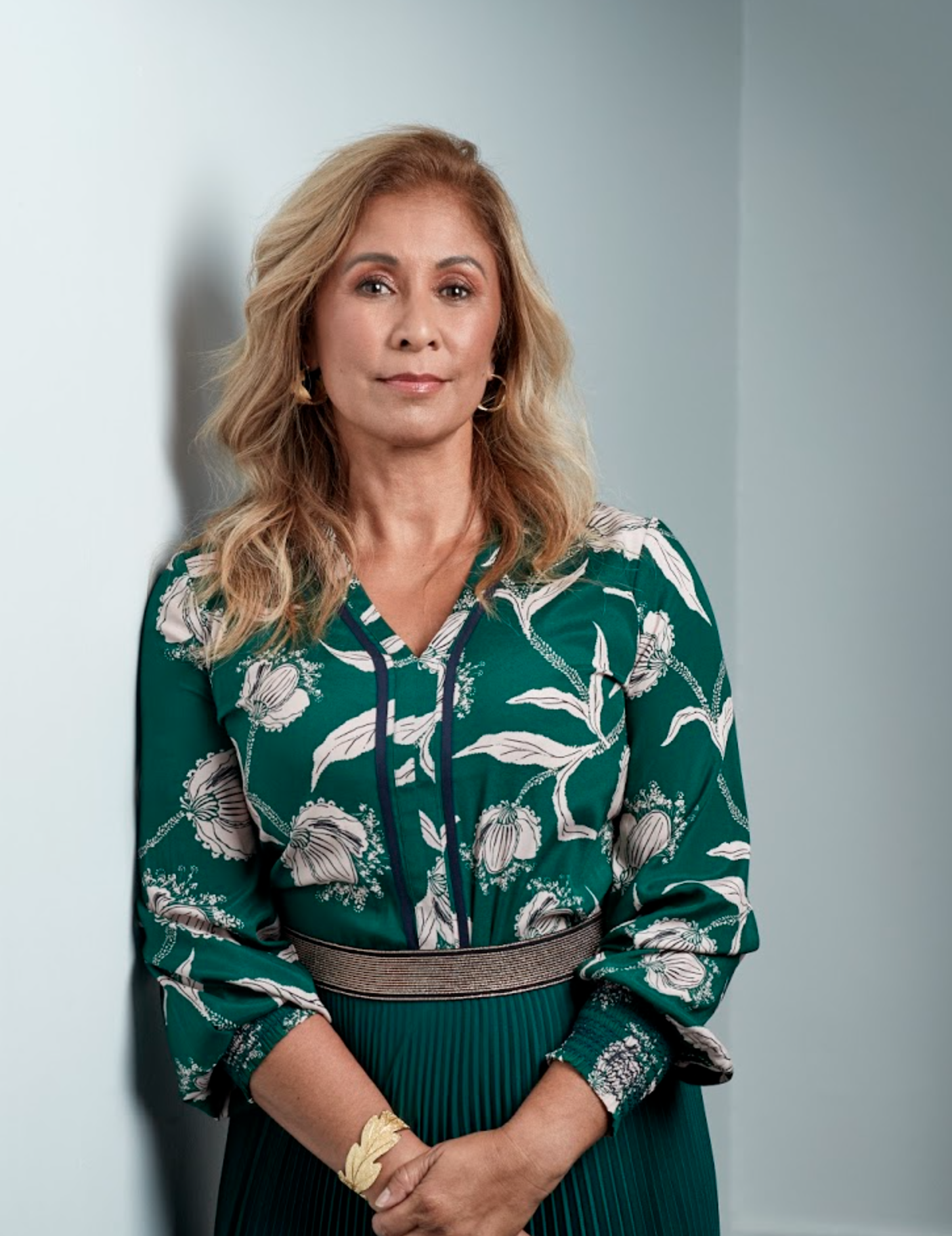
Entrepreneur and disability advocate Charmeyne employs over 200 people to support people with disabilities, like her husband, Peter who suffered a brain injury in a boxing match. What Ever It Takes is a fitting name for her business, and the way Charmeyne approaches life.

Entrepreneur and disability advocate Charmeyne employs over 200 people to support people with disabilities, like her husband, Peter who suffered a brain injury in a boxing match. Whatever It Takes is a fitting name for her business, and the way Charmeyne approaches life. She lives between Mt Maunganui and Auckland.
PHOTOS Garth Badger WORDS Jenny Rudd
At a recent event for our speaker series, This Is How I Did It, Charmeyne told us the incredible story of how her husband Peter Williams’ brain injury and resulting tetraplegia has shaped her life.
Charmeyne and Peter had baby twin girls, who'd just arrived home from a 5-month hospital stay after their premature birth. And four weeks earlier, the couple had buried their son who passed away after being born at 26 weeks. Charmeyne was at home with their daughters in Auckland, on maternity leave for a job she loved at New Zealand Trade and Enterprise in the Māori enterprise team. Peter was down in Timaru at a boxing match, on his path to his plan to qualify for the Olympics. He'd previously won the world title for waka ama (canoe racing) in Tahiti. He was strong, athletic, and world class at the disciplines he put his mind to. He called Charmeyne and announced "I won, so I'm now the New Zealand Super Heavyweight Champion. I just need to go and do a drug test, then I'll call you back."
But he didn't call back. One of his teammates did. Charmeyne said it wasn't what he said that was worrying, it was what he couldn't say. He could barely get the words out. Peter had suffered a traumatic brain injury which left him a tetraplegic.
Her story was so inspiring, we knew we couldn’t leave it in the room.
I remember the day Peter went down to Timaru like it was yesterday. It was labour weekend in 2002. That morning, we'd talked about what we had dreamt the night before. We often did that. He said "I dreamt that my spirit had left my body and it was flying across Samoa.”
After I'd spoken to Peter when he won, I remember being so excited. I thought he hadn't rung back because he was out celebrating. Then his teammate called me and said "You need to get down here." At that point I had no idea what that meant. I didn’t know what I was walking into.
I’ve been so lucky and blessed, because my family has been amazing. My sister was staying with us at the time and she looked after our babies. I jumped on a plane and went down to Timaru.
Since that day, my life has really been in stages. Stage one was going down to Timaru.
STAGE ONE
The Rude Awakening
Some of the questions that came to mind at this time were: What the hell is a traumatic brain injury? I had no idea. I had never worried about Peter because he was so strong.
What the hell is this health system? I had no idea what I was walking into. I went into the hospital, he was in ICU and I just didn’t know what to expect. We weren’t allowed to stay there, so that was really daunting for me.
If it wasn’t enough that we were trying to deal with what was going on with Peter, it was all over the news. My brother rang me up and said, “Have you seen the newspaper?” On a front page was an article that said Peter was actually a Black Power member and had sustained his brain injury through an initiation. So he’s trying to fight for his life and here’s this article on the front page. Where did that even come from?
I rang a friend of mine whose husband was an All Black who’d had some bad publicity, and he put me onto his lawyer who represented us for nothing. We went to court to get them to retract what they'd printed.
By this time, I had to send my girls off, at eight months old, to live with their grandparents in Wellington so that I could work out how to help Peter. Thank god for my whānau, because if it wasn’t for them, I’d never have been able to get through these early stages.
STAGE TWO
The BS
I thought the system would focus on what's best for Peter, me and our whānau. But it didn't feel like that at all. You'd think you’d go from stage to stage – from hospital, to rehab, to home but, actually, it's not that way. Every time I went to another stage of what I thought was our recovery, it was just the same shit on a different day. All I knew was that I loved this man and wanted to keep my family together – that was my priority.
It wasn't just the medical system either, it was our society. Arriving in Auckland, a friend asked me if I was going to stay with Peter as a partner. I was shocked. They asked if I really knew what I was getting myself in for.
We left Timaru after a month and moved into ICU in Auckland for a month, then Peter moved to a rehab facility in West Auckland just before Christmas 2002. I thought that was going to be awesome, but it was really bad. The staff weren’t used to family members sticking around, but I was there every day. I became known as ‘the bitch’ – true story. In my mind I couldn’t understand why, because I was just trying to figure out how I could make sure that Peter was well looked after. What I started to realise was that everyone was doing what they thought was best, as opposed to what was best for me and my family.
Trying to find financial support to keep my family going was really difficult. When my maternity leave was over and I had to go back to work, I thought I’d go to Work & Income to get help with child support but was told I wasn't eligible because I was earning too much. I’m on $50k and I’ve got an adult who has a serious disability and two children. How is that a high income?
Then I was offered redundancy, which I took, because it meant I could go on benefit. I fought with my pride. I had never been on a benefit. But I knew that if I didn't, it was really going to affect my family's well being and my ability to care for them. I was exhausted and I needed to, so I did. And rather than pay me the extra $100 a week on top of my wages I could have been earning, they paid me about $70,000 a year to be on benefit and to support my kids. That seemed dumb!
You expect and trust that the experts are giving you the right advice, but I learned that that’s not the case. I found out some time later that Peter had been eligible for child support the whole time. We had to go to court to recoup it. What a waste of time and money for everyone involved.
STAGE THREE
Kete of knowledge
Finally, the penny dropped. When you’re in a rehab facility, you have a multidisciplinary team. You go to these whānau meetings and sometimes you might be the only member of the whānau with 12 clinicians around the table, who are all telling you what you should do. I was in one of these meetings and everyone was talking about how aggressive I was. I could feel myself shrinking into a corner in the chair, just fading away. My cousin was sitting next to me and she said, “You know, what some people would describe as aggressive, others would describe as proactive”. That was a turning point for me. I thought, that's right. I’m being proactive. I’m not being aggressive, I’m just fighting for what I know is right.
From then on, I started to listen, observe and figure out the things that Peter would respond well to in terms of his rehab. I thought about how I could take all these little bits of advice and information and fill up my kete of knowledge to move forward for Peter.
As well as learning from the model he was under, I looked around the world for different care models that fit what I believed he needed.
My aunty, who’s Māori and a social worker, said, “Have a look at this and tell me what you think.” It was a Māori model of care called Te Aho Takitoru which had been developed by her team as a social work kaupapa. What really jumped out to me was that the mana of the person being cared for was at the core. Reading it solidified in my mind what I have been trying to do since Peter's accident - I was fighting for the mana of this man. I just wanted him to be recognised as the man of the family, as a dad and as a partner. That’s all I was asking – nothing more and nothing less.
STAGE FOUR
Home is where the heart is
I thought going home was going to be easy – but it wasn’t. Having been in hospital and rehab for nearly three years, we’d applied to ACC to fund the modifications we needed for Peter to live at home. It was just before Christmas and I got a reply from ACC saying they’d declined our application. The application had taken forever, and they'd said no. I felt it was because they were solely looking at the injury and how to manage that injury. It was being done adequately, they felt, in the rehab centre. I could see though that there was so much more to the picture surrounding Peter's injury. What about his well-being, his wairua (spirit) and the mental health of my family as a result of the care decisions?
When ACC turned down our application, I thought if I don’t do something now, my family is just not going to survive this.
My brother-in-law worked for 60 Minutes and asked if they could do a story on us. I had turned down offers like this in the past, but I was desperate. So I said ok on the condition that Peter's integrity was maintained, and that the focus should be on getting Peter home.
At one stage during the research, I could see there was some focus on the fictitious Black Power connection. So I went marching up to the Black Power pad in Mt Wellington, knocked on the door and asked their leader to speak on 60 Minutes and set the record straight that Peter was not connected to them.
In the end, the show only talked about ACC for about a minute and how our application had been declined. It took three years for them to decline it, and honestly about two days to approve it.
Finally, we were going home. I got so excited. But we then headed into a new world. The world of agencies. In 18 months, we had around a hundred people come through my house. My girls were verbally abused, and Peter was physically and sexually abused. We went through another grueling court process to bring the sexual abuser to justice, but she got off on a technicality. That whole process was so traumatising for me. It was like I was the criminal. This woman wasn’t held accountable in any way, shape or form, and neither was the agency. That was it. No more. I had to take all my learnings and bring them together to provide a new model.
We weren't the only family going through this either. I knew there were others looking for the same as us, so I put together a business proposal to set up a programme bringing together everything I learnt from Te Aho Takitoru, my research and experience in hospital, at the rehab facility, and the agencies.
Ten years after Peter's accident, I set up What Ever It Takes, a home-based rehabilitation service.
STAGE FIVE
Doing Whatever It Takes
Our vision for our company was to set the standard internationally for how we care for families, regardless of their situation.
The biggest difference between a mainstream clinical approach and the Māori model we use, is we take into consideration all aspects of what’s going on in the whānau’s lives. A mainstream model looks at what's best for that injury in isolation. But that’s not reality for our families. We don't focus just on physical things like the brain or the spine. This person lives at home with a whole family, so we consider that whole picture. What help do they need to access their entitlements? What is the best wrap-around care that this particular family needs? How does the family operate? What are their dynamics? What are their values? What do they need to support them to live how they want to live?
We work mainly with Māori and Pacific Island whānau. They’re already compromised and they’re further compromised with this disability. I’m a supporter of whānau looking after whānau. I think if you want your whānau member to look after you, then let them look after you. There have been lots of debates about whether whānau members take advantage of the situation, but that’s really not my experience.
Our business model has allowed us to really flourish through the lockdown periods. We’re essential services, but we have a single team for each whānau we look after, so during lockdown we went right back to our aspirational goals and how we were going to do that within the confines of our four walls.
Each time my company gets audited, we receive continuous improvement on continuous improvement. That’s not just great, that’s exceptional in our sector. My goal is to create pathways for the future. I want us to be able to really pave the way for other organisations to come in and support families.
STAGE SIX
A deep breath
When my girls were at intermediate school, I realised that I had become so absorbed with what was going on for Peter that I was being counterproductive. That's when I started to think about my happiness. All they’d known their whole life was this environment of conflict where I'd been fighting for Peter. It was incredibly hard, but I moved out. It was the right thing for Peter to be able to work with his team from then on, and for our girls, and me.
My journey continues. It's been 18 years and time moves on. My father and my grandmother have passed away. My twins are leaving school.
I never thought that I’d meet somebody or fall in love, but I have. I’ve had feelings of guilt, but Peter and I were only young when this happened; he was 27. I’ve always committed to being married to Peter. But I got to a point where I thought, I don’t want to die wondering if there could have been more.
When we first met, Rob said to me, “I need to tell you something, I’m having a baby,” and I went, “Oh well, I’m married. I’ll have your baby if you have my husband.” And he goes, “Sweet.” So that’s been the basis of our family. We have five kids now with our big, beautiful, blended whānau. We have all this extended whānau on Rob’s side, and we have Peter and our extended whānau on my side, including Peter’s two sons Puna ma Faleasi and Siagogo.
It's unconventional, but it works because we make it work. I feel that’s probably my biggest learning: you just have to make things work.
No reira ngā mihi nui, ki a koutou. Mo te whakarongo mai ki ahau. Thank you for listening to me. Go home and tell the people that you love how much you love them. I’ve learnt how to care for my family and it's the pathway that I intend to to follow forever more.
What Ever It Takes

There's such determination in the name of Charmeyne Te Nana-Williams's business. And love, when you consider who the beneficiaries are of this determination. What Ever It Takes employs over 200 people across the North Island to deliver a programme of home-based care for people with severe and complex disabilities. What makes it different is the whanāu-centred approach. The family is involved in all aspects of the care, because Whatever It Takes looks at the needs of the whole family, rather than keeping the spotlight on just the injury.
This programme has been developed by Charmeyne and her team to give control, mana and quality of life to those suffering from and affected by major brain traumas and other life-changing disabilities. Their struggle to be allowed to take Peter home to care for him showed Charmeyne that there was a need for a different model of care.
Life’s a beach at Twinkle Twinkle

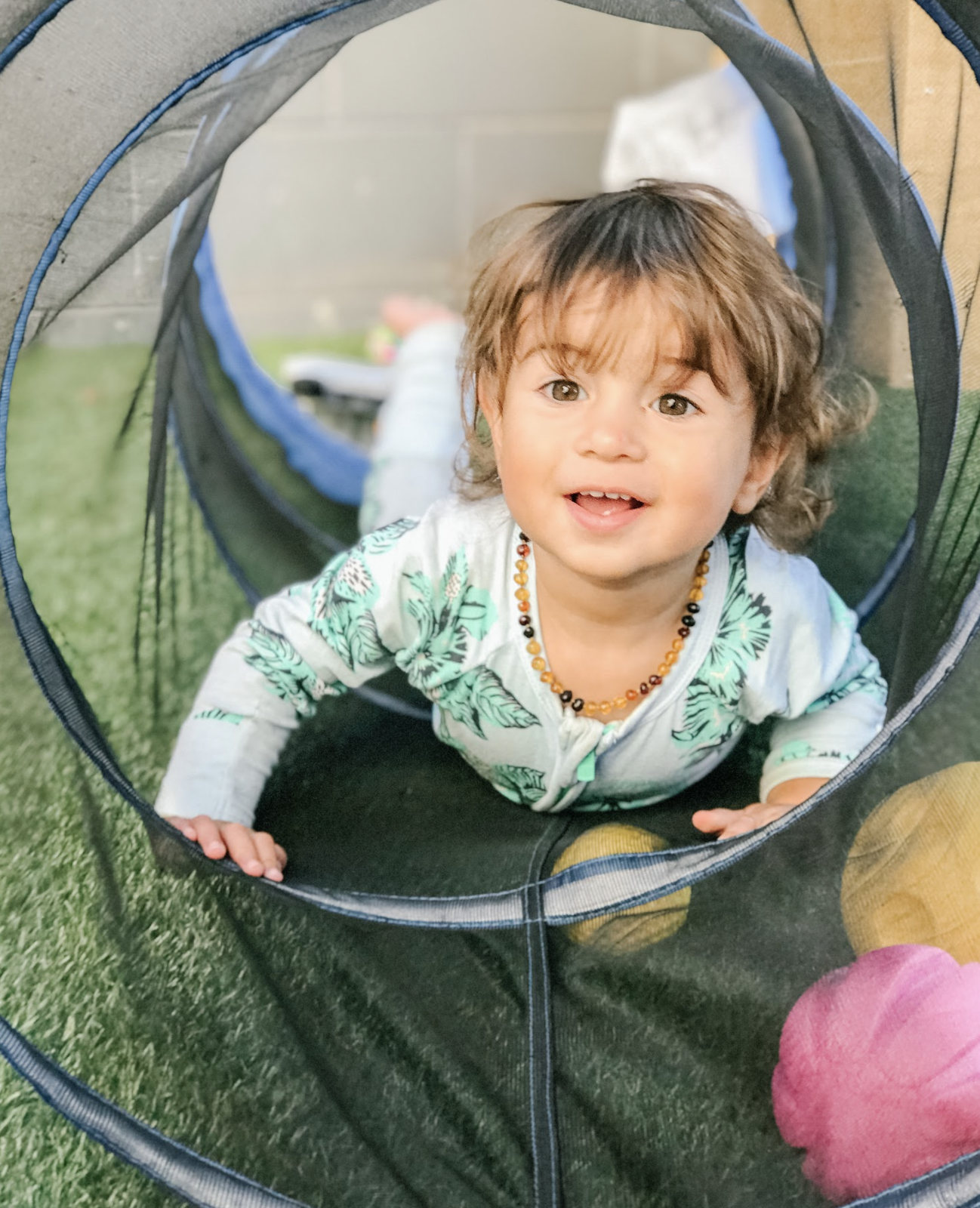
A pirate ship, a submarine, and an ice-cream truck – this early childhood centre is made for little imaginations.
Words Monique Balvert-O'Connor Photos Supplied
Every day is summertime at Twinkle Twinkle Early Learning and Childcare Centre, Mount Maunganui’s new beach-themed early childhood facility. It’s the perfect setting for owner and managing director Rosie Crombie and her team to combine their love for the local community and their expertise in early learning.
Rosie’s own childhood was spent in Tauranga, with Mount Maunganui Beach her family’s treasured holiday spot. Inspiration for Twinkle Twinkle came from those wonderful memories. “I was keen to create something that represents what the Mount means to me – water, sand and sunny days,” says Rosie. The centre’s location in the heart of the Mount ensured the beach theme was fitting.
Twinkle Twinkle, which opened in March, is a lively space that prides itself on providing an environment rich in opportunities. It’s a purpose-built new facility with a number of custom-made props and learning materials. Rosie has a creative focus and high standards; for example, the pirate ship in the outdoor area was designed by the set creators from The Hobbit.
“The pirate ship incorporates all sorts of climbing, crawling and jumping opportunities to extend children’s physical capabilities while feeding their sense of fun and adventure,” says Rosie.
Outside, the sandpit is super-sized, and a thatched bure roof provides a shady spot for imaginative play. Beach-themed pictures of deck chairs, sunshine, shells and sea creatures adorn cupboard fronts.
Inside the centre, the ice-cream truck (complete with wooden ice creams and a number plate that reads TW1NKL) is a magnet for children over age two, while the submarine is a fun attraction for the younger toddlers.
The children are also delighted by the dolphin cut-out, palm tree, surfboard rack for dress-up clothes, and fish tank featuring a shipwreck.
Children equate the beach with happiness, and indications are the same thing can be said of Twinkle Twinkle. “The feedback we get from families is that we provide a service that makes their children’s lives – and their lives – better,” says Rosie. “Our driving force is to provide high-quality care and an impressive education programme for children, and to make life easier for families.”
“I am passionate about providing a support network for families,” adds Rosie. “I believe that when children are happy, families are happy.”
This philosophy sees Rosie working closely alongside her team, striving to deliver everything needed so they can provide quality care and be happy in their work. “If my staff are happy, that transfers to the children, and then to their families,” explains Rosie.
Also pleasing is the centre’s early learning programme, with its focus on putting individuals at the centre of their learning experiences.
“We observe their interests and plan how best to extend those experiences holistically. And when children turn four, we help transition them to be school-ready,” says Rosie.
Rosie’s time with the children at Twinkle Twinkle is hands-on when needed. She also manages the centre, oversees administrative and compliance requirements, connects with families, and generally ensures things run smoothly.
Rosie has a Bachelor of Management degree and her working life has included roles in governance and human resources with the Kindergarten Association. A mother of two sons, and wife to Craig, she started her first early childcare centre nine years ago, selling it to establish Twinkle Twinkle.
“My journey with Twinkle Twinkle is hugely rewarding,” says Rosie.
Located at 413 Mount Maunganui Road, Twinkle Twinkle’s capacity is for 15 under-twos and 45 over-twos. Some places are still available – visit twinkletwinkle.co.nz or check out Twinkle Twinkle’s cheerful Facebook page to find out more.

Diane and Ashleigh Davidson of EVES talk teamwork
This dynamic duo talks teamwork, telling the truth, taking their time and where they focus their attention.


WORDS Nicky Adams PHOTOS Salina Galvan
Diane Davidson loves her daughter Ashleigh. “But,” she says, “the thing is, I also really like her as a person.”
Together, Diane and Ashleigh are Davidson & Co, real estate agents who operate under the EVES banner. Although husband and wife partnerships are common in real estate, it’s rarer to see mother-daughter duos, but its clear this pair have such an easy rapport that helps them work so well together. Explaining the reasons that she thinks the dynamic is so successful, Diane continues, “Importantly, we’re very much on the same page as far as values and goals go. There’s an automatic trust.”
Having started her career in Auckland before moving to Tauranga 20 years ago, Diane has been in real estate for 25 years. Ashleigh is newer to the role. After completing a degree in communications, she moved into marketing and PR. Working for a couple of high-profile international companies, she loved what she was doing, but says “it never felt quite right. With real estate, though, I can use my marketing and communications skills, and every day is different.”
Despite having grown up immersed in real estate (Ashleigh’s dad Alan is also an agent of 30 years and now works part-time as part of the small, tight team), Ashleigh needed to complete her papers before she could become an agent herself, then prove her passion came with ability. In doing so, it quickly became apparent that she’d found her calling.
Dynamic duo
Diane and Ashleigh complement each other perfectly in many more ways than one. Diane has a strong moral compass and belief in old-school real estate values – for her it’s about telling the truth and helping people to achieve their goals, whether that’s finding a property within their price range or getting the best price possible for their home.
Ashleigh shares her sentiments and brings to the table a skill set that’s in keeping with buying and selling in the technological age; her videos and online marketing campaigns speak for themselves. Diane says she admires Ashleigh’s abilities. She laughs when she recalls that long before her daughter became an agent, she insisted that Diane needed to start using social media as a selling forum. “When Ash was still living overseas, she told me I needed to be putting something on Facebook, so I posted about a pair of shoes. ‘No,’ she said, ‘I meant something relevant to real estate!’”
Diane might leave the more complex tech to Ashleigh, yet her expertise in her field is beyond impressive. She’s naturally warm and engaging, but when it comes to work, she gets down to business. Diane has strategies that – evidenced by her excellent reputation and number of repeat clients – work exceptionally well, and Ashleigh, who has the same affinity with people, is similarly focused when it comes to the job at hand.
Extensive experience
As agents, these women do a lot of prospecting, and with that comes plenty of stock. Diane’s extensive experience has taught her that no matter what the market, auctions are almost always the best way to achieve the desired result; however, she doesn’t take credit for the incredible sales prices they’ve reached, instead pointing to the skill of the auctioneer, which she believes is absolutely crucial. The phenomenal auctioneer, Grant Child, they work with is one of the reasons she and Ashleigh love being part of the EVES family.
Another bonus aspect of being under EVES’ wing is its free comprehensive marketing plan – although this is an area where Davidson & Co offer exceptional value, through Ashleigh’s marketing talents, as she’s able to tailor plans to suit specific demographics. The social media whizz is also a proponent of print, which she believes remains an invaluable medium. In fact, she says that just the other day, “a lovely lady brought along a cut-out of a property. Print is definitely not dead. We know we have more people at an open home when it’s in print.”
With Diane and Ashleigh, there’s strategy at every stage, but no pressure. “We’d rather not get the listing than put anyone under pressure,” says Diane. “We under-promise, then do everything we can to overdeliver.”
For Davidson & Co, the keyword is ‘integrity’. It’s not about their egos or position on the awards chart, which is ironic given Diane is a multi-award-winner. For Diane and Ashleigh, it’s about what’s best for the client. “I’ve always said, ‘If it ever becomes about me, tell me and I’ll get out,’” says Diane. “That still holds true today.”
The powerhouse partnership revolutionising real estate in Rotorua
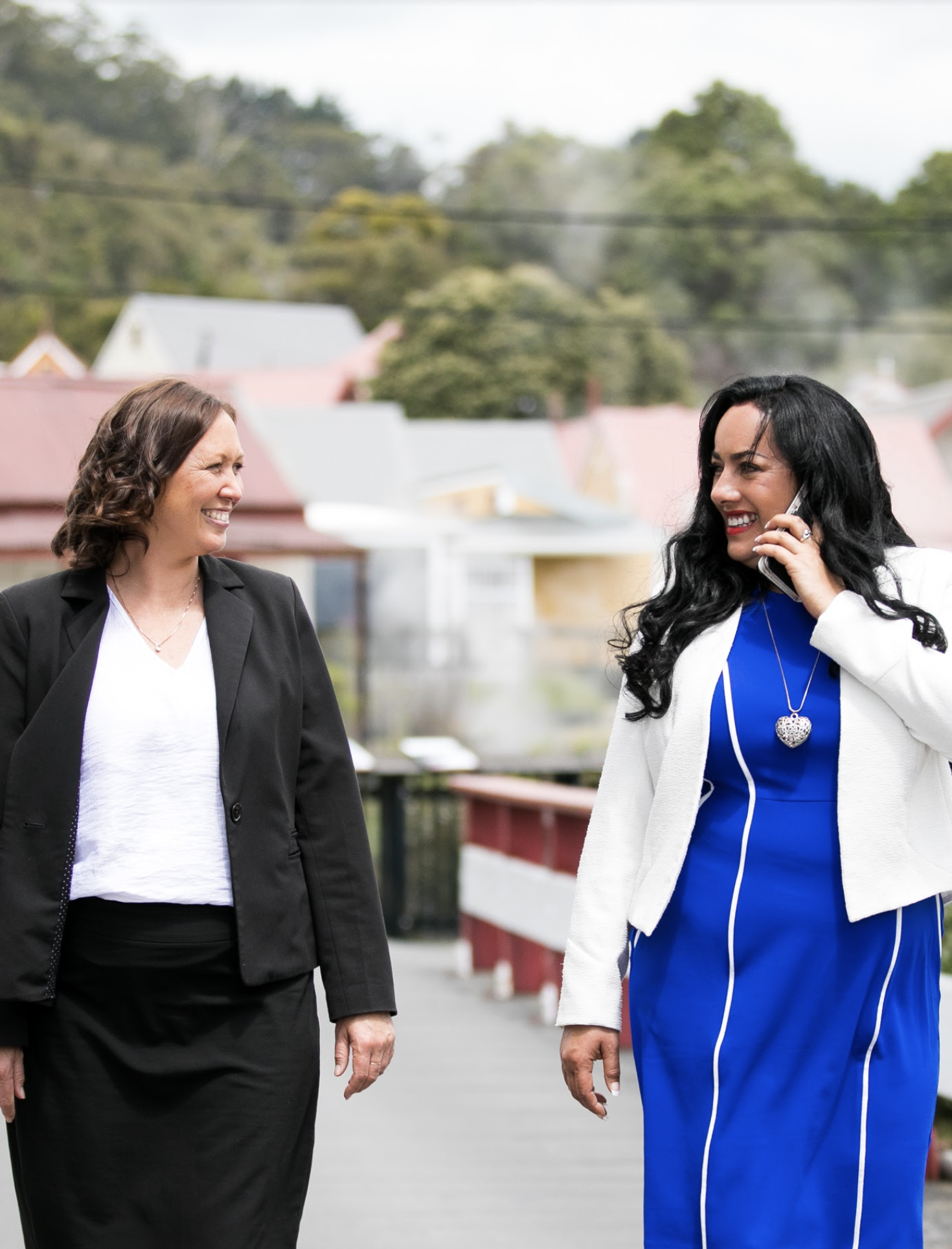
For nearly five years, two Rotorua real estate salespeople have been hitting top-selling prices in street after street. In fact, Jodi Ratahi and Kerif Smerdon of EVES Realty have been so successful, they achieved recognition in the top five percent of EVES estate salespeople for 2019/20.

WORDS Katy Glenie PHOTOS Salina Galvan
For nearly five years, two Rotorua real estate salespeople have been hitting top-selling prices in street after street. In fact, Jodi Ratahi and Kerif Smerdon of EVES Realty have been so successful, they achieved recognition in the top five percent of EVES estate salespeople for 2019/20.
The pair became a partnership after working together on a joint listing and enjoying each other’s style and ethos. “We both come from very supportive families that have enabled us to be focused and driven,” says Jodi. “The addition to the team was bringing on board our lovely PA Heather MaGuire in the first year of our partnership. We so appreciate her loyalty, encouragement and dedication – we love her dearly.”
Both Jodi and Kerif started working at a young age, with people from all walks of life. They learnt the importance of customer service and attention to detail, which they’ve found ultimately generates repeat business. Keeping true to these fundamental values is what drives them today.
The powerful duo have been selling homes together for almost five years, which is unusual for real-estate partnerships. “We each bring different strengths to the team,” says Kerif. “Working in this way makes a huge difference. We’re also one of the only Māori business partnerships in the industry in our city, and we’re very proud of that. Nāu te rourou, nāku te rourou, ka ora ai te iwi – everybody has something to offer, and by working together we can all flourish.”
Rotorua historically undervalued
Jodi and Kerif believe the Rotorua market has been historically undervalued, and this has fuelled their focus on achieving high sale prices for their clients. “Our pricing evaluations are incredibly accurate,” says Jodi. “Based on previous transactions, we can demonstrate to our vendors that around 95 percent of our properties sell within or well above our appraisal range.”
Believing that their success comes from their trust in each other and their genuine concern for their clients, Jodi says, “Our best possible outcome is when a buyer walks in paying what they want, and a vendor walks out getting what they want. We treat our clients how we’d want to be treated.”
Smooth process
Their experience with property transactions gives these women the expertise to guide clients through transactions, helping smooth out the sale process despite changing bank and legislative requirements. They’re also members of the Federation of Māori Authorities, and support a number of local schools and kura kaupapa in the area because as Kerif says, “Ehara taku toai te toa takitahi. Engari, he toa takitini. Success is not the work of an individual, but the work of many.”
After a careful selection process to find the best salespeople to sell their property, Maxine and Roger Houkamau are two vendors who decided that Jodi and Kerif stood out from the rest. “Jodi, Kerif and their support team are experienced, professional and personable – we loved their friendly, honest and consultative approach,” says Maxine. “They took the time to truly understand our needs, carefully advised us on property presentation ideas to maximise the sale and provided excellent insights about the market, including upcoming developments. They then sold our property above asking price in just a few weeks after listing.”
Rapid growth in market
Real estate sales in Rotorua have been strong throughout 2020. The market has experienced rapid growth, with median prices rising 9 percent in June 2020 compared with a year earlier* and by over 40 percent in the last three years**. “Things have really stepped up a notch since the national lockdown,” says Kerif. “We were already seeing more activity in the market at the start of the year – now with the current financial climate, activity has increased, wand buyers on all spectrums are contacting us for their real estate needs.”
Jodi and Kerif are strong advocates for Rotorua. “Our city is beautiful, with lots of activities to attract people, such as world-class trout fishing, superb mountain biking and walking tracks, our incredible redwood forest and thermal wonderland, and there are lots of free events for families,” says Jodi. “It’s a place that really looks after people, and we love it!”
*Infometrics Rotorua District Quarterly Economic Monitor June 2020
**One Roof Property Report Dec 2019

Turning accomplished surfers into frothing groms
“After being an accomplished surfer, going back to being a total learner can be quite a humbling experience, but it’s also an opportunity to get that buzz of your first successful ride, which a lot of us who’ve been surfing for a lifetime have forgotten.”

Catch the wave with a Mount man who’s thrilled to have found his passion and to be helping others find it too.
WORDS + PHOTOS Katie Cox
In July 2016, Mt Maunganui’s Geoff Cox had been working as a videographer in the film and television industry for nearly two decades when he disappeared into his shed. Three days and much tinkering later, he emerged with a prototype of a foilboard he’d shaped. Cut to today and he’s working with Signature Performance Gear to help surfers all over the world take wave-riding to a new dimension.
Getting with it
Not even sure what a foilboard is? It’s sort of like a surfboard but with a hydrofoil that extends down into the water. “To put it simply, it’s a glider flying underwater,” says Geoff. “Just like an aeroplane wing, there’s a foil section that generates lift when you’re moving forward. The unique element of surf foiling is that all of the energy comes from the wave – no kite, no sail, no motor. One of the most rewarding things about surf foiling is learning to feel that energy and get better at finding and using it.”
Geoff was inspired to become a shaper by watching Hawaiian surfer Kai Lenny paddle in on a foil. “It was the first time I’d seen surf foiling not involving jet skis and tow ropes and all of those layers of complexity that make it less accessible. To me, it looked like the ultimate evolution of wave riding.”
The first few foils he shaped were totally experimental; there were very few surf foils on the market and he hadn’t seen any in person. “There were foils that were made for kite foiling, but they weren't fit for the purpose of foil surfing,” he recalls.
Refining the process
In the beginning, Geoff’s process was labour- and time-intensive, much like hand-shaping a surfboard. “I started with a hand-cut foam core that was then hand-laminated in carbon and epoxy,” he says. “It involved lots of sanding and there was a lot of inaccuracy in the design.”
But things got better. As part of his design background, Geoff had always been conversant in computer-animated design (CAD), so he started designing his foils that way. “I built a 3D printer that allowed me to very accurately create my CAD designs as 3D-printed molds, which I’d then use to lay up the foils in,” he says. “This accuracy allowed me to repeat designs while changing and refining features to get the performance I was after.”
Three years on from his first foray, in late 2019, Geoff was entertaining the idea of producing a small run of his foils and testing the market to see if it was worth pursuing further. While communicating with a composite factory about manufacturing them, his contact at the factory mentioned that he knew of a global surf brand that was looking for foil designers to help them develop their existing offerings. That company was Signature Performance Gear.
“He connected us and it went from there,” says Geoff. “The SPG family are an amazing group of people and I’m so stoked to be part of the team. I could not have found a better brand to get involved with.”
Moving on up
The wing Geoff designed for Signature Performance Gear has been met with rave reviews worldwide by some of the major influencers in the sport. “Part of what I did for Signature was update the existing range into a modular system, which involved redesigning every component – the mast, fuselage, tails and existing wings,” says Geoff. “The second part was adding my model, called the GameChanger, to the range.”
Building moulds for commercial production is an expensive process, but Signature invested in Geoff’s model fully trusting it was a good design. “I’d just returned from Tahiti, where I’d surfed my latest design in a wide range of conditions and it was just so good!” says Geoff. “I had a lot of confidence in it, but it’d only been ridden by me and my friends. When the first production models started getting shipped out to the world's top riders and influencers, I was quietly shitting myself, hoping it’d be well received. I had a lot of sleepless nights! And then the first reviews started hitting Instagram wiith 100% positive feedback.”
So how does it feel to know that a design that came out of your head is now under the feet of some of the world's best riders? “I’m just buzzing when I see what guys are doing on my foil,” says Geoff. “I guess it's the same feeling a surfboard shaper gets seeing a surfer improve on their shapes. Locally, Alex Dive is one of the best around and his foiling took a huge leap forward when he got on my foil – he’s pushing his performance to the next level. Internationally, the response is amazing. Seeing videos of the best guys going off on my design is hugely rewarding.”
Sharing the love
A lot of the world's top surfers are now into foiling too, and Geoff thinks they’re drawn by the excitement of a new challenge. “It's a very difficult thing to do, so it’s very rewarding when you start to get it,” says Geoff. “It really is just an amazing feeling – it feels like flying. That’s very different to being confined to the water surface and the bumps and chop that go with it.”
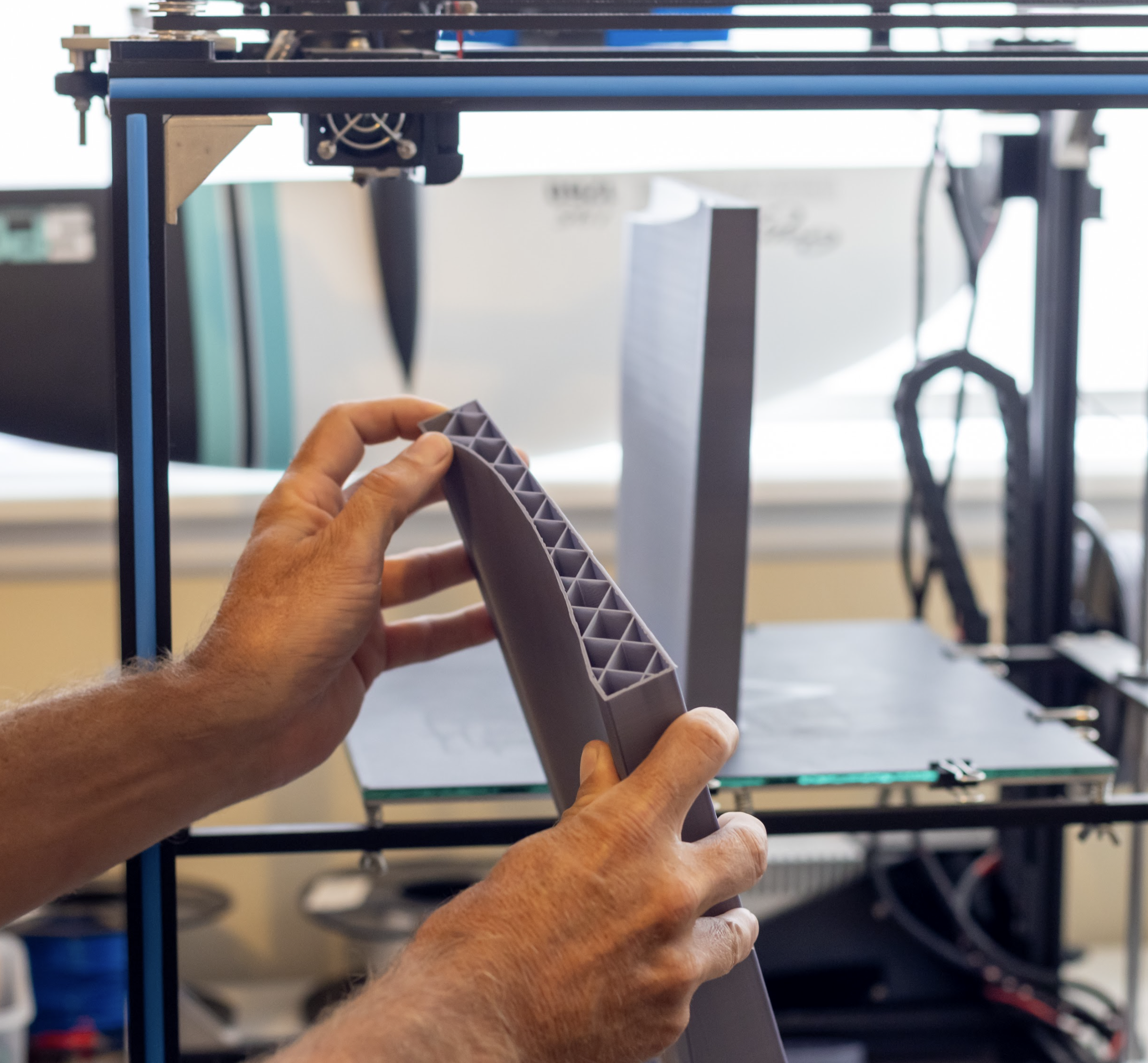
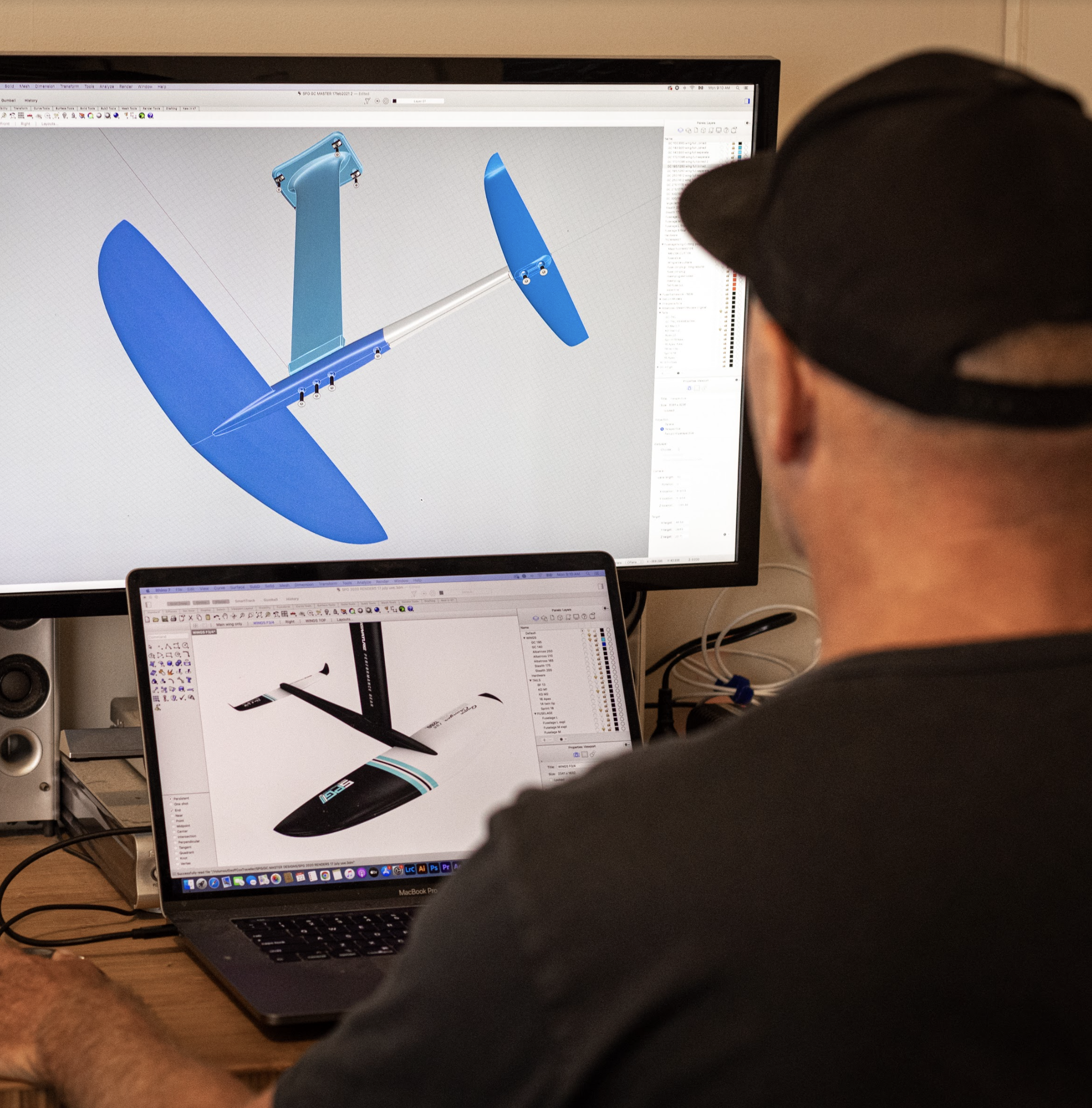
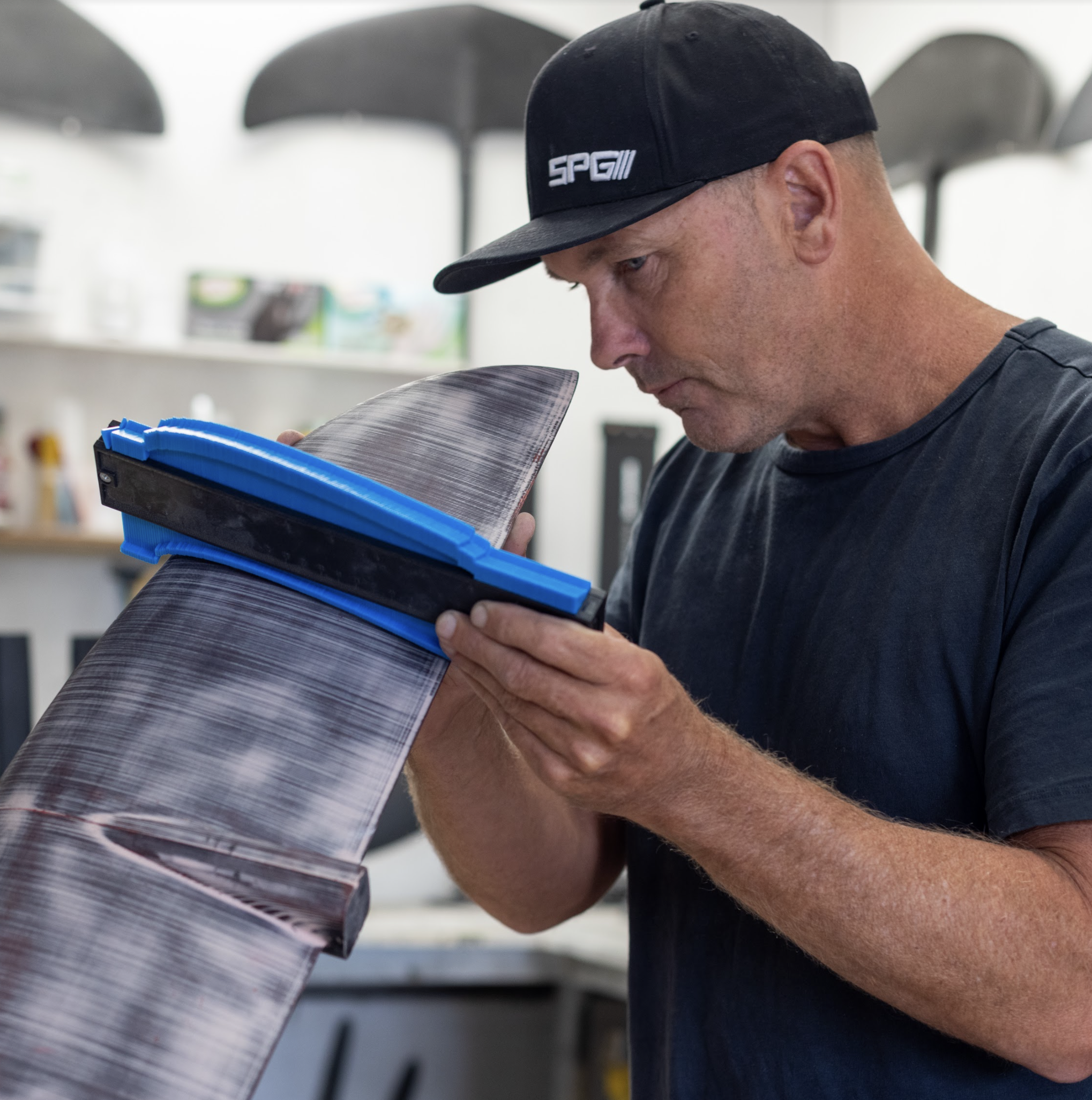
Foiling has changed the types of waves Geoff and others ride, and the way they ride them too. “So many waves that aren’t great for surfing are perfect for the foil, and we’ll often have eight or 10 of us all sharing waves and connecting up multiple rides and pumping back out to share more,” he says. “Living at the Mount, the good surfable days have gone from 50 a year to 200.”
Keen to join the party? Geoff says the learning process is probably harder on the ego than anything else. “After being an accomplished surfer, going back to being a total learner can be quite a humbling experience, but it’s also an opportunity to get that buzz of your first successful ride, which a lot of us who’ve been surfing for a lifetime have forgotten. I love how all my ‘older’ friends have become frothing grommets who just can't get enough!”
YOU MIGHT ALSO LIKE
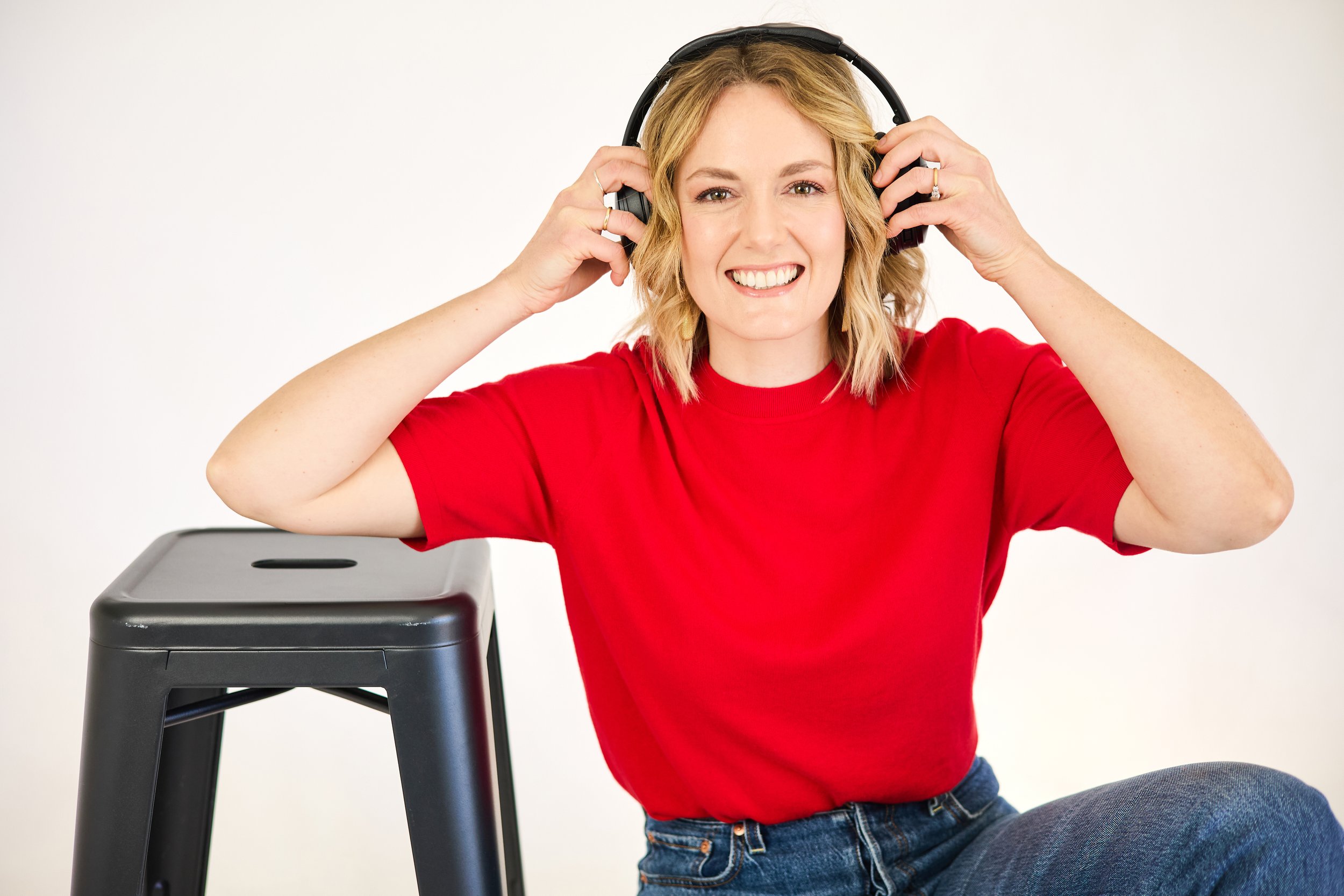


Helping kiwis supercharge their wealth
Ask Kristen Lunman when you should start investing, and she’ll tell you, today. Thanks to Hatch, the digital investing platform she co-founded, the world’s share markets are now more accessible to Kiwis than ever.
Ask Kristen Lunman when you should start investing, and she’ll tell you, today. Thanks to Hatch, the digital investing platform she co-founded, the world’s share markets are now more accessible to Kiwis than ever.

What does wealth mean to Kiwis? Lunman says that for her customers, it means having a full life that balances travel, work, family, friends, and health. Lunman saw limited options for ambitious Kiwis to grow their wealth and, as a woman balancing career, children and life, she felt the pain. It motivated her to start Hatch, which delivers a straightforward way for people like her to get their money working as hard as they do to earn it in the first place.
“We launched Hatch on a mission to help Kiwis supercharge their wealth and build good money habits,” says Lunman. “Term deposits and savings are no longer attractive options to grow wealth thanks to low interest rates and inflation.” With Hatch, Kiwis can now own shares in over 3500 US-listed companies and funds on the intuitive and straightforward platform.
“Property’s great, but you need a large amount of capital to get involved, and then you’re locked in. Building a business is another way to grow wealth but making a success of it is hard work and high risk, and again, once you’re in, you’re in.”
Owning shares in world-class companies and funds has always been an opportunity reserved for the financial elite, something that never sat right with Lunman. She saw a way to offer a fresh new approach to self-directed investing that’s designed for newbies to experts.
“We’ve built a simple, straightforward experience to help you take control, wherever you’re at. With Hatch, it’s not hard to back the pioneers that are shaping our future and benefiting from their success. From Netflix to Zoom, Tesla and Vanguard, when you approach investing like you’re backing a business or industry, it breaks down the mental barriers to getting started.”
It takes about three minutes to open a Hatch account. After transferring money into your account, the next morning, you’re ready to buy shares in companies and funds in the world’s largest and most liquid share market. It’s that simple.
“We want people to be shareholders in businesses because it’s a tried and tested way to meet financial goals over the long term. We’re not about trading stocks on a whim and trying to predict fluctuations in the markets. We want to help Kiwis build sustainable wealth over time, through great financial habits.”
For Lunman, the best investors are mindful investors. This means considering why you’re investing in the first place. This level of self-awareness helps you stay calm and make smarter choices. “Being mindful means you don’t panic when your shares fall in value. There are always going to be ups and downs in share prices, but over time, the highs in the markets should outweigh the lows.”
As part of Kiwi Group Holdings alongside Kiwibank and Kiwi Wealth, Hatch has grown and benefited from the backing and wisdom of one of New Zealand’s most trusted financial names whilst staying completely autonomous. And the Kiwi family has benefitted from a fresh, innovative new brand. Win-win.
Buying a slice of a company or a pioneering industry like fake meat or cannabis and watching it grow and shape our future is exciting. Shareholders in the likes of Apple, Tesla, Beyond Meat and clean energy companies are looking ahead and hoping to benefit from megatrends that are changing the way we live. Why not join 65,000 other Kiwis and to do the same?
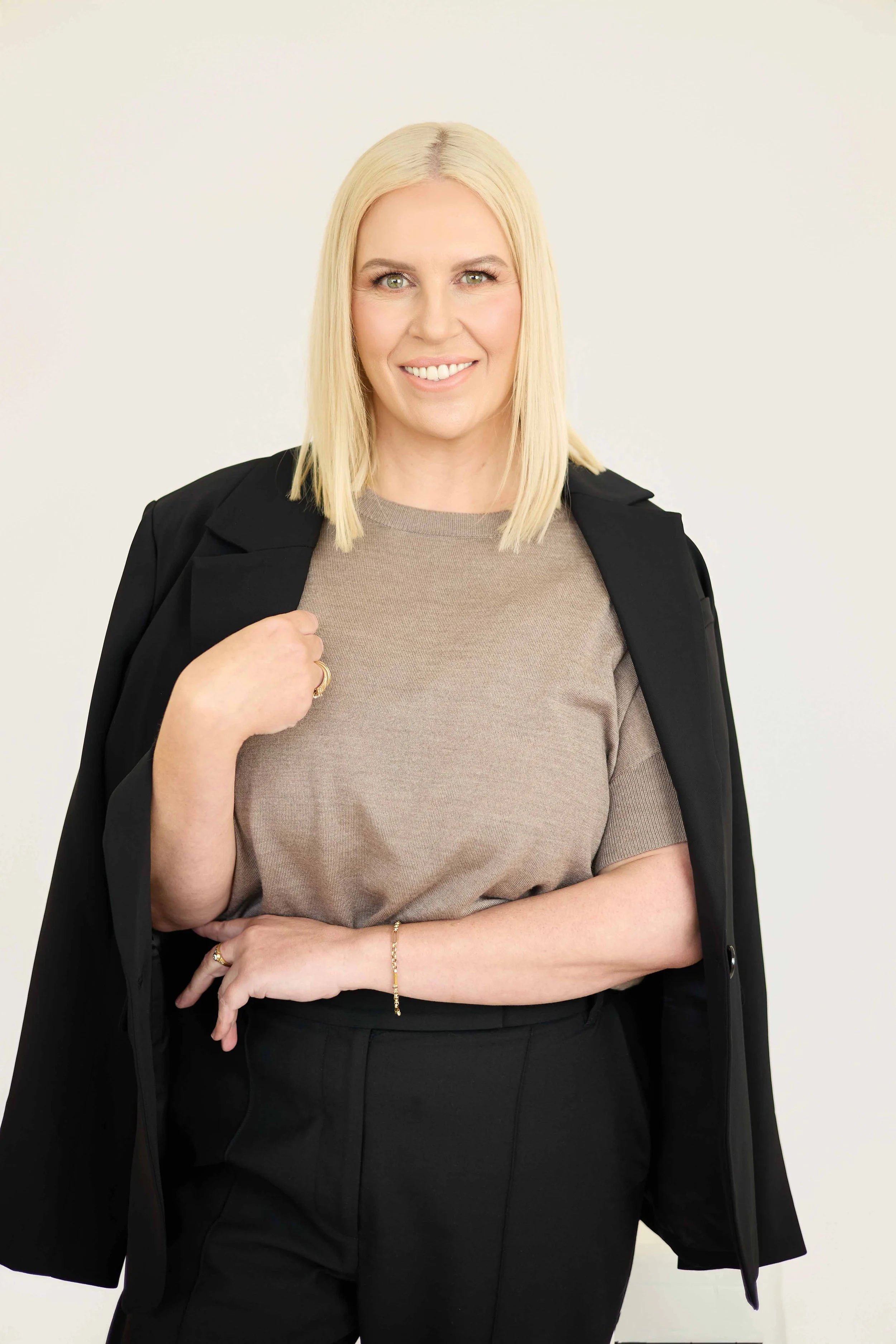
Column: Craig Orr shares his secrets to property success
Craig Orr shares his secrets to property success and explains why there is nowhere like the Bay to call home.

Growing up, my family had a bach at the Mount on Oceanview Road, so we’d escape Hamilton and spend our summers here by the beach. But it wasn’t until I met my wife Natasha not long after I moved back to New Zealand from Perth that I finally moved to the Bay for good. Tash was working at clothing store Augustine, and one day I went in there with my sister and son Duke (now 11), who was two at the time. It was instant fireworks. Now Tash and I are raising our daughters, Estelle (7) and Ivy (3), while Duke, a budding surfer, lives in Jan Juc in Victoria. Safe to say I’m itching to see him when the trans-Tasman bubble gets going!
Being in real estate with Bayleys means I have the flexibility to be there for my kids a bit more. I live for the mornings when we scooter to school and kindy. It’s that close-knit-village feel of our city that makes it such a fantastic place to work and raise a family.
I started as a lifestyle-property agent but naturally moved into residential property through referrals and as my family-minded clients moved around, selling their properties to upgrade or downsizing after their kids had moved out. I cover much of Tauranga and the outskirts, from the Mount to Waihi Beach, but you’ll often find me in Omanu, Te Puna and Tauriko. The best part is I’ve made some really good friends working in the business. I even attended the wedding of some great clients who recently got married on the Te Puna property I sold them.
People buy from agents they trust, and I can tell almost instantly how a buyer feels about a home. You can sense it – and that’s the key to being a great agent.
Just the other week, I had a woman wanting to buy a property I’d listed, but she needed to sell hers first. We got it on the market for her and sold it within a week. To help someone make the move they want to make in a stress-free, positive way is what it’s all about.
As a former landscaper, part of what I bring to the table is my hands-on experience in making a home more liveable when it comes to the backyard. In the Bay of Plenty, so many of us live outside, so I can help clients see how to create the ideal outdoor spaces.
In my twenties, I moved to Western Australia to play semi-professional rugby in the coastal suburb of Cottesloe. It was through the club I met a French stonemason and learned the ropes. That led me to setting up my own landscape construction business alongside a friend and carpenter. We grew it into a successful business, but in 2011, after 15 years, it was time for me to come home. The shift got me thinking about how long I wanted to stay on the tools, and after chatting with my good friend Stephen Shale – a Bayleys auctioneer who was then manager of Bayleys Waikato – I was motivated to follow my passion into property, where I’m proud to say I’ve been for nine years.
I also couldn’t do it all without my personal assistant, Corinne Littlejohn. You need to work as a team and she’s my backbone.
On weekdays, you can find me heading up the Mount with my phone torch at dusk. In the weekends, between open homes, I get down to the beach with the kids and out on my surfboard whenever I can. That’s the thing about living here – you can have a busy day, but the minute you head up the Mount or hit the sand, it all just washes away.

Theresa Gattung: pioneering change from the top down
A regular fixture on Fortune’s most powerful women in international business lists, Theresa is no stranger to the challenges such females face. Now leading the New Zealand chapter of SheEO, she’s helping a global community make long-overdue change.
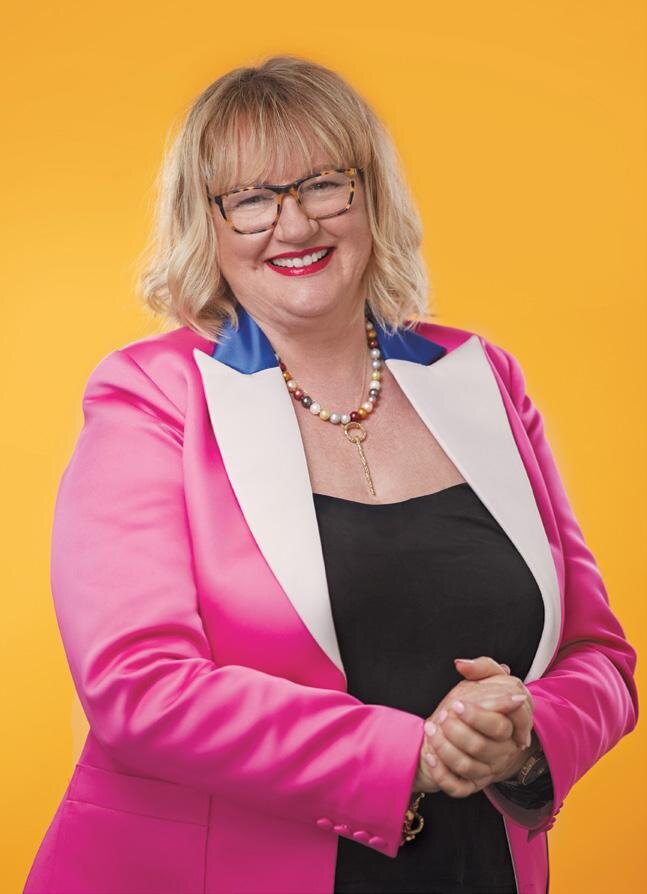
A regular fixture on Fortune’s most powerful women in international business lists, Theresa is no stranger to the challenges such females face. Now leading the New Zealand chapter of SheEO, she’s helping a global community make long-overdue change.
Spend any time looking into the life and times of Theresa Gattung and you’ll realise one thing very quickly: she’s not afraid to pioneer change. Arriving in the public eye at the age of 37, when she became the youngest ever and first female chief executive of Telecom (now Spark), she then went on to co-found My Food Bag, the home-delivered cooking-kit service that revolutionised the way thousands of New Zealanders approach mealtimes. She’s been recognised as one of the country’s leading philanthropists, working with charities such as the SPCA and Tauranga-based Cambodia Charitable Trust, and more recently launched the New Zealand arm of world-first female venture-capital fund SheEO.
Playing her part in an ambitious goal to see 10,000 women-led ventures funded through SheEO worldwide, Theresa’s knee-deep in what may be her most important quest for change yet. To put its significance into context and demonstrate the urgent need for organisations of SheEO’s kind, you need only to consider that worldwide just four percent of all available capital is currently invested in women-led ventures. Having spent decades holding prominent positions in the business world, Theresa’s quick to recognise that even in 2020, the playing field for women in business is still far from even. “You don't really have to walk very long as a woman in business to realise that it's still harder,” she says. “It's not as hard as it was 20 or 30 years ago, but it’s still hard.”
As the daughter of two entrepreneurial British migrants, it’s no surprise that Theresa grew up to be business-savvy, with a bent for challenging the status quo. Leaving behind their native London, her working-class parents, Marion and John, set sail for New Zealand in the 1960s. They were what Theresa affectionately calls, “ten-pound Poms”. “They paid £10, got the passage by ship and had to sign an agreement saying that they’d stay in New Zealand for at least two years,” she says. “And here they are, over 50 years later.”
Moving from their initial base in Wellington to settle in the Bay of Plenty, Marion and John set up a souvenir business in Rotorua. “My parents were entrepreneurs, in a small way,” says Theresa. “My father retired from the paid workforce in his forties after ill-health and had to support himself ever since, with property and other interests. So, yes, I come from a background of small business people.”
Breaking away from their established family tradition of taking the same career path as their parents before them, Theresa believes that her parents’ success in New Zealand is partly due to their adopted Kiwi mentality – simply getting stuck in and being willing to try something new. She also recognises her father’s progressive and supportive approach to parenting as a unique factor in shaping the person she became. “My father had only sisters and then he had four daughters,” she says. “He was always very encouraging of us reaching our full potential, and never had any particular gender stereotypes about what girls could do [or] boys could do, which was pretty unusual [at the time].”
On completing her schooling in Rotorua, Theresa studied a business degree at the University of Waikato, before moving to Wellington to complete a law degree. Even as a young adult, she understood that she would need to play her part in fighting for gender equality in the business world. At the time, there were no women running large companies in New Zealand, so she knew that achieving her dream of running a large company by the age of 40 would not be easy. “I've always understood that there are structural issues that can hold women back in society,” she says.
In the years that followed, Theresa began her corporate career climb through TVNZ, National Mutual, the Bank of New Zealand and telecommunications company Telecom. Originally joining the latter in 1994, she was appointed CEO in 1999. As its first female CEO, she was thrust into the public eye, at times facing challenges that her male counterparts would rarely experience (after being announced as chief executive at a press conference, the first question she was asked was if she intended to have children).
As she says in her memoir, Bird on a Wire, Theresa successfully led the company into an entirely new era of communication. “I joined Telecom in 1994 and I was given a cell phone that was really big; you almost needed a separate briefcase for the size of the cell phones!” she laughs. Two years later, returning from a conference in Europe in 1996, she began to realise just how big the internet was destined to become, and went on to lead Telecom’s transition into the age of IT. “When I was CEO, we bought a couple of large IT companies. We bought Gen-i and we bought Computer Land, and we put it together with Telecom’s IT division and we called it Gen-i. Then over that time, Telecom became the number-one provider of IT services.”
Stepping down from her role at Telecom in 2007, Theresa spent several years pursuing other business and philanthropic ventures, before co-founding My Food Bag in 2012 with Cecilia and James Robinson. “When Cecilia was on maternity [leave] with her son, Tom, she wrote up the business plan for My Food Bag and showed it to me,” she says. “I looked at it and I thought, ‘Yes, this is really gonna work’. I realised that something like that would fill such a need for women of every situation because ‘What are we going to have for dinner tonight?’ usually falls on the woman of the household.”
As chair of My Food Bag and a key investor, Theresa worked with the Robinsons, Nadia Lim and her husband Carlos Bagrie to swiftly get the business off the ground. “In the beginning it was just us and then we started hiring people, and we did have that philosophy that we're going to go for the best,” she says. “We had the best advisors, we got the best people and we always thought that it could be a bigger business. We never saw it just as a small business. We set it up, the systems and everything, to scale fast.”
After huge and rapid success, a majority share of My Food Bag was sold to Waterman Capital, freeing Theresa up to focus on building a name for SheEO in New Zealand. “When I heard [SheEO founder] Vicki Saunders speak a few years ago at a conference in America, she had just launched SheEO in Canada [in 2015] and I thought it was a brilliant idea,” she says. “Her idea was to completely change the paradigm.”
Simple yet hugely effective, SheEO operates on the principal of ‘radical generosity’, a belief that trust, collaboration and a strong female community is key to creating opportunities for more women-led ventures to succeed. Each year, an intake of local investors, called Activators, each contribute $1100 into a central funding pool. These women then work together to choose five women-led ventures to fund through five-year interest-free loans.
“[Vicki] had a couple of cycles [of funding] in Canada and I went up to her and said, ‘This would be fantastic in New Zealand,’” says Theresa. “I organised a conference and brought her down [to New Zealand] and she presented to a room full of 500 women who just loved the idea. We decided to launch in New Zealand, but then we hit a roadblock because in Canada [SheEO] is not a business or a charity. It's not tax-deductible and it doesn't want it to be a charity. We're trying to reframe what business is, and I believe the world will be more effectively changed through business than through charity. So we struggle because the law doesn't really have a category that's in between.”
“You don't really have to walk very long as a woman in business to realise that it's still harder.”
Having ironed out some teething problems and brought Westpac on board as a key supporter, the New Zealand chapter of SheEO has so far raised $700,000, which has been loaned to 10 local ventures over two cycles of funding. Worldwide, SheEO has so far raised more than US$4 million in loans through 4000 Activators, allowing 53 women-led ventures in five countries to gain vital funding. The opportunity to change the face of business seems almost limitless.
When it comes to selecting ventures to invest in, SheEO has unique criteria. They have to be at least 51 percent women-owned, be doing something good for the country, the world or the planet, meet revenue criteria and demonstrate an ability to scale. Among recent local ventures that have received funding from SheEO is Pure Peony Skincare, a Nelson-based business that uses the root of organic peonies to create natural products to soothe skin conditions such as eczema, psoriasis and rosacea.
Although SheEO has game-changing benefits for their selected ventures, the system isn’t all take. Through several nationwide and regional events, SheEO Activators have the opportunity to make invaluable business connections themselves through their involvement in the organisation. Every year, SheEO runs a launch event at which the supported ventures for the year are announced and Activators have the opportunity to gather on a national level. Along with networking opportunities, Activators also have the chance to participate in follow-on funding programmes with the ventures as and when they become available.
“The first benefit you get as an Activator is meeting all the other Activators,” says Theresa. “Vicki comes down from Canada and it’s amazing to spend a day and an evening with that group and to be so inspired. You really make linkages that will benefit your business.”
SheEO is unique in that the required investment is relatively minimal, allowing women of all ages and backgrounds to invest in the fund. Aiming to encourage a more diverse range of women to join as Activators, SheEO gives Activators the opportunity to split the yearly financial commitment across a monthly payment plan. This commitment to accessibility helps to ensure that SheEO not only continues to support women-led ventures, but also creates a chance for women who otherwise may not feel empowered to do so to become involved in investing.
It’s this sort of clever thinking that has contributed to the rapid growth of SheEO locally and internationally. The first ever SheEO Global Summit took place in Canada on March 9 and SheEO Magazine launched in New Zealand with the aim to help to further the SheEO’s reach and inspire Kiwi women.
Seeing SheEO in action, it’s obvious that the world needs more of its kind and Theresa is to be commended for having the foresight to see it could work in the New Zealand market. With a knack for knowing exactly what the world needs when, she says she allows both passion and logic to guide her when it comes to choosing what to take on. “I do what moves me at the heart level and the head level. I think, ‘I could make a difference to this and it would be a good use of my time. It’d have a big enough impact and I’d enjoy doing it.’”
Theresa knows better than anyone that New Zealand is a nation of risk-takers and innovators, but she insists we need to keep pushing for more and looking at how to solve the big issues in our society. When asked about what the world needs most right now, she puts a challenge to her fellow Kiwis. “We just need to keep being more of what we can be, because we can really mean something to the world,” she says. “We show what's possible. We have to make New Zealand the best she can be because we lead the world in many ways. We have to keep doing that, even though we're not perfect. New ways of thinking to deal with problems can flourish here. We have to become even more a part of the solution – that’s the mission of every person living in New Zealand
Theresa recommends: Inspiring reads
The Testaments by Margaret Atwood
A sequel to Atwood’s The Handmaid’s Tale, originally published in 1985 and now a TV series, this 2019 novel is set 15 years after the gripping and gruesome events of the first book. “I find it a complete reminder that [women] have to keep reclaiming our power and asserting our right to have our voices heard,” says Theresa.
Braiding Sweetgrass by Robin Wall Kimmerer
Written by a botanist and professor of biology, Braiding Sweetgrass explores our reciprocal relationship with the earth in connection to the widespread general awakening of ecological consciousness. “It’s a fantastic ode to nature and an inspirational read about the beauty of it,” says Theresa.

Alisha Brady: EnableMe
A financial personal trainer at EnableMe, our guest columnist says that when it comes to paying off your mortgage, 10 is the new 30.

A financial personal trainer at EnableMe, our guest columnist says that when it comes to paying off your mortgage, 10 is the new 30.
PHOTO SALINA GALVAN
When you go to a bank to get a mortgage, many people default to the bank’s offer of a 30-year term. It’s in the bank’s interest for you to take your time, as they’ll make more money. But did you know that over 30 years, you’ll pay back almost three times what you borrowed?
EnableMe founder Hannah McQueen was a young accountant when she applied to get her first mortgage 11 years ago. Reluctant to pay three times the amount she wanted to borrow back to the bank, she approached the University of Auckland’s mathematics department. Together they devised a calculus formula to determine how to pay off your mortgage in the fastest time, with the lowest interest cost and the most flexibility. That’s now the basis of EnableMe’s programme, which in the past decade has helped thousands of Kiwis get in control and get ahead.
We work on these ratios: you can pay off your debt in eight years if it’s four times the size of your household income, or in 10-12 years if it’s five times the size. If it’s more like eight times, you’ve probably stretched yourself too far and we’d suggest selling your house.
That’s why we say 10 is the new 30! Most people can achieve more than they realise when they’re armed with an ambitious plan and expert advice, and when they’re accountable to someone other than their spouse.
Kiwis fritter away 15 percent of their income on things that don’t make them any happier or that they don’t notice they’re spending money on. Finding and eliminating the fritter in your spending provides a huge opportunity to make progress. You’d also be surprised at the savings you can make from efficient mortgage set-ups, tax structures and insurances.
We use behavioural science to work out what your spending personality is, then help you incorporate positive behaviours into your life. Most of us are shoppers rather than savers, but having a plan in place that includes things that make you happy and also gives you something to strive for can help you make progress and build wealth, while taking into account your spending habits.
You can go for the traditional approach of printing out your bank statements and working out where all your money has gone, but that only tells you what you’ve done, not what you’re capable of. We’re not in the business of putting people on financial deprivation diets – we want to help them get ahead while enjoying life.

Bay business matchmakers
Paul Brljevich and Kevin Kerr of Tauranga-based Tabak Business Sales share the secrets of successful deals.
Paul Brljevich and Kevin Kerr of Tauranga-based Tabak Business Sales share the secrets of successful deals.

WORDS DANIEL DUNKLEY / PHOTOS SALINA GALVAN
Making the decision to sell your own business is never easy. If after years of hard slog, you opted to sell up so you could ride off into the sunset, how exactly would you go about it? Would you phone a few contacts and hope for the best, or take up an offer from the first interested party?
For the owners of Tauranga’s Tabak Business Sales, Paul Brljevich (pictured above left) and Kevin Kerr (above right), finding the right buyer is something of an art form. They could be considered matchmakers who link Bay of Plenty businesses with the most attractive suitors.
Paul and Kevin each have more than a decade’s experience in orchestrating business sales for Tabak, Tauranga’s oldest business brokerage. They say selling can be an emotional decision, but requires sharp analysis, impartiality and fairness. After all, it can be the most important decision of someone’s career.
From their base on Cameron Road, in the heart of Tauranga’s rapidly expanding business district, the duo has earned a reputation for their exceptional valuation skills, forensic-like attention to detail and extensive network of contacts. They cover sales all over the Bay of Plenty and up to the Coromandel, finding buyers for businesses valued at between $200,000 and $10 million. Tabak also has offices in Auckland, Hamilton, Wellington, Christchurch and Queenstown.
Kevin has been a business broker since 2001, when he was enticed into the industry from horticultural management. Paul joined in 2007, after running companies in the leisure, hospitality and property industries, plus a spell in banking. “We’ve lived it,” says Paul. “We’ve run businesses and operated businesses, so we can relate. A person’s business is like their baby; their staff are their family. They want to find a buyer who can make things bigger and better for the future.”
The business of selling a business requires top-notch expertise. Tabak works to achieve the delicate balance of getting the right price for sellers while ensuring a fair outcome for buyers. “If the initial valuation isn’t accurate, the business will remain out there on the market,” says Kevin. “We have to give realistic valuations based on thorough analysis and data. Vendors are on one side and buyers are on the other, and we’re right in the middle brokering a fair outcome.”
How does a sale happen? First, Tabak conducts an interview with the seller. A warts-and-all review follows, which evaluates the positives and negatives of the business. Tabak then taps into its prized global network of 3500 buyers, investors and contacts. This network is so successful that 80 percent of Tabak’s listed businesses are sold before they go to the wider market, allowing sellers to discreetly find the right buyer and avoid disruptive publicity.
“It’s different to selling a home,” says Paul. “You need to know the intricacies; you need to know everything! Buyers don’t purchase because we’re slick. They do it because we’ve done our homework and presented it in the right way.”
The results speak for themselves. On average, Tabak sells businesses in just three to four months, and in the past 10 years, has consistently achieved sale prices within 10 percent of the listing price.
So, what advice would the Bay’s business matchmakers give to potential sellers? “Confidentiality is key,” says Paul. “Have an exit plan when you start a business,” adds Kevin, who also believes advisers
with dedicated resources can make all the difference. “Because we’re smaller, we’re not trying to service a huge number of clients. We have a select number of listings, to make sure we deliver.”
Paul and Kevin clearly get a buzz out of their work. From business owners seeking a change, to 60-somethings cashing out on their lifelong endeavours, each case is different and requires a thoughtful, personalised approach. “We focus on quality, not quantity, and situations in which the whole team can work on a deal – where we all know the business inside out,” says Kevin.
The pair’s drive comes from helping people achieve their long-term goals. Whether it’s buying that dream retirement home, splashing out on a beachside bach, or funding a round-the-world trip, there’s great satisfaction in helping people reap their rewards.
“We recently had a husband-and-wife team who’d been in business together for decades – it was their life,” says Paul. “We were able to get multiple offers for it. The buyers loved it, and the couple were able to go on and enjoy their retirement – it worked for everybody. Outcomes like that are why we love what we do.”

Getting it right
Holland Beckett Law‘s new partner Christie Goodspeed tells why she became a lawyer, and what family means to the firm.
Holland Beckett Law’s new partner Christie Goodspeed tells why she became a lawyer, and what family means to the firm.

WORDS DANIEL DUNKLEY / PHOTOS BRYDIE THOMPSON
Christie Goodspeed opens the door to her Omokoroa home mid-conversation, with a phone pressed to her ear and her seven- and five-year-old daughters in tow, and is immediately joined by a boisterous German schnauzer and a fluffy ragdoll cat. The hectic scene offers a glimpse into the busy life of one of the newest partners at Holland Beckett Law (affectionately known as Hobec), the Bay of Plenty’s biggest law firm.
Christie smiles and takes a breath before sitting down to talk about her role at the firm known for its prowess with commercial clients. She may be leading a full life, but her surroundings hint at the meticulous planning of a top lawyer. Christie organised every detail of her family’s modern home, plotting the house from start to finish and overseeing its development from floorplan to family dwelling. Yet interior design, art and landscaping are only her part-time hobbies – in May, she was made partner at Holland Beckett, and now leads its employment and family law teams.
For Christie, Omokoroa is the perfect place for her family to call home. With idyllic views overlooking the water and a lush tropical garden, their property connects to a scenic walk leading to the children’s school. Her husband Nick, an IT technical consultant, works from home two days a week to help the pair strike the right work-life balance amid the rigours of their professions and parenting.“We’re certainly very lucky,” says Christie. “I come to work happy every day.”
Born in Hamilton, Christie decided she wanted to be a lawyer at the age of 10. She says she was attracted to the profession after watching an episode of TV show LA Law. “I liked the rough and tumble of the court litigation,” she says. “It takes a certain type of person to become a litigator – someone who likes to argue. You’ll have to ask my husband!”
She studied law at university alongside psychology, a decision that has proven useful in her work in the delicate and often emotional field of family law. “With family law and employment, it’s all about personal relationships. My psychology background is helpful, particularly when I’m dealing with separation, division of property and issues involving children.”
Christie’s journey to joining Holland Beckett in 2016 began with jobs at New Zealand firms Tompkins Wake and Buddle Findlay, and advisory firm PwC in Sydney. After becoming parents to Lily (7), Sophie (5) and Callum (3), she and Nick moved back to New Zealand.
Holland Beckett has offices in Tauranga, Rotorua, Whakatane and Opotiki. The full-service firm employs lawyers who specialise in property, estate planning, corporate and financial transactions, environmental and resource management, employment, dispute resolution, health and safety, and family and Māori law matters.
When it comes to employment law, Christie covers all areas. She says she likes to help employers problem-solve and “get it right” with their employees. On the family law side of things, she specialises in complex relationship-property cases, in which assets need to
be divided at the beginning or end of a relationship. In particular, she excels at cases involving companies and trusts. Holland Beckett is able to utilise the skills of a large commercial operation to solve difficult issues. “We help people define how they want to manage their assets going forward, and what they want to keep separate,” says Christie.
Christie’s demanding profession puts her at the centre of the Bay of Plenty’s commercial and family life. She has volunteered for Women’s Refuge and spoken publicly about racial-, gender- and sexual orientation-based discrimination. She says it can be difficult for lawyers to not to bring work problems home. “Our role is inherently being involved in conflict. You have to be able to take a step back and look at these issues with objective eyes, and that makes you a better advocate for your client.”
You might say the Bay of Plenty’s unique beauty and relaxed lifestyle provide the perfect backdrop for a family law firm. Many of Holland Beckett’s lawyers have moved here from Auckland or further afield to enjoy all the area has to offer. “Many of the partners have big-city experience or have come back after living overseas,” says Christie. They’ve chosen to be here because they want to raise their families here, and that’s a great thing. We’re a big firm with a high calibre of clients, but there’s a real sense of collegiality between everyone. The culture of the firm is important to us.”
So what makes Holland Beckett stand out from its rivals? Talking to Christie, it’s clear her employer practices what it preaches when it comes to looking after families. She was offered flexible working hours when she joined, which has allowed her to pursue her career goals without sacrificing her personal life.
She says the firm understands the importance of family. “They were so receptive to that. It certainly hasn’t stood in the way of me becoming a partner, which is fantastic. People have been promoted on parental leave, and that’s just unheard of. We have a really supportive team environment, and we all work well together. We just want to get on with it and get the best outcome for our clients.”
Christie looks outside, turning her attention to the garden. If her pristine property is anything to go by, this lawyer’s clients are in safe hands.

Master + Commander
On June 14, 2017, she assumed command of HMNZS Te Mana, becoming the first woman in our navy to captain a frigate. Accepting the symbol of command, she uttered the immortal phrase: “I have the ship”.
Lisa Hunn has a lot of achievements to her name. A member of the Royal New Zealand Navy (RNZN), she’s represented New Zealand as an acting captain in 2016 exercises aboard warship USS America and been chair of the RNZN Women’s Steering Group. But all that and a diploma in fine arts pales in comparison to the moment she’s most proud of.
WORDS ANDY TAYLOR / PHOTOS TRACIE HEASMAN
On June 14, 2017, she assumed command of HMNZS Te Mana, becoming the first woman in our navy to captain a frigate. Accepting the symbol of command, she uttered the immortal phrase: “I have the ship”.
The frigate is a battle-ready component of our navy, with all the bits to blow things up. “And the best part is that Te Mana’s symbol of command is quite big,” says Lisa. “Other ships have pounamu and the like, but with the hoe, I get to tell everyone that mine is bigger than theirs!”
This line is typical of Lisa. She has a very, very serious job, with the lives of 180 people directly in her hands, and often the lives of hundreds more indirectly, dependent on her command. And yet she’s retained that classic Kiwi ability to find humour in all areas of life.
This ability to look on the bright side is essential when you’re “driving” (as she puts it) through rough seas and storms in a warship the navy describes as “designed to fight and evade her enemies and take battle damage”. And you think you need light relief after a bad day in the office.
Lisa talked to UNO just a couple of days after being rushed to hospital with acute appendicitis that saw her have emergency surgery. “It wasn’t exactly what I had planned for the week,” she says, dryly.
Lisa’s story starts in Wellington, in what she describes as a yachting kind of family that could often be found out on the water in a variety of small boats. Her parents regularly attended the local yacht club, and while they were there, young Lisa spent her time with the Sea Cadets. For many of us, childhood interests like this are a passing distraction, but it was clearly more formative for her.
“It did have a huge effect,” she says. “I’d always loved being out on the sea, but the cadets showed me that there was more to it than that. It was a real passion, and the
navy offered something that allowed me to combine that love of being out on the ocean with seeing the world. If I was to try a philosophical explanation, I’d say that the navy offers access: access to the world, to challenges and to experiences that not
many other careers can match.”
Commander Hunn’s experiences are a roll call of foreign locations and corridors of power. She entered the navy in 1990 on the ‘general list’ as a midshipman, and did initial officer training, then a Bachelor of Science in geology. A promotion to sub lieutenant and a stint on her first seagoing unit followed, with time on HMNZ ships Endeavour, Wellington, Canterbury and Takapu. She received commendations for excellent service throughout the ’90s, and by October 2002 was a lieutenant commander and had added a New Zealand General Service Medal (Afghanistan) to her decorations for participating in Operation Enduring Freedom in the Gulf of Oman. She represented New Zealand at international AUSCANNZUKUS meetings (it’s pronounced Oz-Can-Zoo-Kiss, since you asked), then became executive officer of HMNZS Te Mana, whose home port is Tauranga. Executive officer is the second in command, and Lisa’s trajectory seemed fairly clear – until she started looking for another challenge.
“I’d always been interested in the arts and it had always been a passion,but the navy kind of got in the way. There came a point where I thought, ‘It’s now or never’, and so I started a Diploma in Fine Arts. It was the biggest challenge I’d ever faced.”
Bigger than navigating a warship through a cyclone? “Well, yes – in many ways it was! It was such a different approach, a different set of parameters, but I really loved it, and when I graduated I thought I could juggle a life of some part-time work for the navy with being a part-time artist of sorts.”
It didn’t quite work out that way. Instead, in 2014, realising the sea was a stronger calling and that she was missing the navy more than she could have imagined, Lisa re-engaged in the navy’s regular force. Once she was back in the thick of it, a few high-ranking land-based appointments presented themselves, but it wasn’t until that moment at Auckland’s Devonport Naval Base, when she said, “I have the ship” and became captain of HMNZS Te Mana, that it suddenly all made sense.
“It wasn’t so much about the command alone,” she says. “It was about knowing I could lead and inspire – that I could help bring up the next generation that would get to see the world. Commanding a ship is a privilege, but helping to shape young people into the future generation that will serve in our navy is an honour.”
The role of our navy is at a crucial turning point, something Lisa is very much aware of. “We have such a strong naval tradition in New Zealand, and such a strong naval reputation, which is respected all around the world. In 2017, the USS Fitzgerald was in a collision and it was to HMNZS Te Kaha that they turned to fill the gap. That’s the level of respect our training and ability has given us. And yet in some ways we’re very inward looking; we’re an island nation, and the sea is in our heritage, yet we don’t look out to those oceans around us.
“But I believe that’s changing now, and there are several initiatives before the government that are about having a new focus on the Antarctic, because that’s going to be such a huge part of us as a county going forward. So many other countries will be looking to have an influence in our part of the world, and we need to have a presence there – it’s our backyard, after all, and not many other interested parties can say that.”
It’s quite nice to know New Zealand will be flying the flag in our backyard more and more in the coming years. And it’s really nice – and very reassuring – to know someone like Lisa will have the ship when we do.


Seaweed + Mānuka
We meet the award-winning business rebuilding the mānuka industry from the ground up, bringing real benefits to the East Cape.
WORDS CHANTELLE LAURENT PHOTOS LOGAN DAVEY / LARISSA DRYSDALE
We meet the award-winning business rebuilding the mānuka industry from the ground up, bringing real benefits to the East Cape.
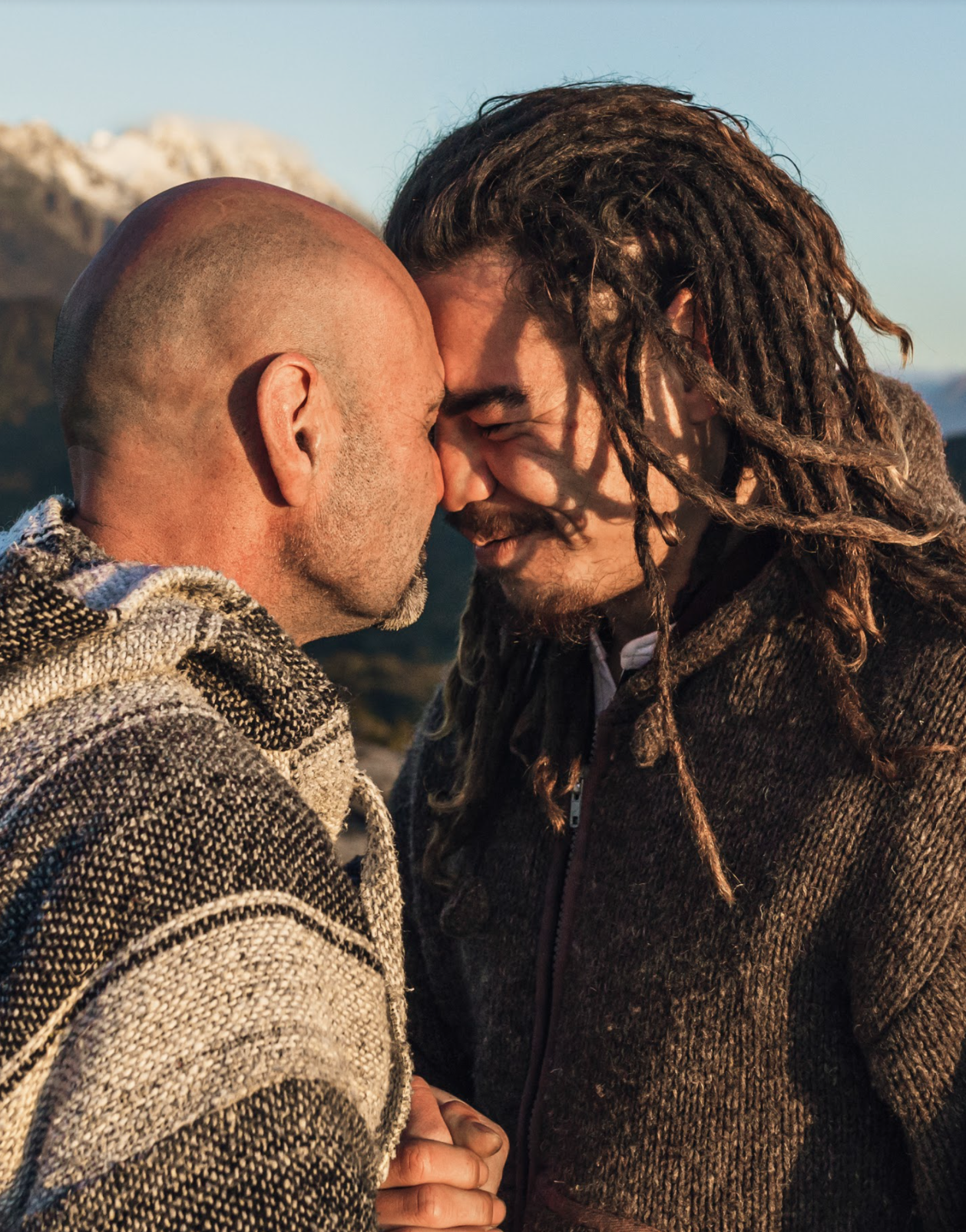
Mānuka honey is a bit of a golden child. Lauded for its antibacterial and antiviral properties, it's a product of bees foraging on the mānuka plant: a flowering, evergreen shrub found growing prolifically across the East Cape. New Zealand Mānuka Group founder, Phil Caskey, kickstarted global demand for mānuka honey when he developed the world's first mānuka honey medical dressing in 2000 (still in use in many hospitals around the world today).
Breaking the cycle
In in 2011, after a break from the industry, a Māori landowner contacted Phil asking for help. Fairness and transparency was needed: landowners growing the plants were suffering. Phil set about establishing agreements between landowners, beekeepers and manufacturers, ensuring an open and fair return for all.
Phil returned fulltime to the industry with his business, the New Zealand Mānuka Group (NZMG). A business rooted in its belief in sustainability of the land as well as its people, the NZMG saw that the mānuka plant had so many other other uses other than just producing honey. They have built, from the ground up, an entire industry around mānuka, creating and returning wealth to local communities, and using the products to bring strength and vitality into our homes, gardens, and families.
What bees do
Bees pollinate the mānuka shrubs over their 20 to 30 year life cycle. During the short flowering season, honey is collected from the hives and processed for our consumption. Once the flowering season is over, the trees are trimmed allowing them to thrive better, and the brush collected is processed into highly potent mānuka oil ßeta triketones (MßTK).
The residual mānuka mulch from this oil processing activity is rich in nutrients and forms a dense fibre which retains an incredible amount of nutrients, making it ideal for gardens. And because it has been steam cooked, it is free from problematic weeds.
Along the coast
Alongside the innovative group's operations with the mānuka plant, they also harvest the abundant, tidal washed seaweed from the pristine waters along the East Cape's fertile coastline. The group is the biggest producer of pharmaceutical grade agar (a jelly-like substance found in seaweed), in the southern hemisphere. In-house scientists have recently identified wide ranging benefits in the green and brown seaweeds also collected by their harvesters. These seaweeds have been found to contain essential amino acids and trace minerals which significantly boost the health of bees as well as pastures, crops and our gardens.
With NZMG building the mānuka industry and other opportunities, Māori landowners and trusts are developing their land on the East Cape into high quality, well-resourced mānuka plantations. Those with already converted land are employing and training local people into wide ranging jobs from plantation workers and production staff, right up to qualified horticulturalists and managers.
The group's full range of products is huge: honey, oils, beauty products, seaweed, garden mulch, fertiliser and so much more: and all from our lush, verdant East Cape.
Going the full circle.
And behind all this product innovation is a commitment to the people of the East Cape and their land. A fair share of the value NZMG creates goes back to the landowners and beekeeping partners, and so to the local community, through job creation, upskilling and redistribution of wealth. Families are able to stay together, on the land of their ancestors, and land is harvested sustainably. Everyone benefits.

Making it home
Corporate sponsorship isn’t just money in exchange for logos. Do you know who supports your children’s hockey club? Of the surf club that keeps us safe in the waves, or the art exhibition you enjoyed with your family?
WORDS ANDY TAYLOR

Corporate sponsorship isn’t just money in exchange for logos. Do you know who supports your children’s hockey club? Of the surf club that keeps us safe in the waves, or the art exhibition you enjoyed with your family?
A recent, search for properties led me down a google rabbit hole, and I ended up on the EVES website looking at the long list of local groups they support. I was a bit taken aback. I suppose we only think a business has sponsored an event if we see their logo. But that's not the case.
Whilst they are excellent at marketing houses, the Realty Group (EVES and Bayleys Real Estate's umbrella company) don't spend much time talking about what they do in our community. I get in contact with Allison Stewart, the group's sponsorship and events manager, who gives me a bit of a history lesson. It becomes clear that investing in where we live is a fundamental to the group.
EVES and Bayleys are two of the most established and trusted names in residential and commercial property. EVES was founded here in the Bay of Plenty in 1968 by Max Eves and Brian Waldegrave. They joined forces in the eighties with Richard Cashmore, the Bayleys founder, and the two businesses started to operate as The Realty Group, whose structure still exists today.
A firm believer in giving back, Richard is the group's current chairman of the board. “Our business was founded on family values, and we are passionate about investing in our region." As good as his word, when he started Bayleys, he went about quietly helping surf clubs, sports teams, schools - just a whole lot of locals - turn great ideas and big dreams into reality. He made sure that it was integral to the DNA of the companies and something that all staff could be a part of. Some aspects of this philanthropy were public – like the highly popular Crippled Children’s Society fundraising dinner the company was involved in for around ten years – but most of it was very low key indeed, with staff from all levels of the companies getting involved in helping out.
The group's investment in our region is best illustrated by Allison. She's fostered great relationships with local community groups. “Our people are passionate about the places they live and work in, and we are really proud of their involvement in community projects, undertaken of their own volition. We want to contribute in a worthwhile way to the communities we operate in.
The help comes in many forms. “We have a pretty skilled group of people here,” Allison says, “with a broad range of contacts. Our business is about problem-solving and we like to use those skills in the community work we do too. It was a great source of pride for us that during the economic downturn, we were still able to fulfill all our commitments to those we had offered to help. We take our commitments seriously because these are our people and our communities.” So seriously in fact that for the last ten years they have made a conscious effort to focus on support for a wider range of groups. “We wanted to spread our efforts,” says Aidan Lett, group marketing manager, “and instead of concentrating on one or two larger groups, get involved with more people at a community level. “There is a genuine love of being able to help out in our two companies,” Allison says, “and we have seen that grow in recent years. It's a Kiwi thing I think, wanting to help out, pitching in and working together.” it’s also a very Kiwi thing that EVES and Bayleys have been pitching in for nearly half a century without making too much noise about it, but then, as CEO Simon Anderson says, "Ultimately our business is all about people. Whether that’s our team, our community or helping people find their dream home. We put people first."
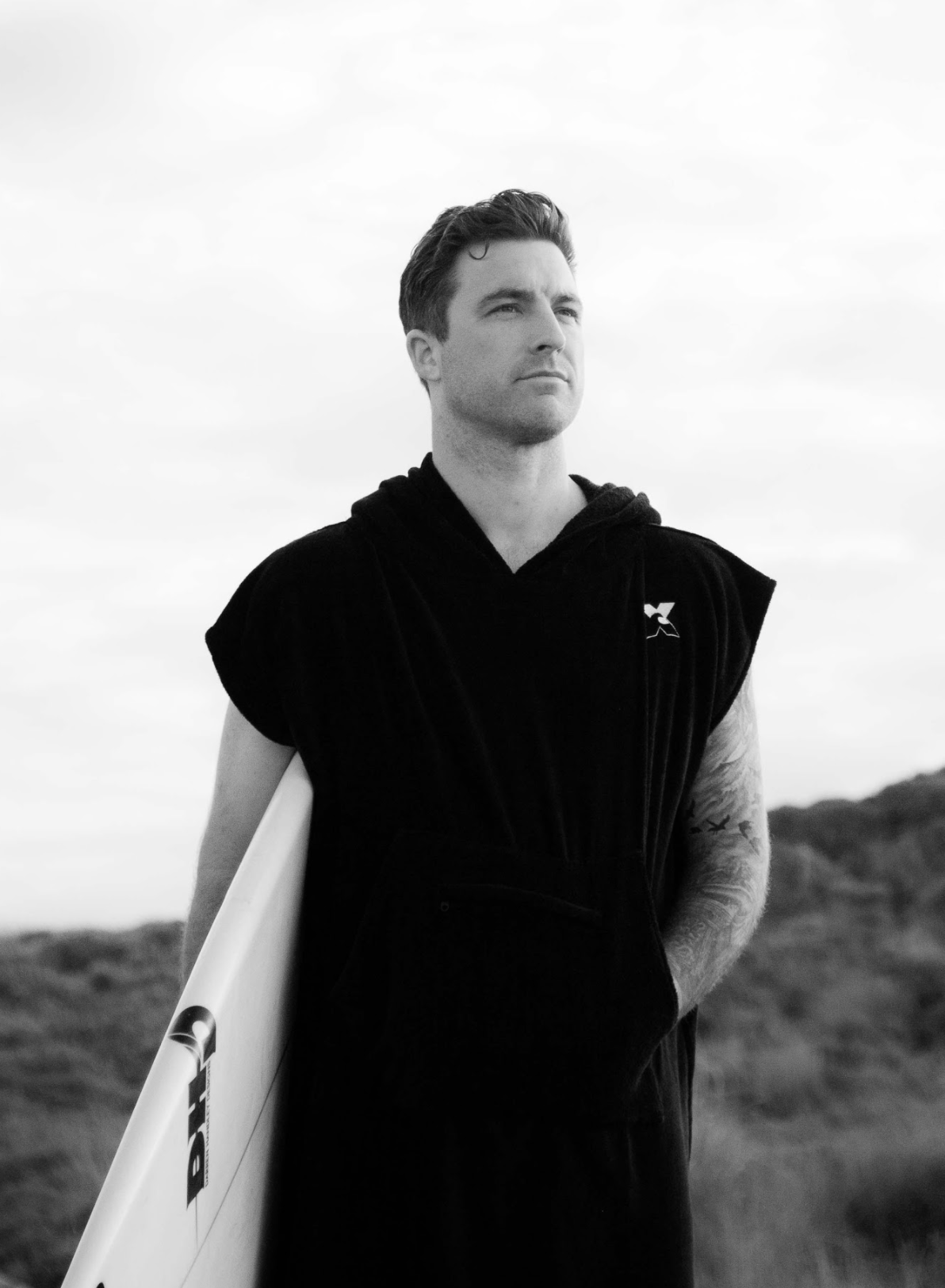
Giving back to the community beyond crisis: Todd Hilleard of Noxen
“I ran at her and tackled her onto the bed. She still had the gun in her hand but now it was pointed at me. I kept thinking, ‘Is this real?’”
“I ran at her and tackled her onto the bed. She still had the gun in her hand but now it was pointed at me. I kept thinking, ‘Is this real?’”

WORDS Ellen Brook


Todd Hilleard was passionate about being a police officer, but a routine callout turned armed confrontation was the first in a series of events that changed his state of mind. Todd had been talking to a woman who had allegedly assaulted her husband when suddenly she pulled out a pistol, held it to her head, and threatened to shoot herself.
“It was a horrible situation,” recalls Todd. “Everything was happening in slow motion and I felt awful to be pinning this woman down, trying to force the gun from her hands.It was my first time in a situation which came from nowhere and involved a firearm. I was completely unprepared for it.”
Later, Todd was rattled when a driver he’d stopped unexpectedly reached under the seat of his car. “I was worried he might be reaching for a gun, and it put me on edge,” says Todd.
After another event where a shotgun was thought to be in the vehicle of a father who had abducted his children, Todd realised he wasn’t coping. The Police transferred him from Tauranga to Christchurch, his hometown, hoping the fresh start would improve his mental health.
But the September 2010 earthquake made Todd even more anxious. “Afterwards, I was on edge.I didn’t feel comfortable in my own skin, especially going out on jobs in the middle of the night.”
During the second earthquake in February 2011, Todd was at work on the third floor of the Christchurch Central Police Station. “The alarms went on and on, and I expected the building to come down,” says Todd. “I was terrified.”
Todd didn’t have time to dwell on his fear; he was immediately sent to the CTV building which had collapsed like a concertina, killing 115 people and trapping many more. “Other cops were on top of the rubble, but I thought, ‘I can’t be here, I’m scared’," says Todd. He stayed at the scene for 12 hours. “It was chaos. I saw terrible things you hope to never see.”
There were also bright spots. Todd and his fiancée Tash were planning their wedding, and he was working on a rewarding project organising the recovery of vehicles trapped in Christchurch’s Red Zone. But the day after his stag party, Todd went to hospital with heart palpitations. He then had an allergic reaction to the drug he was given and went into anaphylactic shock. His heart needed electrical cardioversion to restart its normal rhythm.electrical cardioversion, a high-energy shock sent to the heart to restart its normal rhythm. Todd was devastated.
“I couldn’t believe this was happening to me at 30 years old,” says Todd. “I was beside myself at the thought of my heart stopping.”
Todd married Tash in April 2011. Although the wedding was a happy occasion, Todd hit rock bottom soon afterward. “I was driving to the movies when I started to have chest pains,” says Todd. “I went to the hospital, but my heart wasn’t the problem. I was having a panic attack.”
After the birth of their baby boy, Tate, Todd woke up one morning in 2011 and knew he couldn’t go back to work. “It was time for me to stop fighting.I felt quite euphoric about that.”
He went on sick leave from the Police, and then leave without pay. Soon after, Tash, then 24 weeks pregnant with their daughter Lexi was made redundant and the young family moved back to Tauranga. Todd found solace in the local surfing scene, but he’d lost his identity as a police officer. “I’d be out and see police cars with my old mates in them. It took a long time to accept what had happened,” says Todd. He finally resigned from his job in 2013.
Although he’d left the Police, Todd’s mental health was still poor. At his lowest point, he even considered suicide. “My twisted thoughts were my biggest battle. They put me in a very dark place and I worried I was going crazy,” says Todd. “I finally got help through my doctor, went to therapy and realised that talking openly and rawly and letting myself be vulnerable really helped.”
Todd returned to the workforce in sales at Coca-Cola and then Goodman Fielder, and stayed involved in the surfing scene. His love of the sport led him to the next chapter of his career. Taking part in the 2018 Police Association Surfing Champs in Raglan, Todd noticed that at 1.8 metres and 90kg, the XL-sized hooded towelling poncho Todd received as a souvenir of the event was too small for him. He began researching similar products and looking at samples. When he found what he wanted, he set up Noxen (noxen.co.nz), an online surf and lifestyle clothing business.
For Todd, what started as a solution to one problem has become a way for him to give back to the community. The brand’s tagline “Ride Every Wave” reminds Todd to ride out life’s ups and downs. A percentage of each sale goes to Lifeline, the mental health and suicide prevention hotline, and a further percentage of sales revenue is donated to other charitable causes.
Todd continues to be open about his mental health, both on the Noxen website and at speaking engagements. He acknowledges that his experiences changed his ability to manage things the way he used to. “I’ll never be fully back,” says Todd. “I’ll always have anxiety and depression, but I can manage it, and now I have an opportunity to pay it forward.”
WHERE TO GET HELP
Sometimes it helps to know someone is listening and that you don’t have to face your problems alone.
0800 LIFELINE
Youthline 0800376633
Free text 234, email talk@youthline.co.nz or online chat.

Bayleys CEO Heath Young looks to the future
In the Bayleys family of 570, there are 120 people who've worked there for more than a decade. “Our people are our biggest strength,” says Heath Young - newly appointed CEO of Bayleys.
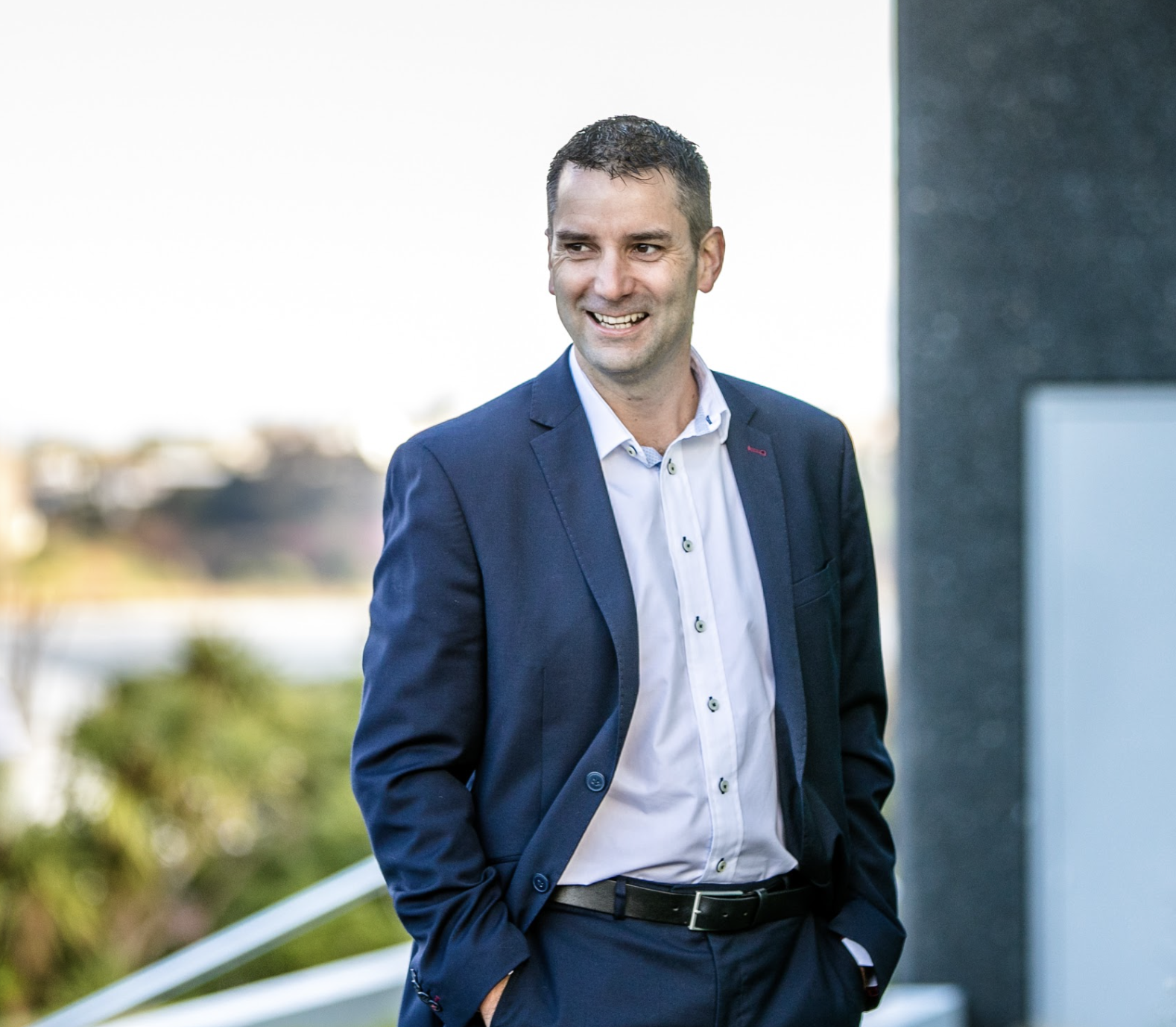
“We are constantly looking to refine what already works really well, to deliver better-than-expected results for everyone we work with.”
Heath Young the new CEO at Bayleys takes his group into the future with the family values they were founded on.
Words Daniel Dunkley Photos Salina Galvan
In the Bayleys family of 570, there are 120 people who've worked there for more than a decade. “Our people are our biggest strength,” says Heath Young - newly appointed CEO of Bayleys. “Selling over 100 homes a month, or 25 a week requires a massive effort, slick operations, and sharp marketing. Of the top 20 salespeople in New Zealand, Bayleys has six of them here in Tauranga. We’re 40 percent owned by the managers and salespeople, and we’re a family.”
As well as state-of-the-art systems and structure to run a group this size, Heath says everything is underpinned by the family values the group was based on when they started out.
The real estate industry is fast-paced, there's lots of information available to everyone. Bayleys is able to use their immense experience and skill to analyse that information and use it to benefit their customers.
"We are constantly looking to refine what already works really well, to deliver better-than-expected results for everyone we work with," says Heath.
Everyone used their time over lockdown differently. “While the nation was in lockdown, people still wanted to buy, which was great,” says Heath. “We were able to try new things, like hold online auctions conducted by our expert auctioneers.” As Bayleys adjusted to the new way of doing things, the company introduced 3D online viewing technology, letting buyers take a virtual stroll through a home and then take part in the auction without setting foot in the property.
“This was a huge boost for sellers, and it was great to introduce new ideas quickly and see immediate positive results. We’ve also improved the way we use data,” says Heath. “We want to build the best business possible for the customers we represent. That’s why we do it.”
Heath, who has led Bayleys since February last year, wants the real estate business to go from strength to strength in the new COVID-19 world. He believes everyone needs specialist help more than ever to navigate the new normal.
Bayleys has been a big presence here for 15 years, and sells 1,200 homes, commercial buildings, and rural properties each year across the mid-North Island. Heaps of know-how and the vast resources of the Bayleys machine have kept the firm at the cutting edge of modern real estate.
For Heath, the Bay of Plenty and his home patch of Mount Maunganui will always hold a massive appeal for buyers. “We’ve pretty much returned to normal,” Heath says. “The market is resilient, and people will continue to flock to the Bay of Plenty from New Zealand and eventually from overseas, when restrictions lift.”
Tokoroa-born Heath moved to Tauranga five years ago to become Bayleys’ chief operating officer, and has worked his way to the top of the business. He was no stranger to the Mount before joining; he spent three years here in the 1990s working for blue-chip firm KPMG.
When you believe in the lifestyle you sell, working in the high-octane real estate game doesn’t feel like hard work. Heath, whose wife Jane runs Mount Yoga, lives life to the full here, too.
“Golf has given way to jet ski fishing in recent years. Nothing beats blasting out through the harbour entrance and spending a couple of hours picking up a few snapper and completely switching off.”
Bayleys also covers Taranaki and Waikato, and Heath is confident about its future across the middle of the North Island. While COVID-19 will be a challenge for some time, he believes the local market is strong. “We’re seeing some real momentum, this is one of the best parts of the country to be in."
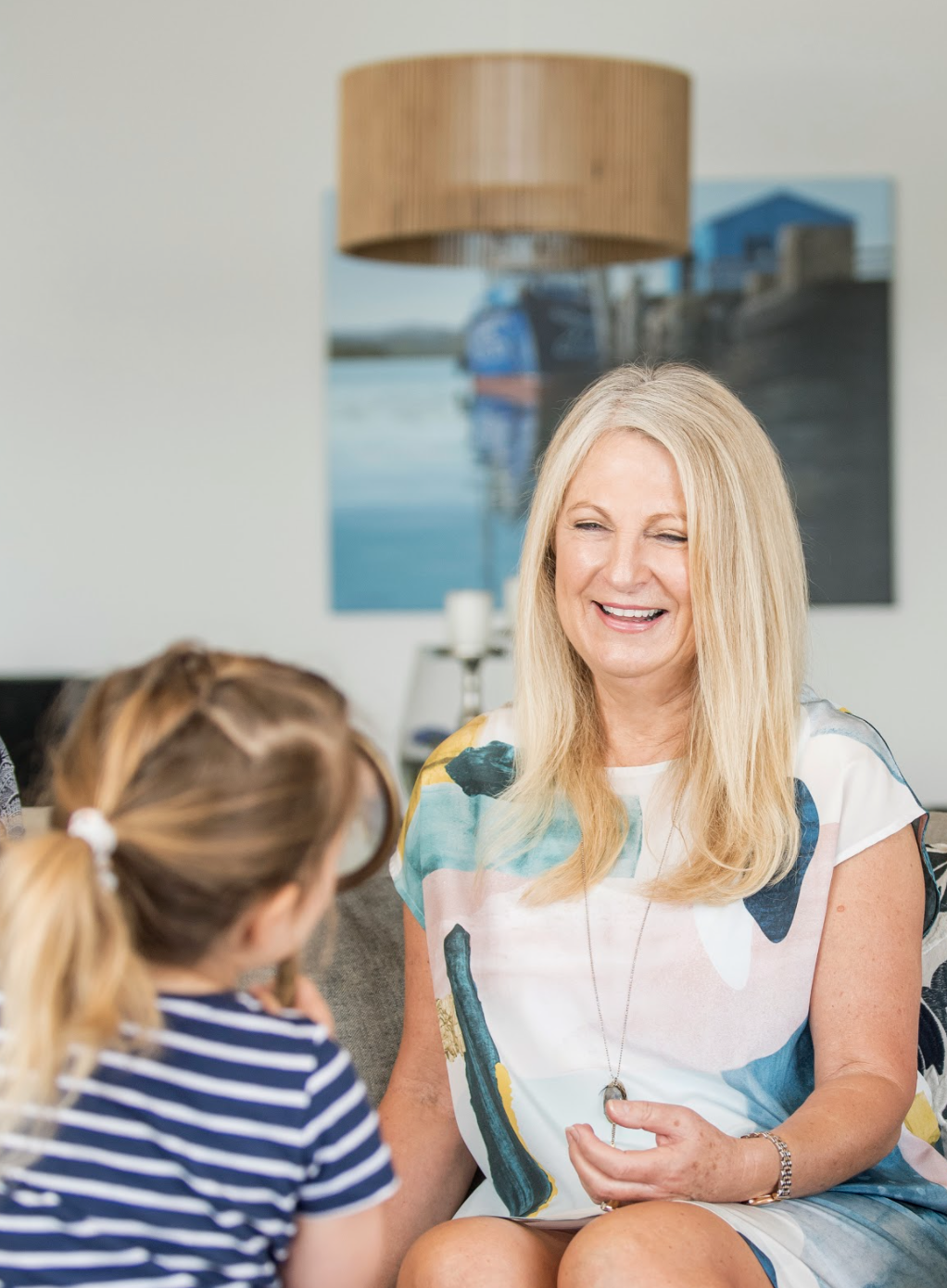
Family with a love for property
Monique Balvert-O’Connor finds out how Kay Ganley combines a record-smashing career in real estate with time for her family – in particular, her beloved granddaughter, Georgia.
Monique Balvert-O’Connor finds out how Kay Ganley combines a record-smashing career in real estate with time for her family – in particular, her beloved granddaughter, Georgia.

WORDS MONIQUE BALVERT-O’CONNOR / PHOTOS BRYDIE THOMPSON
It must be a great day when you realise that the best people to employ in your growing business, are your family.
FOR THE PAST FIVE YEARS, KAY HAS BEEN THE BAYLEYS MOUNT AND PAPAMOA OFFICE TOP SALESPERSON. She doesn’t simply rank highly on the local stage; in the last financial year she was fourth nationwide in Bayleys’ residential sales, and eleventh over all offices covering residential, country, and commercial property sales. She has been in the top five percent nationwide for a few years now. Three years ago, Kay took on a full-time PA and, this year, family members have joined the winning force.
KAY’S ELDEST DAUGHTER, JANELLE GANLEY, WHO HAS WORKED IN THE BAYLEYS OFFICE FOR THE PAST FIVE YEARS, JOINED HER MOTHER’S TEAM ONLY A MONTH AGO. She lists and works with vendors and buyers. Conrad Doyle – the partner of Kay’s second daughter, Chloe – also became part of the team this year, as a buyers’ agent. Chloe, meanwhile, has established a five-star property management company, and that includes house cleaning services for Kay’s clients. Son, Mitchell, though is far removed from the property world. He’s studying towards a PhD in biotechnology.
A TRIP TO SINGAPORE AND THE MALDIVES IN JUNE THIS YEAR, BUENOS AIRES THE PREVIOUS YEAR, AND HAWAII BEFORE THAT, ARE ALL PART AND PARCEL OF THE KAY GANLEY SUCCESS STORY. Bayleys takes their top nationwide high achievers on overseas trips annually, and Kay has got used to packing her bags mid year.
HER WORKING LIFE IS UNDERSTANDABLY BUSY. But as the team has grown, work-life balance has improved. Time for her grandchild, walks around Mauao, and pilates, are now on the radar. “Having a team of four means we provide the ultimate service for our clients, and I get to see my children and granddaughter so much more.”
“A CLIENT TOLD ME RECENTLY THAT I WOULD BE LEAVING A LEGACY. That compliment was hugely humbling. But one day, when I retire, they can carry on that legacy, if that’s what it is,” Kay says.
KAY BEGAN HER REAL ESTATE JOURNEY AS A 42-YEAR-OLD, following years owning men’s fashion stores.
“I OWNED MY OWN BUSINESS FROM THE AGE OF 21. When it was time for a change, I knew I wanted to remain my own boss, have flexibility, and feed my love of people. I hit on the real estate idea.” It was a good fit. She sold her first property two weeks into the job.
AFTER EIGHT YEARS WORKING WITH OTHER COMPANIES, SHE JOINED THE BAYLEYS MOUNT OFFICE IN 2006. Kay deals in high-end properties, from baches to mansions, mainly beach, waterfront, and bordering the golf course at Mt Maunganui, and Papamoa. She’s a record-holder. Her first beachfront sale was over $1 million in the late 1990s – one of the first to sell at that price, and she was responsible for the first $1 million sale bordering The Mount golf course. She also holds the luxury home market record at the office for a $6.6 million Marine Parade sale in 2015.
AS FOR HER RAZOR-SHARP, WINNING EDGE, testimonials are rich in adjectives such as warm, trustworthy, knowledgeable, empathetic, and professional.
“SOME PEOPLE PERCEIVE REAL ESTATE TO BE A SIMPLE BUSINESS, BUT IT’S NOT IF YOU DON’T HAVE DETERMINATION AND COMMITMENT. I HAVE THAT, PLUS I HAVE ALWAYS BEEN DRIVEN TO BE SUCCESSFUL.”
WITH THAT DRIVE HAS COME COMPROMISE – SHE’S MISSED FAMILY GATHERINGS AND OTHER FUNCTIONS. Before having a full-time PA on board, paperwork would keep her up until midnight. Then there’s the on-call component, and weekends dedicated to taking clients to houses, and staging open homes. It’s fortunate, she says, that her husband, Mike Gallagher, understands her working world – he manages a real estate office. But, with the team now in place, a more balanced life is forecast. And, as Kay says, all the highs in the job are people- related. Now she gets to enjoy the job while surrounded by family and the clients who’ve become like family over the years.
AS FOR HER PERSONAL SLICE OF REAL ESTATE? Kay and Mike live in a downtown Mount apartment and own a holiday home in Ohope. She plans to be at the latter, with her feet up, for Christmas.

A family business
We talk to Yolande King about what it’s like working with her husband Paddy, and sister-in-law Tara as a super team at EVES Real Estate. These guys really love where they live, and it shows!
We talk to Yolande King about what it’s like working with her husband Paddy, and sister-in-law Tara as a super team at EVES Real Estate. These guys really love where they live, and it shows!

WORDS JENNY RUDD PHOTOS BRYDIE THOMPSON
HOW DID YOU ALL COME TO BE WORKING TOGETHER?
Paddy and I were passing through on a holiday, trying to work out where to settle. We sat on the beach and Paddy said, “Look at this place, Yols. We have to give it a go.” Our immediate connection to The Mount was amazing. So we started separate careers, Paddy in chemistry and me in real estate. The first years were incredibly busy so Paddy joined me. Boom! It worked beautifully! Then Tara moved from Christchurch and we hammered her to join us. She gave in to stop us nagging, I think.
WHAT SKILLS DO EACH OF YOU BRING TO THE BUSINESS?
Working with Paddy and Tara is the easiest thing in the world! We wrote very specific job descriptions for each person. I think that’s a big part of our success. I’m a highly organised ‘lists’ person and keep the big picture perspective, working on our business development and keeping our team connected. Tara never misses a detail. She should wear a superhero cape. The workload on the admin side is just massive. If Paddy is heading out to an appointment, he doesn’t have to double check any paperwork that Tara has put together. Anyone who knows Paddy is familiar with his relaxed manner, and in this industry I think that goes a long way. You can trust that he’s going to look after you as a buyer or vendor. He hates getting stuck in the office, so Tara and I keep him out there doing what he loves – hanging out and connecting with people. There’s 100% trust between all of us. We’re now on the hunt for the next team member to help us look after our buyers.
Early morning coffee at Tay Street.
HOW HAS THE REAL ESTATE BUSINESS CHANGED OVER THE YEARS?
Since I started in 2006, so much has changed. Continuous training is a must if you want to keep your licence and stay up to date with all the Real Estate Agents Authority legislation. It’s good to see so many more people in the business treating the job with the necessary importance and urgency. It’s not a hobby, it’s a career, and we are helping people through a huge transaction that needs all of our attention. The digital side of advertising is huge now and a job in itself. I look after that for us and it’s a constant learning curve. Keep up or get left behind!
We strongly believe that when it comes to choosing your agent these days, a team isn’t a plus, it’s a must. Nothing falls through the cracks, you’re kept 100% informed and involved. And with us, you get energy, creativity and commitment.
HOW DO YOU FIT IN FAMILY TIME WITH SUCH A BUSY JOB?
It’s something we guard preciously. During the week, we have breakfast and dinner together as a family and don’t book anything that will interfere with that. So we start and end the day with the kids. Of course, Sundays are super busy with open home, so we try to build that family time in elsewhere, like taking the children out surfing or going to the night markets in Papamoa or The Mount. Just reading stories in the hammock with the kids slows things down pretty quickly, too!
WHAT’S IT LIKE BEING SO CONNECTED TO THE COMMUNITY WITH YOUR JOB?
We make connections everywhere we go, from kindy drop-offs to Paddy being out on the water waiting for the next wave. It’s part of everyday life, the nature of the business and it’s great; we feel we’re able to help and bring value. This job is about people and their homes, which involves their families. We feel really privileged to take people through this process and de-stress it as much as possible, all the way through.
WHAT’S BEEN YOUR BIGGEST LEARNING CURVE?
When working in a team you have got to stay connected. The left hand needs to know what the right hand is doing. Rules, the law, the digital space: everything’s constantly changing. We like it. Keeps us on our toes!
WHAT DO YOU DO IN YOUR DOWNTIME?
We just love living here! We’re surrounded by lots of friends, so impromptu catch-ups are easy. We’re lucky to have so many outdoor options for families right on our doorstep, and go out on the bikes, head to a beach or park. Our mums are great gardeners. I’m far from a expert, but we’re trying to grow more and the kids just love it. Exercise is at 6 am so I can be sure it actually happens, and if it’s with a friend then that’s great! I’ve always got a book on the go, too. Then, of course, there’s finishing our renovation. When we bought our home it was a little two bedroom 1955 original, and today it’s a much-loved four bedroom family home. We’ve learnt so much and enjoyed the process immensely, but the very important finishing touches are keeping us busy. There’s always the next detail to plan and execute.
We feel a great responsibility to help keep our coast beautiful, as well. There are so many alarming environmental issues, and we want to start here at home and make a difference. We want our children to enjoy this beauty.

Rotorua Mayor Steve Chadwick on making things happen
For Rotorua Mayor Steve Chadwick, local government is just the latest chapter in a life built around making things happen.

For Rotorua Mayor Steve Chadwick, local government is just the latest chapter in a life built around making things happen.
WORDS Andy Taylor PHOTOS Brydie Thompson
First off, what’s in a name? Given her public profile and her extensive career in politics, it's hard to imagine that anyone meets the Mayor of Rotorua without being previously aware of her; but someone new to these shores might find Steve Chadwick to be not quite what they were expecting. Let’s face it, Steve is a pretty blokey kind of name, and though she is down to earth, humble and devoid of all pretention, blokey is something Steve Chadwick most certainly ain’t.
“It’s actually Stephanie, but Steve stuck from a very early age, and after that I was only ever Stephanie when I was in trouble,” she says with the tone of someone who has had to explain this a million times but is quite happily resigned to her fate. “And yes, there are a few people who come expecting a male and look a bit shocked, and I’m sorry if that disappoints - but there’s not much I can do about it,” she adds with a grin of genuine mischief, and it is clear that confounding expectations and then outperforming them are part and parcel of the ball of energy that is The Honourable Stephanie (Steve) Chadwick.
Originally from Hastings, she is probably best known for her time in Parliament, where she served as Minister of Conservation, Women's Affairs, and Associate Health between 1999 and 2011, and then as the Mayor of Rotorua, a role she has held since 2013. But her story is far more multi-layered than that.

“I grew up the youngest of six children,” she says, “and so constantly had to speak louder to have my opinion heard.” Those siblings included artist Dick Frizzell among other very talented individuals, so this was a family heaving with strong characters and stronger views.
Her first calling in life was as a midwife. “I was always bit of a health activist, and I was drawn to birthing as it was a natural process and I was involved with a group of quite radical midwives. I ended up helping bring about 5,000 babies into this world, and I loved that role, I loved being a part of birthing as it is a profound and intimate profession, and I still meet some of the babies I delivered now. Though many are on to the next generation!”
Whether it is newborns, government policy or social welfare organisations, it could be said that bringing things to life is very much Steve Chadwick’s reason for being on the planet. She has been instrumental in setting up the Rotorua Women’s Refuge, Rotorua’s first Family Planning Clinic and School for Young Parents, as well as its first Kohanga Reo, all entities that seem completely normal and entirely essential now but were reactionary in the 1970s. “My father was an engineer and my mother was an artist,” she says, “so there was both a very creative side to my growing up and a very functional side, a side about making things happen. But both my parents were always about thinking outside of the square – differently, but logically, because that was the artist and the engineer at work. Our family were a square peg in a round hole, and we realised we weren’t conservative, but that was just fine. It was a very creative and happy upbringing that meant I was allowed to reach my own conclusions and was never constrained.” Good luck to anyone who might try!
She met her husband, John Te Manihera Chadwick, in the late sixties, and together they embarked on a future that is virtually cinematic. First there was the big OE, with the first stop being Papua New Guinea – where she set up a birthing clinic, naturally – and then they went on to London where their home – replete with newborns of their own by that stage – became something of a drop-in centre for Kiwi expats on their London sojourns. It was a happy home for many years, until while watching the Commonwealth Games their son asked who the people performing a haka on TV were. “When I had to explain that they were Māori and that he was Māori and that his dad was Māori, we realised it was time to come home! Our children needed to grow up bicultural – and that was what brought us to Rotorua. Our journey ever since then has one of biculturalism.”
After serving as a local councillor, national government beckoned with all the highs and lows that a career in the public gaze entails. “The low was definitely the death threats I got when I brought in the Smoke Free Environment Act. Having to be escorted by a police protection squad and realising that there were people out there that hated you and were unwell – and were following you – was very scary. And being accused of being one of Helen Clark’s ‘Femi-Nazis’ was also very personal, and frankly ridiculous. But the highs put all that in the shadow: passing the Smoke Free Act was great, and working on health issues throughout the Pacific was fantastic – that was right up my ally as an ex-midwife.”
The passing of husband John, who had become a much-loved and prominent lawyer, late in 2017 brought the year to a solemn close, but Steve has no intention of letting her personal loss get in the way of her public commitment. Far from it; instead, 2018 will be a very big year for the Mayor and for Rotorua – because it is obvious from spending even a short time with her that Steve Chadwick and the Rotorua district are very much intertwined.

“One of our main objectives was to revitalise our inner city,” she says, clearly warming to the future and tired of discussing her past. “And we did that by having a councillor sit on a portfolio dedicated to inner city revitalization and by getting all our retailers and CBD businesses to work with us. The inner city had over a hundred empty shops four years ago, but we’ve changed that and it has a completely different vibe now, and the development that will be taking place on the lakefront is really going to be exciting and build on what we've put in place. The whole footprint will be completely different, there will be a conservation zone and it will incorporate the museum, but we are thinking it will be driven by a whole new entity rather than council. Sir Bob Harvey has agreed to help us with this so that is really exciting.”
“We were painted as a zombie town in 2013, but 2018 is going to show that we have invested in our city and we are really going places. The population is growing, we’re performing above the national average economically, and we also have the new Forest Service coming here – to its rightful heartland – so this is going to be a big year for Rotorua. Actually I think it’s going to be a big year for all New Zealand.”
You heard it here first folks. And she should know.