

Cult cinema club
For many, winter is a time to hunker down, but those dark evenings are a great opportunity to get out and fill your brain with a bit of culture
WORDS TALIA WALDEGRAVE PHOTOS SALINA GALVAN
For many, winter is a time to hunker down, but those dark evenings are a great opportunity to get out and fill your brain with a bit of culture.

Each time I visit the Historic Village, exciting things are happening, and in this chapter on Tauranga’s sweet slice of history, I explore the evening offerings available over the cooler months.
The Village Cinema plays host to Tauranga’s newest club for film buffs: Cult Cinema, run by event organisers Kimberley Cleland and Melanie Mills. The girls met while working on ‘Night Owl Cinema’ - the New Zealand interpretation of the All American Drive Thru.
MM. “Most of our events slow down after summer, so we wanted to offer an alternative over autumn and winter. That’s where the idea for Cult came from.”
KC. “Once we had a project, we needed a venue. Mel asked if I’d seen the cinema in the Historic Village and it was so coincidental, because I’d actually just held an event there.”
The first time I saw the Village Cinema, I was told it was destined for greatness, but I wasn’t so sure. Pre-refurbishment, the interior was all shades purple and looking a little worse for wear. On my recent return, I was blown away. The Art Deco makeover has injected it with life and I felt I’d stepped into the glamorously attractive bygone era of the 1920's.
MM. “I happened to be working on a different project, when I spotted the cinema. I’d literally walked past a million times and never noticed it! It was completely under utilised.”
For Cult Cinema, the girls have created a complete cinematic experience, including an outdoor area to enjoy drinks and movie snacks before each showing.
KC. "It was a deliberate choice to provide people with an alfresco dining experience. During the day, you hardly notice the trees, but at night they light up, and the cobbled streets have you feeling as if you're in a little European alleyway.”
MM. "We've got a heater and a little restaurant bar, that was actually handmade for us by our coffee supplier and we often invites a food trucks to come along. We serve as much locally as we can - you can have a hot chocolate and a cookie, or wrap your mittened fingers around a lovely glass of beer, wine or cider."
MM. “We both come from hospitality backgrounds and just love having that interaction with our guests from behind the bar.”
As for the films, it’s all about the classics.
MM. “The reaction we get is the best part. It evokes so many emotions from people and it’s lovely to see them come back and say how wonderful it was.”
KC. “When we played Easy Rider, my father in law told me how revolutionary that movie was for his time. He was so excited about seeing it and that kind of input is always encouraging.”
ALSO ON…
The Detour Theatre is a one-stop shop for all things theatrical. From drama classes to performing, or simply getting involved behind the scenes, it’s a place where the magic happens.
If you find the family suffering from cabin fever and need to escape the four walls of home, a walk through the gardens and surrounding bush, a pit stop at the café, get involved in an art class or a shop for gifts and souvenirs – there’s plenty to do. Check out the Historic Village website for all the need to know.
For long time locals, the Historic Village spurs certain nostalgia, one that some are scared they’ve lost, but it is absolutely worth rediscovering what goes on there today.

To a year well done
Happy first birthday, Eagle Ridge! We talk to owners Nigel and Deb, and manager, Briana, about their first year up in the Ohauiti Hills.
INTERVIEW JENNY RUDD

Happy first birthday, Eagle Ridge! We talk to owners Nigel and Deb, and manager, Briana, about their first year up in the Ohauiti Hills
UNO: So, what's been the highlight?
B: Well I don't know about Nigel and Deb, but mine was undoubtedly getting married. Apart from the fact it was the most special of days, personally, it has been so helpful in my job, as I now know exactly what it's like for our brides and grooms. It gives them real confidence to know I've walked that path.
D: Seeing Briana get married was an absolute highlight for us too. She works incredibly hard, and is a perfectionist with everyone else's weddings, so we knew hers would go off without a hitch.
UNO: That view! It must be hard getting everyone to turn away and walk inside.
N: It's pretty mesmerising, isn't it? Actually, you can see when a helicopter takes off from Tauranga Airport to bring people here, and follow them all the way here.
B: As Nigel's a pilot, he always encourages the helicopters to come in very close, which can be a bit scary!
N: We had a great wedding recently where the groom arrived in a helicopter in great drama. The guests had been picked up in a bus from Wharf St 'mystery bus tour' style. They had no idea where they were going. They stood here and watched the helicopter come from afar, and the groom got out to James Bond music from the band. It was all very glamorous, then we could hear the sound of an ice cream van get closer and closer, and the bride arrived in a Mr Whippy van! Everyone ate ice cream while the bride and groom exchanged their vows.
UNO: Do you ever find anything odd in the lodge after you've had guests stay?
N: Only every week! Actually, I very nearly found something very interesting at one wedding over the autumn; all the guests were up at the function centre, and I was pottering about in the kitchen here in the lodge. There were two guests who hadn't quite made it up to join the rest of the party. He was playing the piano and his friend was singing beautifully next to him. Clearly the emotion of the music got the better of them, because as I walked past the downstairs guest bedroom, I saw they were just about to make use of the beautifully made up bed in there. I gave them a quick jolly up and told them to hoof off and join the others. Deb had just spent the morning making up that bed. I wasn't in any hurry to find clean sheets and remake it!
UNO: Sounds like you get some pretty lively parties up here.
B: We have a full range, to be honest. We've had some seriously wild weddings, giggly and boozy, with the entire party having flown straight in from overseas having never seen the venue. I have a great job - all my customers are people having the time of their lives! It probably doesn't help when Nigel gets behind the bar. We've had to throw him out as he's such a generous host, he keeps refilling glasses quicker than people can drink them.
UNO: We like the beautiful picture in your advert is this issue, what was that event?
D: That was such a special evening, and very popular too. Trelise Cooper came down to support a fundraiser for Homes of Hope (see the pics in Spotted on page 20). As soon as she arrived with her team and saw our beautiful lodge, even though they'd booked a hotel in town she asked if they could stay the night. We were already pretty full, but how can you say no to such a lovely lady who's here to support such a great cause?
N: At the end of the evening, the whole team collapsed, exhausted after their efforts. They were starving and it was pretty late so we ordered pizza. The delivery boy wouldn't come up to us, so I sped down the hill and delivered the pizzas myself to these lovely ladies. They thought it was hilarious.
UNO: It's like a whole world of excitement going on up here, in the hills.
B: It is! It's such a magical place to come to work to every day. There's so much going on here all the time, you'd never guess from the driveway in sleepy Ohauiti. This morning we are preparing lunch for Jaguar. They bring guests up who get to drive their sleek, powerful new cars round all the windy roads up here, have a delicious lunch, then drive back home. Then this afternoon, I'll be making sure our grounds look perfect as we are producing 360⁰ videos for our website. It's impossible to get that wondrous, ever-changing view into one image!

The Incubator
“In 2013, a few of us artists wanted studios, get out of our homes, and be in a space with other artists, and possibly exhibit our work. There was nowhere really in Tauranga for artists and musicians to be together.”

WORDS TALIA WALDEGRAVE PHOTOS TRACIE HEASMAN
After writing about The Men’s Shed in the summer UNO, I convinced my editor to let me go back to The Historic Village, as there’s just so much going on. Last time I came, my interest was piqued by the big red barn of The Incubator.
Simone Anderson gives me a guided tour and explains the role of The Incubator in Tauranga.
“In 2013, a few of us artists wanted studios, get out of our homes, and be in a space with other artists, and possibly exhibit our work. There was nowhere really in Tauranga for artists and musicians to be together.
“We found this brilliant space at The Historic Village, and started looking around at filling the gaps culturally by offering adult art classes, putting on exhibitions and events.
When The Incubator opened in 2013, Simone and the team decided to have an exhibition. “We wanted it to be amazing, and for everyone to feel part of it, even if we thought we might not sell anything! The audience became the art too. We called it The Midnight Circus, and everyone came in costume. We had trapezists, fire eaters, all sorts! We wanted people to really feel enriched by it, that what we had done was worthwhile.”
“The speed with which The Incubator has grown has been completely unforeseen. The growth has been reactionary to the hunger. There was no common denominator for art in our city, just lots of fracture. The Incubator is a platform where that creativity can take place.
“We run lots of projects, supported by a collective made up of our resident artists, and a wider group of creative people who support our philosophy who volunteer a wide range of skills; graphic designers, writers, craftspeople, and theyall collaborate on our projects.”
A Grim Tale
To explain the kinds of projects they undertake, Simone hands me a copy of A Grim Tale. This beautiful book was a collaboration with The Women’s Refuge, putting together survivors of physical abuse, writers and artists. Putting such beauty behind such a taboo subject is such an innovative way to tell a story and just highlights how creatively The Incubator team likes to think.
Other collaborations around the city have The Incubator stamped all over them and one in particular is the colourful pianos we featured in the Peter Williams issue last year. “We were asked to paint one piano, we said we’d do three and we ended up doing eleven.”
A new exhibition space has just gone in and as Simone explains, it’s for emerging artists looking to showcase their work. “It is incredibly difficult to get your work into a gallery, so we wanted to provide something that catered for that.”
Behind the exhibition space are the studios of the resident artists. Wandering between them is like being in an underground cave and each one is completely unique; paintbrushes, tools and inspirational musings are crammed in like organised clutter.
The Artery
Simone leads me into the Artery, the recently acquired building next door that they use for art classes.
“When the government axed night classes in schools, people no longer had anywhere to go. We saw a huge gap to fill that creative space. These are bite sized, achievable classes, often run by our resident artists and the connect people in a social way as well as a creative way. It takes them out of isolation. Most people walk away with connections, having made new friends.”
The classes range from one day to six weeks, and cover printing, painting, ceramics and more. Classes are always changing and information is kept up to date on The Incubator website.
Time to Visit
“The Village comes alive every second Sunday and we wheel out our stage and local musicians perform. It astounds me that aside from the bar and pub scene, there’s nowhere for musicians to meet, so this is another way for us to provide that opportunity.”
Once again I walk away feeling inspired and it’s wonderful to see this space that Simone’s team have created for artists to collaborate.
“It’s not just about the Incubator as a place, it’s what we want to achieve. We want everybody to up the value of arts within the community. Art is not about retail or income, it’s about a way of life.”

Truckin’ good eats
Got the drive to enjoy some delicious food truck flavours? Check out our convoy of options.
Got the drive to enjoy some delicious food-truck flavours? Check out our convoy of options.
Best cheap & cheerful
Kenny Johns Foodtruck
Our pick: Pork sliders
After selling his waterfront café Deckchair, local chef Ken Greenhill found a 1969 fire truck on Trade Me, lovingly restored it and turned it into a food truck from which he now serves fresh, affordable cuisine and award-winning Hawthorne coffee in Tauranga and at the Mount. He also caters for festivals, corporate functions, weddings and other private events – all with his own special brand of charisma and soul.
On the menu: Innovative street food – ribs, wraps, tacos, poke bowls, gourmet burgers and sliders, pies, fries and more from around $4–15.
Best Japanese
Ichiban
Our pick: Donburi
Head to 2 Newton Street, Mt Maunganui and you’ll find Ichiban purveying street food with a Japanese twist. Owner/chef Karen Onishi is a food engineer by trade and passionate about great food. Ichiban arose from her love of tasty and authentic Japanese street food, and she brings to her customers the best of Japanese home cooking, using family recipes, authentic flavours and the freshest ingredients to deliver the best food experience from a cool vintage caravan.
On the menu: Poke bowls, donburi, sides and drinks.
Best kaimoana

OY Premium Oysters
Our pick: Fresh oysters
Brigitte and Lew Davies have taken their decades of combined experience in the fishing and seafood industry and turned it into a business that’s really going places – usually to the Mount, Papamoa, Matua or beside the Wairoa River, depending on the day. They absolutely love meeting fellow oyster-lovers and introducing newbies to the oyster world.
On the menu: Oysters fresh off the ice – on their own, with lemon, with balsamic vinegar, with cheese… From time to time, they introduce rare and seasonal specialties as well, such as whitebait fritters and king prawns.

Best superfood
Soul Boul
Our pick: Smoothie bowls
Soul Boul co-founders Alexandra Bell and Stacey Horton have been friends since university, bonding over being active, healthy, happy humans with a shared love of good food and coffee. With backgrounds in hospitality, after graduating, they decided to open New Zealand’s first smoothie bowl food truck together. Firm believers that we are what we eat, they’ve been serving nutritious, organic and yummy wholefoods every summer for four years now and have just landed their very first permanent spot at 58 Ashley Place, Papamoa.
On the menu: Plant-based smoothie bowls and organic coffee.
Best sushi
Sushi Pandas
Our pick: Cali rolls
Sushi chef Fernando Pinilla just wants to make people happy – and if you’ve ever visited her at her cart, Sushi Panda, you’ll know she’s quite the entertainer! A sushi chef for 18 years and originally from Chile, she arrived in Aotearoa 10 years ago. Today, her three-year-old food truck is well-loved in Tauranga, at the Mount and in Rotorua; catch her at 13 Bain Street, Mt Maunganui, the main Mount Beach, the Bay’s biggest summer festivals and our local markets too.
On the menu: Chilean fusion sushi.
Best Kiwi classics
The Wave
Our pick: Real fruit ice cream
Situated on Marine Parade in front of Leisure Island, The Wave and its owner-operators Elliot and Grace Sims provide the popular treats Kiwis can’t get enough of. Serving food that makes people smile in the most beautiful location, they’ve created a friendly and welcoming family environment that also celebrates great music and good manners. Elliot’s even been known to give away ice-creams to well-behaved children!
On the menu: Real fruit and Tip Top scoop ice-cream, Longest Drink in Town milkshakes, Vogel’s toasties, fresh fruit smoothies, juices and locally roasted Little Drum coffee.

Go to town
It’s not all ancient history at Tauranga’s Historic Village. In fact, there’s a world of contemporary pleasures to get amongst.

It’s not all ancient history at Tauranga’s Historic Village. In fact, there’s a world of contemporary pleasures to get amongst.
WORDS Kate Underwood PHOTOS Salina Galvan
At the foot of 17th Avenue West is a village where makers, bakers, creatives and community organisations come together to offer a unique heritage destination amid original and replica early-Tauranga buildings. The grounds are open seven days a week and entry is free, so gather the crew for a nostalgic excursion to explore and meet the locals. Here are a few you could encounter…
The Whipped Baker
Fuel a wander of the old-timey streets at The Whipped Baker, where you’ll be greeted with a feast for the eyes as well as your stomach, with an array of treats including generous cream donuts, steak and cheese pies, raw salads and ‘freaking good’ shakes. Initially a humble bakery stall founded by Fran and Aaron Cooper at the Tauranga Farmers’ Market in 2006, by 2016 The Whipped Baker had a permanent corner site in the heart of the Historic Village, complete with plenty of local Little Drum coffee to perk up visitors and neighbours. They also have a catering service that offers antipasto platters and birthday cakes for all your party needs.
THEWHIPPEDBAKER
White Silk Bridal Couture
At White Silk Bridal Couture, you’ll find a timeless collection of elegant silk and lace-laden wedding gowns. Each piece is hand-crafted here by lead designer Nicky Hayward, who prides herself on creating a seamless and enjoyable experience for all her brides. Everything is made to measure and of the highest quality befitting of such a significant day. Whether you’re a bride or not, it’s worth popping into this whimsical sanctuary to lust over the Swarovski jewels.
WHITESILKBRIDAL.COM
Imprint Gallery
Imprint Gallery celebrates original, diverse and affordable prints from local and national artists. Co-owner Jackie Knotts is a printmaker who specialises in linocut relief printing, while painter Stella Clark has her studio base at the gallery and works with fine-art prints called giclée created on high-quality cotton rag paper. Both are deeply passionate about the intricate nature of printmaking and love chatting to visitors about the techniques involved.
IMPRINTGALLERY.ART
The Makers
If you’ve enjoyed Tauranga’s Oktoberfest, Gincredible or Night Owl Cinema, you have The Makers to thank. Amy Kemeys and Becks Clarke are the dynamic and resourceful duo behind the multi-faceted project and event company, based at the Historic Village. With 25 years of experience, they believe in the power of gathering together and can turn any idea into an engaging occasion, whether a private theatre screening, a corporate party or a boutique culinary celebration.
WEARETHEMAKERS.CO.NZ
Leadlight Expressions
Lynn and Steve Sinclair are the masterminds at Leadlight Expressions, purveyors of beautiful fused leadlight and stained-glass creations. Part of the village since 2003, they design, manufacture and repair everything leadlight, from commissions for private homes to restorations for churches, including Tauranga’s Holy Trinity. No design is repeated, the couple working with each of their clients to transform simple sketches into stained or textured-glass form. As well as selling made-to-order jewellery and more, they host monthly workshops at which you can craft an exquisite piece of your own.
LEADLIGHTEXPRESS.CO.NZ
HISTORICVILLAGE.CO.NZ
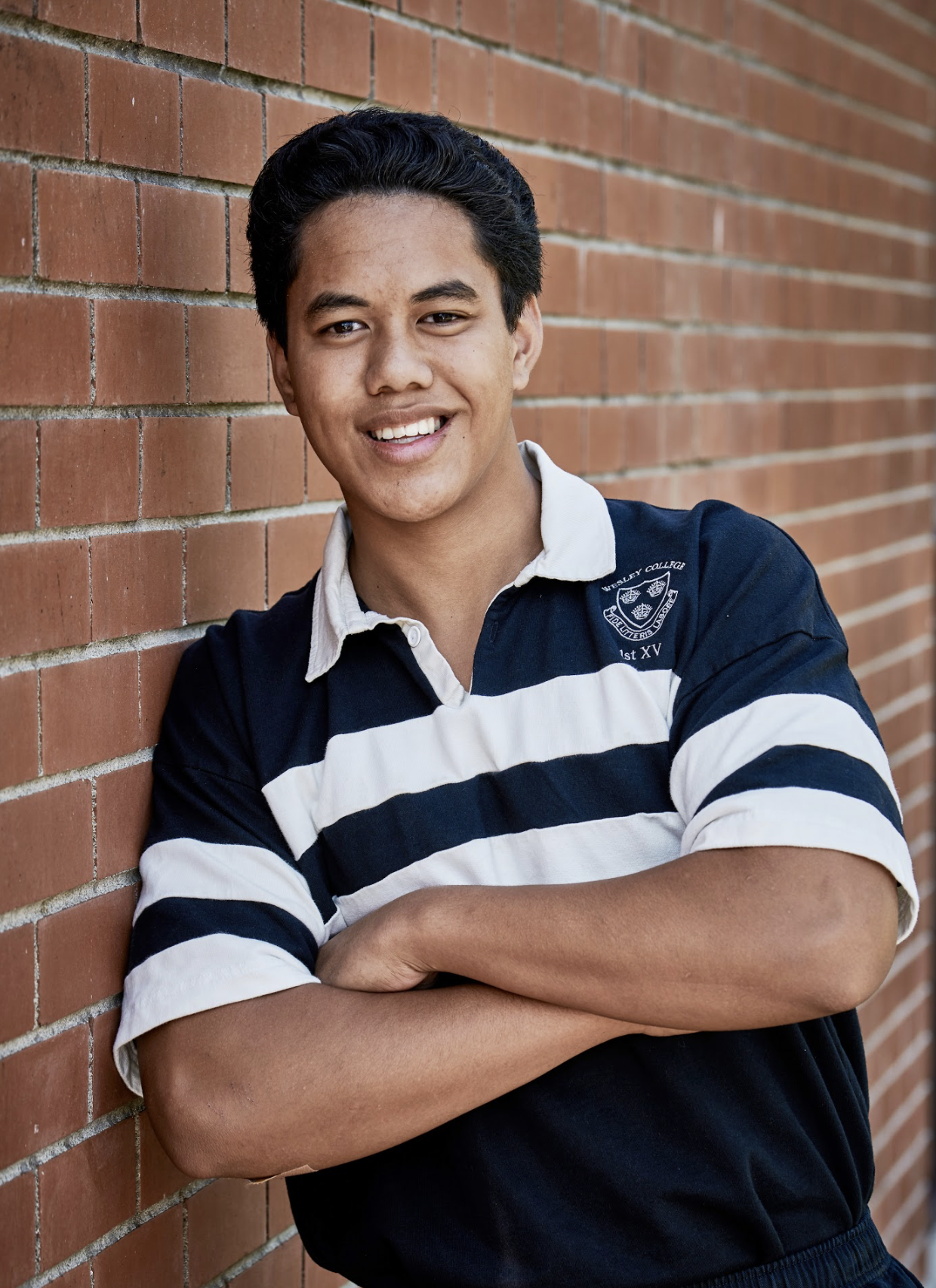
Tauranga’s Dominic Tupou makes his on-screen debut as a young Jonah Lomu
At a family reunion, Dominic Tupou sat down with Jonah Lomu’s mum Hepi and found out just how much he and his distant relation were alike. “I did some character study with his mum and family,” Dominic says. “I learnt a lot about Jonah. In Tongan we call it fie tangata lahi. It means ‘wanna be old’. Because Jonah was surrounded by older cousins and uncles, he wanted to be like them. That was just like me.”

WORDS Casey Vassallo PHOTOS supplied
At a family reunion, Dominic Tupou sat down with Jonah Lomu’s mum Hepi and found out just how much he and his distant relation were alike. “I did some character study with his mum and family,” Dominic says. “I learnt a lot about Jonah. In Tongan we call it fie tangata lahi. It means ‘wanna be old’. Because Jonah was surrounded by older cousins and uncles, he wanted to be like them. As soon as I told my family that that was just like me.”
It was December 2018 that the now 16-year-old headed to Auckland to audition for the role of young Jonah Lomu for a television mini series. “I didn’t think I did too well. We did the scene where I was crying after I got a hiding from my dad,” he says. “I thought I over acted.”
But he nailed it and began filming mid-March in Otara, Auckland. So committed to the role, he even had his newly fitted braces removed to film after finding out he’d got the part.
Dominic says he got a lot out of working with Director Danny Mulheron and the on-set Tongan adviser Nua Finau. “I learnt that acting on stage and acting on camera are two completely different things,” he says. “Acting on stage is more dramatized. You have to make everything big: sing louder, act bigger, all your emotions have to be over-exaggerated.”
“On camera, they’re right there, so you can’t act as much,” Dominic says. “I found it a challenge, especially because all my online stuff is still really exaggerated so everyone understands the character I’m playing.”
In early January 2018, Dominic started posting videos inspired by real-life experiences on Instagram (@holyboy.domtupou). “I started making little skits, funny videos, because I was watching @samoansefaa – he’s a big online creator in the Pacific community,” he says. “I think my first big, big one was How To Be Sexy.”
Today, he’s racked up over 76,000 followers. His following suddenly grew when American-born Polynesian singer Dinah Jane joined one of Dominic’s live streams. His reaction to the former member of the girl-group, Fifth Harmony was funny enough for her to post it to her 3.9 million followers.
“There was a phase where Mum and the rest of my family were like, ‘nah, that’s a waste of time,’” he admits of his insta-fame. “But now they’re all supportive because they’ve seen how much of an influence I am to the younger kids; a lot of them really look up to me.”
And it’s true. Dominic is often asked to visit several schools and chat about everything from role models to identity. He’s also been an MC, on panel discussions, a dance tutor and guest performer at a list of events around the region.
Born in Auckland, Dominic moved to Tauranga when he was and is now in grade 11 at Tauranga Boys’ College. He’s part-Tongan, part-Cook Islander, part-New Zealand Māori and lives with his number one supporter, mum Malia Soifua Tupou Pearson, along with his stepdad and four younger siblings, Marcus (13), Sammie (10) and twins Malia and Evelingi (11).
Dominic won his first talent quest in year three covering One Voice by Billy Gilman, and proceeded to take it out in years five and six. “I’ve been singing ever since I was in kindie,” he says. “I’ve always been interested in the arts. From singing and winning the contest, I started taking piano lessons, learning the ukulele, and then I moved onto musical theatre.”
First off, he landed a lead role in the Selwyn Ridge Primary production of Made in New Zealand in 2014 at age 10. Dominic played Professor Ludwig Von Drake (the German duck) from Mickey Mouse and sung The Spectrum Song. “It was a fun character to play. Ever since primary school, I've been the class clown,” Dominic says.
Then it was on to bigger things, playing Aladdin in 2015 and by Lord Farquaad in Shrek in 2017, both for the Tauranga Musical Theatre. “It was a step up from just your normal school play,” Dominic says. “With proper costumes, makeup and lighting.”
Red carpets aren’t the long-term dream for Dominic. Instead, he looks to what Samoan filmmakers and siblings Stallone and Dinah Vaiaoga-loasa are doing in the industry behind Take Home Pay, Three Wise Cousins and Hibiscus & Ruthless. “Watching and listening to them has inspired me to be where they are,” says Dominic. “Making movies, telling our people’s story through the screen and being able to share it with everyone.”
Dominic is currently in the midst of more auditions, with another role inevitably around the corner. “If that doesn't go to plan, I’ll study psychology and become a detective,” says Domimic. “I like the idea of being in the police force without a uniform.”

Know the craft
The Barrel Room is a knowledge hub of craft beer, fine wine and spirits matched with fantastic food.
WORDS MONIQUE BALVERT-O’CONNOR / PHOTOS KENRICK RHYS

Locals and holidaymakers looking for a notable dining experience need go no further than Tauranga’s The Barrel Room.
Home to craft beer, whisky, fine wine, tasty food and live music, The Barrel Room on Tauranga’s Wharf Street has been wowing people since it opened its doors two years ago. Driven by a passion for finely crafted things, owners Carolyn and Stewart Gebbie came to Tauranga to offer the city something new.
The locals are immensely grateful and appreciate that Carolyn and Stewart have excellent drink, food, service and atmosphere on tap. For this couple, the business is a marriage made in heaven. Carolyn loves wine, while Stewart loves beer – and he certainly knows about it; he co-owns Wellington craft brewery Te Aro Brewing Co, and loves how The Barrel Room is a celebration of great beer.
The selection is great, with 16 independent taps, which means the Gebbies can serve what they believe are New Zealand’s best beers. They have four taps dedicated to local brewers, and use the Untappd app to let customers know which beers and ciders they have on tap at any time. It’s little wonder The Barrel Room is a hit among lovers of craft beer.
The same high level of attention is given to wine. Carolyn explains the Coravin Wine System is in use at The Barrel Room. This allows wine to be poured by the glass without the rest of the bottle spoiling. This wine preservation system is like a favourite appliance, she says.
“We currently offer 63 wines by the glass and more by the bottle. We regularly make changes to our list to provide interest and the opportunity to try new wines,” Carolyn proudly explains.
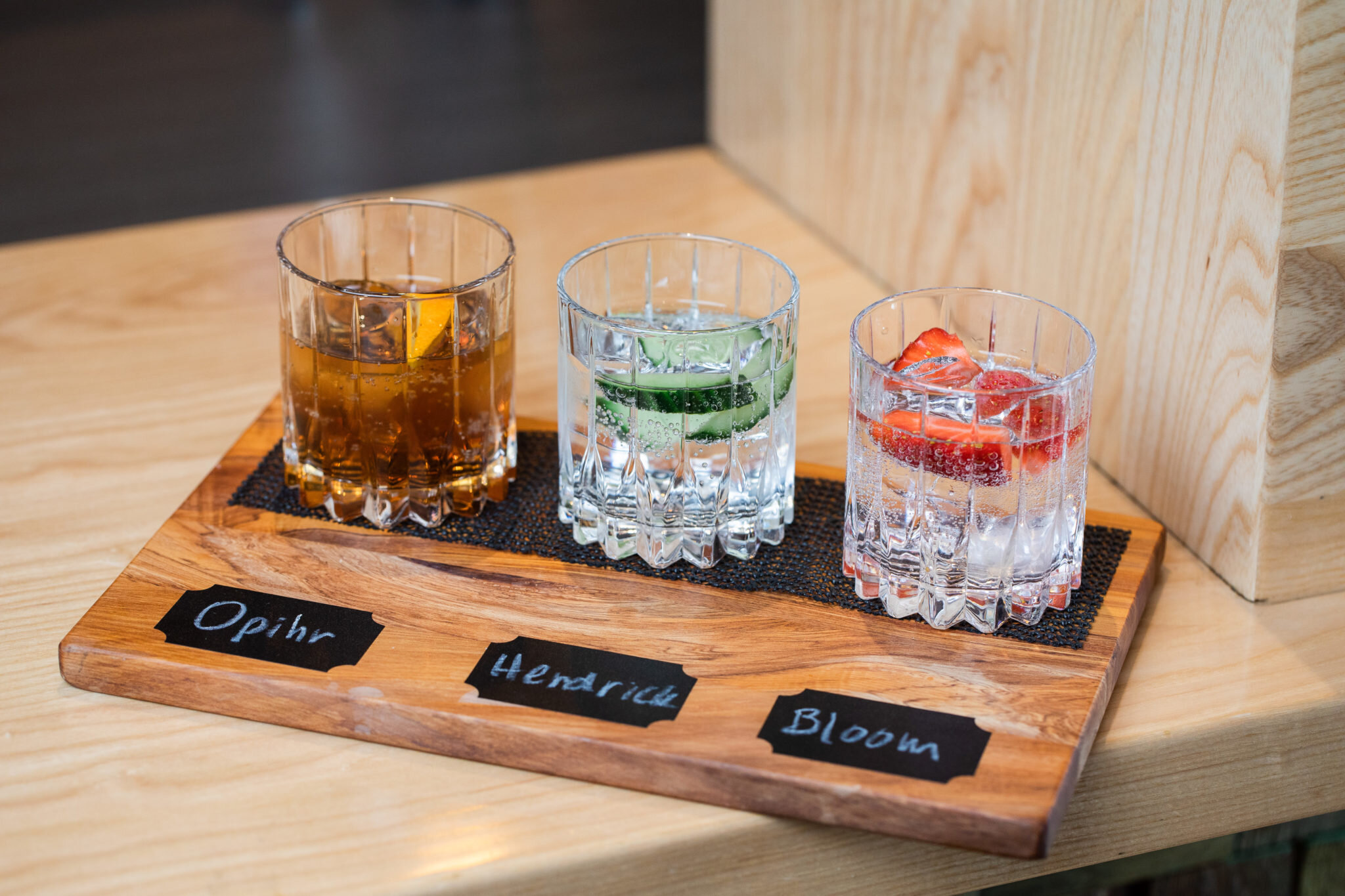
Unsure which wine, beer, whisky or gin (served in crystal, no less) to sample? The Barrel Room provides the perfect solution with its ‘tasting flights’.
“It’s a great discovery experience. For example, the wine tasting flight menu offers a responsible three half-pours. Come in, bring your friends, and ask for a tasting flight,” Carolyn says. Advice will be on-hand, she adds, without the need to listen to a winemaker talk for an hour!
The tasting flights – for wine, beer, or spirits – are proving an excellent idea for work functions (think Christmas), stag dos, hens’ nights, and just fun gatherings in general.
The Barrel Room is open until late, so it’s a great place to head to after late-night entertainment in town. Or come to The Barrel Room for entertainment – there’s live music on Saturdays and sometimes Fridays too.
Stewart and Carolyn say their aim is to do food and drinks well and to pair them well. The food options include: tacos, beef and blue burgers; Thai beef salad; various pizzas (with handmade bases); steak, fish and chips, and lighter offerings like calamari, and build-your-own platters.
“As requested by our regulars, we have introduced a dessert menu,” Carolyn says, adding that matcha panna cotta with yuzu and rosemary crumble is among the favourites.
The menu isn’t complete without excellent service and a great environment, Carolyn and Stewart say. All staff are trained to ensure the service they offer is first-rate. As for offering an atmospheric venue, The Barrel Room’s eye-catching décor includes barrels on the back wall, and the front of the bar features a patchwork of wine barrel staves – a feature created by Stewart.
It’s a cosy and inviting environment in winter, while, in summer, if the sun’s out, then The Barrel Room has a courtyard for drinks in the sunshine. In fact, that was a great attractor when the Gebbies were deciding where to set up their venture. Just perfect, they decided, and thousands agree.
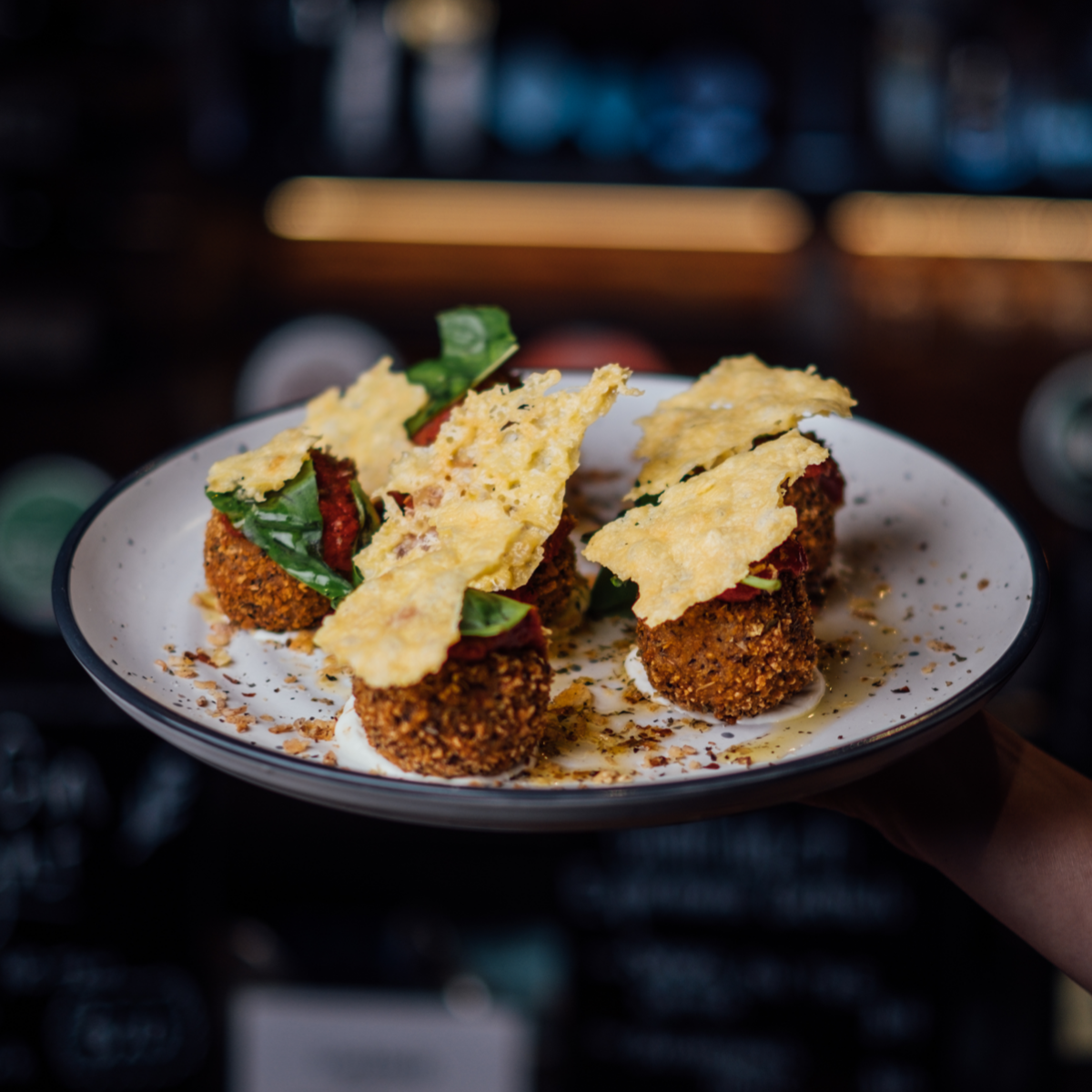

The Global Kitchen recipe: Roasted lamb rump with pea purée
Global Kitchen cookbook includes favourites from the restaurants’ head chefs hailing from Brazil, India and New Zealand, creatively merging South Pacific, Asian, South American and European cuisine.
London restaurateur Lloyd Rooney and Kiwi partner Mike Fraser are known for producing innovative seasonal menus and have earned a reputation locally and on the international culinary stage. Global Kitchen cookbook includes favourites from the restaurants’ head chefs hailing from Brazil, India and New Zealand, creatively merging South Pacific, Asian, South American and European cuisine.
PHOTO GRANT ROONEY

Lamb
6 x 200g lamb rump (cap on)
50ml canola oil
800g baby potatoes
2 Tbsp dukkah
Salt and pepper to taste
Pea puree
500g frozen peas
200g butter
Salad
200g frozen peas
2 long red chillies
1 small red onion
1 bunch of mint
1 bunch of parsley
50g feta cheese
100ml The Quay vinaigrette
Preheat an oven to 200°C. Rub lamb with salt, pepper and canola oil. Heat oil in heavy-based fry-pan over medium heat. Place lamb fat-side down and keep moving and pressing frequently for about 10-12 minutes. Once the fat is fully rendered, transfer rumps to an ovenproof dish to roast for 8-10 minutes. Remove from heat and rest for 10 minutes. Bring a pot of salted water to the boil, add the peas and boil for 3 minutes. Strain peas and combine with butter in a mixer. Blend until smooth and season well. Finely chop salad ingredients and toss in vinaigrette.
SERVES 4
For more recipes like this, check out Global Kitchen by Lindy Davis.

Mr G: capturing and connecting with whakapapa through art
"I respect the portraits that Goldie and Lindauer painted, but what I have that they didn't is direct hononga to the culture, so I feel that puts me in the best possible place to be Māori portrait artist of the future. My plan is to do more portraits of Māori, sourcing materials where they are from, and telling stories of hononga to their whakapapa and homeland."
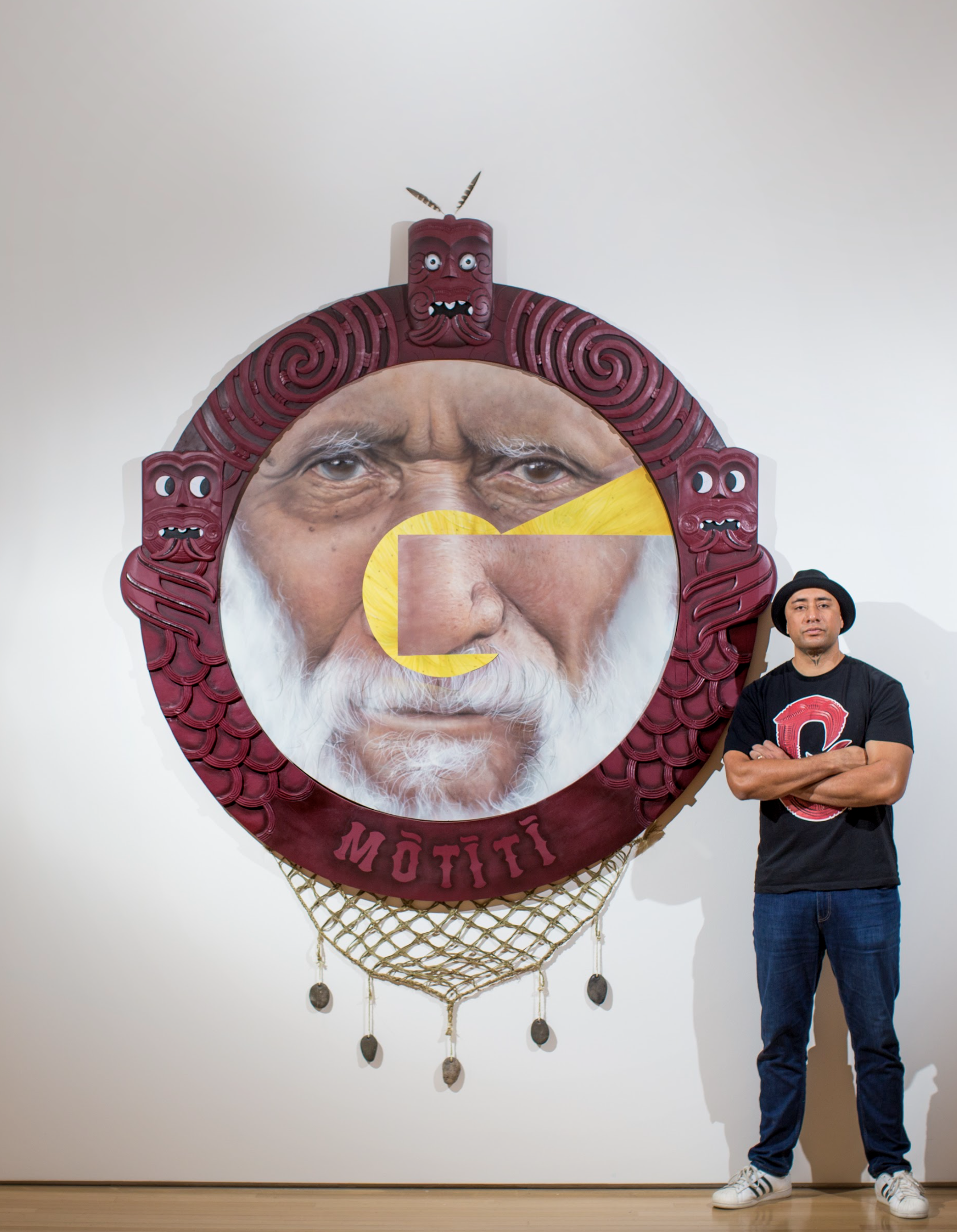
With his large-scale portraiture work proliferating around the globe, UNO discovers that it’s Graham Hoete’s deep connection to home that gives this artist’s pieces a depth that extends far beyond their physical size.
WORDS JENNY RUDD / PHOTOS QUINN O'CONNELL
"Let me talk you through this portrait of my dad," says Mr G, showing me a photo on his phone. I'm having dinner with UNO publisher Mat and artist Graham Hoete, “Mr G”, in Izakai at Bayfair in the Mount. There's quite a bit going on around us in the busy restaurant as they serve a five-course degustation but, at our table, all I can hear is Graham's euphonious voice as the future of Māori portraiture explains why hononga [connection] to the art he's creating has become his true north.
Graham is best known for his large-scale spray paint murals. I wonder how far afield his art can be found and discover a video online of him in an All Blacks shirt and a kilt, painting a mural of his ancestor, John Alfred Borrowdale Murray, onto a wall of the oldest building in the village of Moffat, Scotland, where John Alfred was born. "I wanted to pay tribute to my Scottish three-times great-grandfather on behalf of all the Murray whanau in Aotearoa who are descended from him," says Graham. If you keep looking online, you'll find more celebratory photos unveiling Mr G murals across the world, most of which are portraits.
His current artistic focus plays a film in my head, starting with Graham in front of huge crowds – like the one where he unveiled an eight-metre mural of Prince in Minnesota – running backwards to New Zealand, then Bay of Plenty, then finally to the tiny island of Mōtītī where he grew up and, before him, his father. Home.
Graham is putting together pieces for an exhibition called Home to be shown at Tauranga Art Gallery from November 9, 2019. Graham and photographer Quinn O'Connell flew to Mōtītī to take photos that show the importance of his hononga to home.
It's easy to underestimate the everyday things that are so precious to us. Quinn's photo of jars of preserved peaches sitting on a stove resonated with Graham. "To someone else, it's just fruit and glass but, in the context of my life, it's so much more. It's a symbol of home. I felt the deepest of hononga when I saw those peaches. And it won't last forever as, one day, my mum won't be here to make them, and someone else will be in this house, using this stove."
That takes us back to the portrait he's showing me on his phone. "I'm going to talk you through every aspect," he says. "You will see and feel something else when you understand the context."
"Portraiture isn't just about painting a face, it's about representing a person and all they are connected to."
Every element in the multidisciplinary portrait has some kind of hononga to Graham's father. Photorealism, spray-painting, whakairo [wood carving], sculpting, weaving, fabrication; each has its role in connecting Graham's dad to his past, his whakapapa [genealogy], whenua [land], and to the artist, his son.
"Portraiture isn't just about painting a face, it's about representing a person and all they are connected to." And in this, the first in the series, the artist is part of the story; the bloodline is the ultimate connection. The next day we meet in Graham's Papamoa studio, where I can see, touch and feel it all.
Capturing a father’s spirit
Graham's dad grew up on Mōtītī Island. The islanders grew maize and spent time in the ocean. "He's a hardy, gruff, old school kind of guy," says Graham. As the kaumātua at the marae, he introduces himself by saying,
Ka tangi te titi
Ka tangi te manu
Ko te manu ko te karoro
ko te karoro ko kere am e Hoete
"He's saying he's a black-backed seagull. The first time I heard him say these poetic and soulful words, I was blown away. It was true, too, as that's what we would have seen all the time while he was working in the fields or on the beach. And, when I see the birds from Papamoa where I live, I feel hononga to my Dad."
Painting the face
"I chose to spray-paint the face because it represents the hononga to my artistic journey. Using spray-paint to convey this level of detail isn't easy, and I really went steroids on the photorealism. It helped not having the time constraints that I usually have on a mural.
"Photorealism has an amazing ability to engage and attract people. It's universal. They always buzz out saying, 'Oh, it's so real, look at the lines on the face!' It draws everyone in, no matter their background. You then have their attention to look at the context of the image through the visual storytelling around the frame.
"It's not a traditional head-and-shoulders portrait. The face is pushed forward because I wanted to focus on his eyes, the most engaging component of a portrait. He's always had a great weathered, journeyed look which is well-suited to a portrait. I maximised every detail.
The yellow G
"In the centre of the portrait there's a yellow portion. That's a zoomed-in painting of the yellow pōhutukawa flower. These yellow trees were discovered on Mōtītī Island in 1814, and they are the symbol of the islanders who'll be reminded of home every time they see the bright flower. There are only two of the trees left on the island and one of them's outside my dad's house. The G symbol will continue throughout this portrait series."
The frame
The face has a beautiful aesthetic and spray-painting has a modern, edgy, street feel to it. That contemporary discipline has been fused with whakairo, the ancient art of Māori storytelling through wood carving. The frame tells the story of the central portrait. The wood is a blend of kauri and matai, and it's extremely heavy. It took three people to lift it onto the wall at the gallery for the photoshoot. The physical weight and density of the wood gives heft to its role in the portrait – to solidify and make tangible the histories and stories of Graham's father, his tribe, his home.
"I have always wanted to learn how to carve. I used to live with one of my uncles, he was a master carver in the traditional style. Its purpose is to tell each tribe who they are and show their cultural identity visually. The history of a tribe is told through carvings to future generations.
"About a year ago, I started to learn how to carve, and I'm lucky to be learning from one of the best Māori carvers in the world, Todd Couper. He's just a real Jedi when it comes to whakairo. I was walking up Papamoa Hills one day and he was walking down. He called out, ' Hey, Mr G!', and, from then on, we became friends. His work is exquisite. He's an exceptional perfectionist, and shows his work around the world. He lives in Papamoa, so we see each other most days.
The kupenga
Each marae has a theme which connects the local iwi, hapū and whanau to their ancestry and story. In Tamatea ki te Huatahi marae, which is the main marae on Mōtītī Island, the kupenga [fishing net] plays a central role in its interior storytelling. There are carvings on the pillars as you enter the marae and references throughout the buildings. The curved shapes on the bottom left and right of the frame echo the kupenga hanging below the fame.
“I feel very connected to my dad through his sea-venturing stories, especially through my own love of the moana."
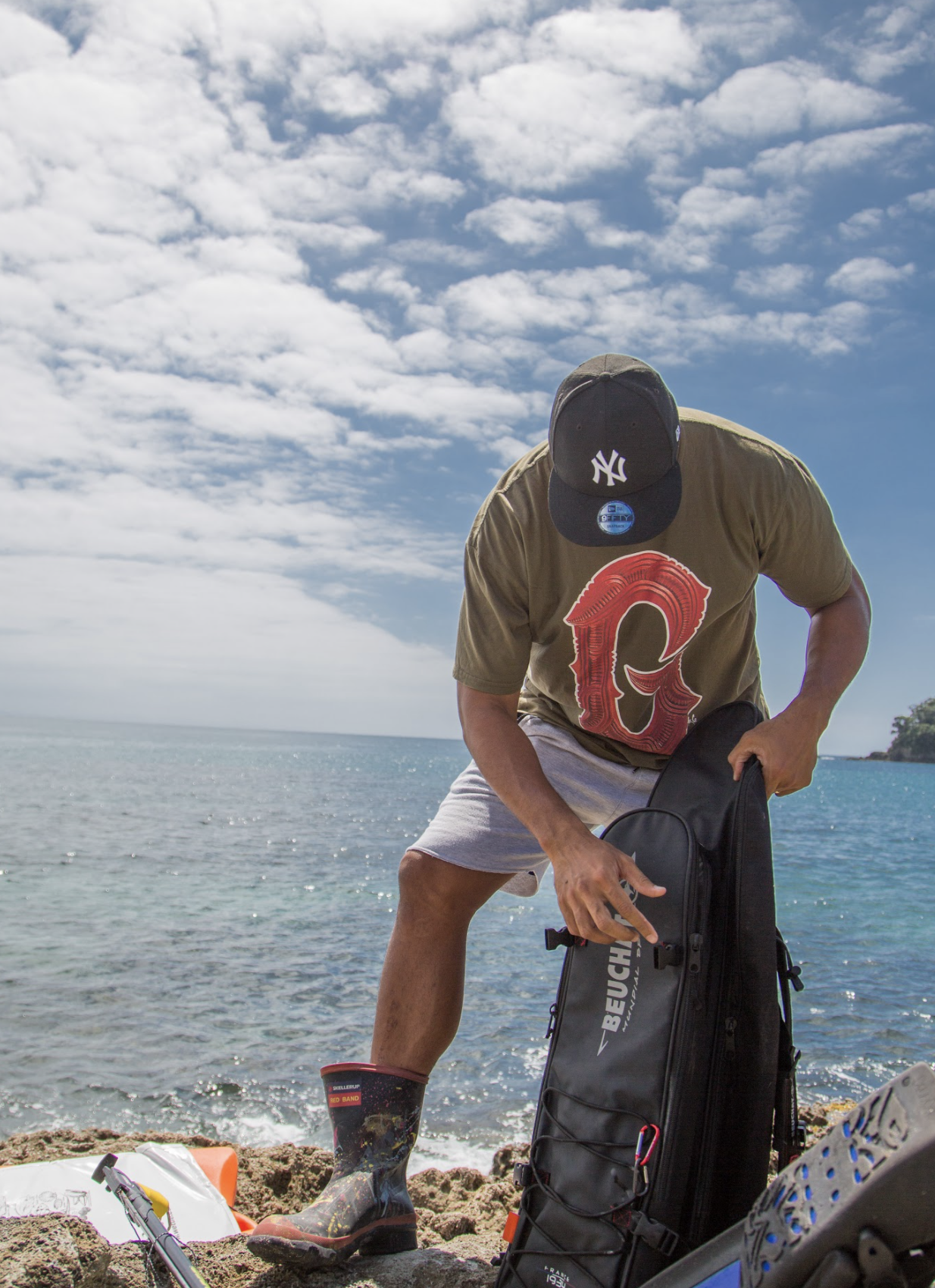
"It shows the connection to the moana [sea] and that lifestyle. My mum and a few of my aunties still go diving for kina and pāua. It's not often you see groups of ladies my mum's age going diving! They are legends.
"There's strong hononga with this element of the portrait. The kupenga has been woven by my sister. She went and collected harakeke [flax] from Mōtītī, and the sinker stones are from Tumu Bay on the island too.
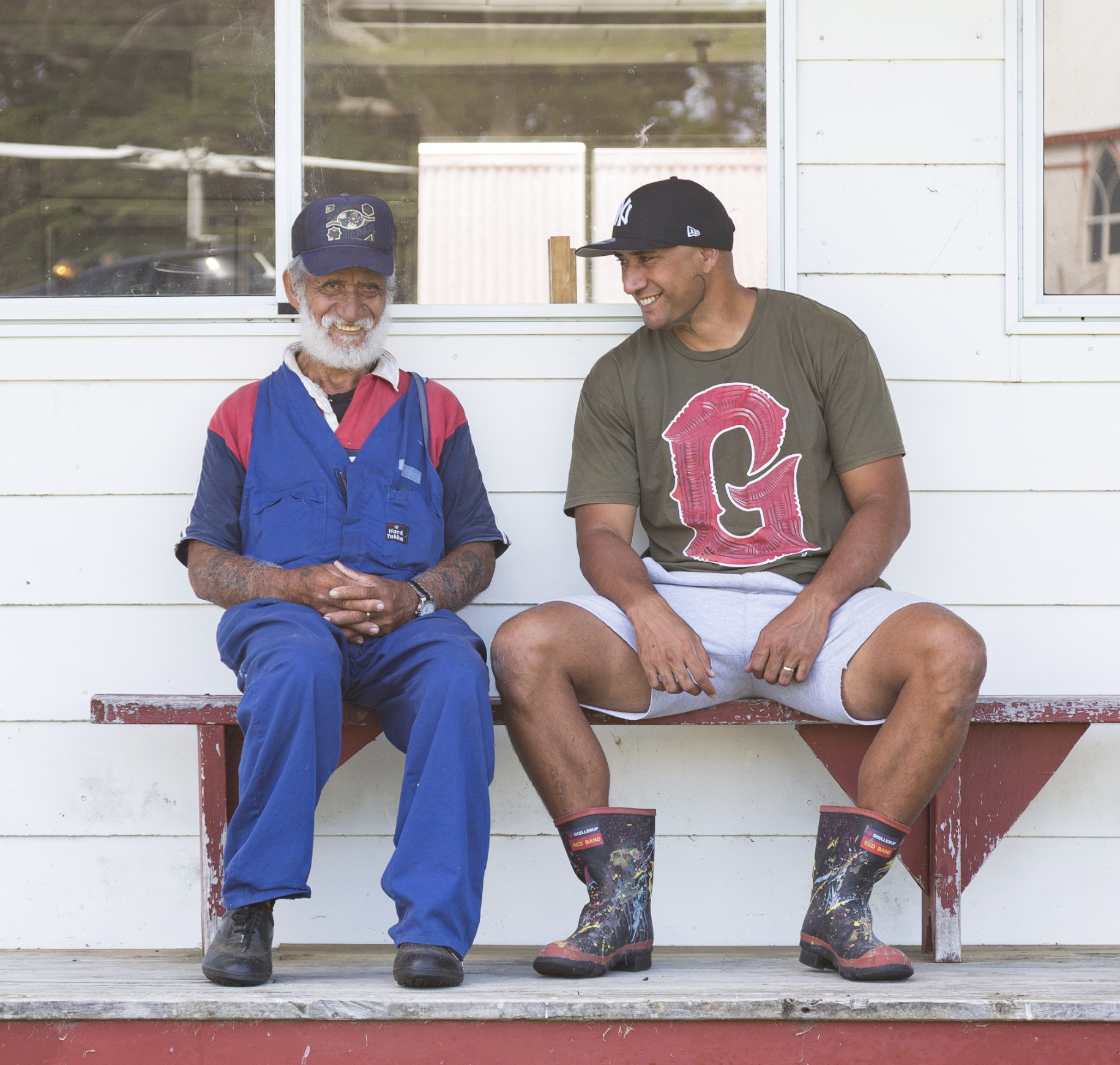
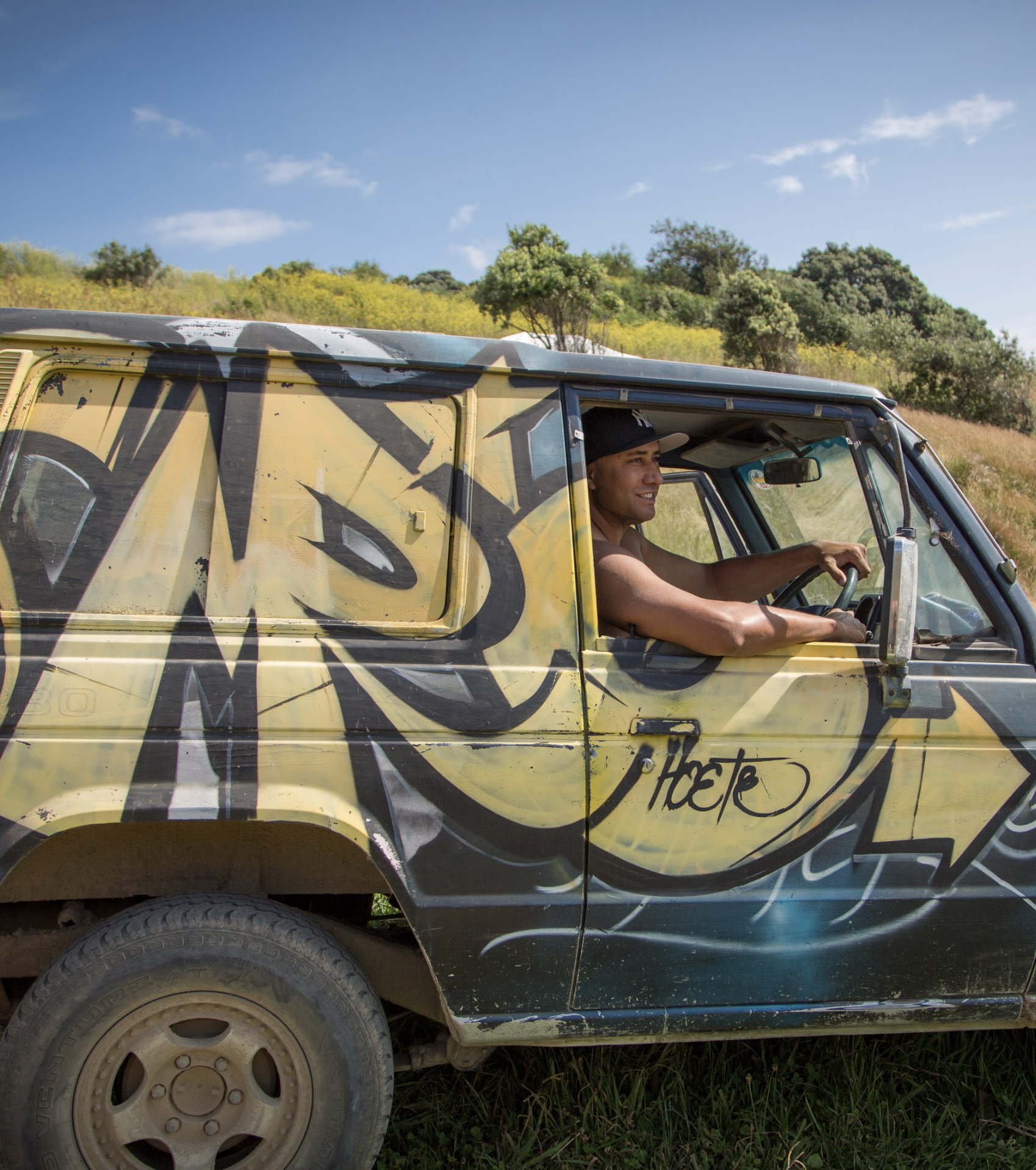
"When my dad was young he used to take me out diving. I loved watching him and my uncles spear fish with a Hawaiian sling. They were graceful, like the fish they swam after. As a young guy, I was inspired to watch them. Many people never get to go diving but, to them, it's second nature. Dad and Uncle Patu used to have competitions to see how many fish they could catch, as kids. They'd make their own spear guns out of poles and bits of rubber and spear blue maomao then thread them and trail them around as they fished. I feel very connected to my dad through his sea-venturing stories, especially through my own love of the moana."
The carved heads
As we move through the portrait, it's clear that the role of the sea is absolutely central to Graham's dad's life as an islander. The two faces on the left and right are based on the amo [posts] outside the marae.
At first glance, the eyes which look inwards at the portrait appear cartoonish. But Graham explains they've been painted to represent maramataka [the lunar cycle], and the waxing and waning crescents of the moon around which island life is based. The phases of the moon affect the tides, when to fish and when to plant crops. The economy and lifestyle of the island is centred around the moon. Mōtītī is so small, but all life upon it is driven by cycles way bigger than any of us.
The double tongues on the faces are common in Māori portraits. And there are various different meanings. Te Kau wae wai runga, Te Kau wae raro refers to the celestial and terrestrial language we use, but it can also refer to how you speak to people inside and outside the marae. Protocol is a big part of Māori culture, especially on the marae ātea [open area in front of the meeting house]. The two tongues can also represent division and deception. You'll often see the double-tongue depiction on maraes on the east coast in the Bay of Plenty, towards Whakatāne."
A closer look reveals many elements of traditional whakairo in the faces with their own inherent meanings. The little notches or taratara ā kae along the tongues represent food
and eating, and the pattern above the mouth is called pākati and is one of the main surface
patterns of whakairo.
"And at the top of the portrait is kōruru, which represents the main ancestor of his marae, Tamatea ki te huatahi. It's the same face that presides over our marae and is the symbol of our tribe and so it's fitting that he does the same job over the portrait of my dad."
The future
Learning about Graham's portrait has opened up discussions about how we relate to each others' cultures and what we can all do to stay respectful. And what's happening to Māori culture in its home, New Zealand, and how we can keep its roots watered and well.
Later this year, Graham and his wife Millie are travelling to Art Basel in Miami – one of the world's biggest and most prestigious exhibitions of modern and contemporary art – to see what place in the world his series of portraits could hold.
Graham believes his portraits are unique and are the future of Māori portraiture. "I respect the portraits that Goldie and Lindauer painted, but what I have that they didn't is direct hononga to the culture, so I feel that puts me in the best possible place to be Māori portrait artist of the future. I have a commision for a lady in Hamilton after she saw my father's [portrait]. My plan is to do more portraits of Māori, sourcing materials where they are from, and telling stories of hononga to their whakapapa and homeland."
When you go to the Home exhibition, you are now able to stand in front of this magnificent portrait and know the connection of this man to the life he has led.
Home Exhibition
Tauranga Art Gallery
9 November 2019 - 9 February 2020
hapū (ha-poo)
sub-tribe, clan a number of whanau (families) make up a hapu, usually from the same ancestor. A group of hapu make up an iwi.
harakeke (ha-ra-kee-kee)
flax
hononga (hoh-nung-uh)
connection
kaumātua (koe-mar-to-ah)
tribal elder
korero (koh-re-roo)
black-backed seagull
koruru (koh-roo-roo)
carved faced on gable at the marae
kupenga (koo-pen-nga)
fishing net
manu (ma-noo)
bird
marae (muh-rye)
meeting house
marae atea (muh-rye ah-tee-uh)
flat piece of land in front of the wharenui
maramataka (mah-ra-ma-ta-ka)
lunar calendar
moana (moh-ah-nah)
sea
takarangi (ta-ka-ran-gee)
the heavenly realm
taonga (tah-ong-ah)
possessions
whakairo (fuh-ky-roh)
Maori carving
whakapapa (fuh-kuh-papa)
genealogy
whanau (fah-noe)
family
wharenui (fa-re-noo-ee)
the main building at the marae
whenua (fen-ooa)
land


The Framer
Looking around, there are stacks of pieces - paintings, prints and photographs, each waiting for the right casing to bind them and make them wall-ready. Danny boasts some of the best machinery in town, including an ancient looking guillotine; apparently it’s one of a kind.

WORDS TALIA WALDEGRAVE PHOTOS TRACIE HEASMAN
Ten years ago, Danny Redwood was admitted to hospital on a Friday afternoon and told “If you are alive on Monday, we’ll start chemo.”
Before that cheery conversation, Danny had been working on his family’s farm, and ignoring the signs that his body was finding the relentless, menial toil, tough. He was neglecting creativity and became very, very sick. “I was working harder, not smarter, and had become increasingly run down for months. When I couldn't lift my arms above my head, I knew something was seriously wrong.
It was his mother Barbara who eventually encouraged him to go to the doctor. Barbara recalls “Looking at Danny next to his brother, his skin looked a ghostly grey. I had to plead with him to see someone.”
Danny says “My blood cells were completely out of whack and although I had been given the all clear for cancer a couple of weeks earlier, in a short space of time. I’d developed the early signs of acute lymphoblastic cancer, an incredibly rare form of leukemia in adults.”
“I needed a bone marrow transplant. Thankfully, my brother James was a perfect match. He is my only blood sibling so the odds of him being a match were pretty slim. In fact, I met someone else in the same boat as me - he had eight siblings - and none were a match.”
“The recovery was brutally intense but as soon as I was strong enough, I picked up a paintbrush. I now know everyone needs to have a creative outlet. It’s so important for our mental health.”
Ten years on, and an herculean recovery later, I meet Danny at work, Artisan Framing and Plaques, in the Chapel Street shopping centre in Tauranga.
"I love being an artist, but it's not always sustainable financially, so I wanted to do something that incorporated what I love to make a living. Being an artist puts me in a great position as a framer."
"I bought this business because it had a great, long-standing reputation. I then moved into this space because I wanted to have room to exhibit work from local artists. We’ve got so many great artists in Tauranga, but we are limited as to where they can showcase that work."
Looking around, there are stacks of pieces - paintings, prints and photographs, each waiting for the right casing to bind them and make them wall-ready. Danny boasts some of the best machinery in town, including an ancient looking guillotine; apparently it’s one of a kind.
Being someone who loves and appreciates art, Danny uses the very best stock, top quality fastenings and mountings for all his frames. “My machinery enables me to provide conservation framing. It’s a very high level of framing, which displays an artist’s work in the best way possible, lasts longer and galleries will far more seriously. It’s also about preserving family memories and making them shine in just the right way.”
It’s clear Danny’s experience has given him a mental calmness and clarity which extends to his work, giving life to the many beautiful prints and paintings he is tasked with preserving.

You’ll never want to leave: Clarence Hotel + Bistro
It’s almost worth going to the Clarence Hotel & Bistro simply for the experience of walking up the grand steps that dissect the long, green-fringed veranda. You just know there’s something significant at the top.
WORDS Jenny Rudd PHOTOS JARED DOBBS + TRACIE HEASMAN + QUINN O’CONNELL
It’s almost worth going to the Clarence Hotel & Bistro simply for the experience of walking up the grand steps that dissect the long, green-fringed veranda. You just know there’s something significant at the top.
Clarence’s owners Kim Smythe and Noel Cimadom recall feeling the same a few years ago when standing outside what was once Tauranga’s post office. “The building has been in Kim’s family trust for a long time,” says Noel. “We’d already transformed the beautiful old post office in Cambridge into our first restaurant, Alpino, so it’s become a family joke now we’ve done the same here.”
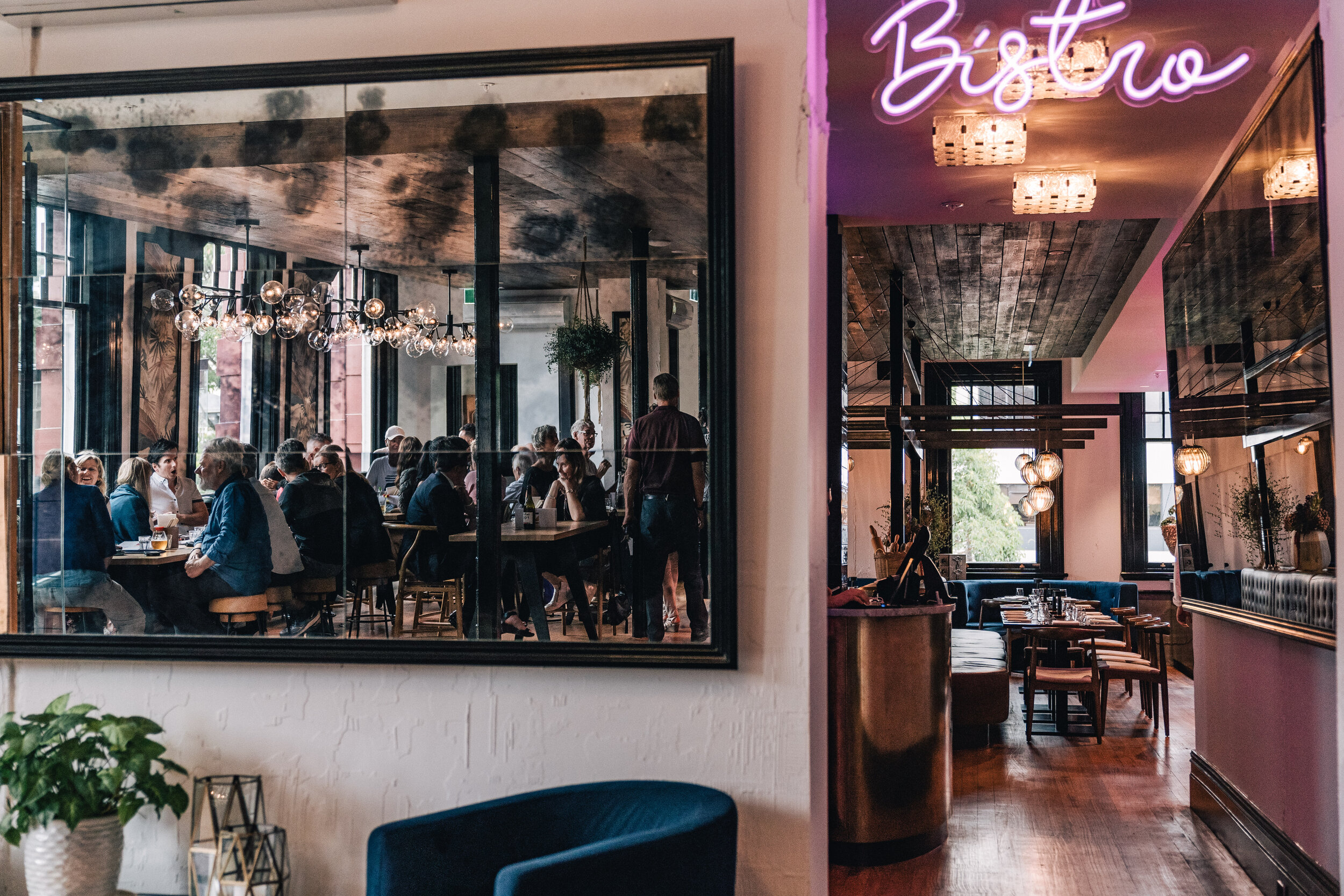
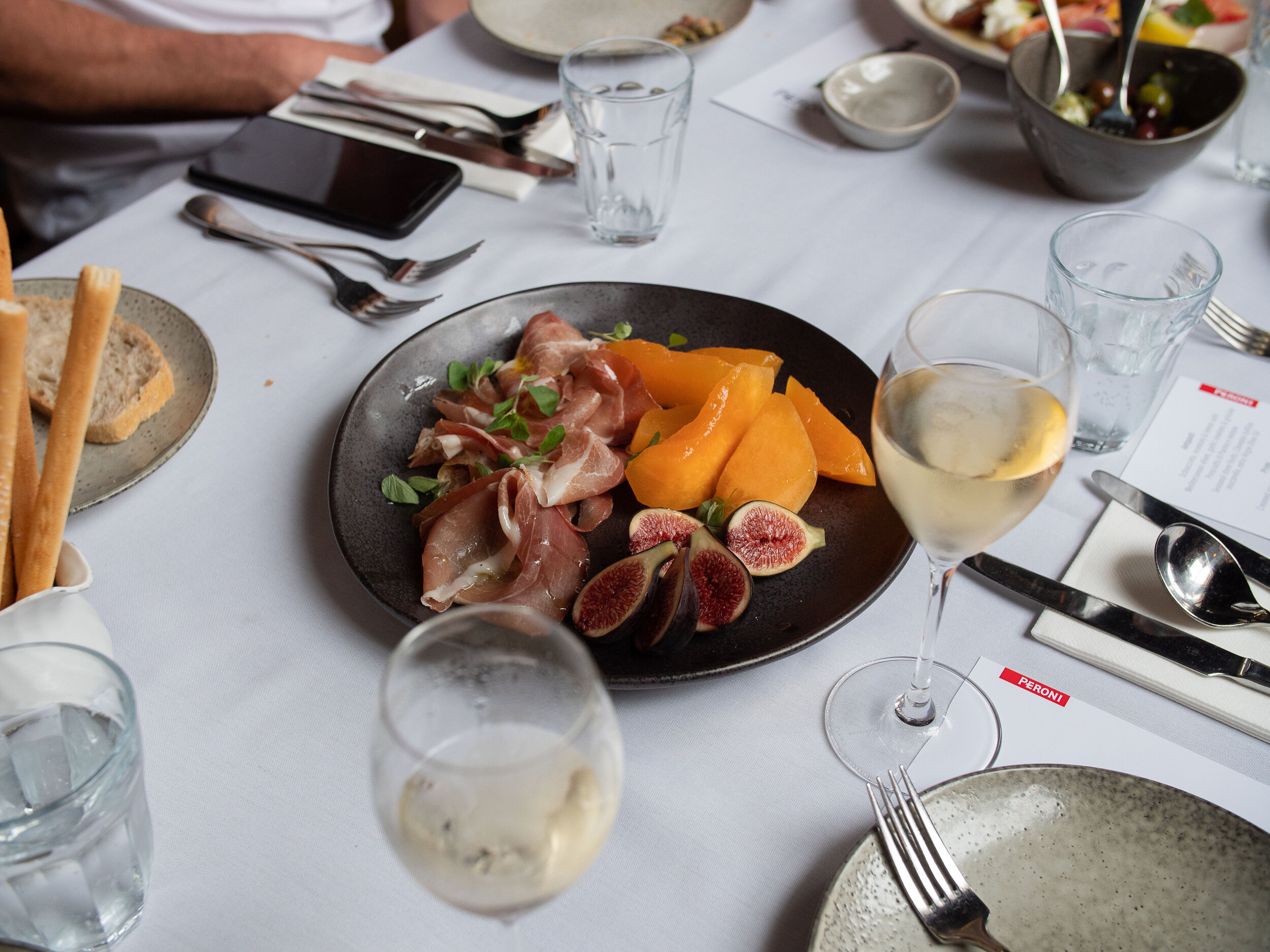
Walking in, you can turn left for the bistro, an elegant dining room serving European brasserie-style food with a Kiwi slant; head up the stairs to the 10 individually styled hotel rooms; or hang a right to Iki, the bar and eatery that sees a constant flow of people from morning till night. With an art deco nod to the building’s heritage, Iki is an opulent scene filled with hints of gold, pops of neon purple and dark velvet. It’s like stepping into another world; you’ll feel miles away from the city.
The heart of the space is arguably the ancient coffee machine at the end of the bar. She’s a grand old dame, too old to make coffee these days, but nevertheless loved for her stately aesthetic.
“I had the same machine at a café I ran when I lived in Munich,” says Noel. “It was designed in Venice and made in Portugal in the ’70s. When we were looking for pieces for Iki, I went on eBay to find it and discovered there were two in the entire world – one in Las Vegas, and one in Taupo. I drove down to Taupo the next day to pick it up.”
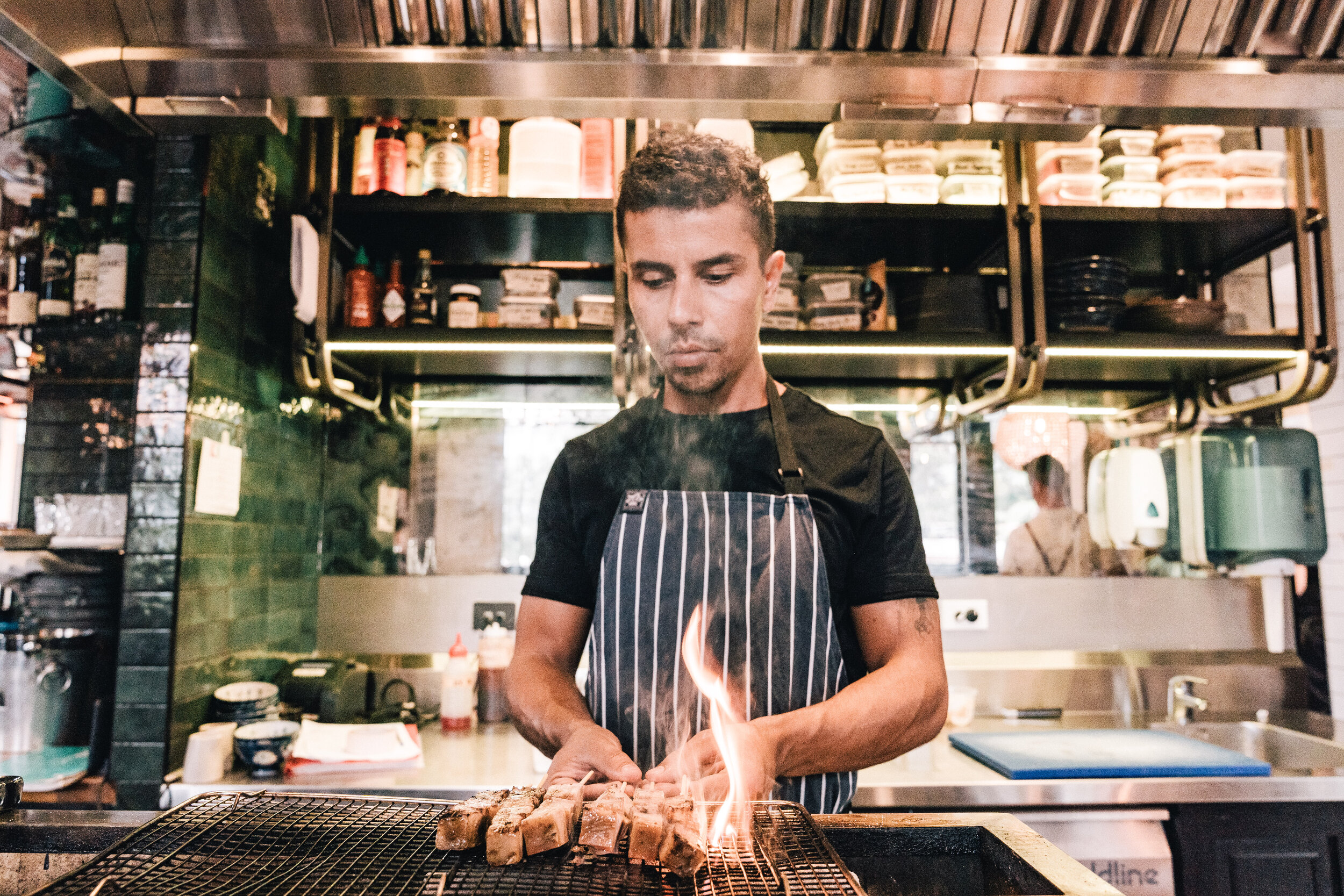
At lunchtime, local suits drop into Iki to enjoy its quick and easy Eurasian street food menu, starring favourite dishes like barbecue pork belly skewers with apple and fennel salad. At about 3pm, the after-work crowd begins to pour in, spilling out onto the deck under the blue sky, green palms and glass roof that keeps the rain out and warmth in, giving you the choice to socialise al fresco year-round.
When the sun’s shining on Friday nights, you’ll find a DJ outside playing smooth beats. And should you end up slightly over-served after an evening at Iki or in the bistro, simply book yourself into one of Clarence’s designer rooms and enjoy eggs and pancakes on the veranda in the morning. You’ll never want to leave.
For the hotel, book online; for the bistro, book online; for Iki, just turn up! Visit: CLARENCETAURANGA.CO.NZ

I want to Hide
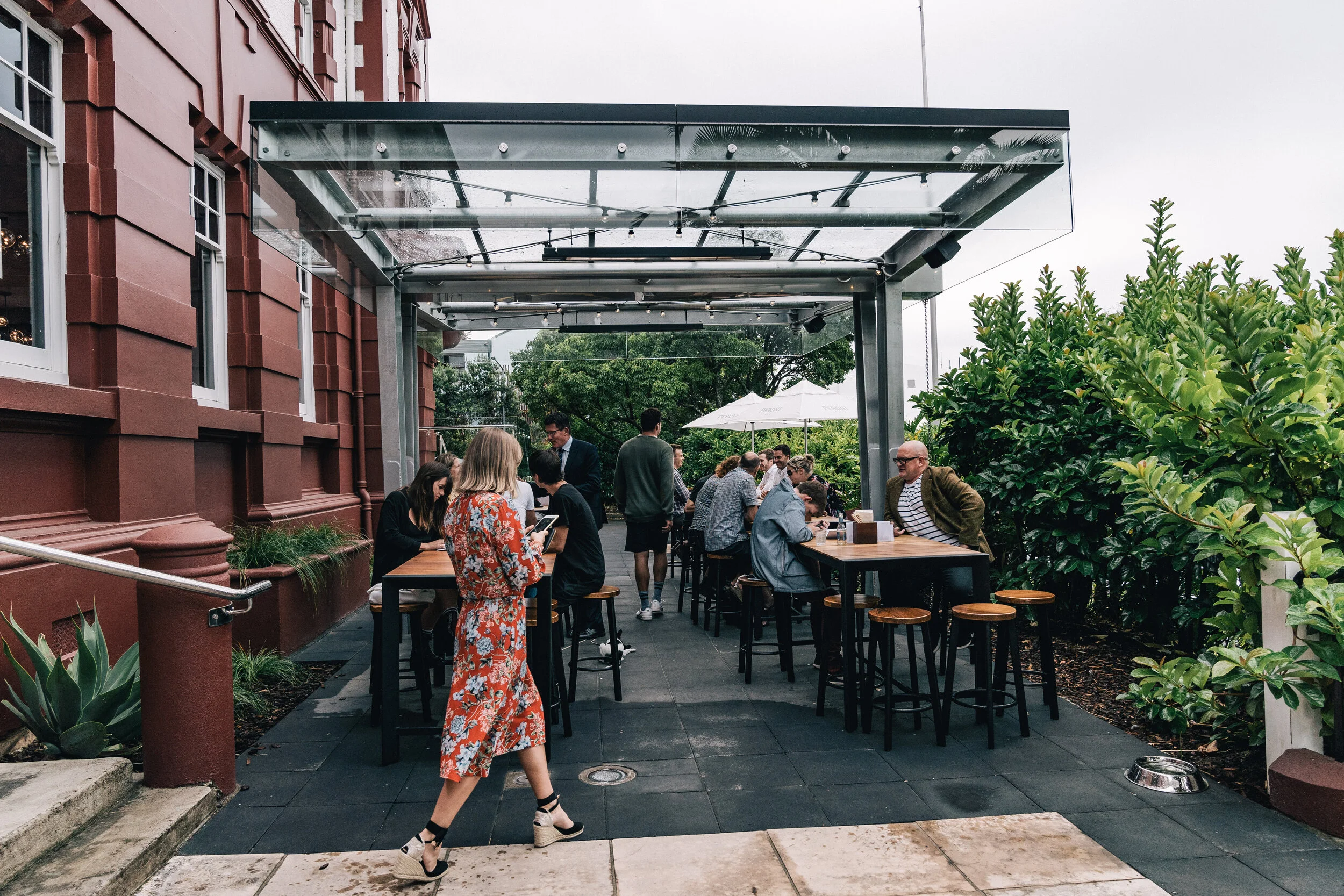
To find Hide, you'll need to shimmy down the alleyway by the Prince Street roundabout on The Mount Mainstreet. It opens out into a courtyard that feels like someone's exceptionally well-appointed backyard.
WORDS JENNY RUDD PHOTOS TRACIE HEASMAN

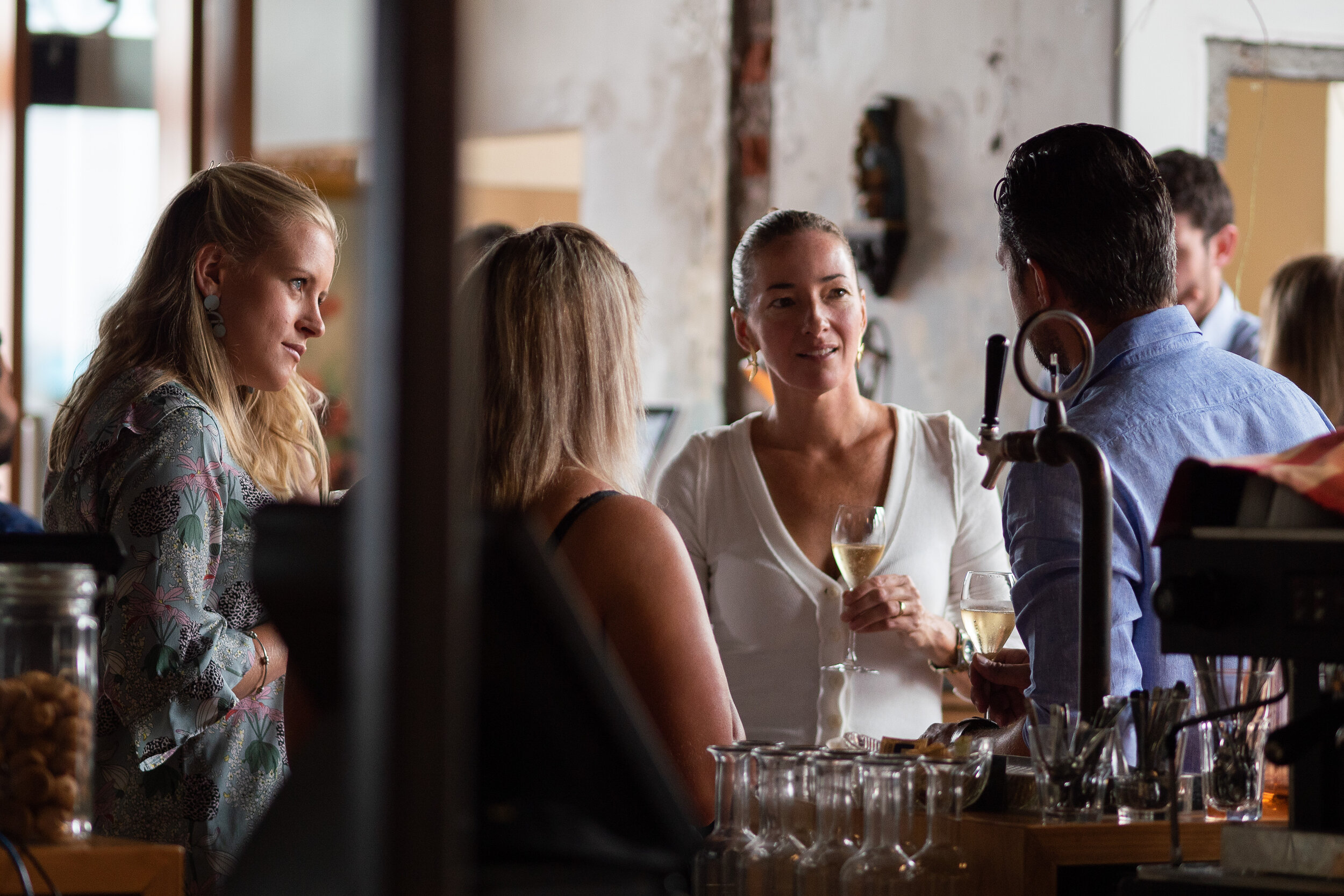
Hide. What a great name for a boozer. To find Hide, you'll need to shimmy down the alleyway by the Prince Street roundabout on The Mount Mainstreet. It opens out into a courtyard that feels like someone's exceptionally well-appointed backyard. Walled in on every side, a roaring fire is the centrepiece. There are built-in wooden booths for big groups to gather, family barbeque under a lush green living wall, a sunny strip of seating tucked behind the fire (perfect for a hot date), and a cosy nook inside overlooking the courtyard.
This place has been home to many things over the years: Lynx hairdressing salon, an outlet store for Sisters&Co, and two restaurants: Mundo Mexicano and more recently, Mr Miyagi. It is now completely unrecognisable. In a good way.
Owners Matt and Kimberly Hayward are hospo royalty in Tauranga, bringing with them the experience of running Winnies in Queenstown in the early 2000s, and owning Da Bierhaus, which they turned into La Mexica on The Strand in Tauranga. The couple and their two girls, Mila and Liv, are now firmly rooted the other side of the bridge with Hide and Mount Brew Co, which is like the cheeky younger sister to Hide's rough and tumble older brother.
"Kimbers' role is to make sure everyone's well fed. She grew up with foodies and fantastic cooks as her parents owned restaurants. It's my job to make sure everyone has a good time." Nice job descriptions. They do it well, too. The opening night had a feeling of goodwill and excitement that you just can't buy. UNO. HQ is a dangerously short walk to the green oasis. Our team went over on a Sunday afternoon for a pre-deadline, morale boosting break. We chose a couple of cold Moas and some plates to share: standouts were tender lamb ribs with sharp salsa verde. Halloumi fries were perfectly crisp out the outside with a creamy horopito dip. And we shared a flounder with fennel mash which was fresh, lemony, buttery and light. Smooth beats from the deck with resident Sunday afternoon DJ, Sarah Bronte, and we really were transported a long way from the demands of the office.
Matt says, "I want people to treat this like their own backyard. You can invite your mates round, light the fire, eat like you're at a barbeque, listen to music, and have a few beers." Even better, no clearing up, and the service is way better than at my house.
The one, the only…
Anyone who’s watched Ben Hurley perform will tell you he’s a bloody funny guy, but he isn’t your typical Kiwi comic.
The Katikati-based comedian makes Friday nights funny nationwide on TV3’s 7 Days, and now he’s set to make us locals laugh as the host of the second-annual Mount Comedy Festival.
WORDS Andy Taylor PHOTOS Brydie Thompson

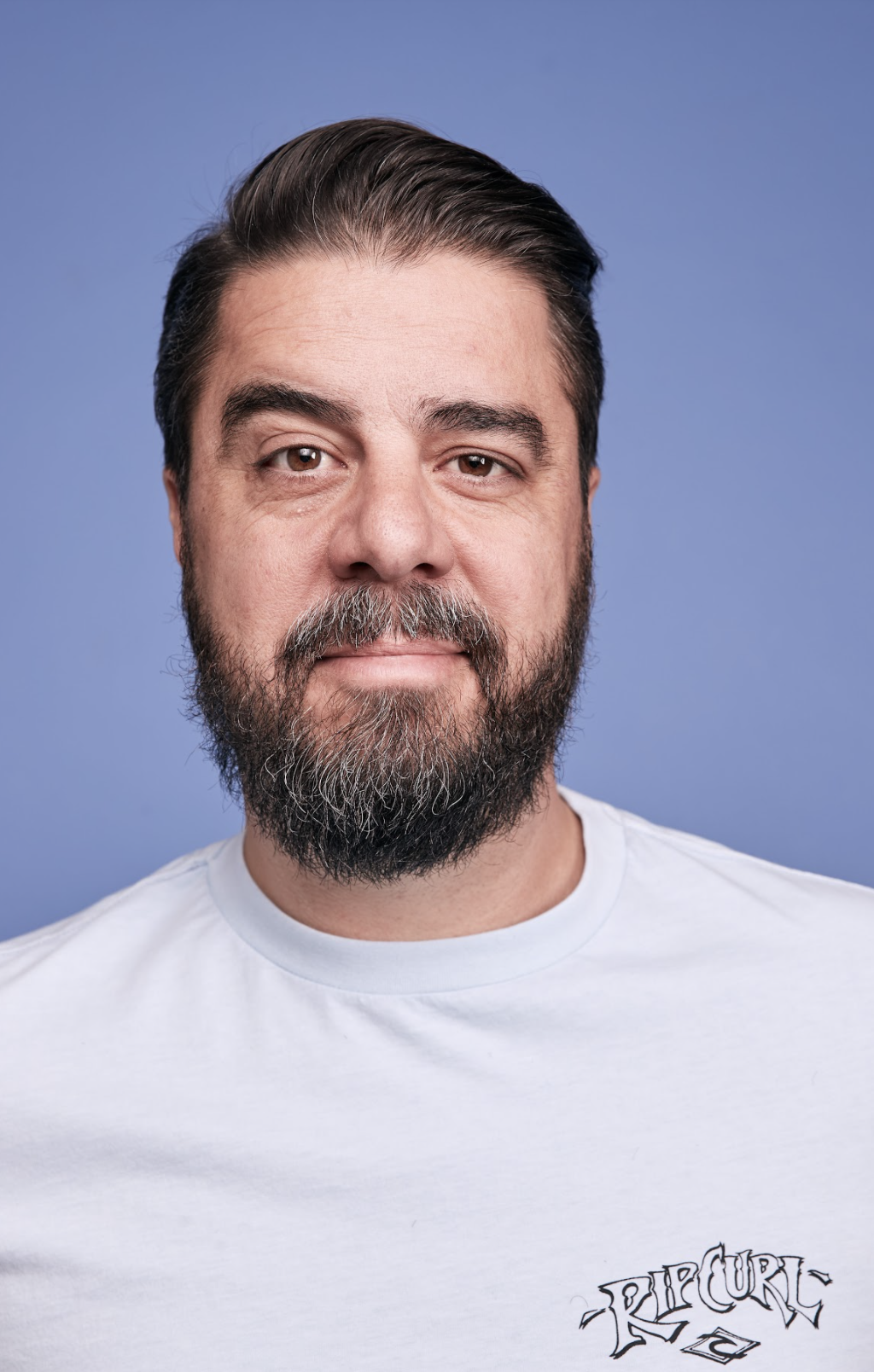
Anyone who’s watched Ben Hurley perform will tell you he’s a bloody funny guy, but he isn’t your typical Kiwi comic. He didn’t grow up using humour as a defence mechanism like so many others. “I really liked school, actually,” he says.
Has he always wanted to be a stand-up comedian? “At the end of fourth form, the school sent around these forms that we had to fill out to check that we were taking the right subjects the following year, for whatever you wanted to do as a career. I’ve always been somewhat suspicious of authority, and I thought it was ridiculous that they were asking 13- and 14-year-olds what they wanted to do in life, so I put down ‘male model’. Then I crossed that out and put ‘comedian’, because that was the next most ridiculous thing that anyone could do. So ‘technically’, yes, I have always wanted to be a comedian. But I was living in a small-town in Taranaki at the time, so it wasn’t really an option.”
University, however, was, and Wellington beckoned, so off Ben went to study politics at Victoria. “They had an improv comedy club, and I met my best friend Vaughan King, who was an actor and comedian and started doing stand-up – and that kind of motivated me to do my first gig in 2001 at the Wellington Fringe Festival.”
“I thought it was ridiculous that they were asking 13- and 14-year-olds what they wanted to do in life, so I put down ‘male model’. Then I crossed that out and put ‘comedian’.”
So much for the politics degree. “Yeah. It’s just what you do isn’t it, something academic? Stand-up is something you shouldn’t really do straight out of school because you just don’t have the life experience, so politics and international relations it was. Dai Henwood has a degree in eastern religion, Jeremy Corbett has a computing degree and Jon Bridges has a philosophy degree – or something like that. And then there are people like Ewen Gilmour and Mike King who came to comedy out of the workforce. Ewen was the funny guy at the factory and Mike was the funny guy on the ferry, and they just got pushed into it by their mates. So you kind of have these two schools and to be honest I don’t really know if there is a stylistic difference between the two or not, or whether it’s more about influences.”
For young Hurley, the influences were the usual suspects: Billy Connolly, Jerry Seinfeld, Blackadder, Basil Fawlty. Humour was always appreciated in the Hurley household, and his father was a big fan of British comedy – although in those pre-internet days, you tended to like what you were given. “It was not like now, where you have every single comedian who has ever been at your fingertips,” says Ben. “There was a very limited range of stuff that we could see. If you were lucky, maybe the Montreal comedy festival or something like that, and the Kiwi show A Bit After Ten, which had the Corbett brothers on it. I was probably about 14 or 15 and I loved their running gags. They’d say, ‘Shall we do the Floyd gag?’ and then never, ever do the Floyd gag. And they had an open-mic section, where I saw some comedians who are good friends now and that I’ve worked with often. In fact, I still say, ‘Shall we do the Floyd gag?’ to Jeremy. I’m probably the only one who remembers it, though.”
(The early-’90s A Bit After Ten can be found at nzonscreen.com and is definitely worth a watch. In addition to an outrageously young and clean-shaven Jeremy Corbett, it also features the wonderful spectacle of contestants vying for the grand prize of a 14-inch TV.)
After making a name for himself as a comic in New Zealand, Ben started gigging in the UK, and toured extensively in Europe and Asia. The winner of the two biggest comedy awards in New Zealand (the 2004 Oddfellows Billy T Award and the Fred Award in 2008), advocate of cricket as a way to achieve world peace (“No two cricketing nations have ever gone to war with each other – that’s a fact”) and one of the few Kiwis to be invited onto America’s prestigious Comedy Store TV show now calls the Bay of Plenty home, but touring is something he knows an awful lot about. Google his name and it’s clear he spends more time on the road than a Fonterra truckie.
“I was in England for four years, gigging around the country five, six, seven and eight times a week, sometimes doing two shows a night, because the clubs are really full and lively over there, and doing it over and over again is how you learn your craft. I love being on the road – well, not so much now that I have a family, but I can’t imagine going to work at the same place every day. It’s hard to be away, but I guess I’m just hardwired to do it.”
Ben says there are regional differences in what people find funny, though they’re relatively subtle in New Zealand. “There are some places that are a bit more conservative than others, but that’s changing. And it all comes down to it being relatable. I mean, I can’t do a joke about Winston Peters in America or anywhere outside of New Zealand really, but even in New Zealand you have to keep it relatable. When Winston Peters left Tauranga as an MP, I made the joke that this was the first time a 70-year-old man had ever left Tauranga. And although that’s a joke that works really well in the North Island, in the South Island they just don’t know that many old people move to live in Tauranga – in the South Island they have their own version of that, it's called Nelson.
“In America, they don’t get the self-deprecating humour so much – that’s very much a UK thing. American comics are much more defined. It’s much more about the character – you’re the angry guy or the party girl or whatever – whereas in the UK, people just say funny things.”
Although the constant gigging and vibrant comedy circuit scene in the UK was formative for Ben, he was also happy to come home with a new appreciation for Kiwiland. “After being in the UK, I came back to what has proven to be a bit of a renaissance in New Zealand comedy over the past 10 years or so,” he says. “And that largely comes down to the TV networks and the overseas success of people like Flight of the Conchords and Rhys Darby. That woke up the networks to the success of comedy and the need to give it some legs here and air some home-grown stand-up. And out of that we got 7 Days, which has been the most popular and longest-running comedy show in New Zealand history. So people get out now to see stand-up, and that’s great.”
His extensive gigging across the globe must also have honed his skills for dealing with those who get out to see stand-up and feel the need to chip in. “Yeah, I kind of encourage hecklers now, to a certain degree. Well, I encourage interaction at least. On this tour, for the first half of the show I pretty much just chat to the crowd, and try to keep it as fluid and interactive as possible. In New Zealand, the heckling is almost never nasty – its just drunk people wanting to be a part of the show. I’ve done thousands of gigs, and I can count the times that heckling has been genuinely nasty on about three or four fingers. But, then again, if they don’t shut up, I do start feeling bad for everyone else.”
In an industry known for driving ambition and raging egos, Ben has a refreshingly down-to-earth approach and concern for his audience and his community. Last year, in response to what he describes as a sense of helplessness about the state of things in the newly Trumped world, he put together a three-night festival at Auckland’s Classic Comedy & Bar. Called Comedy in Action, it raised money for some great charities while also showcasing some top Kiwi talent.
“It was just a reaction to what I saw as the whole futility of people commenting on injustice on social media,” he says. “Liking a post actually changes nothing, so instead I wanted to do something that would have an actual effect – and make people laugh.”
Now he’s at it again, and is busy organising the second annual Mount Comedy Festival, which he’ll host in January. Ben says this year’s event is going to be even bigger and even better than the last. “Tauranga is New Zealand’s fifth-biggest city and I just thought there was a real need for it. There wasn’t really anything going on comedy-wise in the area; there was the odd thing going on with people coming through to play Baycourt, but no regular event. Last time, we had three nights with basically three shows, but this year we’re expanding things over five days. We’re also going to do some matinee shows with family-friendly comedy.
Ben says the support has been amazing. “I mean, it is the place to be, because everyone loves the Mount, so it's something that people want to be involved in and a lot of people have come on board with, like UNO for example. But it does really seem like this is really a thing that has found it’s time.”
Ben makes it sound like it happened, but with scheduling, promotion and venues, not to mention getting the right mix of performers, producing something on this scale isn’t easy. “I really made it the best I could, and it really is a great line-up,” says Ben. “We’ve got Wilson Dixon [aka Kiwi comedian Jesse Griffin) headlining, who is, um, ‘technically’ from America; we’ve got the great Josh Thomson; Justine Smith, who was on the line-up last year and so loved that we brought her back again; newish comedian Hayley Sproull, who’s a 7 Days regular; Brendhan Lovegrove, who will be hosting a new acts competition, so if any locals want to test the water, this is their chance; and Te Radar, who will do his one man show 'Eating the Dog'. So yeah, something for everyone.”
This well-travelled, internationally known performer is bringing something for everyone to our neck of the woods because it’s now his necks of the woods too. After growing up in Taranaki, and living in Wellington, Auckland and the UK, Ben now calls a little piece of paradise in the Western Bay home – a lifestyle block somewhere between Katikati and Waihi Beach with “some sheep, some chickens, some kiwifruit”. Where does he find time to manage that, with all he has going on? “Fortunately, my wife is the property manager,” he says.
Of all the gin joints in all the towns in the world, why here? “I don’t really know,” says Ben. “I just like it here. It has a real lifestyle thing going on, it’s a great place to bring up kids, it’s beautiful, but it's not a million miles away from everywhere else. I mean, I love Taranaki as well, but unfortunately it’s just a little bit too isolated. So here kinda has it all. The best of both worlds. The best of all worlds.”
Ben’s not a typical comedian, no. But for his originality and the fact that he not only makes us laugh but also makes us think, he’s definitely one of our best. And you know what? He might be onto something about the cricket.

Grace Wright: Tauranga artist
We meet Tauranga girl and artist Grace Wright as she prepares for the Auckland Art Fair.
We meet Tauranga girl and artist Grace Wright as she prepares for the Auckland Art Fair.

INTERVIEW CLAUDIA CAMERON / PHOTOS HEATHER LIDDELL / SAMUEL HARTNETT
UNO: How did you start out as an artist?
GRACE: I grew up in Tauranga, so when I finished Elam in 2014 I moved back home for a year to have time to develop the ideas I had generated during my BFA at Elam School of Fine Arts, without financial pressure. During this time I rented a studio space out the back of Zeus Gallery, when they were based on Eleventh Ave. I loved painting there, with the industrial-style spaces, plus having the time to intensively work and establish my practice.
Although I live in Auckland now, I love coming back to see my family and have some down time. Tauranga will always be home.
UNO: What have you been working on lately?
GRACE: Recently I have been working on a series of paintings for the Auckland Art Fair as well as planning for my upcoming show at Parlour Projects in July. My practice is a continually evolving one, so I’m always trying to push myself forward and create something that surprises me.
UNO: Ah, yes, Parlour Projects in the Hawke’s Bay selected you as the recipient of its inaugural artist-in-residency programme. Congratulations!
GRACE: I was so honoured to be selected for this residency and have the support to bring my ambitious 11m x 6m installation concept to life. I had been wondering how our body would feel if we experienced painting more spatially by thinking of the room as a canvas. The body has always informed my work throughout its evolution and in this residency I wanted to recreate the physical sensation of how you feel when you stand beneath something monumental in scale.
UNO: Can you tell us a bit about your process?
GRACE: I see colour as a construction process, so the painting almost builds itself. I never know what the paintings will look like in the end, but I start with one colour or gesture and construct the colours and layers until the final work emerges.
UNO: What inspires you and your work?
GRACE: I’m inspired by an international style of painting that has a real presence with the viewer through scale and the relation to the body. In 2015 I visited Albert Oehlen’s exhibition Home and Garden at the New Museum in New York. It was such a thrill to stand before these huge, three metre square paintings. This feeling of intense physicality is what I’m interested in creating in my own work.
UNO: You’re showing at the Auckland Art Fair as part of the Parlour Projects stand, what can we expect to see from you there?
GRACE: I will be exhibiting a series of new large-scale works measuring 1200 x 1500mm which continue to explore a sense of artificial space and gestural abstraction reminiscent of the body. Recently I’ve been interested in constructing space through subtle illusion and colour combinations so the work will reflect these ideas too.
UNO: You’ll be joined by a number of incredible artists and galleries showing at the AAF this year, what are you looking forward to the most about the event?
GRACE: It’s such a unique experience to see all these galleries in one space, along with work from top galleries in Australia and some further afield. I also love the social aspect of the art fair! It’s a great way to catch up with lots of people in the industry and celebrate all the hard work put in by artists and galleries.
UNO: What are you hoping to achieve from being part of the Art Fair and speaking to an international audience?
GRACE: I’m excited to be exhibiting at the fair and have the support of Parlour Projects. My goal generally is to build up steadily and create work that endures. At the end of the day, art is what makes life worth living, as are the ideas and conversations that surround it.
UNO: What’s it like making art as a full-time job?
GRACE: I love it! I’m pleased with how I’ve set up my week to allow myself the time to paint. I’m definitely a morning person, so my day starts by getting straight into painting. In the afternoons I tend to stretch canvas and gesso, then attend to admin later in the day.
UNO: What skills do you think are useful in your job?
GRACE: I think you need to have a lot of faith in yourself and belief in what you’re doing.
UNO: Can you share a piece of advice for anyone wanting to move into a similar creative space?
GRACE: The best advice I ever received was learning that talent will only get you so far. The way you think determines the rest.
INSTAGRAM: @gracewright08

Chalium Poppy: Mount Maestro
With a Welsh dragon tattooed over his heart, a love of swimming in winter and a husband who works in fashion, the mould was clearly broken when Chalium Poppy was born. Performing since he was four years old and all over the world, he’s arguably one of the most experienced classical musicians in the country.

With a Welsh dragon tattooed over his heart, a love of swimming in winter and a husband who works in fashion, the mould was clearly broken when Chalium Poppy was born. Performing since he was four years old and all over the world, he’s arguably one of the most experienced classical musicians in the country.
WORDS JENNY RUDD PHOTOS SHAWN ROLTON
My voice broke at 12 and I thought my life had ended. I felt like a bad angel about to be cast out of heaven. When the time came for me to be dismissed from the choir, we had a big party. Every boy got one. We called it our puberty party. It was hard saying goodbye to the other boys and I cried for weeks.
My parents put me into a local school but that didn’t last long. I hated it and let everyone know. One week, my mother was called to the school every day. I don’t really want to say what I did but I was very naughty. I was ‘moved’ to another school.
I flourished there. They had a great music program led by talented teachers. They allowed me to play the organ in chapel for services now and then, and help conduct the choir. The chapel became my second home.
INTERNATIONAL STAR
One teacher sent a recording of my singing to a university in Austria. Someone came over to hear me sing live. In a few weeks I received an offer of a full scholarship to study music in Vienna. Although my father loved classical music, my parents absolutely did not support it as a career choice. Knowing they would have forbidden me to go, I ran away from home and have never been back since.
My seven years spent studying at the Academy in Vienna were amazing. I worked with tutors and academics who were leading authorities in their field of music, travelled, studied and performed in Italy, France, Germany and the Czech Republic.
My grandmother had been a contralto soloist of considerable talent, although her piano skills were terrible; a bit music hall-like. It was she who diagnosed my musical abilities and that of my two brothers early on. I had the voice of an angel, she was convinced. My brothers didn’t fare so well. She declared my elder brother tone-deaf and advised him never to sing in public.
At four years old, I auditioned successfully to become a choirboy at Oxford Cathedral, where my family lived in the UK. The training and education of choirboys is an ancient tradition. Our lives are centred around music-making in the context of worshipping God; education, both academic and physical, is really quite secondary to that. Oxford Cathedral is an exceptional place – much of Harry Potter was filmed in its beautiful halls and quads.
All 23 choirboys do absolutely everything together, and we were busy every minute of the day with a continuous round of rehearsals, services and studies. From the beginning, the principles of respect and kindness were instilled in us by the choirmaster. We followed his guidance above all others.
One year, Christopher Hogwood, the great conductor, brought his orchestra The Academy of Ancient Music to record Messiah while we sang. I didn’t appreciate his brilliance and knowledge at the time, I just kept thinking what cavernous nostrils he had.
TEA PARTY
Besides our vocal studies, we were all required to study an instrument. I chose the piano, having taken private lessons since I was five. My father woke me early one Saturday and took me to the cathedral. The organ was undergoing maintenance and repair – they had opened the enormous wind chest up and you could see all the pipes and mechanisms. We sat inside the wind chest having a sandwich and a cup of tea whilst my father explained how it worked. I decided to learn to play the organ too, even though my feet didn’t yet reach the pedals.
After completing my Masters (in Protestant Church Music), I moved to Canada and worked full time as a musician: organist and choirmaster in the cathedral, as well as singer, conductor, teacher, lecturer. I was often asked to conduct Gilbert & Sullivan operas. They thought that being English I was automatically an expert.
Although exciting professionally, this was also a very lonely time. I worked very hard. The life of performer was beginning to lose its lustre and appeal as I got older.
I am a creature of habit. On Sundays, after the morning services at the cathedral, I would walk to my favourite Irish pub for lunch and a pint or two of Guinness, and then return to the cathedral in the afternoon for Evensong. One Sunday, something happened that would change my life dramatically and for the better. I met Michael.
LOVE
There was a young chap sitting at the bar enjoying a drink and chatting casually with the barkeep. He had the most striking red hair and a wonderful smile. I was electrified. I summoned all my courage and asked him to join me for lunch. He was a New Zealander travelling through Canada on his o/e, an avid snowboarder exploring Canada’s world-famous slopes.
I wasn’t sure how he would respond to my chosen career path – being a church music specialist isn’t very glamorous. To my eternal surprise, he asked to come to Evensong in the cathedral that afternoon.
I fell deeply in love with Michael that day. Two weeks later I asked him to marry me. We have just celebrated our seventh wedding anniversary. I couldn’t ask for a better, more loving and supportive partner in life.
As Michael was only in Canada on a holiday visa and I was estranged from my own family, we decided to move to Mount Maunganui. We arrived on the first day of winter 2009. I knew very little about the country.
We watched the sunrise over the water on the day we arrived. Surfers and swimmers were all heading towards the water. I thought to myself – if this is New Zealand on the first official day of winter, what a wonderful place to live!
MUSIC, FAMILY, NEW ZEALAND
Aside from performing and conducting locally, I’ve worked in Auckland, Gisborne, Napier, Whakatane, Kerikeri, Dunedin, Rotorua, Hamilton – all over the place.
In Canada, I performed primarily at a professional level. Here in New Zealand, there simply aren’t the choirs and orchestras to provide much work at that level. My objective is to make music at the very highest level that I can – whether I’m singing Messiah in a barn in Kerikeri or works of Bach in the Auckland Town Hall with the Auckland Philharmonia Orchestra. What’s important for me as a musician is to have the same level of musical integrity no matter what the circumstances.
I’ve been put up in fantastic hotels in Auckland when I perform, or slept quite comfortably on a pull-out couch in someone’s living room. That is what makes the life of a musician in New Zealand different from anywhere else I’ve been.
When I’m not music-making, we usually like to spend our time close to home. We are both home bodies and foodies. Michael is an exceptional cook so we are rarely alone at dinner time. Just over a year ago, we adopted Paddington. He keeps us on our toes. If I have a gap in my schedule, we pack up and take Paddington on an adventure somewhere. Of course we live right at the beach, so I like to get into the water as much as I can – Paddington too.
Chalium is the Musical Director of Scholars Pro Musica, a Tauranga-based chamber choir of exceptional talent.