

Trekking across Greenland with Hollie Woodhouse
I was three hours into trekking across the Greenland ice cap, and all I wanted to do was quit. I’d spent the past six months imagining myself as a strong warrior gliding over smooth snow under bright blue, never-ending skies, the sun warming my bronzed face. The reality, however, couldn’t have been further from the truth.
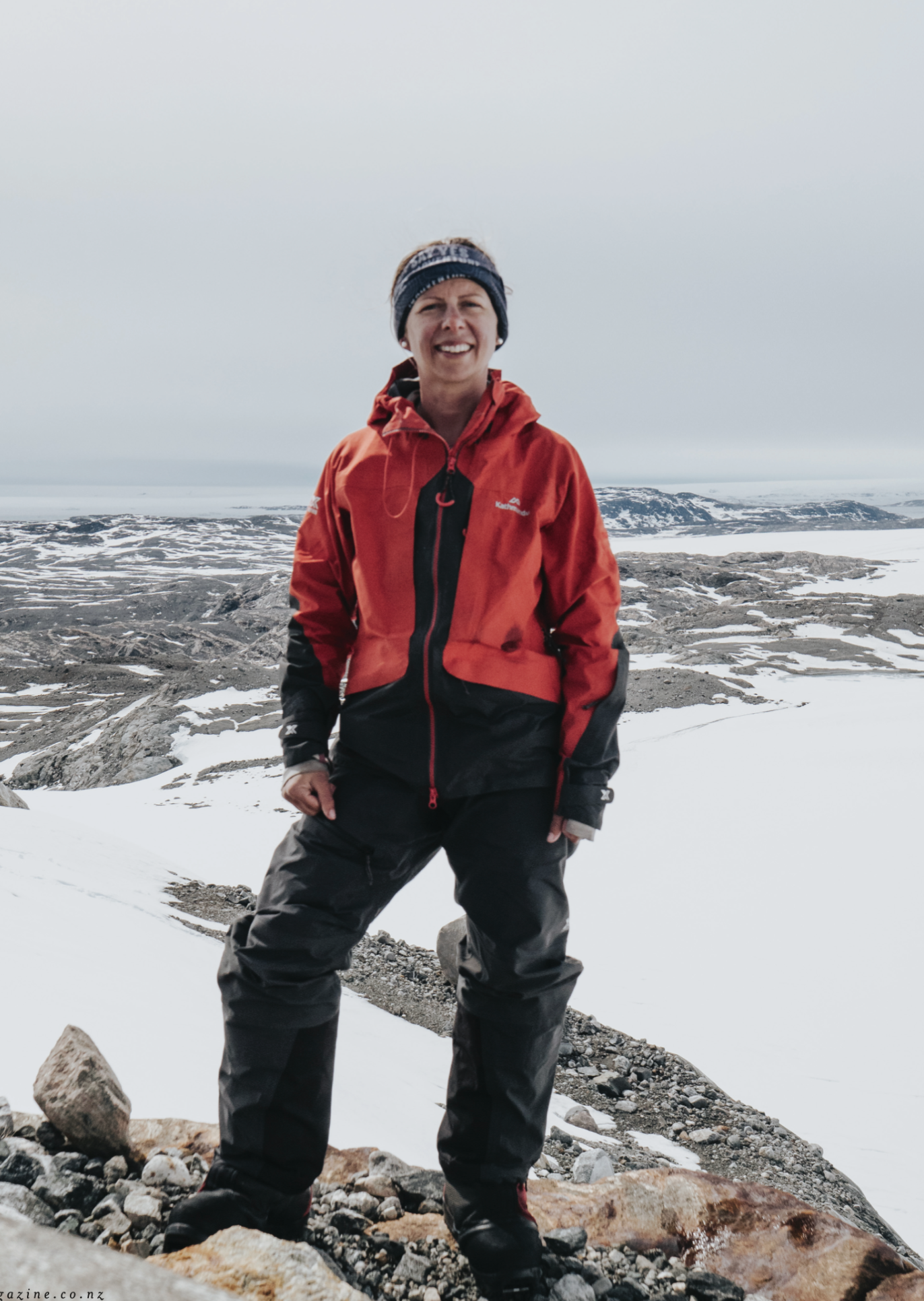
Can you imagine dragging something heavier than you are across a canvas of ice all day, every day for a month? Hollie Woodhouse reckons it’s all about the top two inches.
WORDS JENNY RUDD + HOLLIE WOODHOUSE PHOTOS KEITH PARSONS + BENGT ROTMO
When I first came across Cantabrian Hollie Woodhouse’s magazine Say Yes To Adventure two years ago, I was completely captured by its exciting stories and eye-widening images of people doing things that make you feel like the world is something to climb to the top of so you can truly see how magnificent it is. She published tales of scaling barren mountains in countries I’d never heard of, camping in the ice under the Northern Lights and cycling across continents. At the centre of it all was Hollie herself, a diminutive, blonde handful of sparks. As well as writing about her own adventures, she edited, designed and published the magazine too.
That afternoon, I went for a walk around the Mount and on the spur of the moment, decided to say yes to adventure. I left the track and headed diagonally up, fighting my way through scrabbly scrub and eventually getting stuck. Sweaty and a bit scared, I perched halfway up the slope facing out towards Matakana Island. My only option was to let gravity lead me back to the base track through the dense bush. I arrived home breathless and muddy. ‘Probably won’t mention that to Hollie…’ I thought.
If you ask Hollie about her achievements, she’ll tell you, “I’m not some ultra-athlete, I’m just a girl next door who goes out and gets involved.” But when you consider what she’s done, you realise she’s anything but average. Among other feats, she’s competed in the Coast to Coast, run 250km across the Moroccan desert in the brutal Marathon des Sables, and most recently crossed the 560km Greenland ice cap pulling a sled heavier than she is.
I was expecting her to be a no-nonsense, laser-focused high achiever; instead, when we eventually meet I find a funny, self-deprecating woman with a flair for graphic design. Originally from Ashburton, she’s been spending more time in different parts of the country through being invited to speak at events and share her experiences. Talking to her in Cambridge, I ask what she learned from her Greenland crossing.
“I learned what it feels like to really, really struggle,” she says. “I used to be pretty dismissive of people when they said they couldn’t do something, especially physical things like running 5km or swimming in the ocean, but now I know, because that was me at times in Greenland. I felt like I just couldn’t do it, but our team encouraged me and spurred me on. So I suppose you could say it made me a nicer person!”
I asked Hollie to tell us more about her extraordinary Nordic feat. Here, in her own words, is her story.
I was three hours into trekking across the Greenland ice cap, and all I wanted to do was quit. I’d spent the past six months imagining myself as a strong warrior gliding over smooth snow under bright blue, never-ending skies, the sun warming my bronzed face. The reality, however, couldn’t have been further from the truth.
My 55kg were struggling to pull the 60kg pulk (sled). My skis had a mind of their own, sliding uncontrollably from underneath me, too often seeing me face plant into the icy snow. It’s funny how dreams never quite work out that way we intend, but to hell with happy endings. Ultimately, I was there for the story.
I was part of a six-man team (Antarctic Heritage Trust executive director Nigel Watson, polar guide Bengt Rotmo, and four explorers: New Zealanders me and Brando Yelavich, and Australians Bridget Kruger and Keith Parsons) led by the Antarctic Heritage Trust for its third Inspiring Explorers’ Expedition – a 560km trek across the Greenland ice cap. The trust’s mission is to conserve, share and encourage the spirit of exploration, something they believe is critical in the 21st century. This expedition was to do just that while honouring the remarkable legacy of Fridtjof Nansen, who made the first crossing 130 years earlier.
“I learned what it feels like to really, really struggle.”
Growing up on a sheep and beef farm prepared me for the rough and tumble of the outdoors, but nothing could have prepared me for this adventure. Even though expeditions in freezing climates had never been on my bucket list, however, I knew this was a once-in-a-lifetime opportunity, not to be missed.
Best described as being trapped inside a ping-pong ball, Greenland was far removed from my everyday reality. Life was broken down into the most basics tasks. It would take me 15 minutes every morning to squeeze my feet into my frozen boots while balancing awkwardly in our two-man tent. After boiling water, eating breakfast, then clumsily taking down our tent (a small feat in itself when wearing three layers of oversized mittens) we’d line up ready to tackle the next 20-odd kilometres of the day.
Using the sun and wind to navigate, we’d ski in a line, one behind the other, with a 10-minute break every hour. After anywhere between 10 and 16 hours of skiing, time would be called and the evening routine would commence. Tent up, water boiled, dinner eaten, team meeting, diary entry and finally, sleep. Wake up, repeat. I now understand the meaning of the term ‘Groundhog Day’.
We battled unseasonable wild weather, including two hurricanes. Each time, we dug down our tents to escape the full force of the ferocious winds. Using the excess snow, we built giant walls, their proximity to the tents critical, down to the last centimetre. We hunkered down for up to 30 hours at a time, snow falling like cement around us. These delightful moments were considered ‘rest days’; there’s nothing like the steady drum of 180km/h wind to lull you to sleep.
As the days turned into weeks, my body slowly became accustomed to the new normal. With every step, I managed to grasp the skill of Nordic skiing. Instead of fighting the unnatural movement, I was able to switch to autopilot and would often find myself in a state of flow. It was during these moments that I was reminded why I say “Yes” to the unknown.
“Instead of fighting the unnatural movement, I was able to switch to autopilot and would often find myself in a state of flow.”
We were told the trip would take us anywhere between 22 and 25 days, so we took 27 days worth of food, just in case. Our fuel was high-energy, high-fat foods including nuts, chocolate, chips and lollies – a five-year-old’s dream. On the morning we were due to leave, Bengt was concerned we didn’t have enough to eat. A small detour on our way to the ice cap took us to a tiny supermarket where we bought more food, including three blocks of Norwegian butter. At the time, I questioned if I’d ever be in a situation where I’d voluntarily eat three blocks, but towards the very end of our trip, as I sliced off chunks and ate them straight, I cursed myself for not buying more.

Towards the end of our journey, we were up against it. Storms and sickness had slowed us down considerably, and with five days left and more than 170km still to cover, tensions were high among the team. Would we make it? More importantly, did we want to make it? Frustrations aside, we decided not to call the helicopter, instead opting for human power to get us to the finish – or at least as far as possible.
Pushing on, the final day provided the best conditions of the entire crossing. With our boat having literally sailed, a helicopter was organised to pick us up, regardless of our location. After battling whiteouts, powder up to our knees, relentless winds and temperatures as low as -39.5°C, we could finally smell the salty sea air.
After 22 non-stop hours, I ungracefully pizza-wedged to a stop for the final time. With tears sliding down my sunburnt cheeks, I was overwhelmed with emotion: elation, pride and an immense sense of achievement (and relief in knowing I never had to pull on my boots again!). In a season in which only a handful of teams successfully made it across the ice, I couldn’t have been prouder.
As I peered out the window, safe in the helicopter that was transporting us back to a warm shower and a decent meal, I watched the vast white of the ice cap below. From east to west, 29 days later (five days more than expected), Greenland had brought me many lessons, complete hopelessness, uncontrollable laughter and life-long friendships.
Eight years ago, I made a pact with myself to do one big adventure each year that challenged me, like New Zealand’s Coast to Coast, and ultra-marathons across Morocco’s Sahara Desert and through Peru’s Amazon jungle. While these experiences left me wanting more, Greenland changed me. I came home with a huge appreciation for my life – my boyfriend, my family and friends, my job and just how lucky I am to live in this incredible country.
This adventure taught me the true definition of resilience, and that ultimately, it’s all about the top two inches. I go on adventures to push myself, and to experience moments I never thought possible. Greenland dishedthese up in bucketloads.
In Nansen’s Footsteps, a documentary about this epic expedition, can be viewed at inspiringexplorers.com.
HOLLIEWOODHOUSE.COM


Have family, will travel
Tauranga locals Amy Board and Pat Johnston took a year-long trip around America with their three daughters.
WORDS AND PHOTOS AMY BOARD

Tauranga locals Amy Board and Pat Johnson take their three daughters: Ellie (10), Celia (8) and Molly (4) on a year long trip around America, the country of Pat’s birth.
Travelling around America in a bus has always been a dream for us. I wanted the freedom of long-term travel and the experience of camping alongside other traveling families. My husband Pat was drawn to exploring national parks and teaching the kids wilderness skills, as well as showing them that the country of his birth has so much more to offer than the negative clichés they often heard.
Last year we received an invitation to a family wedding in America. It seemed a pretty big expense for just two weeks. We reasoned that the children were the ideal age for full-time travel and we had a family base (Pat’s parents) in the middle of America to launch from, so we decided this was the ideal time to travel for a year.
We moved out of our home on Oceanbeach Road in The Mount, gave away or sold most of our belongings, and bought five, one-way flights to Los Angeles. Pat's uncle picked us up in his luxurious 33 foot, class-A RV and drove us 2500 km back to Pat’s home town in style, with us thinking “Don’t get used to this, kids!”
Whilst staying with Pat’s parents in Omaha, we quickly found a 1985 converted short bus from a self-proclaimed redneck. He had built it as a 'bug-out bus' for the impending apocalypse and had installed a new Chevy hot rod engine, new tyres and brakes, and a ridiculous powerful sound system: Pat was happy. There was also a flushing toilet, small kitchenette, water tank, and bunkbeds: I was happy. It was nothing like the uncle’s fancy RV monster: the girls were crestfallen. We now had our new, tiny home. We named her Shelby, installed solar panels and hit the road.
Ten years ago, Pat I had witnessed the extraordinary beauty of the Glacier National Park in Montana. That was the kind of wilderness we wanted our girls to experience, so we headed west and have been traveling through the Pacific Northwest for the last three months, camping and exploring the immense wilderness of Oregon and Washington. We always go on hikes when we are staying in national parks and are often surprised at the stamina of the girls. In Crater Lake National Park, little Molly walked 7km with a 350m elevation change and refused to be picked up once. Torrential downpours in the rainforest or recent sightings of bears have yet to stop them from going out into the wild. We have found that the long stretches of time walking out in nature lend themselves to deep discussions and we have been surprised by some of the topics that come up during these walks: Trump versus Hillary, American history, the Civil War and slavery, World War II, and the oil pipeline protests.
To keep up with their schooling, the girls do observational drawings and keep travel journals. Ellie and Celia each have large workbooks that cover all subjects for their year level; proper nouns, long division and so on. But the bigger curriculum they are following at the moment is the one I’m really enjoying helping them with: walking along South Beach in Oregon finding fossils, observing erosion and the weather, identifying animal footprints and semi-precious gemstones, and guessing how fresh bear poo is.
It has been hard adjusting to the small space in the van. Each area has multiple uses; our dinner table converts to our third bed, for example. Something simple like getting your swimming bag out is a three step process with two people in your way. And when it’s pouring with rain, the chaos is intensified. We like to settle at one spot for more than a few days, but we are restricted by our holding tanks. Several times we would have liked to have stayed at certain places longer, but have to go into town to empty our black water and fill up with fresh water, and end up moving onto the next spot. We also have had to change the way we normally hike and camp because of potentially dangerous animals such as bears, cougars and rattlesnakes. We can't let the kids run ahead on hikes like in New Zealand, and have to be very conscious about storing food and cleaning up.
To fund our trip we have been working online or stopping to work when needed. We wanted to keep our route very flexible so if we meet people we want to travel with, we could change direction at a moment’s notice. Some of the best moments on our travels have come about from changing our plans, and making new friends with other traveling families. After surviving a typhoon in the Oregon High Desert, we went with two other families to Summer Lake hot springs. That night the tail end of the typhoon hit hard and all the kids and animals piled into our bus. We lit candles and played the ukulele while very strong winds swept through camp. It's been wonderful to savour what feels like old world moments; cooking on an open fire and eating outside every night, fishing and foraging for wild fruit and berries and reading to the kids by candlelight.
And now we are heading south for winter to stop and work for the holidays; then perhaps onto the East Coast and Canada next year. Ultimately we want to bring Shelby back to New Zealand and continue this adventure.
Amy writes travel letters from the road to her friends and family at her blog