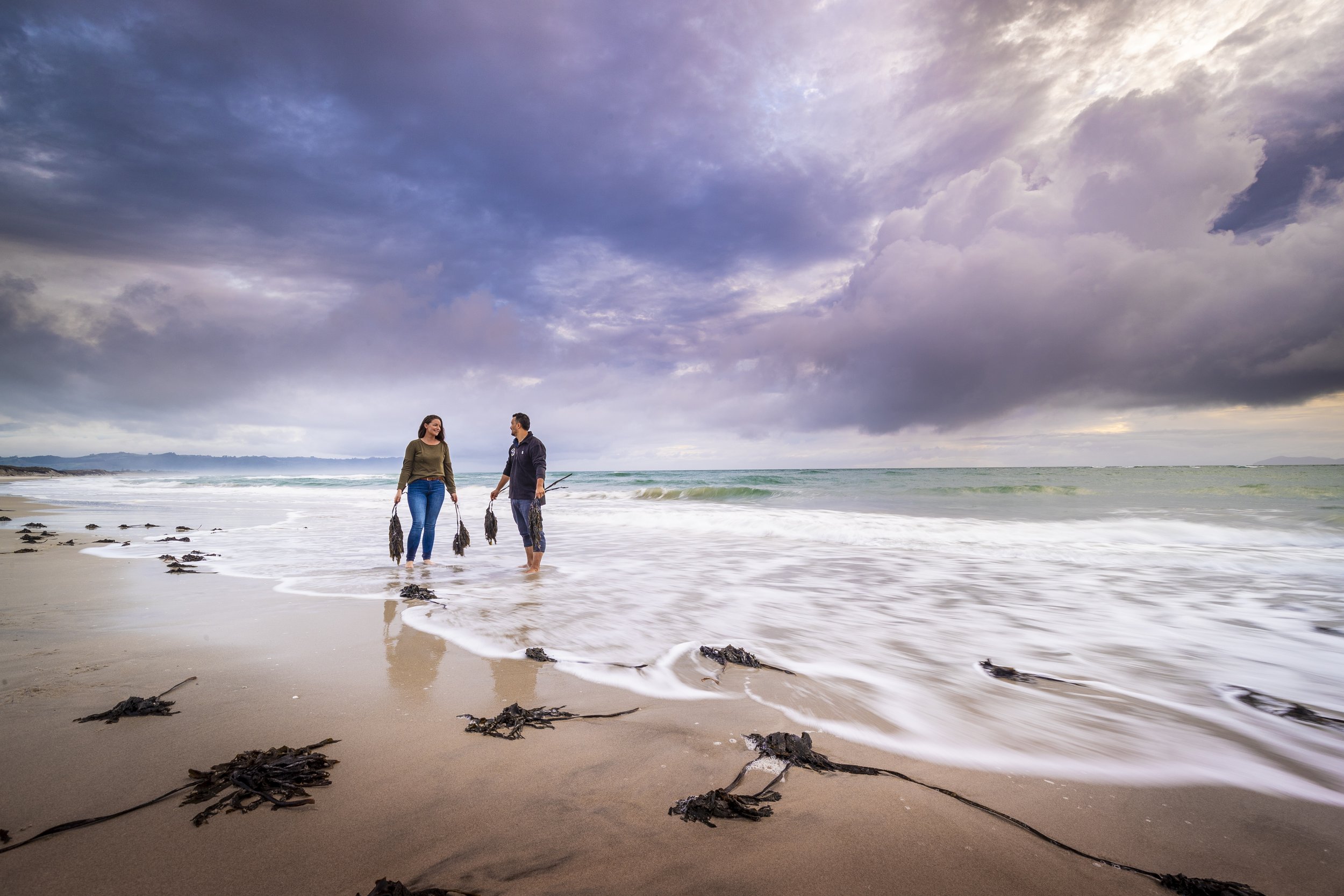

SEA CHANGE
A Tauranga seaweed farm is turning local waters into a hub for climate and coastal innovation.
A Tauranga seaweed farm is turning local waters into a hub for climate and coastal innovation.
WORDS ALISON SMITH PHOTOS PAUL ROSS JONES + SUPPLIED
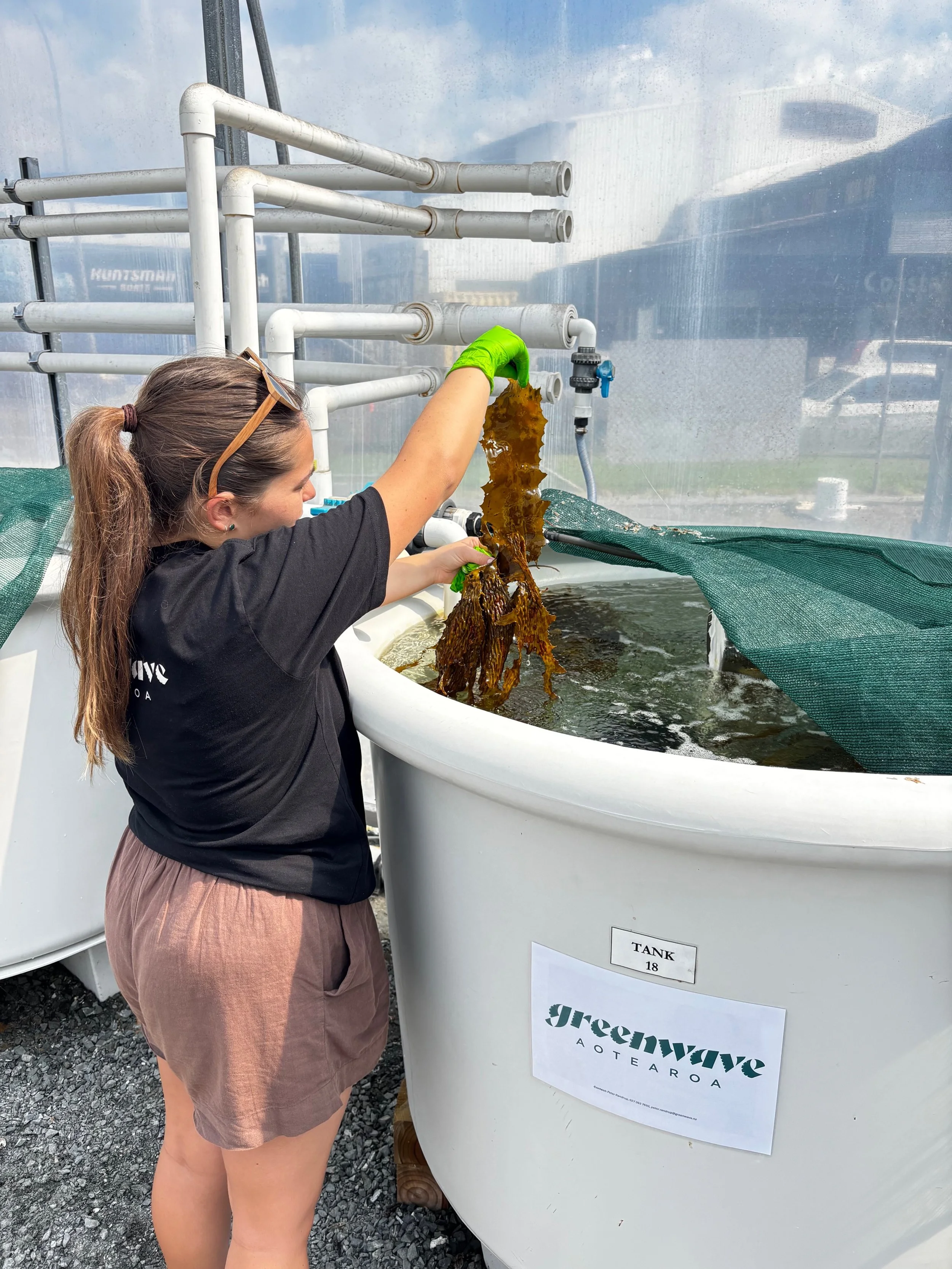
Huna Hough of Greenwave Aotearoa at the Tauranga hatchery.
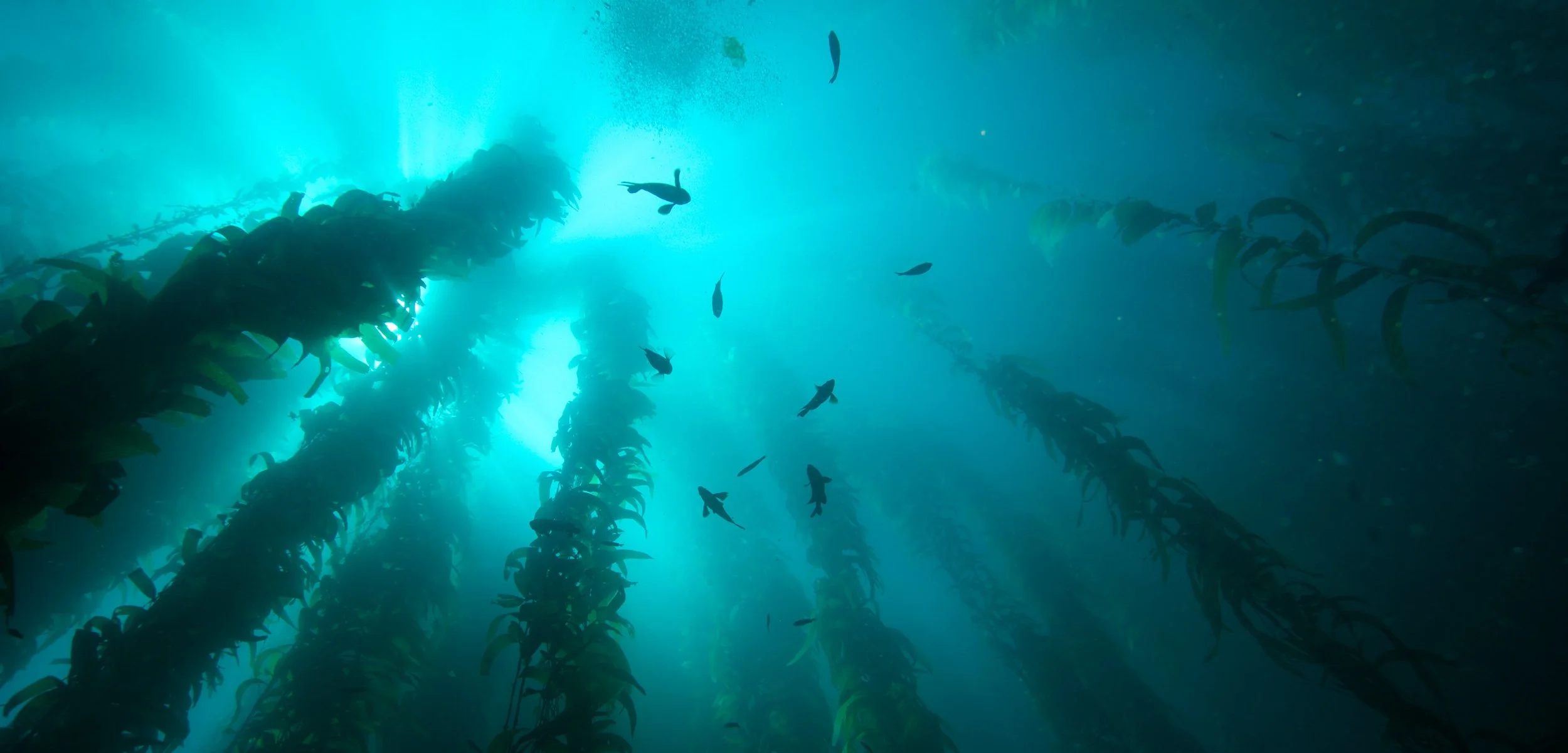
When healthy, New Zealand’s reef ecosystem is a rich and beautiful tapestry of fish species navigating golden hued kelp forests, pink paint and coralline seaweeds against a backdrop of teal green sea and bubbling tide.
This underwater world is underexplored and underappreciated by many, with spearfishers and snorkellers the most common admirers of its charms. Yet seaweed holds huge potential not only as an ecosystem in its own right, but as a climate hero for its ability to absorb carbon, filter water and provide a source of nutrients to humans and animals.
At the University of Waikato Marine Station in Sulphur Point Tauranga, a small and dedicated team lives and breathes seaweed. Greenwave Aotearoa began as a pilot project funded in part by the Sustainable Food and Fibre Futures Fund (SFFF) administered by the Ministry of Primary Industries.
Led by Auckland-based venture developer EnviroStrat, Greenwave Aotearoa is building capacity for a network of regenerative ocean farmers to farm seaweed nationwide.
Māori have used seaweed for centuries — as a food source and for storage. As Te Ara Encyclopedia of New Zealand explains: “with its long coastline and abundant seaweed resources, New Zealand has the potential for a thriving seaweed industry.
However, the labour-intensive nature of harvesting and aquaculture has prevented the country from competing against bigger producers in Asia.
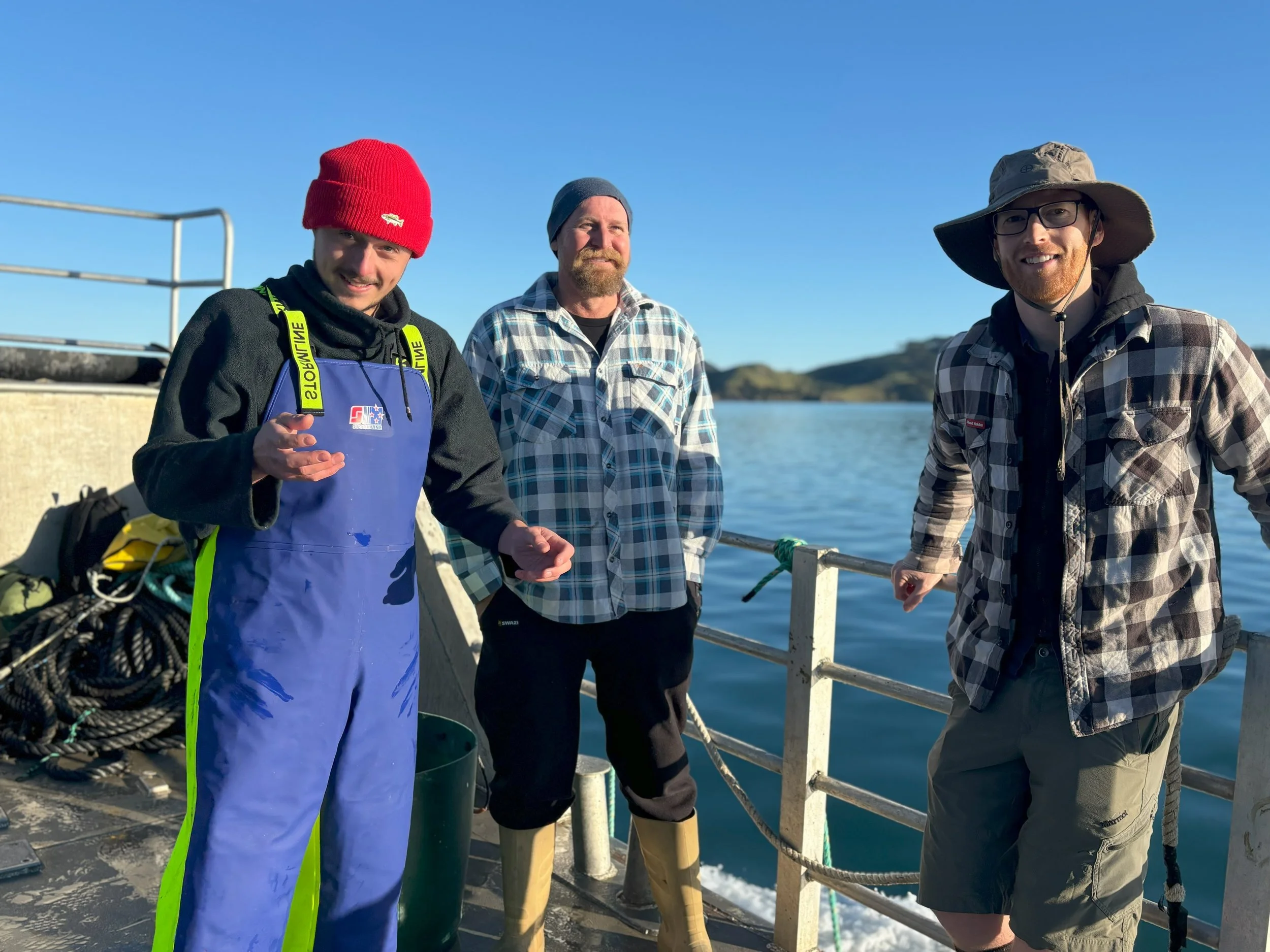
Lucas Evans, Premium Seas, with Peter Randrup and Ryan Marchington, both Greenwave Aotearoa.
Greenwave Aotearoa has been working to turn this around.
“Our oceans hold vast potential for sustainable innovation and seaweed is one of the most promising solutions,” believes founder Dr Nigel Bradly. “By farming seaweed and creating high value uses for the harvested biomass we can create a future that supports our needs while protecting the environment.”
Getting to this point has taken a great deal of learning. The project began in the Hauraki Gulf at a seaweed trial adapted from mussel farm infrastructure off the Coromandel coast. It faced challenges — including skeleton shrimp eating early-stage growth, a marine heatwave, and adapting gear to grow something never farmed here before.
Here, mussel farmer Dave Blyth — who says he keeps meaning to retire — has had his retirement sailing trips disrupted by helping grow a new seaweed industry in New Zealand alongside the Greenwave team.
The process begins with collecting seaweed under permit from the wild. The team works with the seaweed to induce spores in a Sulphur Point hatchery, where it’s nurtured under red lights using techniques refined over three years.
Microscopic baby seaweed (sporophytes) is grown on spools. The Tauranga-based team led by Peter Randrup had to determine exactly what was needed for it to thrive in an artificial environment so seedlings could be produced at scale for planting on farms. This is where farmer Dave Blyth comes in.
Dave is showing the ropes to scientists including Greenwave aquaculture lead Ryan Marchington, who brings his seaweed farming experience from Europe. Seaweed farming is new in New Zealand, and the team had been using systems designed for mussels, not seaweed.
With Ryan sharing knowledge from overseas, the team has now optimised on-water operations using custom systems.
“It’s been a big learning process. You can grow seaweed in a hatchery but it doesn’t automatically follow that they’ll keep growing in the water,” says Dave. “I enjoy the innovating — designing the gear and coming up with new ways of doing things and working with the young people from Greenwave Aotearoa and the University of Waikato. Peter and Ryan and all the guys are good; no-one has got all the answers. You don’t curtail their enthusiasm but it’s good to inject how to do things out on the water in a way that will make it easier and more efficient.”
This collaboration between a seasoned mussel farmer and international techniques was a crucial turning point. Growing seaweed closer to the surface, as farmers do in Scotland, allowed the young sporophytes to photosynthesise more efficiently and outcompete fouling.
“Our hatcheries were producing good-quality spools. The issue was the farming system design,” explains Ryan. “Once we changed that, we saw the difference.”
Greenwave Aotearoa is now expanding to the South Island and is successfully growing Ryan’s favourite product innovation is key to the success of the industry, to enable full utilisation of New Zealand’s precious seaweed resources with benefits to seaweed farmers in coastal communities, product innovators and consumers. All without taking away the underwater forest upon which so many marine species rely.

Superpowered seaweed
Humble and ubiquitous, seaweed has been around since before the dinosaurs, and an enterprising Paeroa family has harnessed its natural benefits for the agricultural industry and beyond.
Humble and ubiquitous, seaweed has been around since before the dinosaurs, and an enterprising Paeroa family has harnessed its natural benefits for the agricultural industry and beyond.
Words Catherine Sylvester

Paeroa, nestled at the base of the Coromandel Peninsula towards the northeast of the Waikato; unofficial antiques capital of the country, geographical originator of the quintessentially Kiwi soft drink L&P, and home to the whānau-founded, owned and operated Agrisea, which specialises in the manufacture and innovation of high-nutrition seaweed products.
If you’ve found yourself traversing north on State Highway 2, emerging from the Karangahake Gorge, you may have spied their factory to the left and wondered exactly what one does with seaweed aside from wrapping sushi rolls with it. The answer, it turns out, is quite a lot.
Tane and Clare Bradley are second generation kaitiaki, or caretakers, of the family business. It was Tane’s parents, Jill and Keith, who saw the potential the marine algae has to make a positive impact on the nutritional and environmental aspects of the food we grow and eat. Almost 30 years ago, a summer spent working on organic farms saw the couple witness firsthand the benefits seaweed nutrients could have on land and crops. Having complete confidence in their discovery, they packed up their family and moved from Tāmaki Makaurau to the more affordable Paeroa to realise their dream of creating organic products to support the home gardener.
“All us kids thought it was just a hobby till they called a family meeting, sold the house, and off we went,” laughs Tane. “We thought they were nuts!”

From humble beginnings selling Ocean Organics seaweed products from the store they rented and lived behind, the business flourished and in 2004 rebranded to become Agrisea, with an expanded focus to include the horticultural and farming climate of the industries the company found itself on the doorstep of.
Clare explains that the Agrisea products are biostimulants, rather than fertilisers.
“Fertilisers work by supplying nutrients such as nitrogen and phosphorus, which in overuse have a negative effect on the farm system and environment,” says the company’s CEO. “Biostimulants stimulate natural processes within the plant and soil to enhance growth, efficiency and health. It’s the plant equivalent of the difference between running a well-serviced car, rather than just putting more oil and gas in it.”
The couple met 18 years ago when Clare was forced to return to New Zealand due to a flesh-eating disease she’d picked up while living and volunteering in the Amazon rainforest. They laugh when retelling this story, which is typical of the pair’s positive view on life.

“Tane makes friends wherever he goes,” Clare explains. “That’s how we’ve started some of our latest collaborations.”
Innovation and forward-thinking are keys to the company’s success. As well as three core agricultural products, they’ve found exciting and interesting ways to incorporate seaweed into new offerings as diverse as alcoholic beverages, kombucha and bee nutrition.
“We’ve partnered with Dominion Salt to make New Zealand seaweed and salt blocks for animals, and Roa Kombucha to make a delicious new drink,” elaborates Tane. “We’ve partnered with others to make a seaweed stout, vodka and gin!”

Apiarists and bees alike have fallen in love with the company’s Bee Nutrition that provides the essential amino acids, trace elements and minerals bees need to grow and reproduce, and the company has gone global with the product.
The apple hasn’t fallen far from the proverbial tree with the Bradleys, as they’ve inherited Jill and Keith’s original care and concern for others and the environment.
“Mum always used to say, ‘We’re not here to buy baches, boats and BMWs’,” Tane says. “'We’re here to make a difference.'”
This care comes in the form of research into the potential seaweed has to remove toxins from our coastal waters. Their pilot programme has seen great success with the next step being to figure out how to replicate this on a larger scale.
They’ve also partnered with Our Land and Water to research ways the mana and mauri of soil can be respected, and how a combination of matauranga Māori farming practices and science can create positive change.
So next time you find yourself in Paeroa and spot the Agrisea hub, take a moment to marvel at the wonder and potential of this humble gift from the sea, and all the superpowers seaweed has to offer.