

OUTWARD BOUND
Through their new online series, Kids Unplugged, a local family of filmmakers is encouraging young ones to turn away from their screens.
Through their new online series, Kids Unplugged, a local family of filmmakers is encouraging young ones to turn away from their screens.
WORDS KARL PUSCHMANN

The question of how much screentime is too much screentime is one many parents wrestle with. Thanks to the rise of streaming services and devices like iPads and smartphones, kids could have access to virtually any TV show or movie they want, whenever they want.
It’s a problem previous generations of parents haven’t had to face, so it’s no wonder that when it comes to screen time, many parents feel the genie has escaped its bottle.
It was while reading social psychologist Jonathan Hyatt's book, The Anxious Generation, that producer Kylie Dellabarca Steel realised something needed to be done to encourage kids to unplug.
“There are a lot of devastating statistics in that book,” she sighs. “The addictions, anxiety, depression, sleep deprivation… all that negative stuff that comes with too much screen time. No parent wants their kids to resemble the statistics in that book. It’s sad and depressing reading.”
Kylie gave the book to her husband, director Anton Steel, who felt the same. They began thinking about how they could “use the tools in our hands” to make a positive change.
The eureka moment came, as these things often do, unexpectedly. “It just popped into my head when I was in the shower,” laughs Kylie.
The idea was Kids Unplugged, an online series of 10-minute episodes that show children how much fun there is to be had when they unplug, and profiles inspiring locals who’ve found joy, fulfilment, health, purpose and human connection after switching off their screens.
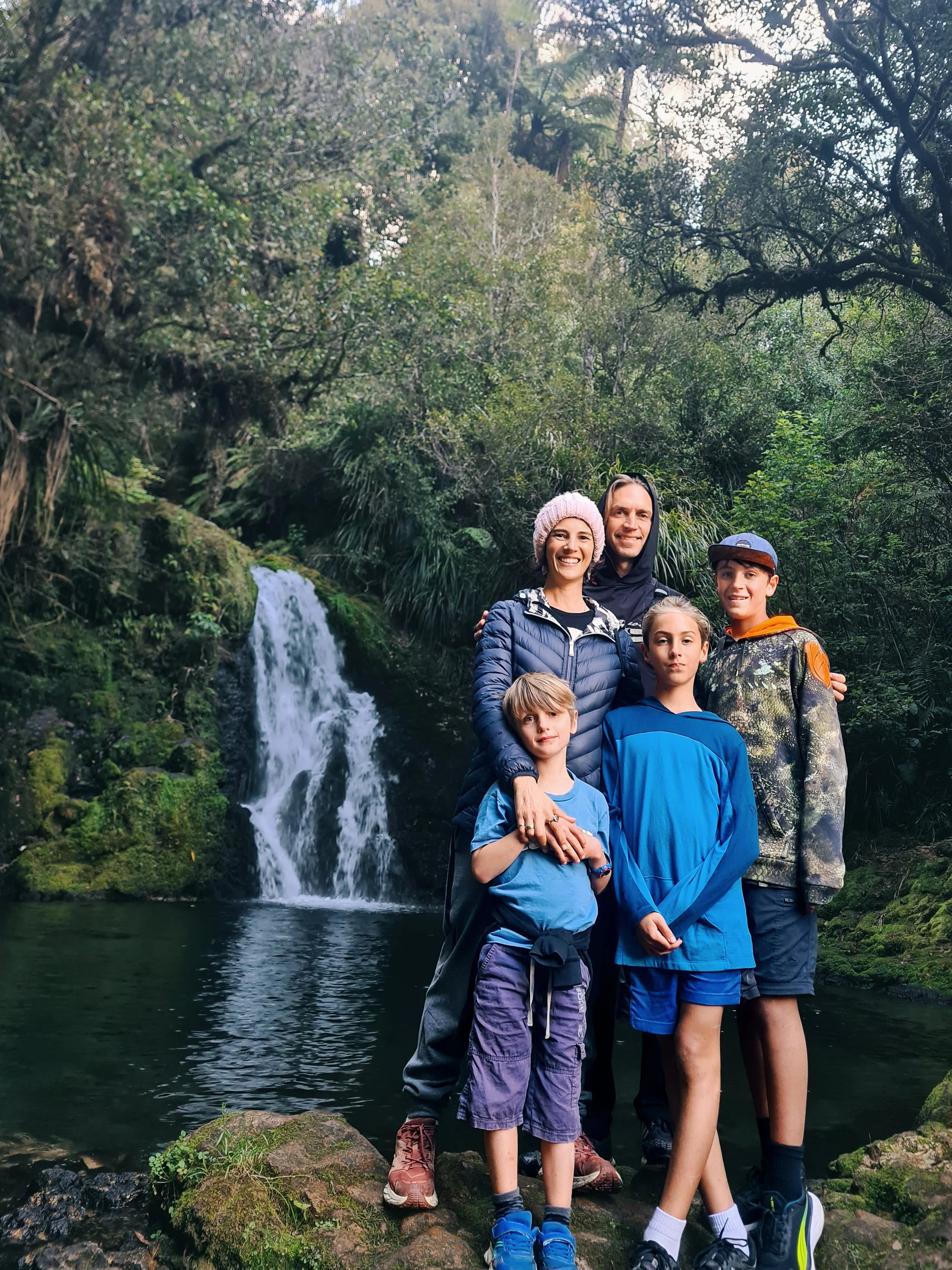
At Otanewainuku waterfall, clockwise from left: Kylie, Anton, Malachi, Judah and Ezra.
The clever part is that the show isn’t doom and gloom, nor does it try to scare kids off their screens. Instead, the couple’s three children, Malachi (15), Judah (12) and Ezra (7), present it, making it hugely relatable to its intended audience and ensuring it stays light and fun, and doesn’t become preachy. The goal was to make kids want to unplug, rather than being told to.
“In mountain biking, there’s a saying, ‘Where you look is where you hit’,” says Anton. “What that means is if you look at the trees, you’ll hit the trees, but if you look at the trail, you’ll focus on that and go where you want to go. If we just talked about all the negatives of screen time, we’d actually lean towards them, but if we tell the story of the positives of unplugging, all the health and wellbeing benefits, that’s where people will go.”
Having crowd-funded several other independent productions, the filmmakers followed the same steps to fund Kids Unplugged. It was a topic that resonated, and people were quick to support the project.
The six-episode series heads off on outdoorsy adventures like hiking, snorkelling, horseriding and skiing, while showing the unplugging journey other kids have made. For example, it features a 15-year-old former videogame addict who gave up screens and found a new calling as a political activist, cycling to Wellington to present a case for the continuation of Māori wards in his hometown of Whakatāne.
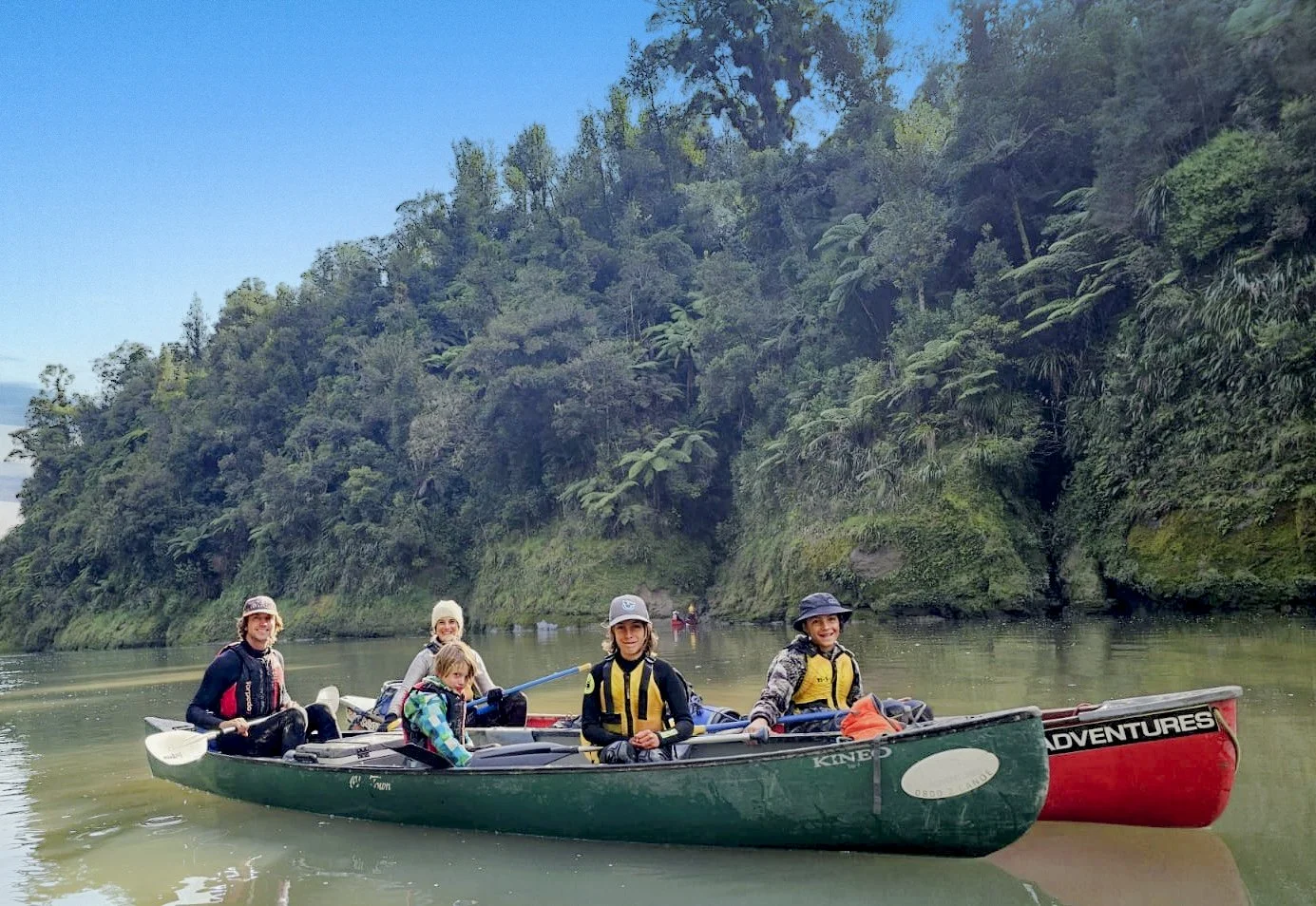
“Jack's a good example of someone who was overweight, sleep-deprived and addicted,” says Anton.
“He had played 3000 hours in the video game Runescape,” Kylie says, almost in disbelief. “He went from a complete screen addict to a child who’s full of life. He’s thriving, happy and healthy, and gives so much to his community.”
“He really turned his life around,” says Anton.
All up, the show took a year to make, from idea to funding, filming to production, to now streaming for free on RNZ’s website and YouTube. It’s been quite a journey, but the family’s keen to get to work on season two.
“We filmed the series in the Bay of Plenty for budget reasons, and because it’s the fantastic place we live in, but we’d love to take it nationwide,” says Kylie.
Anton nods: “The dream would be a family road trip to find amazing kids all around New Zealand.”
As for Judah, he was initially a little wary of the project, having grown up watching the amount of work mum and dad put into their productions.
“I knew it would be a lot of time and effort,” he says, “but it was quite fun. I enjoyed making it because I got to meet other people who live unplugged and I got to do fun activities with them.”
3 TOP TIPS FOR UNPLUGGING
1. “It can be as simple as making a cushion hut in the lounge or going for a walk. Instead of hopping straight onto screens straight after school, just get yourself outside. Start with small steps like that.”
– Judah
2. “Don’t be too hard on yourself to begin with. Ease into it. It’s tricky for parents, but be intentional and recognise that you're your kids’ role model. There’s no point preaching unplugging to them if you don't practice it yourself. We try to be those role models and not use screens recreationally ourselves.”
– Kylie
3. “Aim for balance. We want to eat healthy, we want to exercise for healthy bodies, and we want to think healthy too, so try to encourage balance in your kids’ lives. If they’re going to spend some time on a screen, then think about what they can do to balance that time.”
– Anton

Teens and screens: Finding the balance
Ellie Gwilliam from Parenting Place explains how parents can guide teens back to real-world connections when screen time dominates social interactions.
Ellie Gwilliam from Parenting Place explains how parents can guide teens back to real-world connections when screen time dominates social interactions.

Technology offers us great ways to stay connected and maintain relationships. Our teens, amongst the first ‘born and bred’ digital natives, are experts at online connection − handy if we ‘older folk’ need tech support. But, how are their social skills playing out in real life?
Are our young people able to connect with others and build relationships in the offline world? Can they be social without the media? Will they ever actually talk to us again, instead of just sending a DM asking what’s for dinner?
If this concerns you, here are three things to consider as you encourage your teenager to put down their device and engage in some face-to-face interactions.
Try to remember what being a teenager is like.
The teenage years are defined by social awkwardness, feeling misunderstood and a desire to assert independence, all while still having to follow rules. So, it isn’t surprising that our teens can find interacting in-person difficult – especially when we insist on them doing so on our terms.
While you might think getting them to show off their ukelele skills at the staff Christmas party is a helpful way to face their social insecurities, it may just reinforce their beliefs that the online world is a much safer and more pleasant place to socialise. Instead, provide low-pressure opportunities for social interaction – perhaps with people familiar to them where they can choose to interact or just observe.
Ask for their suggestions and follow their lead.
The teenage brain thrives on connection with peers, but that doesn’t mean it doesn’t like connecting with parents. While a teenager’s friends are very important to them, research tells us that the parental relationship remains a strong influence. Our teens want us to show them that we find them interesting, likeable and worthy of our time. One of the best ways to do this is by connecting through their interests and pursuits. This may mean trying to understand online gaming or wading through obscure reels, but it could also mean giving them a lift to the gaming store or skate park, shopping for snacks or trying testers at the makeup shop – all opportunities to develop real-life social skills without them realising!
Model good social skills.
Teenagers are experts at tuning out lectures. While our words may not matter much, teenagers always watch and learn from our actions. So, if we want our teens to get off their devices and use their real-life social skills, we must do the same.
Managing our own device use and getting out and about ourselves can give our teenagers the confidence to do so as well. Be a role model of good conversation and asking good questions. Show them how to treat others with respect and empathy. And even if you’re not that assertive in social situations, make the effort to go outside of your comfort zone and flex all the social muscles you have – after all, that’s what we’re asking our teenagers to do!

Adventure in comfort
Tanya Chaffey from Chaffey and Turner Travel Associates is UNO's new travel columnist, this time offering her expert advice on navigating luxury travel with the whole family.
Luxury and family-friendly travel don’t always go hand in hand. But travelling with children doesn’t mean you have to miss out on the finer things in life. Tanya Chaffey from Chaffey and Turner Travel Associates is UNO's new travel columnist, this time offering her expert advice on navigating luxury travel with the whole family.
photos SALINA GALVAN + supplied

Embarking on travel with children creates life-long memories that you and your family will treasure for years to come.
It does, however, require a bit more planning to balance relaxation with family-friendly needs. Here are a few tips to get you going.
• When it comes to choosing which destinations to visit with children, look for spots that offer both premium amenities and child-friendly activities. Think resorts with dedicated childrens' clubs, private villas or hotels offering family suites and family activities.

Luxury resorts in places like the Maldives, Bali or the Caribbean offer specialised kids' programmes and family activities, ensuring there’s something for everyone. Also, consider destinations with easy access to nature, such as safaris in Africa, or mountain retreats in Europe, which can engage children while offering relaxation for parents.
• Invest in private tours or excursions. A private guide for a day trip, a yacht charter, or even private spa treatments can offer both family-friendly activities and some quality adult downtime. This can be especially helpful if your child has specific interests or needs (eg a zoo tour for animal lovers). Luxury hotels sometimes offer VIP access to major attractions, meaning you can avoid long lines and crowds, which makes it easier with children.
• Many cruise lines offer amazing inclusions for children, like standing waves, rock climbing walls and even dodgems. And the wide variety of cuisine onboard means there will be options for even the fussiest eaters. Be sure to enlist the help of a travel agent, who can suggest the best cruiseline that will work for you and your family.
• When booking flights, ask your travel advisor to book with an airline that has child-friendly amenities (like bassinets, entertainment and children's meals). Many airlines offer priority boarding, extra legroom, and specialised children's kits to make the flight more enjoyable.
• Finally, even with the best planning, travelling with children can bring surprises – meltdowns, sickness and the like – so remain flexible. Having an advisor on hand means there is always someone available to accommodate last-minute changes or requests. But staying relaxed and patient is the key to enjoying the experience!

Tanya Chaffey is a specialist for premium travel for the Bay of Plenty. Having been in the industry for 17 years, she’s explored 65 countries, with many more on her bucket list, and is a master at planning journeys off the beaten path.
She visits hidden gem destinations and finds experiences that give her an incredible perspective on the culture of a place. One of her best travel experiences was visiting Paro Taksang, or Tigers Nest Monastery, in Bhutan and most recently visited the Five Stans of Central Asia.
No matter your travel plans, whether it's a multi-generational trip of a lifetime, or a romantic seaside escape, the team at Chaffey and Turner Travel Associates will make your holiday special.