
ON THE SHOULDERS OF GIANTS
The seeds of world record-holder Sam Ruthe’s success may have exploded into full bloom recently, but they were sown nearly eight decades ago. Jamie Troughton retraces the remarkable story of a family of runners, which could be culminating in the current generation.
WORDS + PHOTOS JAMIE TROUGHTON + SUPPLIED MAKE-UP DESIRÉE OSTERMAN

If you learn nothing else about Sam Ruthe, just know he’s the type of 17-year-old boy who treasures time with his grandparents.
His ‘Poppa’ and ‘Nan’ are Trevor and Rosemary Wright, who moved to Tauranga 44 years ago. They left behind a life in England, as well as extraordinary athletic careers in their own right.
Sam often pops in during study breaks to see his grandparents at their house in Tauranga’s Avenues, or on his way home from Tauranga Boys’ College, where – almost incongruously – he’s a Year 12 student.
These days, into their late 70s, Trevor and Rosemary are still active. And recently, on a warm autumn day for the umpteenth time in their lives, they were perched on a park bench at Welcome Bay’s Waipuna Park watching cross country. On show was Sam’s younger sister Daisy, and she was putting on an absolute clinic. Not only did she demolish her age group to win the Western Bay under-16 girls title but she cleared home ahead of the entire field of boys, who started at the same time.
“I get more nervous watching the kids and grandkids run than when I used to run myself,” says Trevor. “When I was running, it was down to me and I knew what I was doing, but you can’t control how the kids run their race and you don’t want them to be disappointed.”
Disappointment, however, seems a rare commodity in this family these days. In 1971, Trevor set the world record for the fastest debut marathon, and collected podium medals at the European championships, the New York City Marathon and the London Marathon. His best marathon time would have been enough to finish in the top 40 at the 2024 Paris Olympics. But the former electrician relished the chance to move to New Zealand in 1982, with Rosemary, four-year-old Emma and two-year-old Jess. Now, the girls have five kids of their own and the Wrights are frequently on the sidelines, offering gentle encouragement but a distinct absence of advice. Their once-powerful flame of ambition, which carried them both to achieve worldwide athletic feats, is now just a gentle warm joy for the next generation.
“They really don't talk about their running that much,” says Sam. “Nan's theory is that you don't really need to do too much to be good at running, and she views it as a simple thing you can get good at by doing quality over quantity. She tells me stories about how she used to hide around the corner and eat chocolate while others trained. It might not be a great tip, but it definitely makes running a lot more casual, having that perspective.”
It turns out that Rosemary grew up in Whakatāne – where she spent the first 14 years of her life – next door to the grandmother of one of Sam’s good mates and training partners, Ronin Dickens. That piece of trivia has absolutely no bearing on anything, other than to provide a comforting reminder that, in this country, we live in merely a large village.
Sam’s village is tight and trustworthy and nourishing; his family is his foundation. He may or may not become the greatest runner New Zealand has ever produced, but he will always know where his feet stand, and who has put him on his journey.
“That’s the really cool thing about having a family full of runners – everyone’s been there and done that, and things like records don’t interest them as much,” says Sam. “They understand everything that’s going on, they don’t see you as ‘a runner’, and it helps build your own identity within your family.”
Fifty-six years later, Rosemary can still hear the pulsing roar of 5000 Edinburgh throats, opening as one. Meadowbank Stadium, newly opened for the 1970 Commonwealth Games, shook on its foundations as the women’s 800m field leaned into the final curve.

Time has blurred out most other details for the long time Tauranga teacher, clad that day in the white and St Andrews blue of her adopted Scotland. Intriguingly, she was also something of a prodigy. Then Rosemary Stirling and still just 22, she was at her second Commonwealth Games after a promising debut in Jamaica four years earlier, where she’d picked up a pair of fourths in the 400m and 800m.
Just eight years after moving back to the UK with her British-born parents, and having overcome injury in the lead-up, she was still only rated an outside chance in the 800m on the final day of the Games.
“I remember [England's] Sheila Carey falling over on the first lap and thinking, ‘That’s good’ because she was the favourite to win,” the now 78-year-old recalls of that 1970 final. “And I can just remember crowds. There were huge crowds shouting and bawling and just screaming. It definitely lifted me.”
After two compelling laps, it all came down to the final few desperate strides, when the Kiwi-born Scot lunged at the line to beat England’s Pat Lowe and Australia's Cheryl Peasley. It was the closest finish of the Games, and Scotland’s first-ever female track gold medal at Commonwealth level. It’s given Rosemary an enduring legacy in Scotland. She made the Olympic final in Munich two years later, and her 800m national record stood in Scotland until 2002. She was invited back to help open the 1986 Games and received an honorary doctorate from the University of Glasgow in 2014.
These days, Rosemary downplays her own athletic feats to the point of irrelevance. “It’s only running,” she says. Though dismissive, there’s a glimmer of steel in her tone, well known to the thousands of Tauranga Girls’ College students she’s taught over the years. And there’s also a deeper philosophy embedded in that short truth, one that has become something of a family mantra.
It’s only running. You can see that, later that same autumn day, when Sam starts rekindling his deep, abiding love affair with the sport. On Tauranga Domain’s busy synthetic track, he’s taking the first, slightly tentative steps from a fast walk to a light jog, six weeks after suffering a stress fracture in his fibula during a casual game of backyard football. At 17, it was his first major injury, which has since ruled him out of emulating his grandmother’s Commonwealth Games heroics – this year, at least.
Around him, his village takes note and quietly celebrates. Coach Craig Kirkwood sends his burgeoning training squad on their way, pacing out meticulous laps, alongside Tauranga Boys’ College’s gun running posse, coached by Sam’s uncle, Gareth Hyett. All of them have had front-row seats in the past two years, as a young man in their midst – their buddy, protégé, training mate and schoolmate – burst onto the world stage in the most extraordinary manner.
Sam’s most recent piece of history came at the John Thomas Terrier Classic at Boston University in late January. The mile race featured three Olympians, a world champion, a junior world champion, a US champion and a two-time US college champion – and yet, striding past Belgian Olympian Pieter Sisk in the final 200m, came a 16-year-old from Tauranga, jaw clenched in the final straight, clocking a scarcely believable 3:48.88.
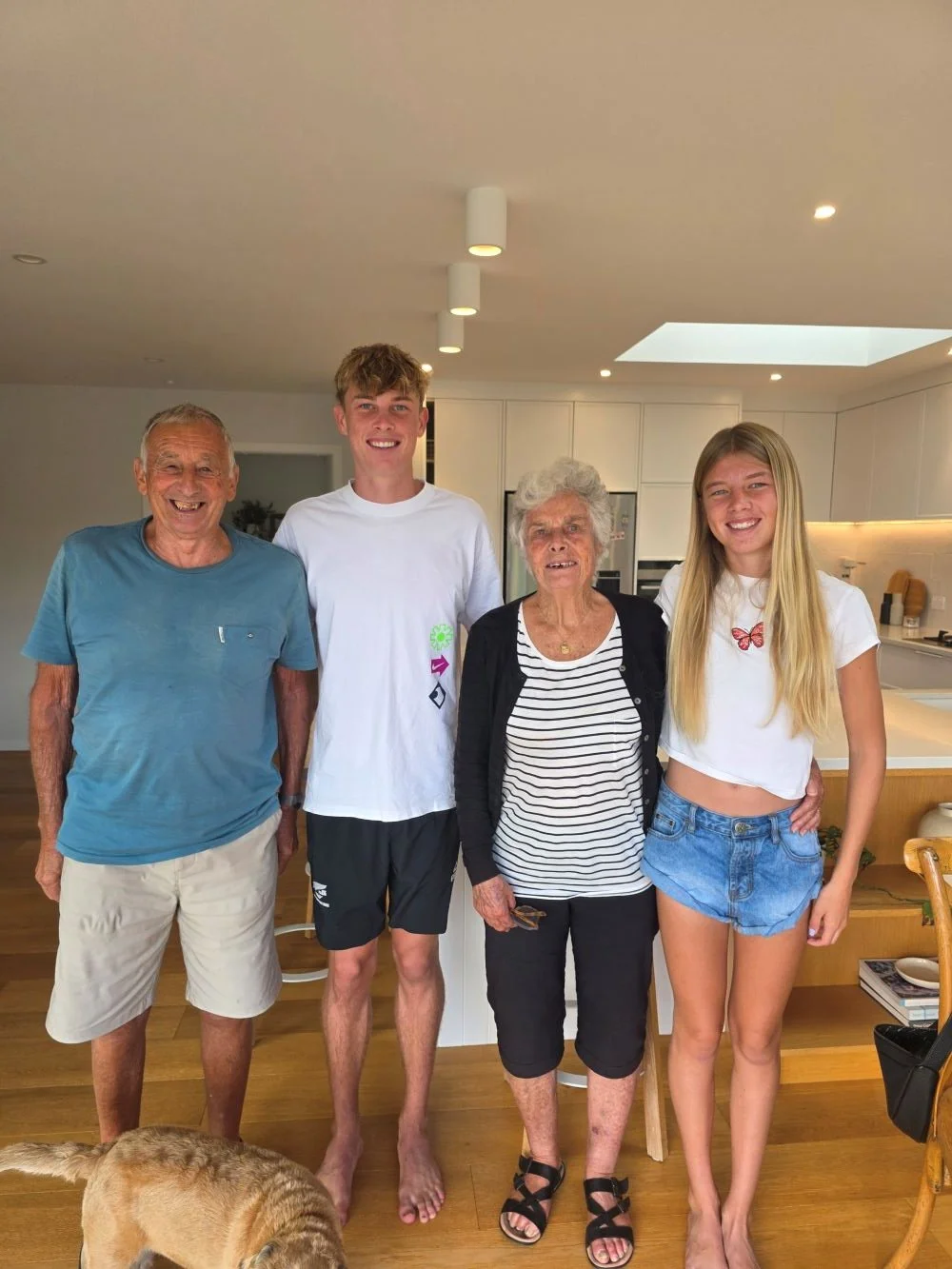
Trevor and Rosemary Wright – aka Poppa and Nan – with Sam and Daisy.
Since New Zealand’s John Walker first broke the three minute 50 second barrier in 1975, only 63 men worldwide have managed it. None were under the age of 18.
As well as breaking the under-18 world mile record – and this is one for the stats lovers – it was also the fastest mile run during the month of January. Ever. But the greatest race of Sam Ruthe’s career – so far – was a curious moment for the Tauranga schoolboy.
“I didn’t really get any sense of satisfaction. Once I finished that race, I thought, ‘I definitely have more to give’. I was just off the plane and know I can definitely go a lot faster than that. At the time, I also didn't really realise how perfect the race went, how even the splits were, the atmosphere at the track and all the factors that played into it.
“But running’s a sport where you’re never satisfied and I don’t even really have goals, so it wasn’t as if it was even a goal for me to run the New Zealand record or the under-18 world record. I guess I was happy about it, but I wasn't satisfied.”
After all, it’s only running. That Boston race was bittersweet for the other Kiwi in the field, who just happens to be another Tauranga prodigy, until recently also coached by Craig, two-time Olympian Sam Tanner. Of course, the 25-year-old has known for a while that his young training partner is something a little bit special. They notably shared the New Zealand 1500m title last year in an enthralling dead heat, and Tanner paced Ruthe on the way to his historic sub-four-minute mile as a 15-year-old weeks later. Things were actually shaping up perfectly for Tanner in Boston, until disaster struck 400m in, with his young training partner tucked in behind.
“I told Sammy before the race, ‘Just turn your brain off and follow me, bro – you’ll be sweet’, and he turned his brain off and followed me. We got in a perfect position, and then the dude who chopped between us clipped my Achilles and I had to pull out. Sam ended up behind him, but then he just went around because that guy was falling off, and then he just followed Peter Sisk, which was perfect.”
Injured, Tanner watched the rest of the race unfold from the sideline, with mixed emotions. “It's not very often that you get a perfect set-up like that for a 3:48 mile. I’ve been waiting five years and I thought it was my chance; often the races that I’ve been part of have had a 3:45 pace or a 3:46 pace and I’m not quite there. You end up blowing up and run 3:50, or 3:49, like I’ve done a couple of times.”
Tanner’s also wise enough to know that a great running career is a thing to build brick by brick, and he piles credits onto Craig for his craftsmanship in that realm.
“Kirky’s just so good at seeing where an athlete’s at, making the best decision and trying to guide them, rather than just thrashing them. He lets the talent speak for itself and just cultivates that. And for Sammy, it just means that a little bit of work goes a really, really long way.
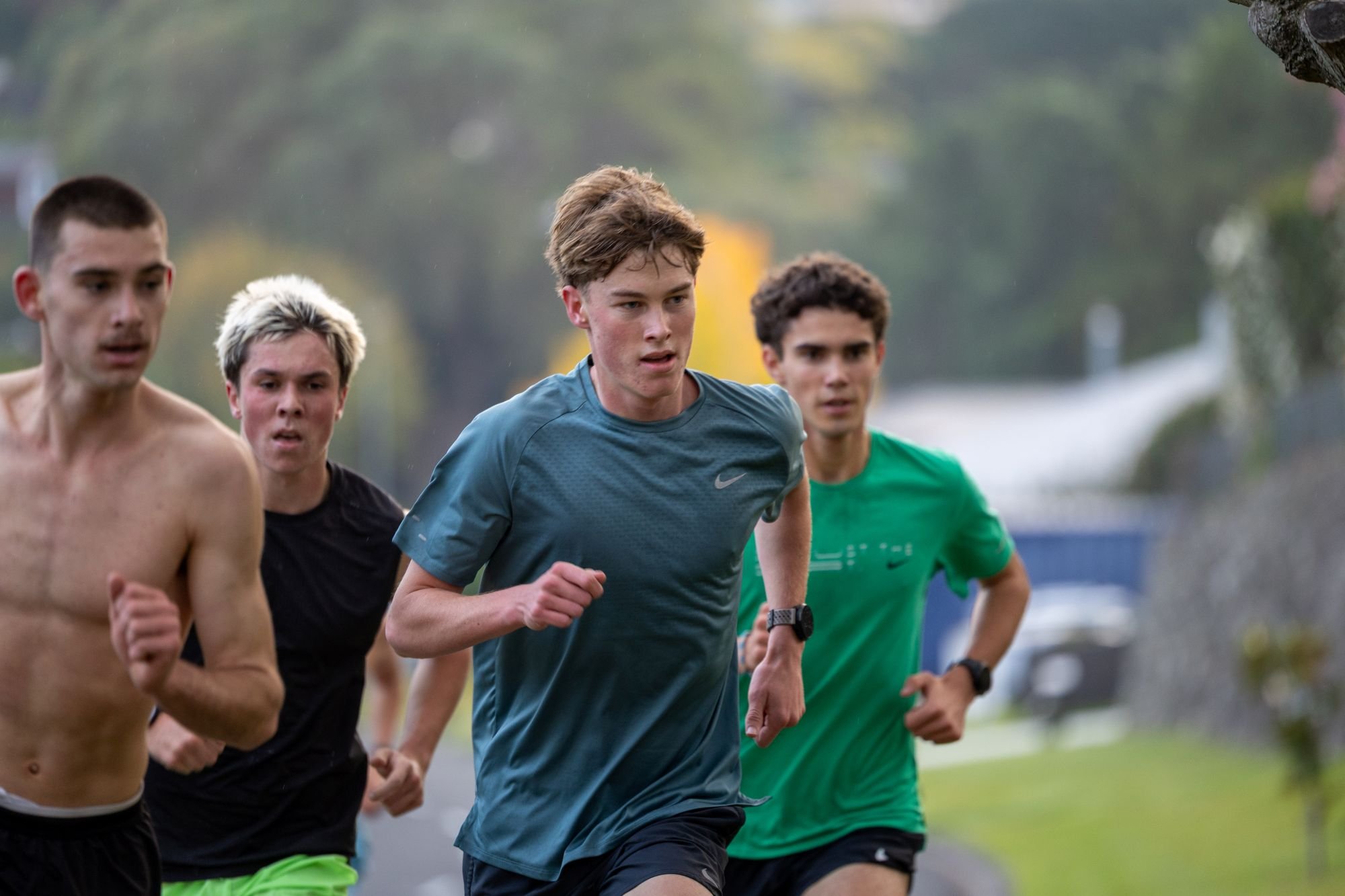
“Sammy and I just got lucky; we can both punish ourselves and enjoy the punishment for the sake of success. And when you've got parents who are good at goal-setting and you look up to them in that sense, it becomes a perfect storm.”
For his sake, young Sam has been exposed to the likes of Tanner, triathlete Hayden Wilde and top Tauranga runner Julian Oakley from the time he started running seriously at 14.
“It's pretty incredible when you can see someone in the training group and you’re like, ‘Oh, that’s the level I need to get to, to make this my career’,” says Sam. “It’s a cool feeling when you’re running with Tanner. Heading off with Ben on the US tour in January, on which Sam broke numerous records. Sam signed with Nike in March 2025. It’s not like, ‘I’m training with an Olympian’ – it’s the feeling of knowing exactly where you need to be to make it. The coolest thing was seeing how close I could get to him, every time I’d run with him, and that brought me to the level I am today.”
Sam has always been polite, quiet, even shy, says Sam’s father, Ben Ruthe. He has a good yarn about his young son at daycare, when a clown came in to make blow-up balloons. Swords, crowns and sausage dogs were being requested and handed out to the other kids, while Sam sat there quietly, as his parents had instructed.
“It wasn’t until right at the end that he went up and asked for a sword, and the clown had run out of balloons,” recalls Ben, clearly still a little mortified. “I thought it might’ve been quite crippling – we'd taught him to be quiet and patient and polite and never demand or ask things, and he’d missed out. I think we spent the next 10 years trying to encourage him to vocalise what he needed!”
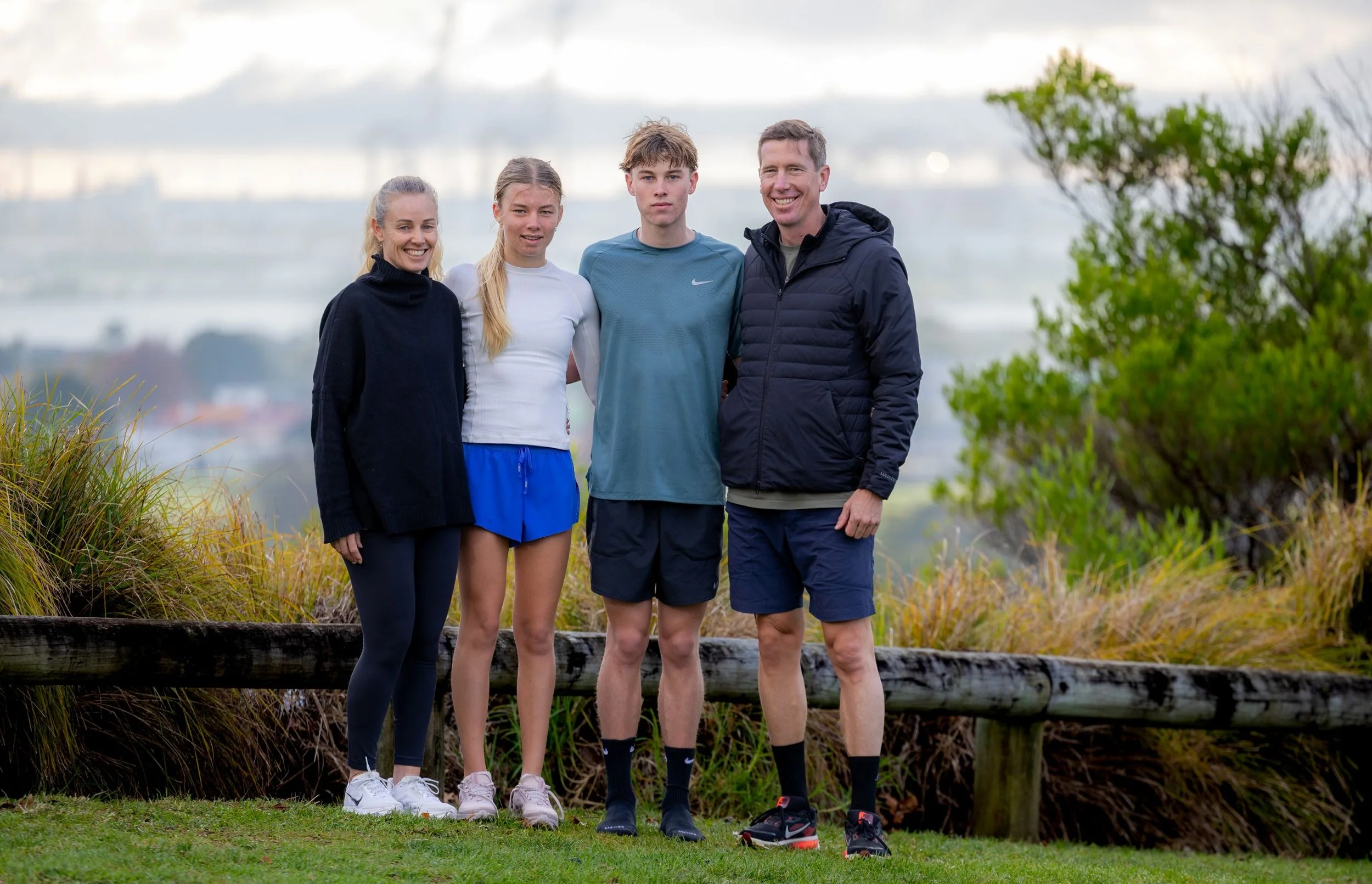
From left: Jess, Daisy, Sam and Ben.
These days, Ben has his own semi-permanent air of bemusement about him. He knows a fair bit about running himself, having won the Auckland Marathon in 2008 and New Zealand titles in the 1500m and 5000m.
Sam’s mum Jess, meanwhile, won the Auckland Marathon in 2009 and New Zealand titles in the 1500m, 3000m, 5000m and the 10,000m (twice). Still, they’re amazed by what Sam has achieved so quickly – it’s been far more life-changing for them than their eldest child. While the sub-four-minute mile was staggering, Ben had an inkling things were about to go up a level late last year.
“There were signs in training in November that Sam was in really good shape,” he says. “He was training with Tanner, who couldn’t have been a better training partner, and all of a sudden, instead of a kid trying to keep up with an Olympian, it was, ‘Sam’s starting to hold on here’, and, ‘Sam’s taking his fair share of reps’.”
Sam’s memory is even clearer. He can pinpoint one typical early-Saturday session along Ōtūmoetai’s Beach Road in particular, when he realised he could genuinely foot it with international-class seniors.
“Tanner always makes us share the reps, and when Craig sets us a pace, sometimes I might push it a little bit faster than that, just to test things a bit. I remember one session when everyone else was dropping off and I was thinking, ‘How hard is Tanner puffing right now?’ and I got the feeling that I was nearing his level because he took over and dropped the pace down again. Little moments like that are really cool to look back on.”
Ben points out that Sam’s recent injury has also had the unintended benefit of encouraging him to ask for help, but it also heaps more pressure on the parents of an athlete, when everyday decisions start carrying increasingly larger ramifications.
“We had a debate about suggesting he didn’t go out and play barefoot soccer with his mates. We weighed it up and decided, ‘Nah, we want him to enjoy the best of Kiwi youth’ – and that’s the day he picked up a fibula stress fracture!
“But if I went back in time, I’d still let him go out and play football, because you learn so much from something like this. His mindset now is around strength and conditioning, stretching, core work, cross training. He was a good runner, but now he’s got a much broader view of all of the ingredients he needs.”
Because of that inbuilt, humble mindset, Ben also has no fear that Sam’s international success will cause him to get cocky.
“We really haven't wrapped him up in cotton wool,” says Ben. “We’ve constantly put him in situations where he could test himself, and that comes with risk. He genuinely just enjoys the process and has never wanted fame. He just wants to work hard and work towards results, and any sort of fame is not a motivator for him.”