

I want to Hide
To find Hide, you'll need to shimmy down the alleyway by the Prince Street roundabout on The Mount Mainstreet. It opens out into a courtyard that feels like someone's exceptionally well-appointed backyard.
WORDS JENNY RUDD PHOTOS TRACIE HEASMAN

Hide. What a great name for a boozer. To find Hide, you'll need to shimmy down the alleyway by the Prince Street roundabout on The Mount Mainstreet. It opens out into a courtyard that feels like someone's exceptionally well-appointed backyard. Walled in on every side, a roaring fire is the centrepiece. There are built-in wooden booths for big groups to gather, family barbeque under a lush green living wall, a sunny strip of seating tucked behind the fire (perfect for a hot date), and a cosy nook inside overlooking the courtyard.
This place has been home to many things over the years: Lynx hairdressing salon, an outlet store for Sisters&Co, and two restaurants: Mundo Mexicano and more recently, Mr Miyagi. It is now completely unrecognisable. In a good way.
Owners Matt and Kimberly Hayward are hospo royalty in Tauranga, bringing with them the experience of running Winnies in Queenstown in the early 2000s, and owning Da Bierhaus, which they turned into La Mexica on The Strand in Tauranga. The couple and their two girls, Mila and Liv, are now firmly rooted the other side of the bridge with Hide and Mount Brew Co, which is like the cheeky younger sister to Hide's rough and tumble older brother.
"Kimbers' role is to make sure everyone's well fed. She grew up with foodies and fantastic cooks as her parents owned restaurants. It's my job to make sure everyone has a good time." Nice job descriptions. They do it well, too. The opening night had a feeling of goodwill and excitement that you just can't buy. UNO. HQ is a dangerously short walk to the green oasis. Our team went over on a Sunday afternoon for a pre-deadline, morale boosting break. We chose a couple of cold Moas and some plates to share: standouts were tender lamb ribs with sharp salsa verde. Halloumi fries were perfectly crisp out the outside with a creamy horopito dip. And we shared a flounder with fennel mash which was fresh, lemony, buttery and light. Smooth beats from the deck with resident Sunday afternoon DJ, Sarah Bronte, and we really were transported a long way from the demands of the office.
Matt says, "I want people to treat this like their own backyard. You can invite your mates round, light the fire, eat like you're at a barbeque, listen to music, and have a few beers." Even better, no clearing up, and the service is way better than at my house.
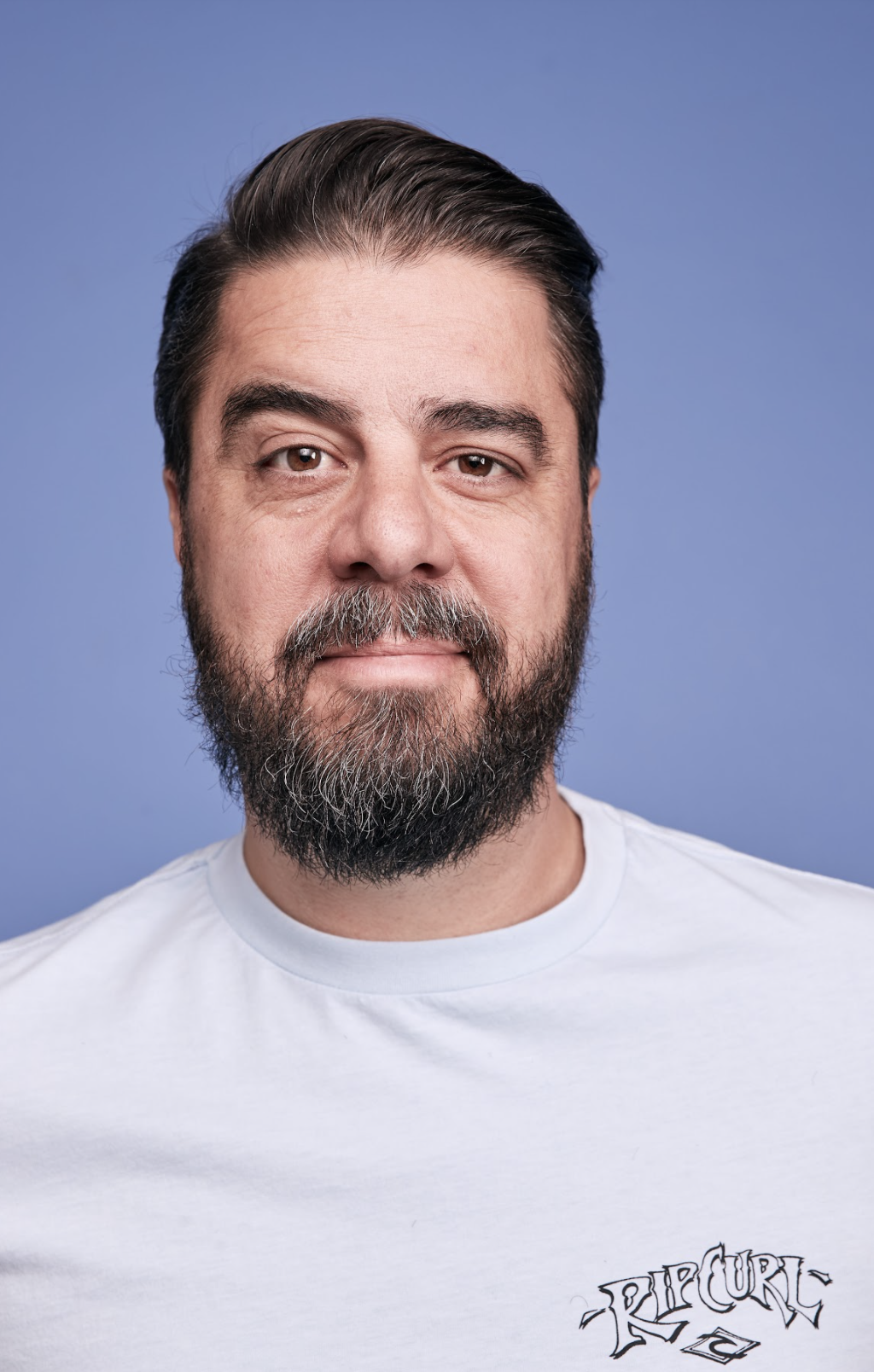
The one, the only…
Anyone who’s watched Ben Hurley perform will tell you he’s a bloody funny guy, but he isn’t your typical Kiwi comic.
The Katikati-based comedian makes Friday nights funny nationwide on TV3’s 7 Days, and now he’s set to make us locals laugh as the host of the second-annual Mount Comedy Festival.
WORDS Andy Taylor PHOTOS Brydie Thompson

Anyone who’s watched Ben Hurley perform will tell you he’s a bloody funny guy, but he isn’t your typical Kiwi comic. He didn’t grow up using humour as a defence mechanism like so many others. “I really liked school, actually,” he says.
Has he always wanted to be a stand-up comedian? “At the end of fourth form, the school sent around these forms that we had to fill out to check that we were taking the right subjects the following year, for whatever you wanted to do as a career. I’ve always been somewhat suspicious of authority, and I thought it was ridiculous that they were asking 13- and 14-year-olds what they wanted to do in life, so I put down ‘male model’. Then I crossed that out and put ‘comedian’, because that was the next most ridiculous thing that anyone could do. So ‘technically’, yes, I have always wanted to be a comedian. But I was living in a small-town in Taranaki at the time, so it wasn’t really an option.”
University, however, was, and Wellington beckoned, so off Ben went to study politics at Victoria. “They had an improv comedy club, and I met my best friend Vaughan King, who was an actor and comedian and started doing stand-up – and that kind of motivated me to do my first gig in 2001 at the Wellington Fringe Festival.”
“I thought it was ridiculous that they were asking 13- and 14-year-olds what they wanted to do in life, so I put down ‘male model’. Then I crossed that out and put ‘comedian’.”
So much for the politics degree. “Yeah. It’s just what you do isn’t it, something academic? Stand-up is something you shouldn’t really do straight out of school because you just don’t have the life experience, so politics and international relations it was. Dai Henwood has a degree in eastern religion, Jeremy Corbett has a computing degree and Jon Bridges has a philosophy degree – or something like that. And then there are people like Ewen Gilmour and Mike King who came to comedy out of the workforce. Ewen was the funny guy at the factory and Mike was the funny guy on the ferry, and they just got pushed into it by their mates. So you kind of have these two schools and to be honest I don’t really know if there is a stylistic difference between the two or not, or whether it’s more about influences.”
For young Hurley, the influences were the usual suspects: Billy Connolly, Jerry Seinfeld, Blackadder, Basil Fawlty. Humour was always appreciated in the Hurley household, and his father was a big fan of British comedy – although in those pre-internet days, you tended to like what you were given. “It was not like now, where you have every single comedian who has ever been at your fingertips,” says Ben. “There was a very limited range of stuff that we could see. If you were lucky, maybe the Montreal comedy festival or something like that, and the Kiwi show A Bit After Ten, which had the Corbett brothers on it. I was probably about 14 or 15 and I loved their running gags. They’d say, ‘Shall we do the Floyd gag?’ and then never, ever do the Floyd gag. And they had an open-mic section, where I saw some comedians who are good friends now and that I’ve worked with often. In fact, I still say, ‘Shall we do the Floyd gag?’ to Jeremy. I’m probably the only one who remembers it, though.”
(The early-’90s A Bit After Ten can be found at nzonscreen.com and is definitely worth a watch. In addition to an outrageously young and clean-shaven Jeremy Corbett, it also features the wonderful spectacle of contestants vying for the grand prize of a 14-inch TV.)
After making a name for himself as a comic in New Zealand, Ben started gigging in the UK, and toured extensively in Europe and Asia. The winner of the two biggest comedy awards in New Zealand (the 2004 Oddfellows Billy T Award and the Fred Award in 2008), advocate of cricket as a way to achieve world peace (“No two cricketing nations have ever gone to war with each other – that’s a fact”) and one of the few Kiwis to be invited onto America’s prestigious Comedy Store TV show now calls the Bay of Plenty home, but touring is something he knows an awful lot about. Google his name and it’s clear he spends more time on the road than a Fonterra truckie.
“I was in England for four years, gigging around the country five, six, seven and eight times a week, sometimes doing two shows a night, because the clubs are really full and lively over there, and doing it over and over again is how you learn your craft. I love being on the road – well, not so much now that I have a family, but I can’t imagine going to work at the same place every day. It’s hard to be away, but I guess I’m just hardwired to do it.”
Ben says there are regional differences in what people find funny, though they’re relatively subtle in New Zealand. “There are some places that are a bit more conservative than others, but that’s changing. And it all comes down to it being relatable. I mean, I can’t do a joke about Winston Peters in America or anywhere outside of New Zealand really, but even in New Zealand you have to keep it relatable. When Winston Peters left Tauranga as an MP, I made the joke that this was the first time a 70-year-old man had ever left Tauranga. And although that’s a joke that works really well in the North Island, in the South Island they just don’t know that many old people move to live in Tauranga – in the South Island they have their own version of that, it's called Nelson.
“In America, they don’t get the self-deprecating humour so much – that’s very much a UK thing. American comics are much more defined. It’s much more about the character – you’re the angry guy or the party girl or whatever – whereas in the UK, people just say funny things.”
Although the constant gigging and vibrant comedy circuit scene in the UK was formative for Ben, he was also happy to come home with a new appreciation for Kiwiland. “After being in the UK, I came back to what has proven to be a bit of a renaissance in New Zealand comedy over the past 10 years or so,” he says. “And that largely comes down to the TV networks and the overseas success of people like Flight of the Conchords and Rhys Darby. That woke up the networks to the success of comedy and the need to give it some legs here and air some home-grown stand-up. And out of that we got 7 Days, which has been the most popular and longest-running comedy show in New Zealand history. So people get out now to see stand-up, and that’s great.”
His extensive gigging across the globe must also have honed his skills for dealing with those who get out to see stand-up and feel the need to chip in. “Yeah, I kind of encourage hecklers now, to a certain degree. Well, I encourage interaction at least. On this tour, for the first half of the show I pretty much just chat to the crowd, and try to keep it as fluid and interactive as possible. In New Zealand, the heckling is almost never nasty – its just drunk people wanting to be a part of the show. I’ve done thousands of gigs, and I can count the times that heckling has been genuinely nasty on about three or four fingers. But, then again, if they don’t shut up, I do start feeling bad for everyone else.”
In an industry known for driving ambition and raging egos, Ben has a refreshingly down-to-earth approach and concern for his audience and his community. Last year, in response to what he describes as a sense of helplessness about the state of things in the newly Trumped world, he put together a three-night festival at Auckland’s Classic Comedy & Bar. Called Comedy in Action, it raised money for some great charities while also showcasing some top Kiwi talent.
“It was just a reaction to what I saw as the whole futility of people commenting on injustice on social media,” he says. “Liking a post actually changes nothing, so instead I wanted to do something that would have an actual effect – and make people laugh.”
Now he’s at it again, and is busy organising the second annual Mount Comedy Festival, which he’ll host in January. Ben says this year’s event is going to be even bigger and even better than the last. “Tauranga is New Zealand’s fifth-biggest city and I just thought there was a real need for it. There wasn’t really anything going on comedy-wise in the area; there was the odd thing going on with people coming through to play Baycourt, but no regular event. Last time, we had three nights with basically three shows, but this year we’re expanding things over five days. We’re also going to do some matinee shows with family-friendly comedy.
Ben says the support has been amazing. “I mean, it is the place to be, because everyone loves the Mount, so it's something that people want to be involved in and a lot of people have come on board with, like UNO for example. But it does really seem like this is really a thing that has found it’s time.”
Ben makes it sound like it happened, but with scheduling, promotion and venues, not to mention getting the right mix of performers, producing something on this scale isn’t easy. “I really made it the best I could, and it really is a great line-up,” says Ben. “We’ve got Wilson Dixon [aka Kiwi comedian Jesse Griffin) headlining, who is, um, ‘technically’ from America; we’ve got the great Josh Thomson; Justine Smith, who was on the line-up last year and so loved that we brought her back again; newish comedian Hayley Sproull, who’s a 7 Days regular; Brendhan Lovegrove, who will be hosting a new acts competition, so if any locals want to test the water, this is their chance; and Te Radar, who will do his one man show 'Eating the Dog'. So yeah, something for everyone.”
This well-travelled, internationally known performer is bringing something for everyone to our neck of the woods because it’s now his necks of the woods too. After growing up in Taranaki, and living in Wellington, Auckland and the UK, Ben now calls a little piece of paradise in the Western Bay home – a lifestyle block somewhere between Katikati and Waihi Beach with “some sheep, some chickens, some kiwifruit”. Where does he find time to manage that, with all he has going on? “Fortunately, my wife is the property manager,” he says.
Of all the gin joints in all the towns in the world, why here? “I don’t really know,” says Ben. “I just like it here. It has a real lifestyle thing going on, it’s a great place to bring up kids, it’s beautiful, but it's not a million miles away from everywhere else. I mean, I love Taranaki as well, but unfortunately it’s just a little bit too isolated. So here kinda has it all. The best of both worlds. The best of all worlds.”
Ben’s not a typical comedian, no. But for his originality and the fact that he not only makes us laugh but also makes us think, he’s definitely one of our best. And you know what? He might be onto something about the cricket.

Grace Wright: Tauranga artist
We meet Tauranga girl and artist Grace Wright as she prepares for the Auckland Art Fair.
We meet Tauranga girl and artist Grace Wright as she prepares for the Auckland Art Fair.

INTERVIEW CLAUDIA CAMERON / PHOTOS HEATHER LIDDELL / SAMUEL HARTNETT
UNO: How did you start out as an artist?
GRACE: I grew up in Tauranga, so when I finished Elam in 2014 I moved back home for a year to have time to develop the ideas I had generated during my BFA at Elam School of Fine Arts, without financial pressure. During this time I rented a studio space out the back of Zeus Gallery, when they were based on Eleventh Ave. I loved painting there, with the industrial-style spaces, plus having the time to intensively work and establish my practice.
Although I live in Auckland now, I love coming back to see my family and have some down time. Tauranga will always be home.
UNO: What have you been working on lately?
GRACE: Recently I have been working on a series of paintings for the Auckland Art Fair as well as planning for my upcoming show at Parlour Projects in July. My practice is a continually evolving one, so I’m always trying to push myself forward and create something that surprises me.
UNO: Ah, yes, Parlour Projects in the Hawke’s Bay selected you as the recipient of its inaugural artist-in-residency programme. Congratulations!
GRACE: I was so honoured to be selected for this residency and have the support to bring my ambitious 11m x 6m installation concept to life. I had been wondering how our body would feel if we experienced painting more spatially by thinking of the room as a canvas. The body has always informed my work throughout its evolution and in this residency I wanted to recreate the physical sensation of how you feel when you stand beneath something monumental in scale.
UNO: Can you tell us a bit about your process?
GRACE: I see colour as a construction process, so the painting almost builds itself. I never know what the paintings will look like in the end, but I start with one colour or gesture and construct the colours and layers until the final work emerges.
UNO: What inspires you and your work?
GRACE: I’m inspired by an international style of painting that has a real presence with the viewer through scale and the relation to the body. In 2015 I visited Albert Oehlen’s exhibition Home and Garden at the New Museum in New York. It was such a thrill to stand before these huge, three metre square paintings. This feeling of intense physicality is what I’m interested in creating in my own work.
UNO: You’re showing at the Auckland Art Fair as part of the Parlour Projects stand, what can we expect to see from you there?
GRACE: I will be exhibiting a series of new large-scale works measuring 1200 x 1500mm which continue to explore a sense of artificial space and gestural abstraction reminiscent of the body. Recently I’ve been interested in constructing space through subtle illusion and colour combinations so the work will reflect these ideas too.
UNO: You’ll be joined by a number of incredible artists and galleries showing at the AAF this year, what are you looking forward to the most about the event?
GRACE: It’s such a unique experience to see all these galleries in one space, along with work from top galleries in Australia and some further afield. I also love the social aspect of the art fair! It’s a great way to catch up with lots of people in the industry and celebrate all the hard work put in by artists and galleries.
UNO: What are you hoping to achieve from being part of the Art Fair and speaking to an international audience?
GRACE: I’m excited to be exhibiting at the fair and have the support of Parlour Projects. My goal generally is to build up steadily and create work that endures. At the end of the day, art is what makes life worth living, as are the ideas and conversations that surround it.
UNO: What’s it like making art as a full-time job?
GRACE: I love it! I’m pleased with how I’ve set up my week to allow myself the time to paint. I’m definitely a morning person, so my day starts by getting straight into painting. In the afternoons I tend to stretch canvas and gesso, then attend to admin later in the day.
UNO: What skills do you think are useful in your job?
GRACE: I think you need to have a lot of faith in yourself and belief in what you’re doing.
UNO: Can you share a piece of advice for anyone wanting to move into a similar creative space?
GRACE: The best advice I ever received was learning that talent will only get you so far. The way you think determines the rest.
INSTAGRAM: @gracewright08

Chalium Poppy: Mount Maestro
With a Welsh dragon tattooed over his heart, a love of swimming in winter and a husband who works in fashion, the mould was clearly broken when Chalium Poppy was born. Performing since he was four years old and all over the world, he’s arguably one of the most experienced classical musicians in the country.

With a Welsh dragon tattooed over his heart, a love of swimming in winter and a husband who works in fashion, the mould was clearly broken when Chalium Poppy was born. Performing since he was four years old and all over the world, he’s arguably one of the most experienced classical musicians in the country.
WORDS JENNY RUDD PHOTOS SHAWN ROLTON
My voice broke at 12 and I thought my life had ended. I felt like a bad angel about to be cast out of heaven. When the time came for me to be dismissed from the choir, we had a big party. Every boy got one. We called it our puberty party. It was hard saying goodbye to the other boys and I cried for weeks.
My parents put me into a local school but that didn’t last long. I hated it and let everyone know. One week, my mother was called to the school every day. I don’t really want to say what I did but I was very naughty. I was ‘moved’ to another school.
I flourished there. They had a great music program led by talented teachers. They allowed me to play the organ in chapel for services now and then, and help conduct the choir. The chapel became my second home.
INTERNATIONAL STAR
One teacher sent a recording of my singing to a university in Austria. Someone came over to hear me sing live. In a few weeks I received an offer of a full scholarship to study music in Vienna. Although my father loved classical music, my parents absolutely did not support it as a career choice. Knowing they would have forbidden me to go, I ran away from home and have never been back since.
My seven years spent studying at the Academy in Vienna were amazing. I worked with tutors and academics who were leading authorities in their field of music, travelled, studied and performed in Italy, France, Germany and the Czech Republic.
My grandmother had been a contralto soloist of considerable talent, although her piano skills were terrible; a bit music hall-like. It was she who diagnosed my musical abilities and that of my two brothers early on. I had the voice of an angel, she was convinced. My brothers didn’t fare so well. She declared my elder brother tone-deaf and advised him never to sing in public.
At four years old, I auditioned successfully to become a choirboy at Oxford Cathedral, where my family lived in the UK. The training and education of choirboys is an ancient tradition. Our lives are centred around music-making in the context of worshipping God; education, both academic and physical, is really quite secondary to that. Oxford Cathedral is an exceptional place – much of Harry Potter was filmed in its beautiful halls and quads.
All 23 choirboys do absolutely everything together, and we were busy every minute of the day with a continuous round of rehearsals, services and studies. From the beginning, the principles of respect and kindness were instilled in us by the choirmaster. We followed his guidance above all others.
One year, Christopher Hogwood, the great conductor, brought his orchestra The Academy of Ancient Music to record Messiah while we sang. I didn’t appreciate his brilliance and knowledge at the time, I just kept thinking what cavernous nostrils he had.
TEA PARTY
Besides our vocal studies, we were all required to study an instrument. I chose the piano, having taken private lessons since I was five. My father woke me early one Saturday and took me to the cathedral. The organ was undergoing maintenance and repair – they had opened the enormous wind chest up and you could see all the pipes and mechanisms. We sat inside the wind chest having a sandwich and a cup of tea whilst my father explained how it worked. I decided to learn to play the organ too, even though my feet didn’t yet reach the pedals.
After completing my Masters (in Protestant Church Music), I moved to Canada and worked full time as a musician: organist and choirmaster in the cathedral, as well as singer, conductor, teacher, lecturer. I was often asked to conduct Gilbert & Sullivan operas. They thought that being English I was automatically an expert.
Although exciting professionally, this was also a very lonely time. I worked very hard. The life of performer was beginning to lose its lustre and appeal as I got older.
I am a creature of habit. On Sundays, after the morning services at the cathedral, I would walk to my favourite Irish pub for lunch and a pint or two of Guinness, and then return to the cathedral in the afternoon for Evensong. One Sunday, something happened that would change my life dramatically and for the better. I met Michael.
LOVE
There was a young chap sitting at the bar enjoying a drink and chatting casually with the barkeep. He had the most striking red hair and a wonderful smile. I was electrified. I summoned all my courage and asked him to join me for lunch. He was a New Zealander travelling through Canada on his o/e, an avid snowboarder exploring Canada’s world-famous slopes.
I wasn’t sure how he would respond to my chosen career path – being a church music specialist isn’t very glamorous. To my eternal surprise, he asked to come to Evensong in the cathedral that afternoon.
I fell deeply in love with Michael that day. Two weeks later I asked him to marry me. We have just celebrated our seventh wedding anniversary. I couldn’t ask for a better, more loving and supportive partner in life.
As Michael was only in Canada on a holiday visa and I was estranged from my own family, we decided to move to Mount Maunganui. We arrived on the first day of winter 2009. I knew very little about the country.
We watched the sunrise over the water on the day we arrived. Surfers and swimmers were all heading towards the water. I thought to myself – if this is New Zealand on the first official day of winter, what a wonderful place to live!
MUSIC, FAMILY, NEW ZEALAND
Aside from performing and conducting locally, I’ve worked in Auckland, Gisborne, Napier, Whakatane, Kerikeri, Dunedin, Rotorua, Hamilton – all over the place.
In Canada, I performed primarily at a professional level. Here in New Zealand, there simply aren’t the choirs and orchestras to provide much work at that level. My objective is to make music at the very highest level that I can – whether I’m singing Messiah in a barn in Kerikeri or works of Bach in the Auckland Town Hall with the Auckland Philharmonia Orchestra. What’s important for me as a musician is to have the same level of musical integrity no matter what the circumstances.
I’ve been put up in fantastic hotels in Auckland when I perform, or slept quite comfortably on a pull-out couch in someone’s living room. That is what makes the life of a musician in New Zealand different from anywhere else I’ve been.
When I’m not music-making, we usually like to spend our time close to home. We are both home bodies and foodies. Michael is an exceptional cook so we are rarely alone at dinner time. Just over a year ago, we adopted Paddington. He keeps us on our toes. If I have a gap in my schedule, we pack up and take Paddington on an adventure somewhere. Of course we live right at the beach, so I like to get into the water as much as I can – Paddington too.
Chalium is the Musical Director of Scholars Pro Musica, a Tauranga-based chamber choir of exceptional talent.