

RHYTHM AND FLOW
Tauranga Museum promises to transform the city centre as it unveils its stunning state-of-the-art floating design.
Tauranga Museum promises to transform the city centre as it unveils its stunning state-of-the-art floating design.
WORDS JO-MARIE BAKER

Hidden behind construction hoardings on Hamilton and Willow Street, a breathtaking project is beginning to rise that will at long last unleash Tauranga CBD’s full potential.
Tauranga Museum is due to open for Matariki celebrations in 2028 and will undoubtedly transform our city centre. The wider $306m civic precinct, Te Manawataki o Te Papa, is expected to triple daily visitor numbers, and the museum — with its stunning façade — will be a major drawcard.
Warren and Mahoney principal architect Vajini Pannila leads a large team who have designed the new museum to look as though it’s floating above the land.
“It’s a once-in-a-generation project,” she acknowledges. “It was a moment for zooming out and thinking about the future of cultural buildings and asking, ‘what will a museum be in the future?’ These cultural and arts projects are very close to my heart, and I believe quite deeply in the impact they can have on our next generation.”
Extensive design workshops and consultation with mana whenua have created a building which will return the site to a place of prosperity and become a vibrant public space.
“Mana whenua were once thriving on this piece of land. It was a place of abundance. One of our design strategies was to have a continuous landscape that’s uninterrupted underneath the building. That also means the general public should be able to flow through it, so the foyer is designed in such a way that you can walk from one side of the site to the other.
“One of the concepts for the site-wide landscape is this idea of flowing water and pebbles, and so we’ve shaped the entrance foyer, which has a big level difference, to get this feeling of water having carved away these ramps, stairs and terraces. We took the challenge of trying to create a place where people can stop and sit. It’s like a living room for the city.”
The façade itself is inspired by traditional Māori storage vessels, such as woven baskets and waka huia treasure boxes. Caramel-coloured aluminum blades with a hint of metallic speckle are woven around the outside of the building, while a textured brick bends and curves its way around the base of the exhibition space in a strong geometric design.
“We have some deep cutouts within the tilted blades with some reflective glass elements sitting behind them. So a weaving pattern emerges in different ways as the light hits it at different times of the day. The exterior melts away and then it builds back up. It’s got this rhythm to it,” Vajini explains.
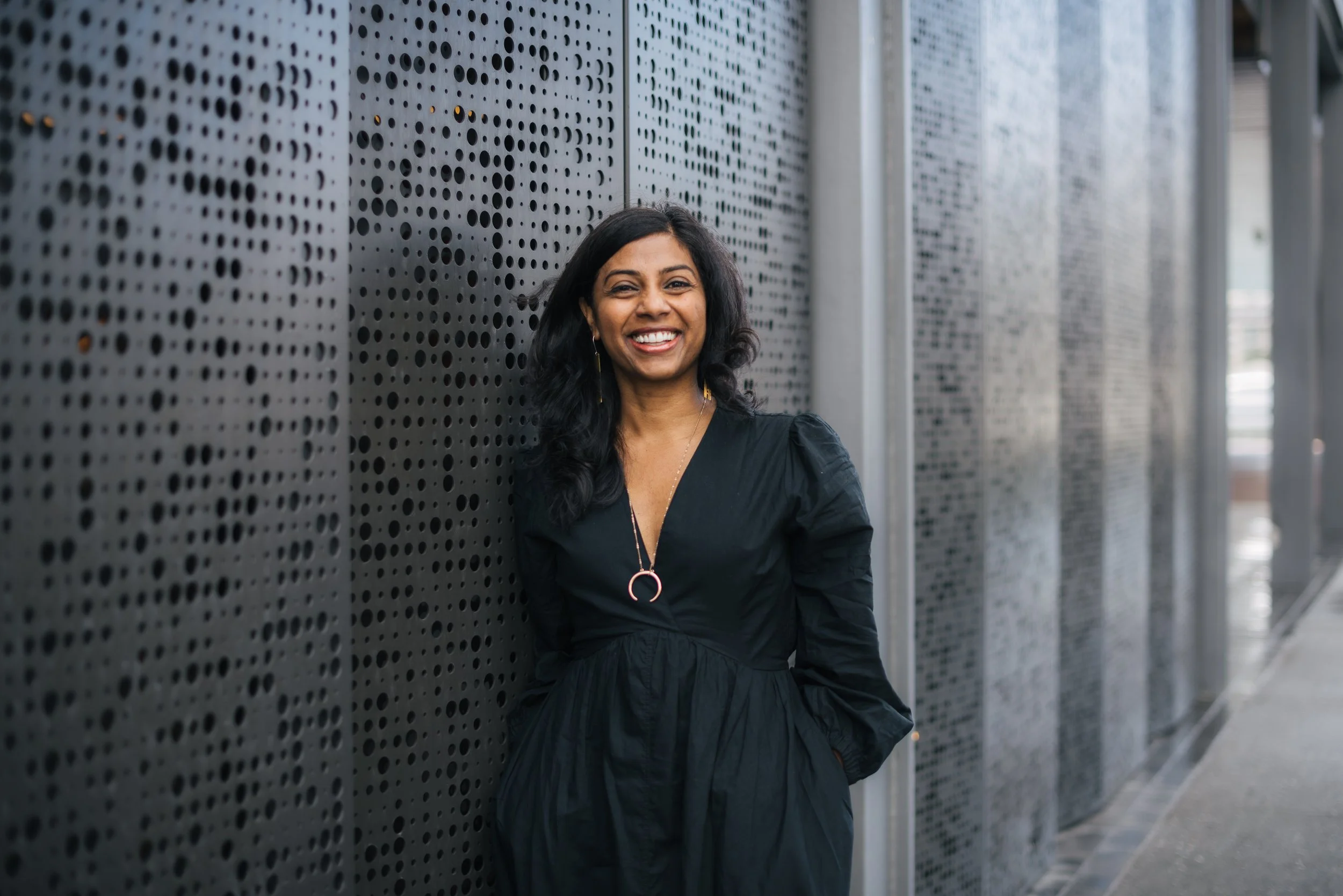
Warren and Mahoney principal architect Vajini Pannila.
“We did a lot of work on developing a bespoke profile for those blades, to get this sense of reflectivity and shadow and depth. Throughout every day it will look different depending on where the sun is and the season. We put a lot of work into that.”
She’s most proud of how the design enables such a large building to sit so lightly on the land. “The façade was a challenge because in order to make the building look very simple, the form of it has to work really hard to tell the story of these vessels. Getting the material to flow around the corners is really pushing the innovation in New Zealand. I think we’ve turned something that was a challenge into something that will be a triumph for a lot of different New Zealand suppliers and contractors.”
One eye-catching feature is inspired by a hīnaki (eel trap), which has an opening to draw fish inside.
“Typically for museums and gallery spaces, natural light is not welcome. But we had a very collaborative process with the museum director and have created a large glass opening that you’ll be able to see from the waterfront to help attract people to visit. The museum is curating a very special object that will be seen from that aperture. It will look incredible!”
The design team also collaborated with local Māori artists whose work will be overlaid on various architectural features, such as a frit on the glazed atrium roof and walls, and patterns on some of the exterior brick.
“They’ve taken our site-wide concepts and they’ve translated it into their art. So there’s a lot of ideas that are reinforced and keep finding form through our work and their work.”
Vajini says cultural engagement and co-design has been integral to the project. “The museum is a moment of reconciliation where this site will return to being a place of coming together and prosperity again.
“Civic buildings are a place where we understand our shared identity. I think people will feel in awe of Tauranga’s history and really understand their place within these rich stories that have come before them.”