

OUTWARD BOUND
Through their new online series, Kids Unplugged, a local family of filmmakers is encouraging young ones to turn away from their screens.
Through their new online series, Kids Unplugged, a local family of filmmakers is encouraging young ones to turn away from their screens.
WORDS KARL PUSCHMANN

The question of how much screentime is too much screentime is one many parents wrestle with. Thanks to the rise of streaming services and devices like iPads and smartphones, kids could have access to virtually any TV show or movie they want, whenever they want.
It’s a problem previous generations of parents haven’t had to face, so it’s no wonder that when it comes to screen time, many parents feel the genie has escaped its bottle.
It was while reading social psychologist Jonathan Hyatt's book, The Anxious Generation, that producer Kylie Dellabarca Steel realised something needed to be done to encourage kids to unplug.
“There are a lot of devastating statistics in that book,” she sighs. “The addictions, anxiety, depression, sleep deprivation… all that negative stuff that comes with too much screen time. No parent wants their kids to resemble the statistics in that book. It’s sad and depressing reading.”
Kylie gave the book to her husband, director Anton Steel, who felt the same. They began thinking about how they could “use the tools in our hands” to make a positive change.
The eureka moment came, as these things often do, unexpectedly. “It just popped into my head when I was in the shower,” laughs Kylie.
The idea was Kids Unplugged, an online series of 10-minute episodes that show children how much fun there is to be had when they unplug, and profiles inspiring locals who’ve found joy, fulfilment, health, purpose and human connection after switching off their screens.
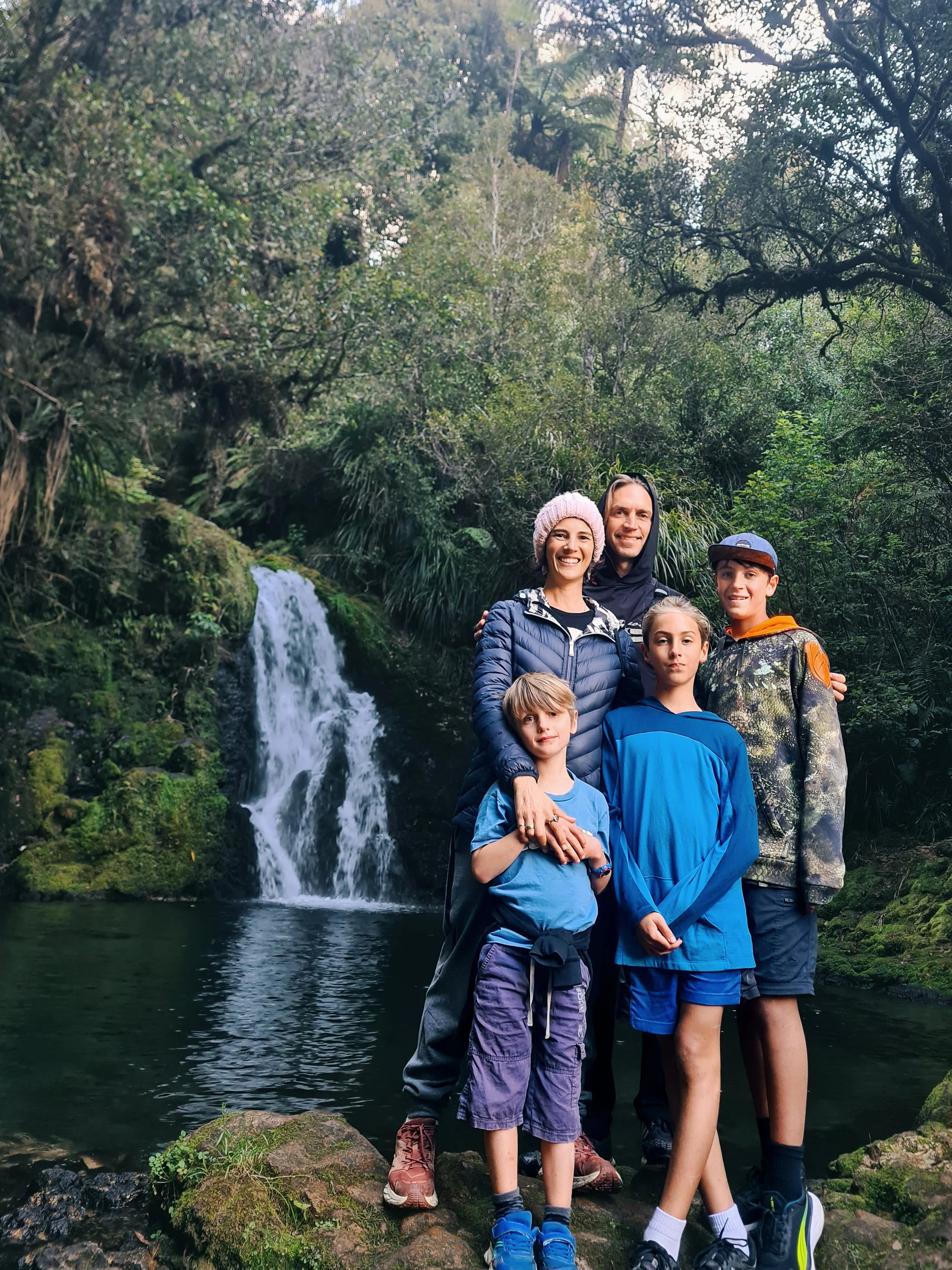
At Otanewainuku waterfall, clockwise from left: Kylie, Anton, Malachi, Judah and Ezra.
The clever part is that the show isn’t doom and gloom, nor does it try to scare kids off their screens. Instead, the couple’s three children, Malachi (15), Judah (12) and Ezra (7), present it, making it hugely relatable to its intended audience and ensuring it stays light and fun, and doesn’t become preachy. The goal was to make kids want to unplug, rather than being told to.
“In mountain biking, there’s a saying, ‘Where you look is where you hit’,” says Anton. “What that means is if you look at the trees, you’ll hit the trees, but if you look at the trail, you’ll focus on that and go where you want to go. If we just talked about all the negatives of screen time, we’d actually lean towards them, but if we tell the story of the positives of unplugging, all the health and wellbeing benefits, that’s where people will go.”
Having crowd-funded several other independent productions, the filmmakers followed the same steps to fund Kids Unplugged. It was a topic that resonated, and people were quick to support the project.
The six-episode series heads off on outdoorsy adventures like hiking, snorkelling, horseriding and skiing, while showing the unplugging journey other kids have made. For example, it features a 15-year-old former videogame addict who gave up screens and found a new calling as a political activist, cycling to Wellington to present a case for the continuation of Māori wards in his hometown of Whakatāne.
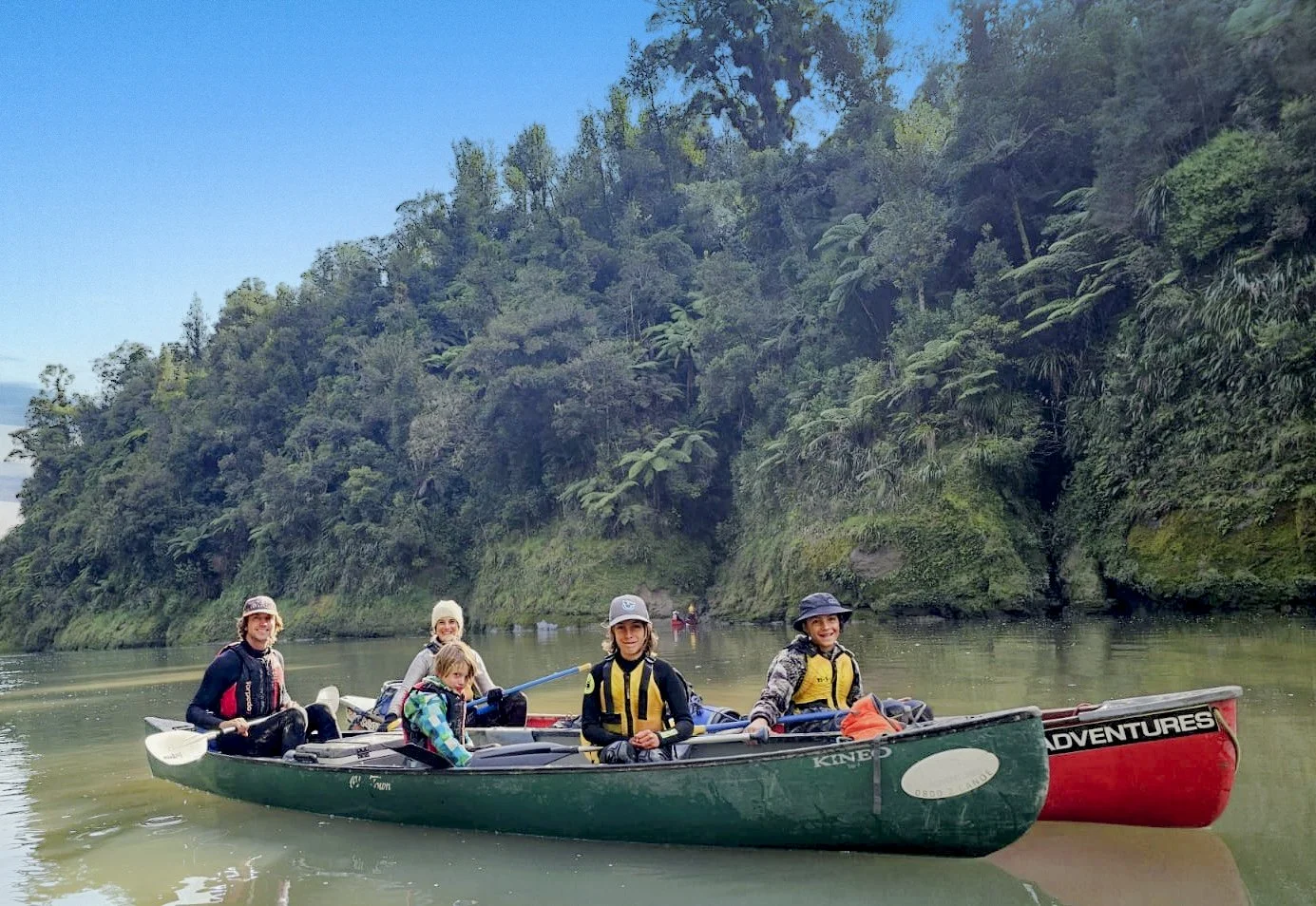
“Jack's a good example of someone who was overweight, sleep-deprived and addicted,” says Anton.
“He had played 3000 hours in the video game Runescape,” Kylie says, almost in disbelief. “He went from a complete screen addict to a child who’s full of life. He’s thriving, happy and healthy, and gives so much to his community.”
“He really turned his life around,” says Anton.
All up, the show took a year to make, from idea to funding, filming to production, to now streaming for free on RNZ’s website and YouTube. It’s been quite a journey, but the family’s keen to get to work on season two.
“We filmed the series in the Bay of Plenty for budget reasons, and because it’s the fantastic place we live in, but we’d love to take it nationwide,” says Kylie.
Anton nods: “The dream would be a family road trip to find amazing kids all around New Zealand.”
As for Judah, he was initially a little wary of the project, having grown up watching the amount of work mum and dad put into their productions.
“I knew it would be a lot of time and effort,” he says, “but it was quite fun. I enjoyed making it because I got to meet other people who live unplugged and I got to do fun activities with them.”
3 TOP TIPS FOR UNPLUGGING
1. “It can be as simple as making a cushion hut in the lounge or going for a walk. Instead of hopping straight onto screens straight after school, just get yourself outside. Start with small steps like that.”
– Judah
2. “Don’t be too hard on yourself to begin with. Ease into it. It’s tricky for parents, but be intentional and recognise that you're your kids’ role model. There’s no point preaching unplugging to them if you don't practice it yourself. We try to be those role models and not use screens recreationally ourselves.”
– Kylie
3. “Aim for balance. We want to eat healthy, we want to exercise for healthy bodies, and we want to think healthy too, so try to encourage balance in your kids’ lives. If they’re going to spend some time on a screen, then think about what they can do to balance that time.”
– Anton

Two paths, one purpose
How one Tauranga school is helping students thrive in their own way.
How one Tauranga school is helping students thrive in their own way.
PHOTO ALAN GIBSON

ACG students Carl Huppmann and Ruby Jones.
There’s a saying that excellence doesn’t come in one shape. At ACG Tauranga, it’s nurtured in many forms. Just ask Ruby Jones and Carl Huppmann. From early mornings in the pool to international academic accolades, the two senior students have carved very different paths, and yet, their journeys are rooted in the same thing: a fiercely supportive school environment.
For Ruby, sport was always in the picture, having been a competitive swimmer since childhood. But it was ACG that introduced her to the team side of things.
“I wasn’t into netball at all before coming here,” she admits. “But we were such a small school back then, they needed more players. I gave it a go and ended up loving it.”
Today, she juggles netball, volleyball and art, along with her school work, and leads by example.
“Leadership for me is about including everyone. Making sure people feel seen, like they belong.”
Whether it’s younger students running up to say hello or teammates bonding during games, her influence is felt widely. But she’s also candid about her journey not always being smooth.

“I’ve never been an overachiever,” she says. “When I started here, I struggled, especially with the academics. I had to learn how to manage my time, ask for help and actually study.”
She speaks openly about the pressure of juggling schoolwork, training and her creative passions. “I put a lot of time into art. It’s something I’m really proud of.”
Carl’s story is slightly different. A self-proclaimed non- athlete when he first moved from Germany, he found his stride at ACG through the freedom to explore.
“I wasn’t into sport until I came here, but we had PE all the time, and I just gave things a try. One day I walked into the sports office and asked if I could join the hockey team and that was how I got started.”
Since then, Carl’s achievements have soared, topping the world in IGCSE PE and mentoring students through coaching and leadership roles. But he’s quick to credit the culture around him.
“Here, every teacher knows your name. They know how to help you grow.”
That close-knit feel is something both students agree on. Teachers are accessible and students are encouraged to take risks, whether in sport, the arts or academics. “It’s a school that doesn’t box you in,” says Ruby. “They support your passions, whatever they are.”
And for students just starting their ACG journey? “Don’t stress the small stuff,” Ruby says with a smile. “You’re here to learn, and everyone’s got your back.” Carl agrees: “Take every opportunity, because in a place like this, they’re everywhere.”

Nurture in nature
Karen Clarkson spoke to the Principal of Matahui School to learn why for the last 30 years the school has turned traditional education systems on its head and the critical role nature plays in creating positive learning outcomes
Karen Clarkson spoke to the Principal of Matahui School to learn why for the last 30 years the school has turned traditional education systems on its head and the critical role nature plays in creating positive learning outcomes.

While politicians and education researchers are divided over the state of our education system in the lead up to this year's election, a special character primary school on the outskirts of Katikati, is providing a beacon of hope for parents whose children have struggled in traditional school environments.
Principal, Mary Woods, says that the mainstream education system is not suited to every child. Matahui School provides an alternative approach to education so that young people can achieve success with the increased pace and technology the modern world demands.
“Matahui School challenges traditional education methods and provides a unique sanctuary for children to learn. All children have a diverse range of strengths and learning styles. Unlike the mainstream system, we don’t believe one size fits all. Our smaller class sizes allows individual one-on-one time with the teacher and creates a quieter, calmer environment that is more conducive to learning,” she explains.
At Matahui, the school embraces a balance of the fundamentals of core learning wrapped in enquiry that encourages the child to flourish in a way that best suits them.

“Recent reports and findings from the ERO (Education Review Office) and Education Hub describe children having better outcomes when they develop their own learning goals. Enquiry-based education is at the centre of our ethos and the children actively influence their own pathways to learning daily.
“Recently the Year 1 and 2 students wanted to learn about space. Through discussion their teacher came to understand that they were more interested in learning about moon buggies and space transport, so she used this as the springboard for their enquiry,” says Mary.
While more and more schools reach for technology to deliver the curriculum, Matahui School nestled among towering pines and surrounding orchards, uses a progressive curriculum that values outdoor education and delivers core subjects across a variety of disciplines.
“Connection with and within nature has been proven around the world to be critical to supporting healthy development in children. All of our teachers will agree that the real magic happens beyond our classroom walls, where hands-on experiences and challenges empower the children to develop independence, confidence, learn technical skills, and manage risk,” says Mary.
Every week, rain or shine, students spend a full day immersed in nature, building makeshift shelters, exploring meandering streams, and overcoming challenges as part of the forest school programme. The Year 7 and 8 students attend four camps throughout the year, clocking up to 30 days a year in the great outdoors. Recently a class visited and worked on a local farm to better understand the milk production process from farm to fridge.
Ruth, mother of Polly, a former student of Matahui, says she appreciates the positive impact the school’s values and unique learning approach has provided her daughter.
“Polly’s college teachers have noted how engaged she is with her personal learning, the confidence she has to challenge herself and her perseverance when things are hard.”
Mary agrees that the environment and experiences Matahui School students are provided supports them to learn in the way that not only suits them best, but empowers them to develop key skills to handle the inevitable challenges they will meet in their future education, and life beyond the classroom.